- What happened on Lamb Canyon Road in Beaumont
- Where the crashes occurred and why that location matters to drivers
- Injuries reported and how emergency response works during a multi-vehicle crash
- Why secondary crashes happen during traffic backups
- How to get official records and reports
- Immediate next steps after a multi-vehicle collision in Riverside County
- Insurance priorities after a multi-car collision in California
- Preserving evidence in and around Beaumont
- Potential civil liability in chain-reaction crashes
- Local places to call for help and information
- Take action now
- Commentary from Gosuits Beaumont, California Personal Injury Attorney
- References
What happened on Lamb Canyon Road in Beaumont
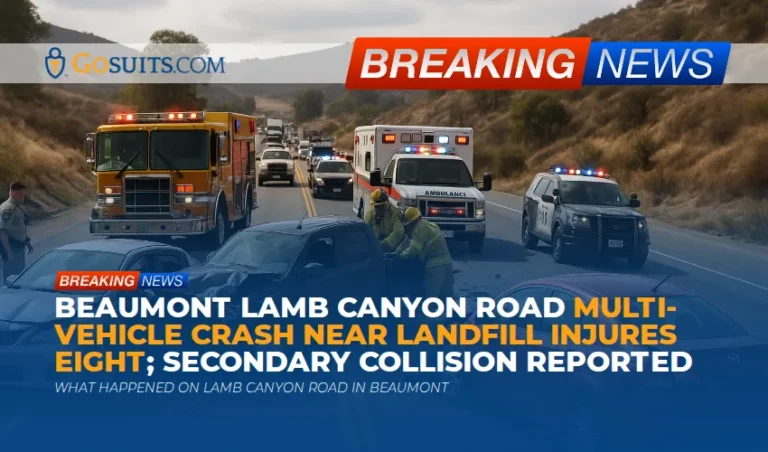
On a Thursday afternoon just before 4 p.m., a multi-vehicle crash occurred in the 16400 block of Lamb Canyon Road at Dump Road, near the Lamb Canyon Landfill in Beaumont. Riverside County Fire Department personnel arrived to find at least one person requiring extrication. Additional equipment was requested at the scene. A second crash then happened behind the original incident during the ensuing traffic backup, bringing the total number of injured to eight. According to initial information, one person was listed in critical condition, one had moderate injuries, five had minor injuries, and one person left hospital care against medical advice. At the time of reporting, officials had not clarified how many vehicles were involved. Lanes were gradually being reopened and the California Highway Patrol’s Inland Division assisted with traffic control.
These facts come from early public safety updates. As with most complex, multi-vehicle collisions, the full timeline and the causes will be better understood after California Highway Patrol collision reports are completed and any scene reconstruction is conducted. The immediate focus for first responders at scenes like this is life safety, securing the roadway to prevent additional crashes, and restoring safe traffic flow as quickly as possible.
Where the crashes occurred and why that location matters to drivers
Lamb Canyon Road connects the San Gorgonio Pass area with communities to the south along a corridor locals know well for its mix of passenger vehicles and frequent heavy truck traffic headed to and from the nearby landfill. Drivers from Beaumont, Banning, and Cherry Valley rely on this route, and traffic can bunch up around the landfill entrance and its turning movements. In the late afternoon, especially in winter when dusk arrives earlier, visibility can fluctuate quickly. Even without high winds, the Pass can feel unpredictable, which is why so many residents slow down along the canyon.
None of this context states a cause for the crashes on that specific day, and it should not be read that way. It does underscore a reality familiar to local drivers: when a primary crash happens on or near a canyon route with limited shoulders, secondary incidents can follow in the queue of approaching traffic unless the scene is managed quickly and drivers remain alert to rapidly changing conditions.
Injuries reported and how emergency response works during a multi-vehicle crash
Emergency dispatch reported eight people transported or assessed following the crashes, including one person listed as critical and one with moderate injuries. First-in fire crews reported the need for extrication, which means at least one occupant could not be removed from a vehicle without specialized tools. In multi-vehicle collisions, responders often establish a medical group, triage patients, assign transport priorities, and coordinate with nearby hospitals and trauma centers.
California’s trauma care network is designed so that the most severely injured are routed to designated trauma centers when possible. The California Emergency Medical Services Authority describes the state’s trauma system and how trauma centers operate in coordination with emergency medical services, hospitals, and regional agencies [5]. In the Inland Empire, that coordination has helped ensure rapid care for time-sensitive injuries such as internal bleeding, traumatic brain injury, or complex fractures. While we do not know where each injured person from this crash was taken, the reported on-scene triage and transports reflect a standard, structured response to a high-energy event.
If you or your loved ones were treated, it is reasonable to expect that hospitals will have their own medical records, imaging, and physician notes. Individuals have a right to access their medical records under federal law, which can be important for insurance claims and any potential civil case later on [6].
Why secondary crashes happen during traffic backups
Authorities noted that a second crash occurred behind the first incident. Secondary crashes, sometimes called “crashes in the queue,” are a well-documented risk when traffic suddenly slows or stops near an incident scene. The Federal Highway Administration explains that Traffic Incident Management focuses on quickly detecting incidents, safely responding, and clearing scenes to reduce the risk of additional crashes, responder exposure, and congestion [3]. Secondary collisions often occur when drivers approach at normal speed, have limited sight distance, or are distracted and do not anticipate stopped or slowing vehicles ahead. On canyon roads with curves or grade changes, that risk increases, and it is why early warnings, flares or cones, and immediate lane control by CHP and fire agencies matter so much.
How to get official records and reports
CHP collision reports
The California Highway Patrol prepares collision reports for injury crashes on state and county roads. Those reports can include diagrams, statements, and preliminary findings. To request a copy, CHP uses the CHP 190 request form and requires proof of involvement or interest. Instructions are provided by CHP on obtaining a traffic collision report [1]. Requests are made to the Area office that investigated the crash. For civil claims, the collision report is often the starting point for understanding the parties, vehicles, and insurance information.
DMV accident report requirement
California requires that an SR-1 Accident Report be filed with the DMV within 10 days whenever anyone is injured or killed, or when property damage exceeds $1,000, regardless of fault. The DMV provides instructions for this report and the forms to complete it [2]. Insurance companies typically help with the SR-1, but the legal responsibility to file rests with the involved driver. When in doubt, it is safer to file than to risk a license suspension for failing to report.

Fire department incident records
Fire agencies maintain incident run reports that can show when units were dispatched, what hazards they encountered, extrication times, and medical transfer details. Some details may be limited due to patient privacy laws, but basic incident information is often available through a Public Records Act request. CAL FIRE provides guidance on requesting public records, which can include incident-related documentation where applicable [9]. If Riverside County Fire Department units were the primary responders, the request should identify the date, time, location, and incident type.
Medical records and billing
Individuals are entitled to request their own medical records and bills from the hospital and any emergency medical provider. Federal HIPAA rules provide a right of access to these records, and hospitals must respond within specific timeframes absent narrow exceptions [6]. Keeping these documents organized can help with insurance claims, wage loss verification, and any future civil case.
Coroner records in cases of fatality
Although current reporting indicates injuries rather than fatalities in this crash, some traffic incidents do involve loss of life. In those cases, families usually work with the county coroner’s bureau for next-of-kin notifications and, when performed, autopsy and investigative reports. Coroner records may become part of an estate’s documentation and are sometimes requested in connection with a wrongful death claim. Procedures and timelines vary by county, and some portions of a coroner’s file can be confidential while investigations remain open.
Immediate next steps after a multi-vehicle collision in Riverside County
In the immediate days following a significant crash, documentation and cautious communication matter. People in Beaumont and surrounding communities often have to navigate multiple insurers, multiple vehicle owners, and sometimes disputes about who caused what in the chain-reaction sequence. A few practical steps can help protect health, safety, and rights.
- Prioritize medical care and follow-ups. Even if injuries feel minor at first, get examined and follow discharge instructions. Some injuries, including concussions and soft-tissue trauma, present more clearly after 24 to 48 hours.
- Collect and secure documents. Save hospital bracelets, discharge summaries, bills, imaging CDs, and pharmacy receipts. Create one folder for records and one for out-of-pocket expenses.
- Request the CHP collision report. Track the report number if you were given one, or note the exact date, time, and location to identify the report later [1].
- File the DMV SR-1 within the 10-day window if you were a driver involved, since injury and likely property damage thresholds were met [2].
- Be cautious with insurance statements. Consider speaking with an attorney first, because recorded statements can be used to limit or dispute claims later. It is common for multiple insurers to call quickly after a multi-car event.
- Preserve photos and video. Back up any scene images, dashcam footage, or phone videos. Share copies only with trusted advisors until you have a plan.
Insurance priorities after a multi-car collision in California
Multi-vehicle crashes near Lamb Canyon, where traffic often includes a mix of local commuters and commercial vehicles, can create complex insurance questions. Whose liability coverage applies first. How medical payments coverage coordinates with health insurance. Whether uninsured or underinsured motorist coverage is implicated for any occupants. California’s Department of Insurance offers consumer guidance about auto insurance coverages and what they are designed to pay [8]. In chain reactions, different carriers may dispute fault allocations or argue that a later impact was the sole cause of a particular injury.
One practical issue after any multi-car collision is the order of payment among policies. For example, liability coverage for the at-fault driver is typically primary for injured third parties, but there are circumstances where med-pay, health insurance, and even UM or UIM may come into play if liability limits are insufficient. For a clear primer on sequencing coverages and common bottlenecks, see which insurance pays first after a multi car crash.
From a practical standpoint, people often feel pressured to give detailed statements to multiple adjusters right away. That can be risky if injuries are still being evaluated or if you do not yet have the CHP report. Many seek guidance from seasoned car accident lawyers to coordinate statements, preserve claims, and prevent unintentional admissions. In a multi-vehicle setting, being precise about impact order, occupant positions, seatbelt use, and symptom onset can make a real difference later on.
Preserving evidence in and around Beaumont
Evidence tends to disappear quickly after a traffic incident. Skid marks fade, vehicles are repaired or salvaged, and cell phone photos can get lost. A thoughtful approach to preservation is especially important where two crashes happen in quick succession, since causation can be debated months later.
- Photographs and video. Keep originals with metadata whenever possible. Capture vehicle damage from multiple angles, airbag deployments, interior intrusion, roadway markings, and resting positions.
- Witness information. Write down full names, phone numbers, and a few notes on what each person observed. Memory fades quickly after high-stress events.
- Vehicle data. Modern vehicles may store limited event data. If a car is declared a total loss, ask the storage yard or insurer to hold the vehicle until arrangements are made to download data, if relevant.
- Public records requests. California’s Public Records Act allows people to request certain government records, which can include 911 call logs, dispatch CAD notes, or lane closure logs, with some exceptions [10].
- Medical documentation. Keep a symptom diary for the first few weeks. Note headaches, dizziness, sleep disruption, and any activity limitations. This often helps physicians and, later, claims reviewers understand the trajectory of recovery.
Potential civil liability in chain-reaction crashes
When two incidents unfold back to back, liability can involve multiple drivers. In chain-reaction cases, insurers and courts look at factors like following distance, speed relative to conditions, attention to warning signs, brake lights, and whether a driver had enough time and space to avoid the impact. If commercial vehicles are involved, there may be additional layers of responsibility related to vehicle maintenance, load securement, and driver hours of service. Mechanical defects or road hazards can also contribute in some instances. None of this assigns fault in the Lamb Canyon crashes, but it reflects what investigators and civil practitioners evaluate.
Secondary crashes also raise questions about scene management and traffic control. The Federal Highway Administration highlights how strategic incident management reduces responder exposure and secondary crash risk through quick detection, proper scene setup, and coordinated clearance [3]. Photographs of cone patterns, flares, or message boards can be helpful evidence, especially where visibility is limited.

Local places to call for help and information
Law enforcement and roadway management
- California Highway Patrol, Inland Division and local Area Office. Request the collision report, ask about lane closure timelines, and verify report numbers. CHP explains how to obtain a traffic collision report and who qualifies to receive one [1].
- Caltrans District 8. For historical lane closures or maintenance logs, some records may be available through a public records request. The California Public Records Act provides the general framework for requesting state agency records [10].
Fire and EMS
- Riverside County Fire Department and CAL FIRE. For incident run sheets or non-confidential incident details, some information may be available through a public records request to CAL FIRE, depending on the nature of the request and applicable exemptions [9].
Hospitals and trauma centers
- Local receiving hospitals. Individuals can request their own records and itemized bills through each hospital’s Health Information Management or medical records department. HIPAA guarantees a right of access to medical records with defined timelines and allowable fees [6].
- California EMS Authority. Learn how the state’s trauma system works and the role trauma centers play in coordinating care [5].
Insurance and consumer guidance
- California Department of Insurance. The Department provides consumer information about auto coverage types, policy obligations, and complaint processes if claims handling becomes a problem [8].
Take action now
After a major multi-vehicle incident, time-sensitive tasks can meaningfully affect health outcomes, documentation quality, and claim efficiency. Here is what should be done and why acting now matters.
- Request the CHP collision report. This anchors claim timelines and prevents confusion about parties and insurers. Report numbers can take time to issue, and Area offices often have backlogs, so starting early helps [1].
- Submit the DMV SR-1 if required. The 10-day deadline runs quickly. Missing it can cause licensing issues that create headaches later, even if someone else was at fault [2].
- Organize medical care and proof of loss. Early record requests ensure imaging and physician notes are not misplaced. Itemized bills and treatment plans support both health insurance processing and any subsequent claim [6].
- Preserve evidence before it disappears. Vehicles get moved or salvaged, and dashcam data can be overwritten. Timely preservation helps resolve disputes about impact sequence and forces involved.
- Consult a qualified attorney before speaking with insurers. Early guidance can prevent harmful recorded statements and can coordinate coverage issues across multiple carriers. What is said to an adjuster can be used against a claim later.
Request CHP collision report File DMV SR-1 Consult a qualified attorney first
Commentary from Gosuits Beaumont, California Personal Injury Attorney
Our hearts are with everyone affected by the Lamb Canyon crashes. Incidents like these shake a community, especially when they unfold near familiar landmarks that many of us pass daily. Please remember that what follows is general information meant to help people understand the process, not a substitute for case-specific guidance.
Based on the early information, responders handled a complex scene that involved both an initial crash and a secondary collision in the traffic queue behind it. That pattern lines up with what highway safety agencies warn about on canyon corridors and two-lane approaches during late afternoon traffic. In our civil work, we commonly see multi-impact sequences where careful documentation of impact order, occupant location, and symptom onset becomes pivotal months later.
Insurance companies and large corporate defendants often move quickly to minimize their exposure, sometimes by taking early recorded statements, parsing words, or attributing injuries to a later impact to avoid paying under a primary policy. In multi-vehicle circumstances, those tactics can confuse people about which carrier should pay first, whether med-pay should be used, or if uninsured motorist coverage can step in. Without someone coordinating the flow of information, injured people can be led into coverage traps or accept low valuations before the full medical picture is known.
That is why obtaining a free consultation can be important. It helps people understand what should be documented, which statements can wait until records are in hand, and how multiple policies may interact. Even a brief discussion can clarify next steps and reduce the risk of mistakes that are hard to fix later.
References
- How to Obtain a Traffic Collision Report – California Highway Patrol
- Accident Reporting (SR-1) Requirements – California DMV
- Traffic Incident Management Overview – Federal Highway Administration
- Traffic Crash Data and Statistics – NHTSA
- California Trauma System Overview – California EMS Authority
- Individuals’ Right under HIPAA to Access their Health Information – HHS
- Seat Belts: Safety Facts and Statistics – NHTSA
- Auto Insurance Guides for Consumers – California Department of Insurance
- Public Records Requests – CAL FIRE
- California Public Records Act Basics – Office of the Attorney General
Additional context residents often ask about
What does “extrication” signal about the crash force
Extrication typically indicates that the vehicle structure or occupant position made it unsafe or impossible to exit without specialized tools. It can be consistent with higher-energy impacts or awkward resting positions. While not proof of any single cause, it often means responders had to deploy hydraulic tools, remove doors or the roof, or otherwise make the patient accessible for safe removal.
How trauma center transport decisions are made
Paramedics use trauma criteria that weigh factors like blood pressure, respiratory rate, Glasgow Coma Scale, and mechanism of injury. When criteria are met, crews aim to transport to the nearest appropriate trauma center, even if a non-trauma hospital is closer. The California EMS Authority outlines the framework for trauma systems and triage considerations statewide [5].
Why your words to insurers matter
In multi-vehicle crashes, statements sometimes get taken out of context. Saying you felt “okay” immediately after the crash can be used later to challenge a concussion diagnosed the next morning. That is why people often consult with car accident lawyers before giving recorded statements, especially in events that involve a secondary collision where causation and timing of symptoms can become contested.

Local safety reminders for Lamb Canyon and the San Gorgonio Pass
- Allow extra space approaching known bottlenecks. Around landfill entrances and canyon curves, leave additional following distance and scan ahead for brake lights.
- Expect sudden slowdowns in late afternoon. Dusk changes depth perception. Even familiar routes like Lamb Canyon can feel different as shadows lengthen.
- Avoid distraction while cresting grades. Secondary crashes often happen when drivers are glancing at phones, radios, or GPS as the roadway alignment changes.
- Move over for stopped vehicles and responders. California’s Move Over law protects people working on the roadside. Slowing and changing lanes early gives others time and space.
Civil process overview without legalese
Once emergency care is stabilized and reports begin to arrive, the civil process usually follows a familiar path. Insurance claims are opened, adjusters review the collision report and medical records, and liability negotiations begin. Where multiple impacts are involved, each insurer may try to shift responsibility to another driver. That is where documentation and a clear timeline can make resolution faster and fairer.
It is common for injury claims to include several categories of damages, such as medical expenses, wage loss, and pain and suffering. Health insurance or med-pay may have reimbursement rights that must be addressed when a settlement is reached. These are standard parts of the process, but they can surprise people if not explained early.
Practical note on documentation
A single strong photo of traffic queuing around the Lamb Canyon Landfill entrance, with timestamps and location data, can clarify both why a secondary crash happened and which vehicles were in the danger zone first. If traffic camera images or third-party video exist, act fast to preserve them. Agencies and private businesses do not always keep footage long without a timely request.
For a broader walkthrough of evidence basics in injury claims, internal resources like collecting evidence guides can be useful. Pair those resources with official reports and medical records to keep everything aligned.