- What we know about the Baldwin Park 10 Freeway crash near Puente Avenue
- Location, timing, and traffic impacts across Baldwin Park and the San Gabriel Valley
- Injury status and emergency response at the scene
- Why rear-end crashes involving big rigs are so dangerous
- Immediate steps to consider after a serious freeway crash
- How to obtain official records and where to call in Los Angeles County
- Understanding potential civil liability in California truck and box truck collisions
- Insurance considerations unique to commercial vehicle crashes
- Preserving evidence from commercial vehicles and roadway sources
- Common safety and visibility issues on I-10 near Baldwin Park
- Deadlines that may apply under California law
- Community perspective and roadway safety tips for the morning commute
- Commentary from Gosuits Baldwin Park, California Personal Injury Attorney
- Action steps and timing considerations
What we know about the Baldwin Park 10 Freeway crash near Puente Avenue
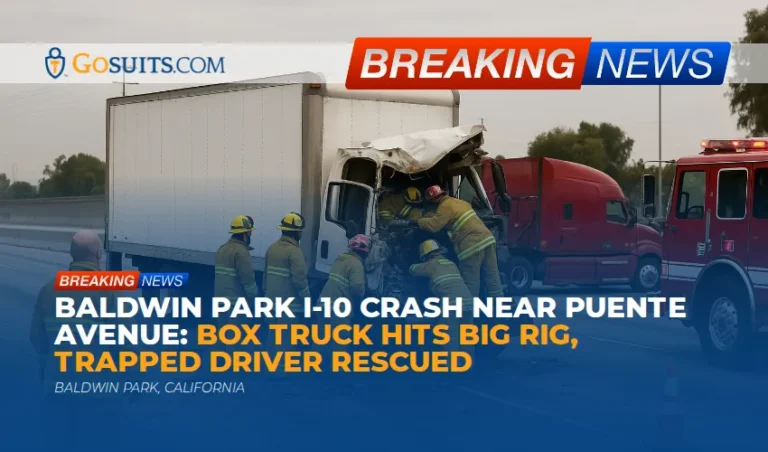
Early Tuesday morning, a serious collision on the eastbound 10 Freeway in Baldwin Park disrupted the rush-hour commute and triggered a complex rescue. According to initial information, a smaller box truck collided into the back of a semi-truck near Puente Avenue. The crash was first reported around 5:47 a.m., and first responders arrived quickly to find the box truck’s cab badly crushed with its driver trapped. Crews worked to free the trapped driver and transported him to a hospital. He was reportedly alert at the time of the rescue, though his condition has not been publicly confirmed.
All eastbound lanes were initially shut down, causing major backups in the Baldwin Park area during the morning drive. By approximately 7 a.m., at least three lanes had reopened. Officials had not immediately released the cause of the collision, and no additional details were made public at the time of the initial reports.
Location, timing, and traffic impacts across Baldwin Park and the San Gabriel Valley
The crash occurred near Puente Avenue on the eastbound I-10 corridor, a busy stretch that funnels traffic from El Monte through Baldwin Park toward West Covina and the Inland Empire. This area sees a mix of local commuters and regional freight traffic during the early morning hours. When lanes close here, ripple effects often hit nearby on-ramps and arterial streets like Baldwin Park Boulevard, Puente Avenue, Francisquito Avenue, and Maine Avenue.
Morning closures on I-10 can also push drivers onto the 605 interchange a few miles west, or onto surface streets near Baldwin Park High School and the Kaiser Permanente Baldwin Park Medical Center area. For real-time road conditions during events like this, Caltrans maintains statewide traffic updates and camera feeds through its QuickMap tool at quickmap.dot.ca.gov. That resource helps drivers see lane closures, incidents, and travel speeds while planning alternate routes.
Injury status and emergency response at the scene
The driver of the box truck was trapped due to the severity of the cab damage. Fire and rescue crews performed an extrication and transported him to a hospital. He appeared alert based on reports from the scene. No other injuries were immediately reported, and there was no public confirmation of injuries to occupants of the semi-truck.
On freeways in the Baldwin Park area, the California Highway Patrol typically leads the traffic investigation and overall incident management, while fire and rescue operations are handled by fire agencies serving the area. It is common in high-impact truck crashes for responders to deploy heavy rescue equipment and coordinate with tow operators to stabilize large commercial vehicles.
Why rear-end crashes involving big rigs are so dangerous
Even at moderate speeds, a rear-end collision with a semi-truck can cause catastrophic damage to a smaller vehicle or a box truck. The under-ride risk, the mismatch in vehicle mass, and the stiffness of a trailer’s rear structure often lead to extensive cab intrusion. Large trucks also have longer stopping distances and different handling dynamics than passenger vehicles, which can affect how a crash unfolds in heavy traffic.
Technology can help. Forward collision warning and automatic emergency braking systems are increasingly used to reduce or mitigate rear-end impacts. The National Highway Traffic Safety Administration has explained how these technologies function and why they matter for roadway safety. For background, see NHTSA’s overview on automatic emergency braking at nhtsa.gov/technology-innovation/automatic-emergency-braking. While the presence or absence of advanced driver-assistance features in the vehicles involved here has not been reported, this context helps explain why rear-end crashes still account for a significant share of serious injuries nationwide.

Immediate steps to consider after a serious freeway crash
When a high-impact crash happens on the 10 Freeway, the first priorities are medical care and safety. Once immediate hazards are managed, it becomes important to preserve information that can later clarify what happened and protect the rights of those involved. The following steps are general guidance that families and community members often find helpful after a serious collision:
- Prioritize medical evaluation even if symptoms seem minor at first. Some injuries present hours or days later.
- Preserve photos and videos of the scene, vehicle damage, road conditions, and any visible injuries. If you cannot safely document the scene, save what you can afterward, including damaged clothing and personal items.
- Identify potential witnesses and keep their contact information in a secure place.
- Write down a timeline of events. Memory fades quickly after stressful incidents.
- Secure vehicle data where possible. Commercial vehicles and many modern trucks store electronic data that can be crucial to understanding speed, braking, and other factors.
- Consult an attorney before contacting any insurance company. Statements made to an insurer can be recorded and may be used against the claimant later.
How to obtain official records and where to call in Los Angeles County
Traffic collision report
Because this collision occurred on the 10 Freeway, the investigating agency is typically the California Highway Patrol. CHP collision reports can be requested through the CHP’s process using their published form and instructions. Start at the CHP’s collision report page: chp.ca.gov/notify-chp/collision-report-request. You can also locate the appropriate CHP Area office, such as the one serving Baldwin Park, using the agency’s office locator: chp.ca.gov/find-an-office.
To speed up your request, have the date, location, and report or incident number ready. If you do not have the report number, the date, time, location near Puente Avenue, and vehicle descriptions can help CHP staff locate the right file.
Medical records
Treating hospitals maintain medical records for patients they treat. In the Baldwin Park area, that may include facilities such as Kaiser Permanente Baldwin Park Medical Center and nearby trauma centers in the San Gabriel Valley. Hospitals require HIPAA-compliant authorization forms to release records. When injuries are significant, it is often useful to request records and imaging from all treating providers, including follow-up clinics and physical therapy.
Medical examiner or coroner records
In crashes involving fatalities, the Los Angeles County Medical Examiner-Coroner oversees examinations and related records. Families can begin with the agency’s website for information about requesting records: mec.lacounty.gov. For incidents without fatalities, coroner records will not apply.
Traffic and roadway data
Caltrans provides real-time and historical traffic information through several channels. For live closures, lane status, and highway cameras, use Caltrans QuickMap at quickmap.dot.ca.gov. For certain roadway maintenance records or traffic camera data, members of the public may submit a Public Records Act request to Caltrans. The Department provides PRA guidance here: dot.ca.gov/programs/legal/public-records-act-requests.
Understanding potential civil liability in California truck and box truck collisions
While the official cause of this crash has not been released, the civil responsibility framework in California generally considers whether one or more parties acted unreasonably under the circumstances. In rear-end scenarios, investigators often review speed relative to traffic, following distance, visibility, sudden slowdowns, mechanical conditions, and roadway design elements. Key California rules sometimes evaluated include:
- Following distance: California Vehicle Code section 21703 requires drivers to follow at a distance that is reasonable and prudent. See the statute text at leginfo.legislature.ca.gov.
- Basic speed law: California Vehicle Code section 22350 prohibits driving at a speed greater than is reasonable or prudent given traffic, visibility, and conditions. The statute is available at leginfo.legislature.ca.gov.
When a commercial motor vehicle is involved, additional safety obligations may be relevant. Federal Motor Carrier Safety Regulations address topics such as hours of service and vehicle inspection and maintenance. For reference, see the Federal Motor Carrier Safety Administration regulatory overview at fmcsa.dot.gov/regulations and the hours-of-service summary at fmcsa.dot.gov/regulations/hours-service/summary-hours-service.
Depending on the facts, potential civil claims may consider the conduct of individual drivers, employers responsible for commercial vehicles, and any entities with duties related to vehicle maintenance or loading. California also applies comparative fault principles, meaning the responsibility for damages can be allocated among multiple parties based on their respective shares of fault. Every case turns on its own facts and evidence.
Insurance considerations unique to commercial vehicle crashes
Collisions between a box truck and a semi-truck commonly involve multiple insurance carriers. There may be separate policies for the driver, the motor carrier, the vehicle owner, and the cargo. That can complicate communications, the exchange of information, and the process of determining coverage and responsibility.
- Liability coverage for commercial carriers is usually higher than personal auto policies, but coverage disputes can still arise about fault, policy exclusions, or independent contractor relationships.
- Medical payments coverage may be available on some auto policies in California, though it is optional.
- Uninsured or underinsured motorist coverage can sometimes apply if a responsible party is uninsured or does not have sufficient coverage for losses. The applicability depends on the specific policy and facts.
- Cargo and shipper issues can enter the picture if cargo shift, loading, or weight played a role. Those facts must be supported by evidence rather than assumption.
Before speaking with any insurance company or providing a recorded statement, it is prudent to consult with an attorney first. Insurance adjusters may be friendly, but they represent their company’s interests. What someone says to an insurer can be used against them later.
Preserving evidence from commercial vehicles and roadway sources
Evidence can disappear quickly after a freeway crash. Families and involved drivers often benefit from safeguarding the following, when possible:
- Electronic data from vehicles: Many trucks store information related to speed, braking, throttle, and fault codes. Preservation letters can help ensure this data is not overwritten. The same goes for telematics from fleet systems.
- Dashcams and in-cab video: Many commercial fleets use forward-facing or driver-facing cameras that loop on short intervals.
- Maintenance and inspection records: Regulations require periodic inspections and driver vehicle inspection reports. These records can clarify whether a mechanical issue contributed.
- Driver logs and hours-of-service data: Electronic logging devices are common and can show duty status and rest periods subject to FMCSA rules. See hours-of-service references at fmcsa.dot.gov/regulations/hours-service/summary-hours-service.
- Scene documentation: Photos of skid marks, debris fields, and gouge marks, along with measurements, can help reconstruction experts calculate speeds and positions.
- Third-party video: Traffic cameras, business cameras near freeway frontage roads, and passing motorists’ dashcams sometimes capture critical moments. Requesting this quickly can be the difference between having it and losing it.
- Official reports: CHP collision reports and any supplementary diagrams are central pieces of documentation. Request details at chp.ca.gov/notify-chp/collision-report-request.
Common safety and visibility issues on I-10 near Baldwin Park
Residents of Baldwin Park know the 10 Freeway can feel unpredictable in the early morning. Traffic ebbs and flows, with pockets of stop-and-go interrupted by short stretches of higher speeds. Add in a mix of commuter sedans, delivery box trucks starting their routes, and long-haul tractor trailers moving through the San Gabriel Valley, and the risk of rear-end impacts rises whenever visibility or following distances suffer.
Weather can play a role too. In cooler months, ground-level haze or light fog sometimes settles along this corridor before sunrise. Glare from a rising sun can momentarily blind drivers heading east toward West Covina and Covina. Construction activity and temporary lane shifts may add complexity. Caltrans QuickMap at quickmap.dot.ca.gov is useful to check for new work zones or incidents before leaving.
Technology and policy are part of the safety equation as well. NHTSA has published context on technologies like automatic emergency braking and how they can reduce or mitigate rear-end collisions. See nhtsa.gov/technology-innovation/automatic-emergency-braking for an overview of function and safety rationale. Even with technology, though, real-world safety hinges on attentive driving, safe following distances, proper vehicle maintenance, and practical trip planning for commercial operations.
Deadlines that may apply under California law
California law imposes time limits for bringing civil claims, and some are quite short. These timeframes can be affected by the identity of the at-fault parties, the type of claim, and whether any public entities are involved. Two important statutes to be aware of are:
- General personal injury statute of limitations: In many cases, a two-year statute of limitations applies to personal injury claims arising from negligence. See California Code of Civil Procedure section 335.1 at leginfo.legislature.ca.gov.
- Government claims: If a government entity might be involved, special claim procedures and shorter deadlines can apply. California Government Code section 911.2 addresses the time for presenting a claim. See leginfo.legislature.ca.gov. For state agencies, the Department of General Services provides claim information at dgs.ca.gov/orim/How-to-File-a-Claim.
These are general references. Specific deadlines can vary based on facts, including the identity of the defendants and the nature of injuries or damages.
Community perspective and roadway safety tips for the morning commute
Folks in Baldwin Park often start early. Delivery routes head out before dawn. Parents move along Puente Avenue, Francisquito Avenue, and Los Angeles Street, while freeway traffic stacks up between El Monte and West Covina. In this setting, a single crash at the wrong time can lock up the eastbound 10 and spill cars onto neighborhood streets near Morgan Park and the Metrolink right-of-way.
While investigations will determine why this particular collision occurred, many local drivers appreciate practical reminders for mornings on the 10:
- Build in extra time for the stretch between the I-605 interchange and Puente Avenue, especially when school is in session or weather is unfavorable.
- Increase following distance when behind or ahead of a large truck. Heavy vehicles need more time and space to stop or evade hazards.
- Scan ahead for brake lights and lane changes where on-ramps merge near Baldwin Park Boulevard and Puente Avenue.
- Avoid sudden braking when possible. Smooth speed adjustments give drivers behind you more time to react.
- Use real-time tools like Caltrans QuickMap at quickmap.dot.ca.gov to spot closures, CHP activity, or new construction before committing to a route.
Commentary from Gosuits Baldwin Park, California Personal Injury Attorney
Our hearts go out to the driver who was rescued after this serious crash on the eastbound 10 near Puente Avenue, and to everyone stuck in that tense morning commute. This article is meant for general information and education. Every situation is different, and the details of this collision will matter.
From a civil-injury perspective, rear-end impacts involving big rigs and box trucks raise urgent questions about following distance, speed relative to traffic, visibility at dawn, loading, and maintenance. We look to official reports, witness statements, and vehicle data to sort out how and why a crash happened. On a corridor like the 10 in Baldwin Park, conditions can change in seconds. The evidence collected in the first few days is often decisive.
Insurance companies and commercial carriers move fast after serious freeway crashes. They gather statements, collect vehicle data, and frame the narrative early. People who are hurt and families who are rattled by a frightening call often do not realize how quickly critical evidence can be lost or how a simple recorded statement can be interpreted against them later. Keeping control of information, preserving electronic data, and understanding the coverage landscape are key steps in leveling the playing field.
A no-cost consultation can be valuable simply to understand rights, timelines, and evidence priorities before speaking with any insurer. Knowing what matters, what to say, and when to say it can help protect claims and reduce stress during recovery.

Action steps and timing considerations
Here are focused actions that can make a difference after a serious freeway collision in the Baldwin Park area:
- Secure the paper trail now: Request the CHP collision report, collect medical records, and safely store photos, videos, and contact information. Early documentation helps prevent disputes later.
- Preserve electronic evidence: Ask that relevant vehicles not be repaired, sold, or destroyed until data can be downloaded. Telematics, dashcam video, and electronic logs are time sensitive.
- Manage insurance communications thoughtfully: Consider obtaining guidance before offering any recorded statement. Statements can be used later to limit or deny compensation.
- Calendar legal time limits: Note general two-year injury deadlines and any shorter public-entity claim windows that might apply based on the facts. Missing a deadline can end a claim.
- Track symptoms and treatment: Keep a simple journal of pain levels, medical appointments, missed work, and daily limitations. This helps connect injuries to the crash over time.
- Check roadway context: Save incident details from Caltrans QuickMap for the date and time of the crash. Noting lane closures or unusual congestion patterns can be helpful context.
Why act now rather than later? Because vehicles get repaired or scrapped, camera systems overwrite older clips, witnesses change phone numbers, and lanes reopen with no visible trace of what happened. The more time that passes, the harder it becomes to reconstruct the truth and support a civil claim with reliable evidence.
Understand Your Deadlines See Evidence Preservation Steps
References
- California Highway Patrol: Collision Report Request
- California Highway Patrol: Find an Office
- Caltrans QuickMap
- Caltrans Public Records Act Requests
- California Vehicle Code § 21703
- California Vehicle Code § 22350
- California Code of Civil Procedure § 335.1
- California Government Code § 911.2
- California DGS: How to File a Government Claim
- Federal Motor Carrier Safety Administration Regulations
- FMCSA Hours of Service Summary
- NHTSA: Automatic Emergency Braking Overview
- Los Angeles County Medical Examiner-Coroner