- What this Austin news item highlights
- Four lesser known Texas traffic laws that still lead to tickets
- Other Texas rules that quietly trip up drivers
- Why these rules matter in a Dallas car accident or East Texas crash
- Where families can get official records in Texas
- Insurance considerations after a crash tied to a violation
- Local driving realities in Austin, Dallas, Tyler, and Longview
- Practical steps after a violation-related collision
- Why taking action sooner matters
- Commentary from Gosuits Austin, Texas Personal Injury Attorney
- References
What this Austin news item highlights
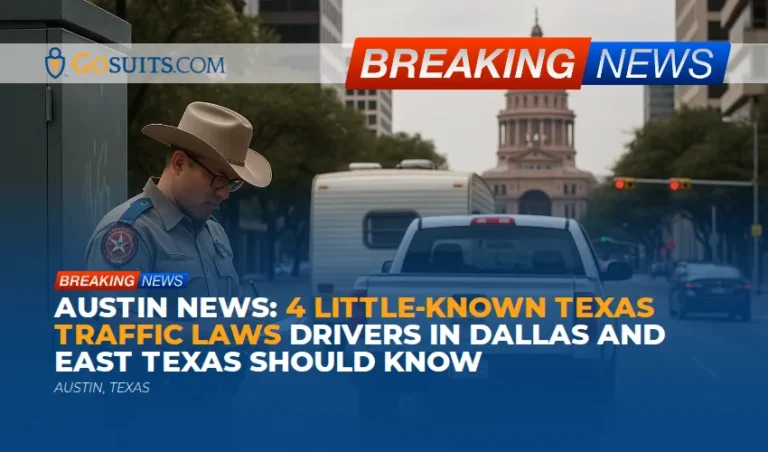
A recent Austin-tagged piece published on January 30, 2026 called attention to traffic rules in Texas that many drivers overlook, especially in communities like Dallas, Tyler, Longview, and Gilmer. The thrust was straightforward: once you put your vehicle in drive, Texas law expects you to know the rules of the road. Ignorance is not a defense. The article specifically pointed out examples such as passengers riding in trailers while towed, and it framed these as lesser known laws that can still result in a warning or a citation. No crash was reported in the item. Rather, it offered a reminder that compliance is part of the responsibility we all carry on I-35 through Austin, on I-30 in Dallas, and on the two-lane farm-to-market roads that lace through East Texas.
We took that reminder as an opportunity to explain four often-missed Texas rules using official sources, and to show why these rules can be decisive when a collision occurs. We also list the public offices that hold the records people look for after a wreck, including crash reports and autopsy findings. Wherever possible, we cite the Texas Transportation Code and other government resources so you can check the language directly.
Four lesser known Texas traffic laws that still lead to tickets
1) Do not ride inside a towed house trailer
Texas law prohibits riding inside a house trailer while it is being towed on a public road. This is not a mere recommendation. It is a safety rule aimed at preventing severe injuries in even minor crashes, given how poorly trailers protect occupants compared to passenger compartments. The prohibition appears in the Texas Transportation Code under the rules of the road for vehicle operation [1].
Why it matters in practice: a rear-ender on Loop 323 in Tyler that would be manageable for a modern SUV becomes catastrophic for anyone riding inside a trailer. If an injury occurs, the rule will be part of the liability conversation because violations can be evidence of negligence.
2) Move Over or Slow Down for stopped emergency and certain service vehicles
When you approach a stopped emergency vehicle with lights activated, or TxDOT vehicles and tow trucks under specified conditions, you must either vacate the lane next to the vehicle or reduce speed accordingly. This is the well known, but still often ignored, Move Over or Slow Down law. It is codified at Transportation Code section 545.157 [2]. On LBJ Freeway in Dallas or along US 80 through Longview, that can mean sliding one lane left when a marked cruiser is on the shoulder, or lowering speed if a lane change is unsafe.
Why it matters: collisions with roadside responders in Texas remain a serious safety issue. A violation can amplify civil exposure if a crash injures a trooper, a tow operator, or a roadway worker.

3) Steer It, Clear It after a minor crash
If a crash results in property damage only and vehicles are drivable, Texas law expects drivers to move their vehicles from the travel lanes to a safe location without unnecessary delay. This helps prevent secondary crashes. The duty to remove your vehicle after a non-injury, damage-only collision is tied to Transportation Code provisions on accidents involving damage to vehicles, including section 550.022 [3]. TxDOT’s public safety campaigns have long reinforced this concept as Steer It, Clear It.
Why it matters: failing to move off the main lanes on I-35, Mopac, or I-20 can trigger further collisions and injuries. In a civil claim, leaving vehicles blocking a lane when it was safe to move them can become a factor in fault allocation.
4) You must stop for school buses with flashing red signals
Drivers must stop for a school bus that is operating its visual signals and may not proceed until the signals are deactivated and it is safe. This applies on most roadways unless the lanes are separated by a physical barrier or intervening space that qualifies under the statute. The rule is found at Transportation Code section 545.066 [4].
Why it matters: failure to stop for a bus in neighborhoods around Pflugerville, South Austin, or North Dallas is not only a ticketable offense, it can be devastating if a child is crossing in front of the bus. In civil court, violating this rule can carry significant weight.
Other Texas rules that quietly trip up drivers
A lot of us think of speed limits and stop signs first. But several everyday rules quietly shape safe driving in Austin, Dallas, and across East Texas. Here are a few with official sources you can check.
- Statewide texting and driving ban. Texas prohibits reading, writing, or sending electronic messages while driving, with limited exceptions. See Transportation Code section 545.4251 [5]. On stretch after stretch of I-30 or I-20, a momentary glance can have outsized consequences at highway speed.
- Seat belt use for drivers and passengers. Adults must be secured by a seat belt, and children must be restrained in an appropriate child passenger safety seat system per age, height, and weight. See sections 545.413 and 545.412 of the Transportation Code, and the Texas Driver Handbook from DPS for practical guidance [6].
- Headlights when visibility is limited. Texas requires headlights at nighttime and when conditions reduce visibility to less than 1,000 feet. The general rules for displaying lights appear in Transportation Code section 547.302, and DPS’s Texas Driver Handbook summarizes when to switch on lights for safety [7].
- No stopping or standing in an intersection. Apart from very limited scenarios, stopping, standing, or parking in an intersection is prohibited. See Transportation Code section 545.302 [8]. Gridlock in downtown Austin or on McKinney Avenue in Dallas can turn unsafe fast when drivers block the box.
- Window tint and equipment rules. Texas regulates windshield and window tint, lighting, and certain equipment. If you’re unsure whether your family SUV is compliant after an aftermarket upgrade, it helps to review a plain language guide like our Texas window tint law guide and then verify details with the Transportation Code and DPS inspection guidance.
In many of these settings, a violation is not just about a fine. If a crash happens and injuries follow, the presence of a violation can become a building block of negligence in a civil case. That is where seasoned evaluations by Austin car accident lawyers can make a difference in how evidence is preserved and presented.
Why these rules matter in a Dallas car accident or East Texas crash
Traffic rules do not exist in a vacuum. In Texas civil law, violations can be considered by insurers and juries when they decide who bears responsibility and by how much. Sometimes the violation lines up directly with the danger the rule was meant to prevent, and that connection can be powerful. Think of a driver who texts on I-635 near the High Five and rear ends a stopped truck, or a motorist who fails to Move Over on I-35 and sideswipes a DPS cruiser. The safety rule tells a story about foreseeable risk and preventable harm.
At the same time, Texas follows proportionate responsibility. Fault is often shared. If one motorist failed to clear the lanes after a minor fender bender on US 69 north of Jacksonville, and another motorist approached too fast in rain with headlights off, each decision can matter when insurers apportion fault. Understanding the interplay of facts, statutes, and roadway conditions is crucial.
To give context, Texas sees a high volume of crashes year after year. TxDOT’s crash statistics pages track annual totals and emphasize that secondary crashes, pedestrian conflicts around school buses, and roadside response collisions are persistent concerns statewide [9]. Those trends are visible close to home, from the choke points where SH 130 meets I-35 to the busy interchanges along Dallas’ Mixmaster.
Importantly, the presence of a citation does not end the civil analysis, and the absence of a citation does not bar an injury claim. Civil liability looks at the totality of evidence. That is one reason many people choose to speak with car accident lawyers before calling an insurer, even when a ticket was or was not issued. What you say to an adjuster can be recorded and used against you later.
Where families can get official records in Texas
After a serious crash in Austin, Dallas, Tyler, or Longview, families often ask the same urgent questions: where do we get the police report, how do we request 911 audio, and who handles autopsy examinations if a loved one has passed away? The following are general pathways to the key records most people seek. Procedures and eligibility rules apply, and some records are restricted by law.
Police crash reports
– Statewide crash reports are maintained for public purchase via TxDOT’s crash records system. TxDOT also provides guidance on crash records and purchasing reports through its safety and crash records pages [10].
– For Austin-area crashes, the City of Austin provides police report and records request information through austintexas.gov. You can start with the Austin Police Department’s public records and police report portals and follow their instructions for crash reports and supplemental materials [11].
– For other cities and counties, police report requests are typically handled by the specific department or through county portals subject to the Texas Public Information Act. The Texas Department of Public Safety also provides statewide driver resources and the Texas Driver Handbook, which explains what information officers typically collect at crash scenes [6].
Autopsy reports and medical examiner records
Texas uses a mixed system. Larger counties operate medical examiner offices under Article 49.25 of the Code of Criminal Procedure, while many rural counties rely on Justices of the Peace to conduct inquests [12]. Whether an autopsy is ordered depends on the circumstances of the death and the county’s policies. Here is where to begin:
- Travis County handles the Austin area through the Travis County Medical Examiner’s Office. Their website explains request procedures and any limits on release of reports and images [13].
- Harris County operates the Institute of Forensic Sciences serving the greater Houston area. Their site provides public request instructions and guidance on who may obtain which records [14].
For other counties, search for the county’s medical examiner or the county clerk website. Where a county does not have a medical examiner, contact the appropriate Justice of the Peace court to ask about inquest records.
Death certificates
The Texas Department of State Health Services Vital Statistics Section issues death certificates to eligible requesters. The DSHS site outlines eligibility, required identification, and ordering options by mail, online, or in person through participating local registrars [15].
Other useful public records
– Roadway maintenance and construction logs may help in some collisions, especially work zone incidents. Those records are often held by TxDOT district offices. TxDOT’s crash and safety pages are a good starting point for understanding how the agency stores and releases traffic safety data [9].
– School district transportation departments sometimes retain bus video. If a school bus was involved near Pflugerville, Round Rock, or Tyler ISD, the district can explain its public information procedures, subject to privacy laws.
Insurance considerations after a crash tied to a violation
Insurance carriers move quickly after a wreck. Adjusters look for statements and documents that help them limit exposure. If a ticket was issued for Move Over/Slow Down or a Steer It, Clear It situation, the carrier may emphasize it to shift blame. If the other driver was cited for texting, the roles reverse. Either way, it is prudent to speak with an attorney first before giving any recorded statement. What someone says to the insurance company can be used against them later on.
A few common issues we see on I-35 through Austin and on the High Five in Dallas:
- Recorded statements. Adjusters may request a recorded statement within 24 to 48 hours. That can be too soon to fully understand injuries and the scene dynamics. Slow down and get informed before you speak.
- Early medical authorizations. Broad authorizations can expose full medical histories when only limited records are relevant at this stage. Ask questions about scope and necessity.
- Comparative fault framing. Even in clear bus-stop violations or Move Over cases, carriers may argue the injured person also contributed to the crash. Evidence preservation is key.
When claims touch multiple rules of the road, an early strategy discussion with car accident lawyers can help protect the record, gather the right statutes and agency materials, and avoid unforced errors that harm a claim later.
Local driving realities in Austin, Dallas, Tyler, and Longview
We all drive the same basic Texas roads, but each region has its quirks that interact with these laws. In Austin, I-35 construction zones and the SH 130 corridor change lane availability in a hurry, which makes the Move Over/Slow Down rule and the Steer It, Clear It expectation particularly important. Downtown events around the Capitol and the University of Texas amplify school bus and pedestrian interactions at certain times of day.
In Dallas, rapid lane changes around the Mixmaster and tight shoulders on Woodall Rodgers leave little margin for error when a cruiser is on the side of the road. Secondary crashes happen when vehicles linger in travel lanes after minor collisions instead of clearing to the shoulder or nearest exit ramp. If a school bus stops along neighborhood streets in Lake Highlands or Oak Cliff, stopping distances and sight lines are different than along a divided highway.
East Texas has its own rhythm. On US 69 outside Jacksonville, passing zones fluctuate and trailers are common. Riding inside a towed house trailer is both unsafe and unlawful, and the risk compounds on rolling two-laners. In Tyler, Loop 323 and Old Jacksonville Highway see frequent stop-and-go that can lure drivers into quick glances at their phones. In Longview, US 80 and Spur 502 mix local and truck traffic, which underscores how a single missed rule can cascade into real harm.
Across these communities, law enforcement emphasizes the basics in the Texas Driver Handbook, which consolidates many of the practical rules of the road that drivers rely on daily [6]. But it is the less talked-about rules that often show up in the hardest cases.
Practical steps after a violation-related collision
Here is a clear, local-first checklist to follow if a collision in Austin, Dallas, or East Texas may involve one of the rules discussed above. Always put safety and health first.
- Get to a safe location. If the crash is damage-only and drivable, Texas expects you to move out of live lanes when safe to do so. That protects everyone from secondary crashes on I-20, I-35, or neighborhood arterials [3].
- Call 911 and request medical assessment. Some injuries are not obvious in the first hour. EMS can evaluate and advise even if you feel okay.
- Note potential rule violations. Was a school bus stopped with red lights? Was an emergency vehicle on the shoulder? Was someone riding in a towed trailer? Make a contemporaneous note on your phone if you can safely do so.
- Document the scene. Photos of final rest positions, shoulder distances, activated light bars, bus stop arms, and signage can be decisive later.
- Request body-worn camera identifiers. If APD or DPD responds, note the unit numbers to facilitate later records requests through the city.
- Obtain the crash report. Use TxDOT’s crash records guidance for statewide reports and the Austin Police public portals for local requests [10][11].
- Preserve medical and autopsy records. In the hardest cases, contact the appropriate county medical examiner office or Justice of the Peace court for inquest materials, and order certified death certificates from DSHS if you are eligible [12][13][14][15].
- Talk to counsel before giving a recorded statement. Carriers often request statements quickly. Get grounded first, understand the statutes that may apply, and consider how those facts align with negligence theories.
Why taking action sooner matters
– Preserving evidence. Roadside camera footage, school bus video, and responder dashcam clips can cycle out quickly. Acting promptly increases the odds those materials are still available.
– Keeping control of the narrative. When rules like Move Over/Slow Down, Steer It, Clear It, or the texting ban might apply, small phrasing differences in an early insurance statement can change how fault is framed. Getting your documents in order and understanding the statutes reduces the risk of mischaracterization.
– Managing timelines. Records requests to city police departments, TxDOT, and medical examiner offices have their own queues. Starting early helps align the arrival of key materials with medical decision-making and any insurance claim steps that follow.
– Avoiding gaps in care. Prompt evaluation and consistent documentation matter both for health and for clarity. Delays can complicate causation in any later claim tied to a specific violation, whether it was a bus stop incident in North Austin or a roadside response crash on I-30.

Commentary from Gosuits Austin, Texas Personal Injury Attorney
Our hearts go out to anyone affected by crashes where a little known rule turned a normal day upside down. This article is meant for general information and education, so people in Central Texas and East Texas can better understand how these rules fit into everyday driving and, when things go wrong, what records matter most.
Here is our perspective: when a collision intersects with a safety rule like Move Over/Slow Down or Steer It, Clear It, the law is pointing to a specific danger that was supposed to be avoided. Those same rules become part of the civil analysis. The facts still need to be gathered carefully. Road geometry on I-35 is not the same as a two-lane in Gilmer. Lighting at dusk around a school bus in South Austin is not the same as a midday stop in Plano. But the statutes and official guidance provide a map for investigating what happened.
Insurance companies and large corporate defendants understand these dynamics and use them early. They capture recorded statements, emphasize pieces of the Transportation Code that favor their position, and de-emphasize others. They know how to turn small gaps in documentation into big arguments about comparative fault. That is why it is so important for people to be fully informed before speaking at length with adjusters.
A free consultation can help clarify which statutes apply, which public records to request, and how to pace communications with insurers. The goal is to protect your rights, not to escalate conflict. Even if no claim is filed, good information early often leads to better, calmer decisions later.
References
- Texas Transportation Code Chapter 545 Rules of the Road – Texas Legislature Online
- Sec. 545.157 Passing Certain Vehicles – Texas Legislature Online
- Sec. 550.022 Accident Involving Damage to Vehicle – Texas Legislature Online
- Sec. 545.066 Passing a School Bus – Texas Legislature Online
- Sec. 545.4251 Use of Wireless Communication Device – Texas Legislature Online
- Texas Driver Handbook and Manuals – Texas Department of Public Safety
- Sec. 547.302 Duty to Display Lights – Texas Legislature Online
- Sec. 545.302 Stopping, Standing, or Parking Prohibited – Texas Legislature Online
- Crash Statistics and Facts – Texas Department of Transportation
- Crash Records Information – Texas Department of Transportation
- Police Reports and Records – City of Austin
- Art. 49.25 Medical Examiners – Texas Code of Criminal Procedure
- Travis County Medical Examiner’s Office – Travis County
- Harris County Institute of Forensic Sciences – Harris County
- Death Records – Texas Department of State Health Services