- What happened at S. Cooper Street and Eden Road
- What we know so far from Arlington Police
- Location context: understanding the S. Cooper and Eden intersection
- Early safety and legal takeaways for Arlington drivers
- Who to contact for official records and reports in Arlington and Tarrant County
- Potential civil liability in Texas intersection crashes
- Evidence to preserve right away after a serious crash
- Insurance considerations after a major Arlington crash
- Support for grieving families and the Arlington community
- Call to action: steps the community can take now
- References
- Commentary from Gosuits Arlington, Texas Personal Injury Attorney
What happened at S. Cooper Street and Eden Road
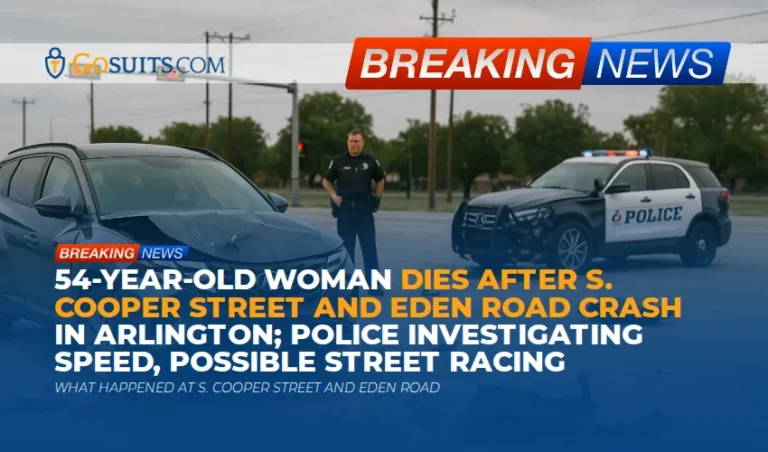
Shortly after 12:30 p.m. on Friday, Arlington officers responded to a major two-vehicle crash at the intersection of S. Cooper Street and Eden Road in south Arlington. According to Arlington Police, a 54-year-old woman driving a 2022 Hyundai Tucson was severely injured at the scene and later died at a nearby hospital. A man driving a 2025 Mercedes-Benz C30 was also injured and hospitalized. Identities have not been publicly released as officials work to notify next of kin.
Investigators believe speed likely played a role. They are assessing whether possible street racing was involved, although that has not been confirmed. Preliminary details indicate the Hyundai was traveling south on S. Cooper and attempting a left turn when it was struck by the northbound Mercedes.
The facts above reflect information shared by Arlington Police at the time of reporting. As with any active investigation, details can evolve as officers, crash reconstruction specialists, and data analysts review physical evidence, vehicle data, and video sources.
What we know so far from Arlington Police
Confirmed details
Arlington Police have stated the following:
- Crash time and location: Around 12:30 p.m. Friday at S. Cooper Street and Eden Road in Arlington.
- Vehicles involved: A 2022 Hyundai Tucson and a 2025 Mercedes-Benz C30.
- Injuries: The woman driving the Hyundai was pronounced deceased at the hospital. The man driving the Mercedes sustained injuries and was hospitalized.
- Preliminary cause factors: Investigators believe speed likely contributed. Possible street racing is under investigation but not confirmed.
- Next of kin and identity: Authorities will release the deceased person’s name after family notifications are complete.
Unknowns at this time
- Street racing determination: Whether street racing occurred has not been established.
- Specific fault allocation: No final determination has been announced regarding the precise allocation of civil fault between the drivers.
As officers gather surveillance video, witness statements, and electronic data, expect a more complete picture to emerge. The process includes reviewing skid marks, crush damage, signal timing data if applicable, and event data recorder information when available.
Location context: understanding the S. Cooper and Eden intersection
S. Cooper Street is a major north south arterial that connects neighborhoods and commercial corridors from the University of Texas at Arlington area down toward the Mansfield line. Eden Road is a busy east west connector serving subdivisions, schools, and small businesses. Midday traffic near this junction can include a mix of passenger vehicles, delivery vans, and work trucks moving between errands, schools, and lunch hour routines.
Left turns at high volume intersections require careful judgment about oncoming traffic speed and distance. Even a modest miscalculation when an approaching vehicle is moving faster than expected can dramatically increase crash severity. National roadway safety guidance consistently identifies intersections and turning movements as higher risk conflict points for urban traffic streams [2].

Early safety and legal takeaways for Arlington drivers
- Speed multiplies risk: Higher speeds lengthen stopping distance and raise the energy of any impact, leading to more severe injuries and fatalities. National data link speeding with a significant share of deadly crashes each year [1].
- Left-turn duty to yield: Under Texas law, a driver turning left at an intersection must yield the right of way to vehicles approaching from the opposite direction that are close enough to constitute a hazard [3].
- Basic speed rule: Texas law requires drivers to operate at a speed that is reasonable and prudent under existing conditions, regardless of the posted limit [4].
- Street racing prohibition: Racing on a highway is prohibited under Texas law. If proven, it has serious consequences and may be a factor in civil liability assessments [5].
It is too soon to draw legal conclusions about this collision. Still, these general principles help explain how investigators and insurers evaluate duty, breach, and causation once the facts are clear.
Who to contact for official records and reports in Arlington and Tarrant County
In a tragedy like this, families often need official documents to understand what happened and manage necessary affairs. Here are common points of contact and what to expect.
Crash report and supplemental materials
- Texas Department of Transportation Crash Records Information System (CRIS): In Texas, eligible parties can typically obtain the official crash report through the statewide system. This is often the most direct path to secure a certified copy of the officer’s report, which includes narrative details, contributing factors, and diagrammatic information [9].
- Arlington Police Department records: Beyond the statewide crash report, some crash-related records may be available via public information requests under the Texas Public Information Act. Processing times and availability can vary depending on the status of the investigation and statutory exemptions [10].
Autopsy and medical examiner documents
- Tarrant County Medical Examiner’s Office: The county medical examiner handles medicolegal death investigations, including autopsy reports and determinations of cause and manner of death. Families can inquire about report availability and request procedures through the Medical Examiner’s Office. Policies and timeframes are set by county and state rules [11].
Other potential records
- Traffic signal data or timing sheets: Where applicable, these may be held by municipal or county traffic engineering departments. Access typically requires a public information request. Availability can depend on system capabilities and retention schedules [10].
- Body cam or dash cam footage: Video from responding officers, if any, may be requested, subject to statutory limits on disclosure during active investigations [10].
When requesting records, expect to verify your relationship to those involved and to confirm your eligibility under Texas laws for crash documents. The statewide system and public information procedures detail who can obtain which records and when [9][10].
Potential civil liability in Texas intersection crashes
Every collision is fact specific. Generally, civil liability in a Texas intersection crash can hinge on a few recurring issues that investigators, insurers, and courts examine.
Right of way and turning movements
Texas Transportation Code requires drivers turning left to yield to oncoming traffic that is close enough to pose a hazard [3]. Investigations look closely at whether the turning driver had a reasonable opportunity to complete the turn safely, and whether the oncoming vehicle’s speed or position changed that calculation.
Speed and the basic speed rule
Even where the posted limit is not exceeded, the law requires driving at a reasonable and prudent speed based on conditions. Excessive speed can be found where, given traffic and visibility, a lower speed would have been safer [4]. High speed can substantially increase stopping distance and impact forces, often decisive in severe or fatal outcomes [1].
Street racing allegations
Racing on a highway is prohibited by Texas Transportation Code [5]. If evidence ultimately shows street racing contributed to a crash, it can influence civil liability considerations. At this time, Arlington Police have not confirmed racing in this case.
Wrongful death and survival claims
Texas law provides two separate civil avenues in fatal incidents. A wrongful death action allows certain surviving family members to pursue claims related to the loss of their loved one [6]. A survival action allows the estate to seek the decedent’s own claims that accrued between injury and death [7]. Whether and how these apply depends on the facts and parties involved.
Comparative responsibility
Texas follows proportionate responsibility rules. If multiple parties share fault, recoveries can be reduced by a claimant’s percentage of responsibility. A claimant generally cannot recover if found more than 50 percent responsible [8]. This framework underscores why precise fact development is so important in intersection collisions.
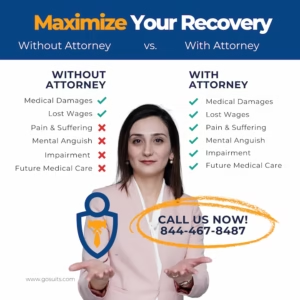
Because liability turns on specific evidence, many families find it helpful to consult with Arlington car accident lawyers early to understand their rights and possible next steps. Timing can matter for preserving critical proof.
Evidence to preserve right away after a serious crash
Important evidence can disappear quickly after a roadway crash. When safe and appropriate, consider the following approaches to preservation. If any claim may be made, it is wise to speak with an attorney before taking independent steps.
- Vehicle data and inspections: Modern vehicles often record speed, braking, and other parameters in event data recorders. Prompt preservation letters can help ensure this data is not lost during towing, storage, or repairs.
- Surveillance and dashcam video: Businesses along S. Cooper Street and Eden Road may have exterior cameras. Many systems overwrite footage within days. Early outreach can be vital. Likewise, private dashcam video held by witnesses can be invaluable.
- Scene documentation: Photos of the intersection, skid marks, debris fields, and vehicle resting positions can assist reconstruction professionals, particularly if weather or road maintenance changes the scene soon after.
- Witness identification: Names, contact details, and initial impressions from witnesses help provide context that raw measurements cannot capture.
- Medical records: For injured persons, emergency department records, imaging, and specialist notes can establish mechanism of injury and severity over time.
For families navigating the loss of a loved one, a simple paperwork guide can help keep tasks organized. A practical resource many find useful is this Dallas wrongful death paperwork checklist for families. While created with Dallas families in mind, the steps are similar for Tarrant County and the greater Arlington area.
Insurance considerations after a major Arlington crash
After severe collisions, multiple insurance carriers can be involved, including liability, underinsured motorist, medical payments, and sometimes umbrella policies. Because early statements can be recorded and parsed, it is generally prudent to speak with an attorney before giving any formal statement to an insurer. What someone says to an adjuster can be used against them later, and early case framing can influence the trajectory of negotiations.
In fatal crash settings, estates and qualifying family members may face different timelines and proof requirements than injured survivors. Coordinating benefits, medical liens, and property damage claims gets complicated quickly. Many people choose to consult car accident lawyers to help identify all available coverages and to manage communications with insurers so that deadlines are met and rights are protected.
If a claim is contemplated, consider engaging counsel before contacting the insurance company about liability or injuries. This preserves flexibility on sensitive issues like comparative fault, causation, or alleged policy exclusions.
Support for grieving families and the Arlington community
South Arlington neighbors know this corridor well. Churches, schools, youth sports, and small businesses form tight networks across subdivisions from Bardin Road over to Matlock and New York Avenue. When tragedy strikes at a familiar intersection, the shock reverberates through workplaces, congregations, and extended families.
Practical steps in the first days can feel overwhelming.
- Lean on your circle: Ask trusted friends to help coordinate meals, childcare, and transportation. Accept support from faith communities and local organizations.
- Organize key documents: Keep hospital bills, funeral home estimates, correspondence from law enforcement, and any insurance letters together in one folder or digital file.
- Note important dates: Write down when you requested records, when you received them, and who you spoke with at each agency. Small details matter later.
- Protect privacy: Be cautious about posting sensitive details on social media while investigations are ongoing.
For official documentation, the county’s Medical Examiner manages autopsy reporting and death investigation records for Tarrant County [11]. Crash reports are generally accessed through the statewide TxDOT CRIS system [9]. Public information requests are guided by the Texas Public Information Act [10].

Call to action: steps the community can take now
Here are concrete steps that community members can take following a serious roadway crash in Arlington.
- Request official records methodically: Identify which documents you will need and in what order. Start with the crash report, then track autopsy documentation if applicable. This sequencing helps with insurance coordination and benefits paperwork.
- Preserve time sensitive evidence: Ask nearby businesses about video retention policies and request that any footage be preserved. Photograph the area promptly, including signage and lane markings that could change with routine maintenance.
- Document financial impacts: Keep receipts and records of funeral expenses, counseling, lost income, and transportation. These records provide an audit trail if claims are made later.
- Consult counsel early: Timelines in Texas can be tight, and early strategy often affects outcomes. A brief discussion can clarify who should speak with insurers, how to handle recorded statements, and whether a preservation letter is needed.
- Attend to wellness: Grief and trauma can surface in waves. Connecting with local counselors, faith leaders, or support groups can help families and friends navigate the weeks ahead.
Why act now? Many data sources are overwritten quickly. Insurance timelines and Texas limitation periods continue to run as families grieve. Taking measured, organized steps in the first weeks can prevent permanent loss of key evidence and reduce administrative burdens later.
References
- Speeding – National Highway Traffic Safety Administration
- Intersection Safety – Federal Highway Administration
- Sec. 545.152. Turning Left at Intersection – Texas Transportation Code
- Sec. 545.351. Maximum Speed Requirement – Texas Transportation Code
- Sec. 545.420. Racing on Highway – Texas Transportation Code
- Chapter 71. Wrongful Death – Texas Civil Practice and Remedies Code
- Sec. 71.021. Survival – Texas Civil Practice and Remedies Code
- Chapter 33. Proportionate Responsibility – Texas Civil Practice and Remedies Code
- Crash Records Information System (CRIS) – Texas Department of Transportation
- Public Information Act – Office of the Texas Attorney General
- Medical Examiner – Tarrant County
Commentary from Gosuits Arlington, Texas Personal Injury Attorney
Our hearts are with everyone affected by the crash at S. Cooper Street and Eden Road. Losing a neighbor in a sudden collision is devastating, and we recognize that families and friends are processing shock and grief. This commentary is provided for general information and education. It reflects broad legal concepts that often arise in intersection crashes in Texas and is not tailored to any one person’s situation.
From a civil-injury perspective, two issues immediately come to mind in a left turn scenario like this: speed and right of way. Texas law places a duty on turning drivers to yield to oncoming traffic that presents a hazard, and it requires all drivers to travel at speeds that are reasonable and prudent for the conditions. When investigators determine how fast each vehicle was moving, how far away they were when the turn began, and whether any sudden acceleration was involved, those facts will shape the ultimate allocation of responsibility [3][4]. The open question about potential street racing is significant too, though it remains unconfirmed. If racing or exhibition of speed occurred, that can be relevant to how civil fault is assessed under Texas law [5]. It is appropriate to reserve judgment until all evidence is reviewed.
In the days after a collision, insurance companies often move quickly. Adjusters may request recorded statements, ask for broad medical authorizations, or suggest early conclusions about who was at fault. Large insurers and corporate entities understand the procedural rules and how narrative framing can affect claims. People navigating loss or recovery usually do not have the same background, and it is not uncommon for well-meaning statements to be used out of context later. Having a seasoned advocate manage communications, gather and preserve evidence, and identify all applicable coverages can help level the playing field.
Finally, for anyone considering a potential claim, a free consultation can be an important first step. It allows a person to understand timelines, evidence preservation needs, and how the law may apply to their circumstances. It also creates space to ask practical questions about interacting with insurers and what to expect next, without committing to any course of action prematurely.