- What we know about the Arlington crash at Eden Road and South Cooper Street
- Video evidence and the role of suspected street racing in civil liability
- Who was involved and the status of the investigation
- Why intersections like South Cooper and Eden see serious collisions
- Family rights after a fatal crash in North Texas
- Key evidence to preserve immediately
- Where to get official records in Arlington and Tarrant County
- Insurance issues after a suspected street racing crash
- Timeline and legal deadlines that can affect a claim
- Community context and safety steps for South Arlington
- Practical steps today
- Commentary from Gosuits Arlington, Texas Personal Injury Attorney
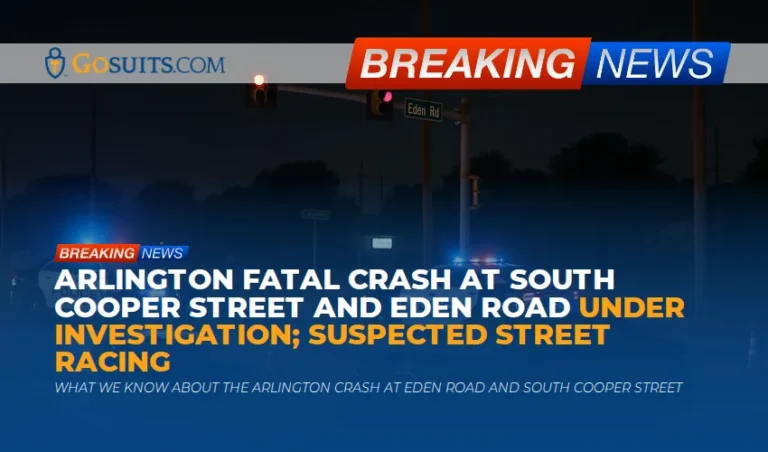
What we know about the Arlington crash at Eden Road and South Cooper Street
South Arlington is grieving after a collision at Eden Road and South Cooper Street took the life of 53-year-old Tanya Cypert. According to local reporting, two vehicles were seen traveling northbound on South Cooper at a high rate of speed moments before impact. One of those vehicles struck Ms. Cypert’s car as she attempted to turn toward her home nearby. She survived for roughly an hour following the crash and later passed away.
Surveillance video from a nearby real estate office appears to show two cars speeding just before the impact. Detectives with the Arlington Police Department are investigating whether street racing was involved. The driver who struck Ms. Cypert remains hospitalized, and police have not conducted a full interview as of the latest update. No criminal charges have been filed as of the report’s publication.
Neighbors in the area, including residents along South Cooper toward Interstate 20 and the Parks Mall corridor, have voiced concerns about night-time speeding and loud engines echoing toward the highway. Anyone who regularly travels through this part of South Arlington recognizes how quickly traffic can move along South Cooper, especially in off-peak evening hours when signal timing and lane merges can invite risky behavior.
Video evidence and the role of suspected street racing in civil liability
When investigators suspect a speed contest, civil liability issues often turn on whether drivers were operating with ordinary care. Texas law explicitly prohibits racing on a highway. If the investigation confirms a speed contest or exhibition of speed, that conduct violates the Texas Transportation Code and can factor into civil fault analysis, including potential negligence per se in an injury or wrongful death case if the statutory violation is found to be a proximate cause of the harm [1]. Separate and apart from racing, drivers in Texas have a duty to control speed and to drive at a speed that is reasonable and prudent under the circumstances, considering traffic, intersections, and hazards that may exist [2].
Evidence that can speak to speed and driver behavior includes private business surveillance, vehicle event data recorders, witness statements, and intersection signal timing reports. Event data recorders, sometimes called black boxes, can log speed and brake application in the seconds before a collision. Federal guidance discusses the function of these devices and the type of pre-crash information they may store [3]. In a contested liability case involving suspected street racing, timely preservation of vehicles and their electronic data is critical.
Speeding contributes to a significant share of fatal crashes in the United States. National Highway Traffic Safety Administration data and safety campaigns consistently identify excess speed as a major factor that increases crash severity and reduces reaction time [4]. That broader safety context aligns with what residents report hearing along South Cooper at night, which is why video and speed-related forensic evidence become essential in determining civil responsibility.
Who was involved and the status of the investigation
Based on public reporting, Ms. Cypert was in the process of turning when a northbound vehicle on South Cooper struck her car near Eden Road. Two vehicles were recorded speeding northbound just prior to impact, and detectives are reviewing whether the drivers were racing. The driver who made contact with Ms. Cypert’s car is hospitalized, which has delayed a formal interview. At this time, no criminal charges have been filed, which is common early in an investigation when police are still collecting statements, mapping the scene, and awaiting medical updates.
In the civil context, the fact that criminal charges have not been filed does not preclude a wrongful death or personal injury claim. Civil liability is proven by a preponderance of the evidence, a different standard than criminal cases. In Arlington, responding officers typically document the scene, diagram vehicle paths, record witness information, and note any suspected contributing factors such as speed or failure to yield. Those materials become part of the Texas crash report that families can later request through the state system [5].

Why intersections like South Cooper and Eden see serious collisions
South Cooper Street is a major north-south arterial that feeds traffic between Mansfield, South Arlington neighborhoods, and the I-20 corridor. Intersections where neighborhood streets such as Eden Road meet a higher-speed arterial often present complex decision points. Left turns across fast-moving traffic, sun glare at certain hours, and variable driver speeds can combine to reduce the margin for error.
The Federal Highway Administration identifies intersections as among the highest risk areas on the roadway network, partly because multiple conflict points exist where vehicle paths cross or merge. Intersection safety guidance underscores the importance of speed management, sight distance, signal timing, and turn protections in reducing severe crashes [6]. Local observations about frequent late-night speeding along South Cooper fit that risk profile, particularly if drivers engage in aggressive maneuvers or speed contests near cross streets.
Family rights after a fatal crash in North Texas
Texas law provides two distinct but related civil claims after a fatal crash. A wrongful death claim allows certain family members, typically the spouse, children, and parents, to seek civil remedies from those whose wrongful act or neglect caused the death [7]. A survival claim allows the decedent’s estate to pursue the claims the person could have brought had they survived, including pain and suffering experienced between injury and death [8].
In cases where suspected street racing or reckless speeding is involved, the legal analysis often focuses on duty and breach, the foreseeability of harm from racing on a public road, and causation. Evidence obtained early can support these elements. Skilled investigation and careful documentation also help determine whether more than one driver shares responsibility, which can be especially relevant if two vehicles were racing and one collided with a turning motorist.
Families sometimes feel pressure to give statements to insurers right away. Before any insurance communications, it is prudent to speak with car accident lawyers to understand rights and obligations. What someone says to an insurance adjuster can be recorded and used to challenge fault or damages later.
Key evidence to preserve immediately
Even while police are investigating, there are proactive steps that protect a civil claim. Some must be taken quickly, since private video systems often overwrite footage in a matter of days.
- Request and preserve video from nearby businesses and residences. Ask managers if cameras captured South Cooper northbound traffic leading into Eden Road. If personnel are unsure how long footage is retained, request they save the specific time window now. A formal request can be reinforced later through a public information request to the City for any city-held footage or traffic data [9].
- Secure the vehicles involved for inspection. If a vehicle is about to be released from a tow yard, notify the yard and the insurer in writing to preserve the vehicle and its event data recorder for download. NHTSA provides information about EDR data elements that can matter in crash analysis [3].
- Identify and contact witnesses listed on the Texas crash report when available. If witnesses are nearby residents or workers, brief statements taken early can help establish speed, lane position, and the presence of a second vehicle.
- Collect medical documentation that reflects the timeline between impact and passing. Those records can support a survival claim by documenting conscious pain and suffering [8].
- File targeted public records requests to Arlington officials for 911 audio, dispatch logs, officer body-worn camera, and any roadway speed studies related to South Cooper and Eden. The City’s open records portal provides a path to request these under the Texas Public Information Act [9].
For families navigating paperwork during mourning, a practical guide can help sequence these tasks and avoid missed steps. The Dallas wrongful death paperwork checklist for families offers a structured approach that many find helpful in the first weeks after a loss.
Where to get official records in Arlington and Tarrant County
Obtaining the right records early provides clarity and helps align the civil process with the ongoing police investigation. Here is where to start locally.
- Texas crash report. Texas crash reports are obtained through the Texas Department of Transportation’s Crash Records Information System. You can search and purchase a certified copy once the report is released by the Arlington Police Department [5].
- Arlington Police Department Records Unit. The Records Unit provides copies of incident reports, supplements, and may advise on the status of video or body-worn camera materials. Access and request procedures are outlined on the City of Arlington website [10].
- City of Arlington open records. For 911 audio, CAD logs, traffic studies, or city-held video, submit a Texas Public Information Act request through the City’s portal [9]. Be as specific as possible with dates, times, and locations.
- Tarrant County Medical Examiner. Autopsy, toxicology, and confirmation of cause and manner of death are handled by the Tarrant County Medical Examiner’s Office. Families can request reports and discuss release timelines directly with that office [11].
Keep copies of receipts, request confirmations, and all correspondence with agencies. Those documents can help demonstrate diligence and may become exhibits later in a civil claim. Arlington car accident lawyers often use these records to build a clear sequence of events and verify what each agency documented at each step.
Insurance issues after a suspected street racing crash
Insurance questions surface quickly after a fatal crash. Texas requires drivers to maintain minimum liability limits, currently 30,000 per injured person, 60,000 per crash for injuries, and 25,000 for property damage, known as 30 or 30 slash 60 slash 25 [12]. These minimums are often inadequate in severe or fatal collisions. Families may need to explore additional coverage layers, including the at-fault driver’s higher policy limits, any applicable umbrella policy, and the decedent’s own uninsured or underinsured motorist coverage.
State regulators publish consumer guidance on handling auto claims, including documentation, communications with adjusters, and timelines. The Texas Department of Insurance provides tips and explains rights during the claims process [13]. Before opening any claim or providing a recorded statement, it is wise to consult car accident lawyers so that rights are protected and communications are coordinated.
When multiple drivers may have contributed to the crash, insurers sometimes point fingers at each other or at the turning driver to reduce payouts. Early preservation of video, EDR downloads, and eyewitness statements puts you in position to counter incomplete narratives and to press each insurer to honor its obligations based on solid proof rather than speculation.
Timeline and legal deadlines that can affect a claim
Texas sets strict deadlines. For wrongful death and personal injury claims, the general statute of limitations is two years from the date of the incident, though specific facts can affect how that clock is calculated [14]. Families bringing wrongful death claims under the Civil Practice and Remedies Code must also ensure that the right parties file at the right time, since the statute designates who can file and when [7].
Other timelines can matter. TxDOT’s crash report release depends on the investigating officer submitting the report and the state processing it, which can take days or weeks. Body-worn camera and 911 audio retention policies can have shorter windows. Submitting a detailed public records request early helps prevent loss of time-sensitive materials [9].
If municipal or county entities are potentially implicated, additional notice requirements and shorter deadlines can apply under Texas law. Coordinating with counsel early helps ensure all potential timelines are identified and tracked without last-minute scrambles.
Community context and safety steps for South Arlington
Residents around South Cooper and Eden know the rhythm of this corridor. Rush hour backs up near Sublett and I-20, late evenings can bring quick-moving traffic past neighborhood entrances, and weekend nights sometimes carry the echo of engine revs toward the highway. The University of Texas at Arlington campus sits a few miles north, and the Parks at Arlington retail area draws steady evening traffic. These patterns are familiar, which is why safety efforts often focus on speed management and visibility.
National roadway safety guidance highlights several steps that reduce severe intersection crashes, including protected left-turn phases, improved lighting, and speed enforcement tailored to corridors with frequent high-speed travel. The Federal Highway Administration’s intersection safety resources outline strategies communities often deploy when crash data identifies a hotspot [6]. Residents can also document and report recurring high-speed behavior to Arlington officials to support targeted enforcement.
While communities work on prevention, families affected by this crash need answers and support. Preserving evidence, obtaining official records, and understanding the legal framework are essential, and community members can assist by sharing any dashcam or security footage captured near the time of the collision.
Practical steps today
When a sudden loss shakes a neighborhood, it can be hard to decide what to do first. Here is a practical, time-sensitive roadmap that can help anyone who wants to support a careful, thorough civil investigation.
- Coordinate with an attorney before speaking to insurers. Insurance adjusters are trained to ask questions that limit liability and damages, and recorded statements can be used against claimants later. A consultation helps set the right approach to communications and preserves options.
- Request the Texas crash report when it becomes available through TxDOT’s Crash Records Information System. Track the report status if needed and request certified copies [5].
- Submit a City of Arlington open records request for 911 audio, dispatch, and any city-held video. Include the exact date, approximate time, intersecting streets, and a description of the vehicles suspected of speeding [9].
- Contact the Tarrant County Medical Examiner to understand timing and process for autopsy and toxicology results. Clarify what can be released to next of kin and how to request copies [11].
- Preserve any personal evidence such as phone location data, text messages around the time of travel, and vehicle infotainment downloads that may reflect timeline and route.
- Identify potential coverage sources. Confirm whether the household carried uninsured or underinsured motorist coverage that may apply, since Texas minimum limits are often insufficient in a fatal crash [12]. Review consumer resources from the Texas Department of Insurance to anticipate insurer requests and deadlines [13].
- Keep a written log of calls, dates, and agency contacts. Documentation helps avoid duplication and provides a clean record of efforts to obtain information.
Taking these steps early can make a significant difference later when insurers evaluate fault and damages. Insurers may dispute liability in suspected racing cases or argue a turning driver is primarily responsible. Thorough documentation and timely public records requests help counter those narratives with objective proof.
In situations where grief and logistics collide, guidance from Arlington car accident lawyers can also reduce the burden on families, especially when multiple drivers or complex evidence sources are involved.
Commentary from Gosuits Arlington, Texas Personal Injury Attorney
First, our hearts are with the Cypert family and with everyone in South Arlington who is shaken by this loss. Losing a loved one at a familiar intersection, just blocks from home, is a trauma no family should endure. The thoughts above are shared for education and general information.
From a civil standpoint, the publicly reported facts raise serious concerns about excessive speed and possibly a speed contest on a busy arterial where drivers routinely make left turns into neighborhoods. Texas law is unambiguous that racing on public roads is prohibited, and speeding dramatically increases both the likelihood of a crash and the severity of injuries. When video appears to capture two fast-moving vehicles seconds before impact, it becomes vital to secure that footage, download vehicle event data, and interview witnesses swiftly. Those steps help clarify responsibility where more than one driver may share fault.
Insurance carriers and large corporate entities understand how to leverage uncertainty. They benefit when families do not know what records to request, how quickly private video is overwritten, or how to coordinate EDR downloads before a vehicle is destroyed. Adjusters may also try to obtain recorded statements that shift blame onto a turning driver, even when independent evidence points to dangerous speeding. In our experience, the best antidote is early, organized evidence preservation and careful communications planning.
Finally, a free consultation matters for reasons that go beyond paperwork. It helps clarify which claims may be available, which agencies to contact first, and how to avoid unforced errors that can undercut a case. Speaking with car accident lawyers before making insurance statements or signing documents ensures families understand their rights and the timelines that apply.
References
- Transportation Code Sec. 545.420 Racing on Highway – Texas Statutes
- Transportation Code Sec. 545.351 Maximum Speed Requirement – Texas Statutes
- Event Data Recorder Information – NHTSA
- Speeding and Aggressive Driving – NHTSA
- Purchase a Crash Report – TxDOT Crash Records
- Intersection Safety – Federal Highway Administration
- Civil Practice and Remedies Code Chapter 71 Wrongful Death – Texas Statutes
- Civil Practice and Remedies Code Sec. 71.021 Survival – Texas Statutes
- Open Records Requests – City of Arlington
- Police Records Unit – City of Arlington
- Medical Examiner – Tarrant County
- Transportation Code Sec. 601.072 Minimum Liability Insurance – Texas Statutes
- Auto Insurance Claims Tips – Texas Department of Insurance
- Civil Practice and Remedies Code Sec. 16.003 Limitations Period – Texas Statutes