- What this arctic outbreak means for Texans
- Regional impacts across Texas
- Road safety, crash risks, and why winter weather matters in injury cases
- Texas legal insight after weather-related crashes
- What to do right after a winter-weather crash
- Who to call for help: police reports, road info, medical examiners, warming centers
- Insurance pitfalls during and after winter storms
- If a loved one is lost in a storm-related incident
- Community notes for Dallas Fort Worth, Houston, El Paso, the Panhandle, and South Texas
- Deadlines and core Texas laws that may affect claims
- Next steps to protect your rights before you make any calls
- Commentary from Gosuits Texas Personal Injury Attorney
- References
What this arctic outbreak means for Texans
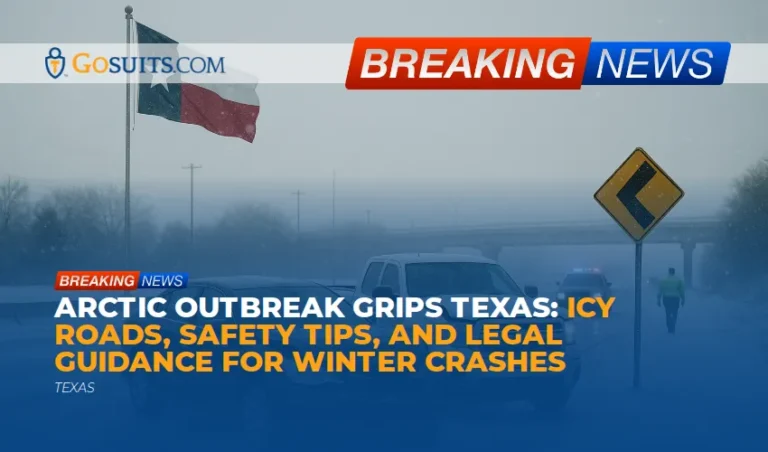
Texans are staring down the coldest blast of the season. Forecast guidance from the National Weather Service points to subfreezing temperatures statewide with a dangerous mix of freezing rain, sleet, and, in some regions, accumulating snow. That combination threatens road safety, power reliability, and access to critical services, especially for neighbors who must commute along major corridors like I-35, I-20, I-10, I-27, and US 75 through North Texas. Expect hard freezes from El Paso to the Houston region, with wind chills that can make outdoor exposure risky in minutes if not properly dressed [1]. This is not just a nuisance cold snap. Icy bridges, elevated roadways, and shaded stretches can glaze unexpectedly. Any precipitation that falls ahead of the cold air may freeze on contact, turning typical commutes through spots like the High Five in North Dallas, the Mixmaster near downtown Fort Worth, the West Loop in Houston, and the Spaghetti Bowl in El Paso into slow, hazardous crawls. NWS guidance also emphasizes the increased likelihood of slick sidewalks and parking lots, which can lead to falls and injuries for workers, seniors, and anyone navigating outside during the coldest period [2].
Regional impacts across Texas
Texas Panhandle and South Plains
The Panhandle, from Amarillo down toward the South Plains, often sees the earliest snow and subfreezing air in these setups. Visibility can drop rapidly during bursts of light, fluffy snow, and winds can compound the cold. Drivers along I-27 and US 287 should give themselves far more time than usual to avoid late braking on icy stretches.
Dallas Fort Worth and North Texas
North Texas frequently sits on the line between freezing rain and sleet, and even minor icing can send crash numbers soaring. Watch bridges on the High Five, SH 183, US 75, and the I-20 corridor. Neighborhood streets in Collin, Denton, Tarrant, and Dallas Counties can glaze after sunset. Temperatures well below normal are likely through the weekend, increasing the duration of slick roads before any thaw. The local NWS office is the best place to monitor timing changes and precip types for the Metroplex [3].

Central Texas and the Hill Country
In the Hill Country and the Austin to San Antonio corridor, shallow cold air can arrive quickly. Overpasses on US 281, SH 130, I-35, and flyovers between Loop 1604 and I-10 can ice first. Even if totals are modest, short periods of freezing rain can make surface streets treacherous, especially before sunrise.
El Paso and far West Texas
El Paso and higher terrain in far West Texas can see rounds of snow with gusty winds that limit visibility. Road conditions on I-10 through the Franklin Mountains often change fast as bands pivot through. NWS El Paso updates are essential for timing and snowfall potential [4].
Houston region and the Upper Texas Coast
In the Houston area, cold rain can transition to freezing rain, especially overnight and on early morning commutes. Flyovers around the Galleria, I-610, and Beltway 8 are historically vulnerable to icing before surface streets. While thawing can occur faster along the Gulf Coast, hard freezes are still possible, and wind chills can be dangerous for people without adequate shelter.
South Texas and the Rio Grande Valley
From Laredo to Brownsville, the front’s southern reach often brings a rapid temperature drop and, at times, freezing rain in pockets. Agriculture and sheltering concerns increase when hard freezes push into the Valley, and local roads in shaded areas can become slick even if air temperatures hover near freezing.
Road safety, crash risks, and why winter weather matters in injury cases
The Federal Highway Administration tracks how road weather affects crashes. On average nationwide, a large share of weather-related crashes occur on snowy, slushy, or icy pavement, and many happen during snowfall or sleet. These conditions contribute to thousands of injuries and over a thousand fatalities each year across the United States [5]. Those numbers are not abstract for Texas communities. During prior North Texas ice events, crashes surged on major interstates and arterial connectors, with first responders stretched across dozens of incidents at once. Winter weather is also a public health and household-safety issue. When power outages coincide with hard freezes, families sometimes turn to generators or indoor heating alternatives that create serious carbon monoxide risks. The CDC warns that CO is odorless and deadly, and that generators must be used outside, far from windows and doors [6]. Similarly, hypothermia and frostbite can occur quickly in high wind chills, so stocking warm layers, hats, gloves, and blankets in vehicles is a smart move for anyone who must travel [7]. From a personal injury perspective, weather does not excuse unsafe driving. Every driver still owes a duty to operate reasonably for the conditions. That means slowing down, increasing following distance, clearing ice from windows and lights, and avoiding sudden lane changes or harsh braking. Failing to adapt can be considered negligence, even on icy roads.

Texas legal insight after weather-related crashes
Texas law requires drivers to control speed and operate at a speed that is reasonable and prudent under existing conditions. In icy or low-visibility situations, that often means speeds well below the posted limit. The Transportation Code sets this baseline duty, and facts like black ice, sleet, or snow are part of the analysis of whether a driver acted reasonably [8]. Evidence in a weather-related crash may include photos or video of the roadway and bridge decks, temperature and radar snapshots, dashcam footage, 911 records, witness statements, ECM downloads for commercial vehicles, and vehicle damage patterns consistent with loss of control. In multi-vehicle pileups, investigators often look closely at spacing, speed choice, and reaction times relative to visibility and pavement conditions. If injuries result, Texas law governs the release of crash reports and certain records to involved parties. Access to crash reports is controlled by statute, with eligibility for release established by the Transportation Code [9]. Families should expect to verify their relationship or involvement when requesting documents. When it comes to the types of losses that can be claimed, Texans commonly ask what can be included beyond medical bills. There can be claims for lost wages or earning capacity, pain and suffering, physical impairment, and other recognized damages depending on the circumstances. You can learn more about common categories of recovery in Texas by reviewing this resource: types of damages available in texas personal injury cases.
What to do right after a winter-weather crash
A sudden ice event can leave people shaken and unsure of next steps. A calm, methodical approach helps protect health and preserves evidence. – Check for injuries and call 911. Move to a safe location if you can do so safely. Use hazards, and set out flares or triangles if available. First responders in Texas are trained for winter incidents but may be delayed when widespread icing occurs. – Document the scene before vehicles are moved. Photograph vehicle positions, skid marks, surrounding ice on the roadway or bridge decks, and any traffic control devices. Capture wide shots and close-ups of damage and road surface conditions. – Exchange information. Get names, phone numbers, plate numbers, insurance details, and any commercial carrier information for company vehicles. – Seek medical care promptly. Some injuries, including concussions or soft-tissue injuries, worsen over hours or days. Early evaluation creates a record and supports appropriate treatment. – Preserve clothing and personal items. They may show glass, road material, or other transfer helpful later in proving mechanism of injury. – Speak with an attorney before you speak to insurers about fault. Adjusters often request recorded statements quickly. What someone says in the first 24 to 48 hours can be used against them later. It is wise to understand your rights first. Guidance from seasoned car accident lawyers can help clarify next steps without overcommitting to a narrative.
Who to call for help: police reports, road info, medical examiners, warming centers
Texans lean on a wide network of public resources during winter storms. Here are practical points of contact and what they are for. – Emergency response and road closures. For emergencies, call 911. For evolving road conditions, rely on National Weather Service updates for your local office and follow official guidance about staying off roads when advised [1] [3] [4]. – Crash reports and records. Texas law controls who may obtain a crash report and how. Involved parties, their representatives, and certain others can typically request them under the Transportation Code [9]. In many cities, the police records unit or TxDOT processes these requests. Have the date, location, and report number if available. – Medical examiner or coroner’s office. In the event of a fatality, the local medical examiner handles jurisdictional investigations and autopsies under the Texas Code of Criminal Procedure Chapter 49 [10]. Large counties may have a dedicated office, like the Harris County Institute of Forensic Sciences, which provides guidance for next of kin on obtaining reports and personal effects [11]. Families can also coordinate with funeral homes to receive certified copies of necessary documents. – Death certificates. Certified copies are typically obtained through the Texas Department of State Health Services Vital Statistics Office or through the county clerk, which is critical for estate administration and benefits [12]. – Warming centers and shelter resources. During prolonged freezes, cities and counties often open warming centers. To find local options and transportation support, dial 2-1-1 within Texas or consult your local city or county emergency management pages. The Texas Division of Emergency Management maintains statewide preparedness information, while Ready.gov provides winter storm guidelines and checklists [13] [14]. – Carbon monoxide and generator safety. For power outages, follow CDC guidance on safe generator placement and CO alarm use. Never run generators indoors or in partially enclosed spaces. If a CO alarm sounds, go outside and call 911 [6].
Insurance pitfalls during and after winter storms
Weather-related crashes lead to predictable insurer tactics. Some carriers quickly label incidents as “unavoidable” because of ice, implying no one is at fault. Texas law does not treat ice as a blanket excuse. If a driver failed to slow or followed too closely for conditions, fault can still be established. Insurers may also try to minimize medical care or push early settlements before the full scope of injuries is known. – Do not provide a recorded statement about fault without legal guidance. Adjusters are trained to lock in statements that reduce or shift liability. A short consultation helps clarify what to share and when. – Know how PIP and UM/UIM can apply. Personal Injury Protection can cover medical expenses and some lost income, regardless of fault, and uninsured or underinsured motorist coverage can be crucial when other drivers slide into you and carry minimal limits. Terms vary by policy. – Watch for low offers and release traps. Some quick-pay offers require signing broad releases. Consider the long view before closing your claim, particularly if your care plan is not complete. In winter crashes, delayed-onset injuries are common.
If a loved one is lost in a storm-related incident
Texas law recognizes the need for independent investigation when a death occurs from an unexpected incident. The medical examiner or justice of the peace process is governed by the Code of Criminal Procedure. Autopsy results, cause and manner of death, and chain of custody for personal effects are handled through those offices [10]. Families can request: – Autopsy report and toxicology once released by the medical examiner. – Death certificate through DSHS Vital Statistics or local offices [12]. – Crash report and supplemental records under Transportation Code provisions [9]. Be prepared to provide proof of relationship and a government-issued ID. If a commercial vehicle, public entity, or employer vehicle was involved, additional records and logs may be relevant. The process takes time during widespread weather events, so patience and persistent follow-up can be necessary.
Community notes for Dallas Fort Worth, Houston, El Paso, the Panhandle, and South Texas
– Dallas Fort Worth. Bridges and interchanges like the High Five, SH 183, and the I-30 Trinity River crossings glaze early. Road crews treat major routes, but neighborhood streets can remain slick until temperatures rise. If a multi-vehicle crash occurs, expect long waits for tow capacity. In complex pileups, preserving photos and names of witnesses adds clarity later. In busy corridors around the Metroplex, Dallas car accident lawyers often see disputes over following distance and speed choice tied to sudden black ice. – Houston region. Elevated connectors around the Galleria area and Beltway 8 can ice overnight, especially on north-facing ramps. Marinas and coastal communities may see freezing spray and wind chills that complicate marine operations. Homeowners should remember CO risks during power outages and avoid heating with grills or ovens indoors [6]. – El Paso and far West Texas. Snow bands with gusty winds reduce visibility through the Spaghetti Bowl. Sun angle and elevation shifts can create alternating melt and refreeze conditions, so late afternoon slick spots are common on return commutes. Monitor NWS El Paso forecasts for snow totals and timing for I-10 and US 54 [4]. – Panhandle and South Plains. Dry, powdery snow can drift, covering previously plowed lanes. County roads near open fields may become impassable quickly. If you do not have snow tires or chains, consider delaying travel until crews have treated routes and sun has aided clearing. – South Texas and the Rio Grande Valley. When freezes reach the Valley, infrastructure and agriculture can suffer. Protect pipes and plan for pet and livestock shelter. Elevated roadways on US 77 and US 83 can ice, particularly at night. In each community, local emergency managers and NWS offices share the most precise timing and hazard details. Staying tuned to those official channels and limiting travel during the worst window prevents the majority of crashes [1] [3] [4].
Deadlines and core Texas laws that may affect claims
Texas generally applies a two-year limitations period for many personal injury and wrongful death claims, measured from the date of the incident, though exceptions can apply. If a governmental unit is involved, notice rules and shorter timelines may apply. Paying attention to these deadlines prevents dismissal of valid claims on purely procedural grounds [15]. Winter-weather cases can include: – Negligence claims against drivers who failed to control speed or follow at a safe distance under icy conditions [8]. – Commercial vehicle claims, which can require preservation of driver logs, ECM data, and dispatch records early. – Premises cases involving dangerously icy walkways or unaddressed hazards, depending on notice and reasonable care. The earlier key evidence is preserved, the clearer the liability picture becomes. Weather is a factor, not a shield from accountability.
Next steps to protect your rights before you make any calls
– Prioritize safety and medical care. Stabilize health needs first. Keep all discharge instructions and receipts in one folder. – Preserve evidence immediately. Save photos and videos to two locations, note the exact time and place, and identify the nearest cross street or mile marker. – Request records methodically. Track your crash report number, ambulance run sheets, ER visit records, and any imaging results. For fatalities, request ME records and certified death certificates as soon as they are available [10] [12]. – Pause before recorded statements. Anything said to an insurer can be used later to limit or deny a claim. Consulting with counsel before speaking to any carrier clarifies what is required and protects your interests. – Do not sign broad releases early. If property repairs or initial medical bills are pressing, ask for time-limited or issue-limited solutions that do not close your entire claim prematurely. – Use community resources for shelter, transportation, and care during the freeze so you are not forced into risky travel for essentials [13] [14].

Commentary from Gosuits Texas Personal Injury Attorney
Our hearts are with every Texan preparing for this deep freeze and with those already affected by icy roads and power concerns. This article is for general information and education. We hope it helps neighbors across the Panhandle, North Texas, Central Texas, El Paso, Houston, and the Valley make safer choices and understand the civil law context that follows weather-related incidents. From our perspective, storms expose how fragile everyday routines can be. Icy bridges, sudden sleet, and low visibility are known hazards in Texas, even if they are not daily occurrences. Drivers still have a duty to slow down and leave space, and companies still have obligations to operate, train, and dispatch with safety in mind. When those standards are not met, people get hurt. We also see how large insurance carriers and corporations quickly move to shape the narrative. During winter events, the refrain is often that crashes were “unavoidable.” But the law asks whether people acted as reasonably careful drivers would under those exact conditions. Adjusters may push early statements or quick settlements while folks are cold, stressed, and without transportation. That imbalance of knowledge can cost families essential support for medical care, lost time from work, and long-term recovery. A free consultation can be a simple way to understand rights, deadlines, and common traps without making commitments. It can also help families sequence next steps like securing the crash report, preserving photos, and managing communications with insurers while treatment continues. Above all, please stay safe this weekend and look out for your neighbors.
References
- Winter Weather Safety – National Weather Service
- During a Winter Storm – National Weather Service
- NWS Fort Worth/Dallas Forecast Office – National Weather Service
- NWS El Paso/Santa Teresa Forecast Office – National Weather Service
- Road Weather Management Program – Federal Highway Administration
- Carbon Monoxide Poisoning Prevention – Centers for Disease Control and Prevention
- Winter Weather Preparedness – Centers for Disease Control and Prevention
- Sec. 545.351. Maximum Speed Requirement – Texas Transportation Code
- Sec. 550.065. Release of Certain Accident Report Information – Texas Transportation Code
- Chapter 49. Inquests Upon Dead Bodies – Texas Code of Criminal Procedure
- Harris County Institute of Forensic Sciences – Harris County
- Death Records – Texas Department of State Health Services
- Texas Division of Emergency Management – State of Texas
- Winter Weather – Ready.gov
- Sec. 16.003. Two-Year Limitations Period – Texas Civil Practice and Remedies Code