- What we know about the Highway 18 wrong-way five-vehicle crash in Apple Valley
- Road closures, scene work, and how investigators reconstruct crashes on Highway 18
- Why wrong-way crashes happen and what agencies do to prevent them
- Injury and wrongful death rights in California after a multi-car crash
- How liability may be evaluated in a five-vehicle collision
- Insurance layers after a multi-car crash on Highway 18
- How to get official records: police report, collision records, and coroner documents
- Practical next steps for Apple Valley residents after a serious crash
- Local context and safety notes for Apple Valley and the Victor Valley
- Why timely action matters and what to do
- Commentary from Gosuits Apple Valley, California Personal Injury Attorney
- References
What we know about the Highway 18 wrong-way five-vehicle crash in Apple Valley
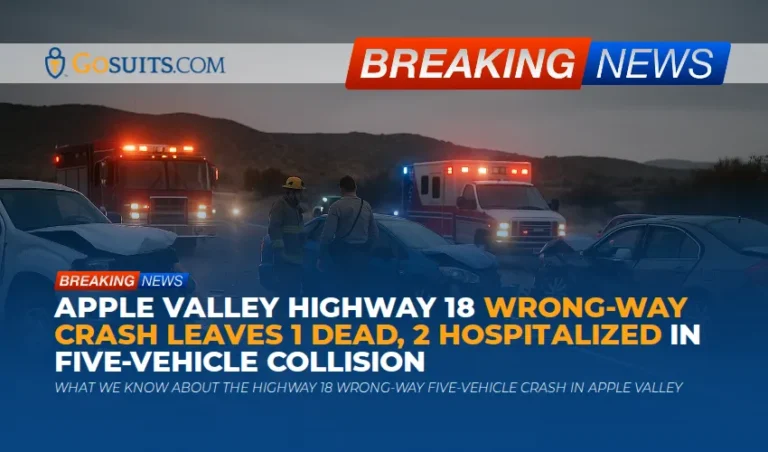
Late Saturday night in Apple Valley, a five-vehicle collision on State Route 18 near Mile Marker 92.5 left one person dead and two others hospitalized. According to a news release from the San Bernardino County Sheriff’s Department’s Apple Valley Sheriff’s Station, deputies determined a white Nissan Frontier driven by a 74-year-old man was traveling westbound in the number one eastbound lane toward Tao Road. The Nissan’s wrong-way movement precipitated a chain reaction that pulled four additional vehicles into the crash. The eastbound driver of the Nissan was hospitalized with major injuries and later died. Two other drivers were transported for medical treatment. Their conditions were not immediately available.
Deputies closed the eastbound lanes of Highway 18 between Tao Road and Piute Road for nearly three hours. Additionally, the eastbound and westbound lanes of Outer State Highway 18 South were closed between Atnah Road and Mandan Road for about two hours during the on-scene investigation and clearance. The Apple Valley Sheriff’s Station asked anyone with information or who witnessed the collision to call Deputy T. Arlotti at 760-240-7400.
At this time, authorities have not publicly identified the deceased driver. The preliminary description indicates wrong-way travel as a primary factor. Final determinations about fault or contributing causes typically depend on a full traffic collision report, scene measurements, vehicle inspections, and if applicable, toxicology findings from the coroner’s office.
Road closures, scene work, and how investigators reconstruct crashes on Highway 18
When a serious crash happens on a desert highway like SR-18, deputies and emergency crews must balance lifesaving care, fire hazards, debris removal, and preserving physical evidence. That often means closing lanes so investigators can:
- Secure the scene safely so medical teams can treat patients and traffic does not endanger responders.
- Identify all involved vehicles and drivers and confirm the number of occupants and any witnesses.
- Document tire marks, gouge marks, and debris fields to reconstruct speeds, angles, and points of impact.
- Photograph and measure the roadway including lane positions, signage, lighting, and sight lines.
- Collect potential video evidence from nearby businesses or traffic systems, if available.
- Request toxicology testing and vehicle inspections to rule out mechanical defects or impairment where appropriate.
On steep or curving segments of SR-18, investigators also note roadway grade and curvature, especially around Tao Road and the stretches heading toward the mesas above town. Those details can matter when determining how quickly a wrong-way hazard would come into view at night and how much time drivers had to react.
Why wrong-way crashes happen and what agencies do to prevent them
Wrong-way collisions on divided or multi-lane highways are often severe because they produce head-on or near head-on forces. National and federal safety research shows that the most frequent contributing factors in wrong-way driving include impaired driving, older driver challenges, and entering highways via exit ramps at night, often in low-visibility or low-traffic conditions [1] [2]. The Federal Highway Administration and National Transportation Safety Board have published countermeasures that state and local agencies use, such as:
- Enhanced signage like oversized or lowered “Wrong Way” and “Do Not Enter” signs that are more visible at night.
- High-visibility pavement treatments including directional arrows and red retroreflective markers.
- Geometric improvements at ramp terminals to make wrong-way entries less likely.
- Active detection systems that sense a vehicle moving the wrong direction and notify law enforcement or activate flashing beacons [1] [2].
California agencies also emphasize education and enforcement. The California Office of Traffic Safety funds projects that address impaired driving and night-driving risks statewide. Their annual reporting and program summaries provide a statewide picture of high-risk behaviors and interventions [3]. Wrong-way countermeasures can be tailored to specific corridors, and Caltrans District 8, which covers San Bernardino County, has access to FHWA guidance on where and how to implement those tools [1].

Injury and wrongful death rights in California after a multi-car crash
Two distinct legal paths can open after a crash like this: personal injury claims for the people who were hurt and wrongful death claims for surviving family members of anyone who passed away. Under California law, most injury claims must be filed within two years from the date of injury. Wrongful death claims generally have a two-year timeline from the date of death, subject to limited exceptions [4]. Separate, shorter deadlines apply to any claims against public entities, such as a dangerous roadway design claim, where a government claim typically must be presented within six months before a lawsuit can be filed [5].
Injured drivers and passengers often look to the at-fault driver’s auto insurance first for medical costs, lost income, and other covered losses. If the wrong-way driver is deceased, claims are commonly presented to that driver’s insurance policy and potentially through the deceased driver’s estate if insurance is insufficient. Many Californians also have uninsured or underinsured motorist coverage on their own policies, which can help when the at-fault coverage is unavailable or inadequate. In all of these scenarios, it is prudent for community members to speak with a qualified attorney before giving recorded statements or signing releases for any insurance company. What someone says early to an insurer can be used against them later.
Residents in San Bernardino County often ask who can help evaluate these issues. A conversation with seasoned car accident lawyers can clarify how insurance applies, how damages are documented, and how multiple-vehicle facts may shape fault analysis and recovery paths.
How liability may be evaluated in a five-vehicle collision
Based on the Apple Valley Sheriff’s Station summary, deputies determined the Nissan Frontier traveled westbound in the number one eastbound lane, creating a wrong-way hazard and leading to the multi-vehicle crash. While the preliminary facts describe a clear wrong-way movement, full liability analysis in a five-car chain will typically involve these considerations:
- Primary negligence The wrong-way vehicle’s movement is often a primary cause. Investigators look at why the vehicle was going wrong way and whether impairment, confusion, poor visibility, or a turn-around maneuver was involved [2].
- Secondary impacts With multiple vehicles, some collisions occur as drivers try to evade the initial hazard. That can result in side-swipes or rear-end crashes. Investigators analyze whether those reactions were reasonable given the sudden emergency.
- Comparative fault California applies comparative negligence. If multiple drivers contributed to collisions, fault can be apportioned accordingly. This is fact-specific and depends on roadway evidence, speeds, lighting, and visibility.
- Potential third-party factors On some corridors, claimants explore whether ramp signage, pavement reflectors, or confusing geometry played a role. Any claim alleging a public entity’s responsibility must follow strict notice procedures and timelines [5].
Witness statements and any available dashcam or nearby video can be critical in multi-vehicle crashes. Because Highway 18 carries steady traffic even late on weekends, it is not uncommon for investigators to locate drivers who saw either the wrong-way approach or the immediate aftermath.
Insurance layers after a multi-car crash on Highway 18
Multi-vehicle collisions can trigger several insurance layers. Typically, the at-fault driver’s bodily injury liability coverage is the first avenue for injury claims. If multiple people are hurt, that single policy can be spread across claimants, and policy limits may be reached quickly. When liability limits are insufficient, injured people often look to their own policies for uninsured or underinsured motorist benefits, as well as medical payments coverage, depending on the policy. If a commercial vehicle is involved in the chain, higher liability limits may be available. For those who want a deeper plain-language overview, see which insurance pays first after a multi car crash.
It is also important to understand the process for obtaining the official traffic collision report. If the California Highway Patrol handled the report on a state route, parties can request it using CHP procedures and qualifying criteria [6]. If the Apple Valley Sheriff’s Station authored the report, it is typically requested through the Sheriff’s Records Division with the report number. Having the report in hand helps confirm insurance information for all involved vehicles and the investigating agency’s initial findings.
How to get official records: police report, collision records, and coroner documents
In the immediate weeks after a Highway 18 crash, families and involved drivers can obtain key documents that help with insurance and, if needed, legal claims. Here is what to know locally:
- Traffic collision report Ask the Apple Valley Sheriff’s Station for the report number related to the State Route 18 crash near Mile Marker 92.5 around 9:40 p.m. on the date noted. The station number listed by deputies is 760-240-7400. If the California Highway Patrol authored the report, CHP provides requests via the Traffic Collision Report Request system and form CHP 190, subject to eligibility and identity verification [6].
- Coroner records In San Bernardino County, the Sheriff-Coroner’s Division manages autopsy and coroner case files. Families can contact the Coroner Division to inquire about case status, certified copies of death certificates, and autopsy reports, subject to release rules and processing times [7].
- DMV reporting California requires drivers to report a traffic crash to the DMV within 10 days using the SR-1 form if anyone was injured or the property damage appears to exceed the statutory amount. This is a separate requirement from the police report and applies even if a law enforcement report was filed [8].
- Road closure and incident logs Caltrans QuickMap provides live and recent road closure information that can corroborate the time and place of larger incidents, which sometimes helps when reconstructing timelines for insurance claims [9].
When requesting sensitive documents, be prepared to verify your relationship to the case, provide identification, and pay any required fees. Processing times can vary, and agencies may withhold portions of reports during an active investigation.
Practical next steps for Apple Valley residents after a serious crash
People in the High Desert community often ask what comes next after the chaos of a late-night highway collision. In Apple Valley, where many neighbors commute down Highway 18 toward Victorville or Lucerne Valley, these steps tend to make a real difference in both safety and any potential claim:
- Prioritize medical care Even if injuries feel minor, get evaluated. Hidden injuries often emerge 24 to 48 hours later. Keep copies of all discharge instructions and follow-up referrals.
- Collect and preserve evidence Save photos, dashcam clips, and witness contacts. If a vehicle is declared a total loss, ask the yard not to crush or dispose of it until you have what you need for inspections.
- Request the collision report Note the agency and report number. This helps confirm all involved parties and insurance carriers.
- Be cautious with insurance communications It is wise to consult an attorney before providing recorded statements. What people say to an insurance adjuster can be used later to limit or deny a claim.
- Track expenses and impacts Keep a simple journal of symptoms, missed work, and out-of-pocket costs. This documentation can be vital months later.
When questions arise about fault, coverage, or deadlines, many families turn to Apple Valley car accident lawyers for guidance on how to navigate multi-vehicle facts and competing insurance narratives. Conversations early on can help prevent common missteps, like signing broad medical releases or giving a comprehensive recorded statement before evaluating the scope of injuries.
Local context and safety notes for Apple Valley and the Victor Valley
State Route 18 threads through Apple Valley’s commercial and residential areas, connecting Tao Road, Piute Road, and key cross streets down toward the Outer Highway segments. At night, especially on weekends, stretches can move quickly from well-lit commercial zones to darker transitions with wider spacing between signals. The mix of local traffic and regional through-drivers heading to or from the desert communities can reduce reaction time when an unexpected hazard appears.
In community safety forums across San Bernardino County, night-time visibility, impaired driving, and lane confusion at divided approaches are persistent themes. Federal safety agencies note that wrong-way risks often increase during overnight hours. Targeted countermeasures like lower-mounted signs and prominent red retroreflective markers have shown promise in reducing wrong-way entries at ramps and divided highways [1] [2]. Residents who frequently use Highway 18 may want to watch for nighttime work zones or safety upgrades that Caltrans District 8 deploys along this corridor.
Why timely action matters and what to do
Here are focused, non-legal steps community members can take after a severe Apple Valley highway crash, and why timing matters:
- Secure the report number quickly Collision reports help confirm insurers and involved parties. Getting the number early can shorten claims processing time.
- Preserve vehicle and digital evidence Tow yards can move fast. Ask that the vehicle be preserved for inspection. Download dashcam footage before it overwrites.
- Consult an attorney before calling insurers An initial legal consultation clarifies rights, deadlines, and coverage options. Speaking to adjusters first can lead to statements that reduce claim value.
- Calendar the key deadlines California’s general two-year window for injury or wrongful death claims can be cut much shorter if public entities could be involved, with some notices due in six months [4] [5].
- Use official channels for records CHP and the Sheriff-Coroner have set procedures. Using the right request process helps avoid delays [6] [7].
Acting promptly helps ensure evidence is not lost and that insurance timelines are met. It also provides space to make considered choices rather than reacting under pressure from adjusters or repair deadlines.
Commentary from Gosuits Apple Valley, California Personal Injury Attorney
Our hearts are with everyone affected by the Highway 18 tragedy in Apple Valley. Crashes like this shake a community, and we share sincere condolences with the family of the driver who passed, and concern for the neighbors who were hospitalized. This overview is for general information and education only. Every case turns on its own facts, and folks should seek individualized guidance before making decisions.
Based on the initial account from the Apple Valley Sheriff’s Station, investigators determined the Nissan Frontier was traveling the wrong direction in the number one eastbound lane. When a wrong-way vehicle forces a multi-vehicle chain reaction at night, the physics often leave little time for avoidance. In a five-car sequence, however, questions can still arise about how each impact occurred, lighting and sight distance, and whether the roadway geometry or signage played any role. Those are fact-driven inquiries, and they depend on the traffic collision report, scene mapping, and any video evidence.
In our experience, insurance carriers and corporate risk managers move fast after a high-profile crash. They may call quickly, ask for recorded statements, and offer early settlements before medical care is complete or the full scope of injuries is known. They do this because most people are not familiar with coverage layers, policy limits, or how comparative fault can be argued in a multi-vehicle pileup. Insurers control information, and they sometimes leverage that asymmetry to reduce what they pay.
That is why a free consultation can be so important. It levels the playing field and helps people understand their rights, confirm which insurance applies, and avoid common pitfalls, like signing broad medical authorizations or giving comprehensive statements too early. It also helps families understand timelines, including the two-year statutes and the shorter six-month claims requirements that can apply if a public entity is potentially implicated. No one should have to navigate that alone while recovering.
References
- Wrong-Way Driving – Federal Highway Administration
- Wrong-Way Driving: Actions to Address Deadly Crashes – National Transportation Safety Board
- Research Studies and Reports – California Office of Traffic Safety
- Code of Civil Procedure § 335.1 (Two-year statute for injury and wrongful death) – California Legislature
- Government Claims Program Overview – California Department of General Services
- How to Obtain a Traffic Collision Report – California Highway Patrol
- Coroner Division – San Bernardino County Sheriff-Coroner
- Accident Reporting Requirements – California DMV
- Caltrans QuickMap – California Department of Transportation
- Low-Cost Safety Improvements for Rural Roads – FHWA