- What we know about the Anaheim multi-vehicle crash
- When and where it happened
- Community impact and early reactions
- Safety and legal basics that often arise in red light and high speed collisions
- How fault may be evaluated in a four vehicle crash
- Evidence and documentation families often need
- How to obtain key records in Orange County
- Insurance questions after a Southern California multi-vehicle wreck
- Local resources and public safety context
- Why taking action matters now
- Commentary from Gosuits Anaheim, California Personal Injury Attorney
What we know about the Anaheim multi-vehicle crash
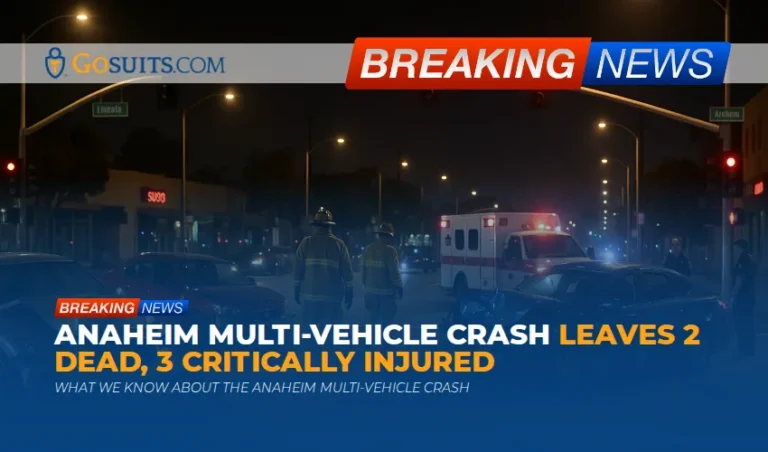
Two people tragically lost their lives and three others were critically injured after a multi-vehicle crash in Anaheim early Tuesday morning. According to details released by Anaheim Police, the sequence began around 12:45 a.m. when officers observed a silver Infiniti sedan traveling at a high rate of speed near Cypress Street and Harbor Boulevard. Officers reported that before they could activate emergency lights, the Infiniti turned off its headlights and accelerated away. A short time later, patrol units located a serious four-vehicle collision at Lincoln Avenue and Anaheim Boulevard.
Investigators stated the 19-year-old driver of the Infiniti allegedly ran a red light and triggered the collision. Police identified two people who died: a 70-year-old Orange resident, and a 14-year-old Anaheim High School student who was riding in the front passenger seat of the Infiniti. Two female Katella High School students were reportedly riding in the back seat of the Infiniti and were among those transported in critical condition to local hospitals, as was the 19-year-old driver. Authorities believe a blue sedan struck the Infiniti as it sped through the intersection, which then led to a secondary impact with a red sedan. The intersection remained closed for part of the morning commute while crews cleared debris and investigators documented the scene.
When and where it happened
The initial observation occurred near Cypress Street and Harbor Boulevard just after midnight. The crash took place shortly afterward at Lincoln Avenue and Anaheim Boulevard, a busy crossroads a few blocks from Anaheim’s Civic Center area and not far from the Packing District. That corridor sees both local traffic and through-traffic headed to and from downtown neighborhoods. At that hour, traffic is lighter, yet speeds can be higher than daytime norms. Overnight conditions can magnify risk due to reduced visibility and driver fatigue, which federal safety agencies note can worsen outcomes in severe crashes at night [6].
Community impact and early reactions
Anaheim High School and Katella High School communities are grieving. When a teen is among the deceased and classmates are hospitalized, the shock echoes across families, campuses, and sports fields. The timing also compounded commute delays along Lincoln and Anaheim Boulevard during the morning school and work rush. Residents who live or work near the Packing House and MUZEO area likely encountered closures as first responders worked through collision reconstruction.
Crashes that involve young passengers and multiple vehicles raise complex questions that families naturally ask: What exactly happened in the intersection, how are investigators sorting out fault, and how do insurance coverages apply in a multi-car, late-night collision? Those questions are understandable, and there are practical steps that can help preserve answers and protect rights.
Safety and legal basics that often arise in red light and high speed collisions
Even while the investigation is ongoing, it helps to understand baseline safety and legal principles that commonly come up in high-speed and signalized intersection crashes in California.
- Red lights must be obeyed. California Vehicle Code section 21453 requires drivers to stop at steady red signals and remain stopped until it is lawful to proceed [1]. Entering against a red can be a significant breach of duty on the road.
- Basic speed law applies, day and night. California’s basic speed law states no person shall drive at a speed greater than is reasonable or prudent given traffic, weather, visibility, and roadway conditions [2]. High-speed entries into intersections reduce reaction time and magnify crash forces.
- Speed magnifies injury risk. Federal data tie speeding to a large share of serious and fatal crashes nationwide. Higher speeds increase both the likelihood of a crash and the severity of injuries because stopping distances lengthen and kinetic energy rises steeply with speed [3].
- Red light running is a major safety issue. Federal roadway safety programs have long highlighted the harm caused by red light running at intersections and support efforts to reduce these violations through engineering, education, and enforcement measures [4].
These principles are not about blame at this stage. They frame how investigators and insurers often analyze what happened, especially when multiple vehicles are involved, lights were reportedly off, and an intersection control was allegedly violated.

How fault may be evaluated in a four vehicle crash
California uses comparative fault, which means responsibility for a crash can be shared among multiple drivers according to their percentage of fault. In practice, that can include the driver who allegedly ran the red light, any driver who struck that vehicle, and potentially other motorists who collided as a result of the first impact. The allocation can be disputed and is highly fact specific. California’s jury instructions contemplate dividing fault among parties and considering whether any party’s negligence was a substantial factor in causing harm [7].
In intersection cases, investigators typically analyze:
- Signal timing and phasing: What color each approach displayed at impact.
- Approach speeds and visibility: Estimated speeds, headlight status, sight lines, and nighttime lighting.
- Impact sequencing: The order of collisions, which vehicles first contacted, and secondary impacts.
- Vehicle positions and damage patterns: Crush profiles, angles, and rest positions that tell a story of the forces at play.
- Driver behavior: Right-of-way compliance, distraction indicators, and pre-impact maneuvers like braking or evasive steering.
When a traffic signal is reportedly violated, insurers sometimes argue over whether a striking vehicle could have had the last clear chance to avoid impact, or whether darkness and sudden vehicle movement left no reasonable time to react. That is why objective evidence matters. Independent witness statements, surveillance video, and vehicle data can sharpen the factual picture and reduce speculation.
Evidence and documentation families often need
Right now, preserving available evidence is critical. Time-sensitive items can disappear quickly, especially in a commercial and civic corridor with rotating data retention schedules. Consider the following:
- Traffic and security video: Nearby city cameras, private business systems in the Packing District, and residential cameras may have captured pre-impact movements or signal phases. Many systems overwrite footage in days. California’s Public Records Act generally requires agencies to respond within set timelines, but actual camera retention varies by agency and system [9].
- 911 audio and dispatch logs: Calls and Computer Aided Dispatch entries can establish timing, initial observations, and early statements. Requests should be made promptly under applicable public records rules [9].
- Vehicle Event Data Recorders: Many cars contain modules that may log speed, braking, and throttle data seconds before a crash. Access often requires formal preservation letters and, later, legal process.
- Medical records: Hospital records document injuries and care timelines. In Orange County, critically injured patients from central Anaheim may be transported to regional trauma centers. California’s trauma system is organized by the state EMS Authority [5].
- Photographs and scene measurements: Skid marks, debris fields, and signal heads are often documented by investigating officers, but bystander photos can also be valuable, especially if taken before the intersection was cleared.
Families dealing with catastrophic injury or loss are not expected to do this alone. Preserving evidence can be coordinated through representative counsel and formal letters that put agencies and businesses on notice to retain relevant materials under applicable law.
How to obtain key records in Orange County
Traffic collision reports
The investigating agency generally maintains the primary collision report and related supplements. In California, involved parties or their authorized representatives may obtain a copy of a highway patrol collision report through a formal request, and municipal agencies typically follow similar eligibility rules for their reports. The California Highway Patrol publishes consumer-facing guidance that explains eligibility and process for collision reports [8]. For city-handled cases, requests are directed to the city police department’s Records Bureau, identifying the date, time, location, and report number if available.
Important to know: collision reports are generally released only to parties of interest, such as involved drivers, vehicle owners, or injured persons, and their insurers or attorneys. Third parties may be limited by confidentiality provisions until cases are resolved.
Coroner and autopsy records
In Orange County, the Coroner Division is part of the Orange County Sheriff’s Department. The Coroner Division provides information about its role, family support, and how to request certain records through county processes [10]. Families often ask about autopsy findings, cause and manner of death, and timelines for report completion. Complex collision-autopsy reports can take weeks to months depending on necessary tests.
Death certificates
Certified death certificates are issued through California’s statewide vital records system, administered by the California Department of Public Health, with local recording through county offices. The state provides information about requesting vital records, including death certificates [11]. Funeral homes often coordinate initial requests for the family.
911 audio, dispatch logs, and traffic signal data
Requests for 911 audio and dispatch logs are typically submitted to the relevant public safety communications agency. Signal timing records and maintenance logs may be held by the city’s public works or traffic engineering department. These requests often proceed under California’s Public Records Act, which has response timelines and exemptions that agencies must follow [9].
Insurance questions after a Southern California multi-vehicle wreck
Multi-vehicle collisions raise layered insurance issues. Which policy responds first, how fault apportionment affects payouts, and whether multiple insurers share responsibility are common questions. California law requires drivers to maintain minimum financial responsibility. As of 2025, the minimum liability coverage increased to 30,000 for bodily injury or death to one person, 60,000 for bodily injury or death to more than one person, and 15,000 for property damage [12]. In a crash with severe injuries or loss of life, those minimums are often insufficient to cover medical bills, lost income, and non-economic harm.
Because these collisions involve multiple cars and potentially several insurance carriers, it can help to review how primary, excess, and underinsured motorist coverages interact. For a deeper dive on policy priority, see Which insurance pays first after a multi car crash.
Many people feel pressured to give recorded statements quickly. Before engaging with any insurer, speaking with car accident lawyers can help prevent misstatements that insurers may later use to limit claims. Statements given without full medical information or accident documentation sometimes get taken out of context.
- Consider UM and UIM coverage: Uninsured and underinsured motorist coverages can be critical if an at-fault driver lacks adequate limits. These are first-party coverages that may provide additional protection if other policies do not cover all losses.
- Expect aggressive fault arguments: In a four-vehicle scenario, insurers commonly dispute light phases, approach speeds, and reaction time. They may claim a second driver could have avoided impact. Meticulous evidence collection is the antidote to speculation.
- Preserve medical billing records: Maintain every bill and Explanation of Benefits. California’s personal injury limitations period is generally two years from the date of injury or death for potential civil actions [13], but insurance claim timelines can be much shorter.
If a claim is likely, it is wise to consult a representative first, then decide how and when to communicate with insurers. Early calls to a carrier often get recorded, and what is said can be used against the claimant later on. That is a practical risk worth managing proactively. It is common for Anaheim car accident lawyers to coordinate all insurer communications once retained.
Local resources and public safety context
Several public resources can ground what we see at intersections across Anaheim and Orange County.
- City and county crash rankings: The California Office of Traffic Safety publishes annual city and county rankings that compare traffic safety outcomes across jurisdictions [5]. While these rankings change year to year, they highlight ongoing statewide efforts to reduce intersection and speed-related crashes.
- Nighttime driving risk: NHTSA publishes educational materials regarding nighttime driving risks, including reduced visibility and higher fatality rates during overnight hours [6]. That is directly relevant to a 12:45 a.m. collision.
- Trauma care system: California’s EMS Authority oversees the statewide trauma system, including regional trauma center designations that receive the most critical patients [5]. The central Orange County corridor that includes Anaheim is served by established trauma centers regionally, which are designed to manage polytrauma from high-speed, multi-vehicle impacts.
Local transportation agencies often review serious crashes to consider engineering responses such as signal timing adjustments, visibility improvements, or targeted enforcement. While the investigation is still developing, it is appropriate to recognize the work that first responders, traffic investigators, and roadway engineers put into understanding and addressing risk.
Why taking action matters now
When a serious multi-vehicle crash occurs, key information can vanish quickly. Camera systems overwrite, vehicles get salvaged, witnesses disperse, and insurers begin shaping narratives based on the documents they collect first. Taking defined early steps helps ensure decisions later are grounded in facts rather than assumptions.
- Pin down the facts: Submit timely requests for reports and recordings, send preservation notices for private and public video, and document all medical care. Doing so creates an authoritative timeline that reduces room for dispute.
- Protect legal options: California generally provides two years for personal injury and wrongful death civil actions [13]. But insurance reporting deadlines, public records response times, and evidence retention windows are much shorter. Acting now preserves choices later.
- Balance health and paperwork: Families can delegate records collection to a trusted representative. That allows loved ones to focus on healing and remembrance while critical materials are preserved in the background.
- Anticipate insurer strategies: Expect recorded calls, quick low-document evaluations, or efforts to apportion fault unfavorably. Preparing a complete file early can counter incomplete or premature conclusions.
Exact steps to consider include organizing a secure evidence folder, logging all medical visits, capturing photos of injuries and vehicles, and preparing a short, neutral summary of the incident for reference when speaking to any insurer or investigator.
Request a Free Consultation Learn About Insurance Options Preserve Video and Records
Commentary from Gosuits Anaheim, California Personal Injury Attorney
Our hearts are with the families, classmates, and neighbors shaken by this crash. Two lives were cut short and several young people were critically injured. This note is meant for general educational purposes to help the community understand common steps and issues that follow a serious incident like this.
From what has been publicly shared so far, investigators are focusing on speed, headlight status, and a reported red light violation at a major Anaheim intersection. In four-vehicle collisions, the picture can be complicated. We look for objective indicators like signal logs, camera footage, vehicle data, and independent witnesses to clarify light phases, speeds, and impact sequencing. That evidence tends to speak louder than memory alone.
Insurance companies often move fast to shape the narrative in multi-car collisions. They may request recorded statements, ask leading questions, or point to partial facts before a complete file exists. Large carriers and corporate entities do this every day. People living through their first catastrophic crash do not. Uneven information and experience can tilt outcomes in ways that are not fair.
That is one reason a free consultation matters. It equips people with a plan for preserving evidence, managing insurer communications, and understanding the role of each policy that may apply. Early guidance can help avoid unintentional statements that later get used to undercut a claim. The aim is simple: protect your options while the facts are still coming together.
References
- California Vehicle Code § 21453, Steady circular red signal – California Legislative Information
- California Vehicle Code § 22350, Basic Speed Law – California Legislative Information
- Speeding – National Highway Traffic Safety Administration
- Red Light Running Resources – Federal Highway Administration
- City and County Rankings – California Office of Traffic Safety
- Night Driving Safety – National Highway Traffic Safety Administration
- Judicial Council of California Civil Jury Instructions (CACI) – California Courts
- Obtain a Collision Report – California Highway Patrol
- California Public Records Act Overview – Office of the Attorney General
- Coroner Division – Orange County Sheriff’s Department
- Vital Records – California Department of Public Health
- California Vehicle Code § 16056, Financial Responsibility – California Legislative Information
- California Code of Civil Procedure § 335.1, Two-year limitations – California Legislative Information