- What Happened in Alhambra and What We Know So Far
- Where and When the Crash Occurred
- Who Was Involved
- Agency Statements and Investigation Status
- Safety and Legal Considerations in Pursuit-Related Crashes
- Potential Civil Liability Pathways in a Pursuit Collision
- Insurance Issues After a Fatal Crash
- How to Obtain Official Records and Documents in Los Angeles County
- Practical Steps Families Often Take in the Days Ahead
- Community Reflection: Alhambra and the San Gabriel Valley
- What to Know About Legal Timelines in California
- How Wrongful Death and Related Damages Work in California
- Commentary from Gosuits Alhambra, California Personal Injury Attorney
- Why Taking Timely Steps Matters Now
What Happened in Alhambra and What We Know So Far
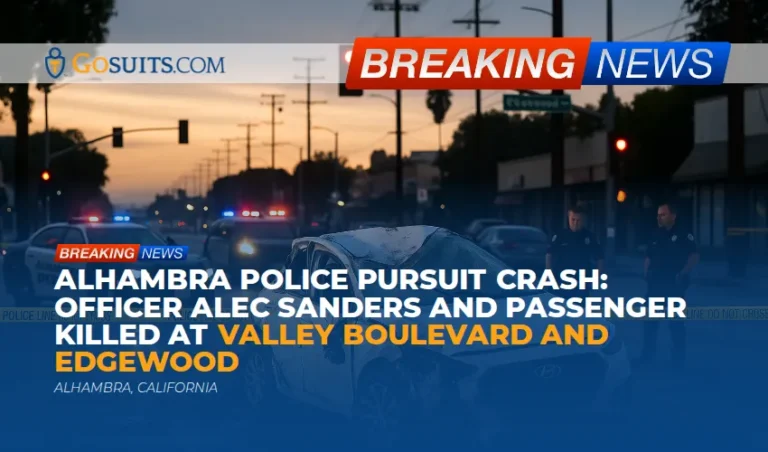
Before sunrise on a Thursday morning, a police pursuit in Alhambra ended in a violent collision at Valley Boulevard and Edgewood Street. A 28-year-old Alhambra Police Department officer, identified publicly as Officer Alec Sanders, sustained fatal injuries. A passenger in the fleeing vehicle, identified as 42-year-old Gabriela Moreno, was also killed after being ejected. Two other occupants in the stolen Hyundai were injured, including the reported driver, a 27-year-old El Monte resident. According to the California Highway Patrol, the driver was arrested on suspicion of second-degree murder and will be booked once medically cleared. A memorial fund has reportedly been organized to support Officer Sanders’ family, and a growing memorial outside the Alhambra Police Department reflects the community’s grief.
As with every pursuit-related fatal collision, the investigative process will examine roadway evidence, in-vehicle data, witness accounts, and agency policies. This is a difficult moment for Alhambra and the wider San Gabriel Valley community. It’s also a moment when impacted families begin asking how to secure documents, understand their rights, and navigate insurance and possible civil claims. We’ve gathered the most practical, fact-focused guidance below, with links to government resources where they exist.
Where and When the Crash Occurred
The collision occurred in the early morning at the intersection of Valley Boulevard and Edgewood Street in Alhambra. If you know Valley Boulevard, you know it’s one of the corridor’s busiest arterials, connecting Alhambra to San Gabriel, Monterey Park, and Rosemead. Traffic can be a mix of commuters, delivery trucks, and early-morning shift workers. Even before dawn, speeds can creep up on wide, straight segments. The Edgewood area sits near residential streets that feed into Valley, and the mix of commercial driveways and side streets often increases conflict points. The time of day matters too: low light can compound speed and reaction-time issues, and fewer vehicles can mean higher operating speeds for drivers.
Who Was Involved
Public reports identify the fallen officer as a 28-year-old who had served with the Alhambra Police Department for approximately eight months and previously with the Long Beach Police Department for about a year. He leaves behind close family, including a fiancée and siblings. The passenger who lost her life was a 42-year-old woman. Two others were injured from the fleeing vehicle, including the 27-year-old driver who, according to CHP, was arrested on suspicion of second-degree murder. We are not identifying any additional names here beyond what has already been made public.

Agency Statements and Investigation Status
Based on information shared publicly, the California Highway Patrol has indicated the driver would be arrested on suspicion of second-degree murder, pending medical clearance. In fatality cases within Los Angeles County, the Los Angeles County Department of Medical Examiner conducts examinations and certifies cause and manner of death. Families typically can request official reports from that office once completed. Collision reports are generated by the investigating agency and released in accordance with California law. In pursuit-involved incidents, internal and possibly external reviews often look at pursuit initiation, adherence to policy, and risk balancing. While those processes unfold, families may need to secure records and preserve evidence for potential civil claims.
Safety and Legal Considerations in Pursuit-Related Crashes
Police pursuits raise complex public safety questions. California law requires law enforcement agencies to maintain a written pursuit policy and provide regular training if the agency wishes to claim certain statutory immunities for pursuit-related collisions. The governing statute is California Vehicle Code section 17004.7, which lays out the prerequisites for agency immunity in pursuit scenarios. You can review the statute text at the California Legislature’s official website: leginfo.legislature.ca.gov.
California’s overall framework for public entity liability and immunity is found in the Government Claims Act. Public entities can be liable only as provided by statute, with many exceptions and immunities. See the Government Code generally, including sections addressing entity liability and employee acts: leginfo.legislature.ca.gov.
On the policy side, California’s Commission on Peace Officer Standards and Training (POST) publishes guidance and training materials related to vehicle pursuits that agencies consider when drafting and updating policies and training. You can explore POST resources here: post.ca.gov.
From a roadway risk perspective, national traffic safety agencies continue to examine speed, restraint use, ejection risk, and nighttime visibility. NHTSA offers broad safety research and data tools at nhtsa.gov, and California’s Office of Traffic Safety provides state safety initiatives and grant-supported programs at ots.ca.gov. While general data can’t answer what caused a specific crash, it helps frame known risk factors like high speeds and nighttime operation on urban arterials.
Potential Civil Liability Pathways in a Pursuit Collision
Every case turns on its facts, but civil liability in crashes involving a fleeing driver can include several potential pathways. The following are general frameworks under California law, offered to help families understand what an investigation may examine, not to draw conclusions about this incident.
- Negligence of the fleeing driver. A driver who engages in unsafe maneuvers or unlawful driving that causes injury or death can be civilly liable. Proof usually centers on duty, breach, causation, and damages. Evidence from the scene, vehicle data, video, and witnesses all matter.
- Owner liability for permissive use. California Vehicle Code sections 17150–17151 may impose liability on a vehicle’s owner when the vehicle is operated with the owner’s express or implied permission, subject to statutory limits. See statute text at leginfo.legislature.ca.gov.
- Employer liability (respondeat superior). If a driver was acting within the course and scope of employment, an employer can sometimes be vicariously liable under Government Code and common law principles. This requires evidence of an employment relationship and duties being performed at the time.
- Public entity considerations. Claims involving pursuit policy and tactics are governed by specific statutory immunities and requirements. As noted above, Vehicle Code section 17004.7 provides pursuit-related immunity if an agency meets policy and training criteria. Public entities are otherwise subject to the Government Claims Act, which includes strict notice requirements and immunities. Start at the Government Code here: leginfo.legislature.ca.gov.
- Comparative fault. California follows comparative fault principles. In civil cases, a factfinder can assign percentages of fault among multiple parties as supported by evidence. This can affect total recoverable damages.
For officers and passengers harmed during a pursuit, civil claims can be different in character. Officers’ families may navigate workers’ compensation death benefits alongside any potential third-party civil claims. A passenger’s family may consider claims against the driver and other legally responsible parties. Each route involves separate rules and deadlines.
Insurance Issues After a Fatal Crash
Insurance questions often surface immediately after a fatal collision. Policy language and coverage limits matter, and so do coordination and timing. A few common issues:
- Liability insurance. If the at-fault driver carried liability insurance, it can address wrongful death and injury claims up to policy limits. Adjusters may reach out quickly; what’s said can be used later. It’s wise to consult an attorney before any recorded statement or releases.
- Uninsured/Underinsured Motorist (UM/UIM). If the at-fault driver lacked adequate coverage, UM/UIM on a decedent’s or household member’s policy might apply. These claims have notice and consent-to-settle requirements that can be traps for the unwary.
- Property damage and towing. Separate adjusters may handle vehicle damage and storage fees. Keep invoices and document condition with photos.
- Medical liens and subrogation. Health plans, workers’ compensation carriers, and government payers often assert reimbursement rights. Coordinating liens is a key part of any recovery plan.
If a claim may exist, contact a seasoned attorney first, then decide how and when to speak with insurers. In California, statements to insurers can be cited against you later, and early settlement packets may not reflect the full scope of damages or responsible parties.
How to Obtain Official Records and Documents in Los Angeles County
Securing official records helps families understand what happened and plan next steps. Here are the most relevant offices and government resources:
- Traffic collision report
- If the California Highway Patrol investigated, requests typically use the CHP 190 form. See CHP’s “Request a Collision Report” guidance: chp.ca.gov.
- If a municipal police department investigated, California’s Public Records Act governs the accessibility of records to the public and involved parties, with exemptions for ongoing investigations. See general Public Records Act information at the Attorney General’s site: oag.ca.gov.
- Statutory limitations on disclosure may apply while investigations are ongoing. Vehicle Code and Evidence Code provisions can restrict release of certain materials until cases close.
- Autopsy and medical examiner records
- The Los Angeles County Department of Medical Examiner provides instructions for requesting autopsy and investigative reports: me.lacounty.gov.
- Some records are releasable only to next of kin or those with a legitimate interest, and processing times can vary.
- Death certificate
- Certificates are issued by the Los Angeles County Registrar-Recorder/County Clerk. See “Death Records” information and request options here: lavote.gov.
- Court information for related cases
- For statewide court locator tools and general access guidance, see the California Courts portal: courts.ca.gov.
- Victim compensation support
- California Victim Compensation Board (CalVCB) may assist eligible victims and families with certain expenses. Learn more at: victims.ca.gov.
Tip: When requesting records, have key details ready such as date and location of the incident, names of involved parties, and the investigating agency’s report or incident number if known.
Practical Steps Families Often Take in the Days Ahead
Early choices can shape both peace of mind and legal options. Consider the following, and pace yourself to what’s feasible in a difficult time:
- Preserve evidence. Save clothing, photographs, video, and any digital messages related to the incident. If you have dashcam footage, back it up. If a nearby business on Valley Boulevard or a residence near Edgewood might have cameras pointed toward the street, note addresses and dates for potential preservation requests.
- Do not speak with insurance adjusters before consulting counsel. Even innocuous statements can be taken out of context. Ask for time and provide only basic contact details until you’ve received guidance.
- Collect benefits paperwork. Locate any life insurance policies, employer benefits information, and union or association benefits. Public safety families may have access to additional benefits; agencies usually share a point of contact.
- Track expenses. Keep receipts for memorial costs, travel, lost work time, and counseling. Documentation can help with benefits, compensation programs, and potential civil claims.
- Identify all policies. List auto, homeowner’s/renter’s, umbrella, and health insurance policies in the household. UM/UIM coverage can be crucial in motor vehicle cases.
- Consider counseling and community support. Local faith communities, neighborhood associations, and peer support groups can help. In Alhambra, vigils and memorials often take place near civic buildings along Main Street or at the police station, giving neighbors a place to connect.
Community Reflection: Alhambra and the San Gabriel Valley
Valley Boulevard isn’t just a road; it’s a spine for the San Gabriel Valley. It’s the breakfast rush at mom-and-pop cafes, early deliveries to small shops, and commuters trying to make it to downtown or City Terrace before traffic thickens. The corner at Edgewood sits near quiet blocks where families start their day before sunrise. A crash at that hour jolts a city because it interrupts these everyday rhythms.
In the days following the collision, it’s typical to see candles and flowers gather outside the Alhambra Police Department, and to hear residents at parks and along Fremont Avenue trading stories about a familiar patrol car or a neighbor who knew one of the victims. That’s who we are here. We take care of each other when something terrible happens.
What to Know About Legal Timelines in California
California has multiple timelines that can apply in a fatal crash. Missing one can limit options, so it’s important to mark calendars early.
- General statute of limitations for wrongful death. In most cases, two years from the date of death. See Code of Civil Procedure section 335.1 at leginfo.legislature.ca.gov.
- Government Claims Act notice. If a claim may involve a public entity, a government claim is generally due within six months of the incident in many personal injury and wrongful death matters. See Government Code section 911.2 at leginfo.legislature.ca.gov.
- Survival actions. Claims on behalf of a decedent’s estate have separate rules under Code of Civil Procedure sections 377.30–377.34. Start here: leginfo.legislature.ca.gov.
- Public safety benefits. Certain benefits for fallen officers’ families and crime victim programs may have their own application deadlines. See CalVCB’s time limits overview at victims.ca.gov.
Because these deadlines can be affected by specific facts, minors, and other considerations, it’s prudent to get a free consultation to understand which timelines apply in your situation before contacting any insurance company.
How Wrongful Death and Related Damages Work in California
California provides two primary civil paths after a fatal incident: a wrongful death claim and a survival action. They serve different purposes and can proceed together.
- Wrongful death. Brought by specific surviving family members listed in Code of Civil Procedure section 377.60, wrongful death claims focus on losses the survivors themselves suffer, such as loss of financial support, household services, companionship, care, and guidance. See the statute here: leginfo.legislature.ca.gov.
- Survival action. Brought by the decedent’s personal representative or successor in interest under Code of Civil Procedure sections 377.30–377.34, survival claims address harms the decedent suffered before passing, and certain economic losses. Statutory rules define what categories are available. Review sections 377.30–377.34 at leginfo.legislature.ca.gov.
Damages in motor vehicle cases also intersect with insurance policy limits and potential liens. Where UM/UIM coverage applies, coordination is essential to avoid jeopardizing benefits. And if a public entity is potentially involved, damage recovery can be affected by immunities and statutory caps in certain contexts.
Commentary from Gosuits Alhambra, California Personal Injury Attorney
Our hearts are with both families and everyone in Alhambra who’s grieving. Losing a public servant and a community member in the same event shakes the city to its core. This overview is shared for educational purposes and general information. It isn’t a substitute for advice tailored to any specific situation.
From what’s publicly reported, this was a high-risk, early-morning pursuit that ended at a major corridor. Pursuit collisions often combine the worst factors: speed, limited visibility, surprise entries from side streets, and occupants who may be unrestrained. In a civil context, attention turns to the fleeing driver’s conduct, any permissive-use or ownership issues, and the statutory framework that governs pursuit policies and public entity responsibilities. Thorough, independent evidence review is crucial in these cases.
Insurance companies and large institutions know that families are overwhelmed in the first days and weeks. Adjusters may ask for recorded statements, push quick payments in exchange for broad releases, or focus discussions on policy limits rather than full harm. Corporations and carriers manage risk for a living; they rely on process and paperwork. People, especially when grieving, don’t always have the bandwidth to push back or to spot coordination problems between liability, UM/UIM, workers’ compensation, and health liens. It’s one reason a free consultation can be so important: it levels the playing field, clarifies rights, and helps avoid missteps before any conversation with an insurer.
Why Taking Timely Steps Matters Now
What should be done next, and why does it matter?
- Secure key records and preserve evidence. Requesting collision and medical examiner records and saving photos, videos, and messages helps build a clear picture of what happened. Early preservation reduces the risk that footage is overwritten or physical evidence is discarded.
- Map all insurance coverages. Identifying every potentially applicable policy (liability, UM/UIM, umbrella, health, workers’ compensation) ensures no source of recovery is missed. Acting promptly can prevent deadline problems and avoid accidental waiver of benefits.
- Hold off on recorded statements and releases. There’s urgency to respond, but it’s more important to respond correctly. What’s said now can be used later. Make informed choices before any insurer discussion.
- Calendar legal deadlines. The two-year wrongful death statute and the six-month Government Claims Act notice can run quickly. Marking deadlines now preserves options for later, even if you’re not ready to make decisions today.
- Engage support systems. Whether it’s peer support through public safety associations, faith communities along Main Street, or neighbors near Valley Boulevard, these connections ease immediate burdens and help gather information that might otherwise be lost.
Acting on these items soon improves clarity, protects rights, and keeps options open. Timing is critical because evidence fades, memories dim, and statutory clocks don’t stop. Even small steps make a difference.