- What happened on US 80 near Helms Trail in Kaufman County
- Traffic impacts and community context along the US 80 corridor
- How serious multi-vehicle and 18-wheeler crashes are investigated in Texas
- Critical evidence to preserve after a Kaufman County truck crash
- Practical steps for the first 72 hours
- Texas civil claims overview: injury and wrongful death options
- Potential liability issues unique to big-rig collisions
- Insurance layers that may apply in a Texas truck crash
- How to obtain official records: crash report, inquest or autopsy, and vital records
- Safety notes specific to the US 80 corridor east of Forney
- Step-by-step: organizing information after a Kaufman County highway crash
- Why acting promptly matters after a serious crash on US 80
- References
- Commentary from Gosuits Forney, Texas Personal Injury Attorney
What happened on US 80 near Helms Trail in Kaufman County
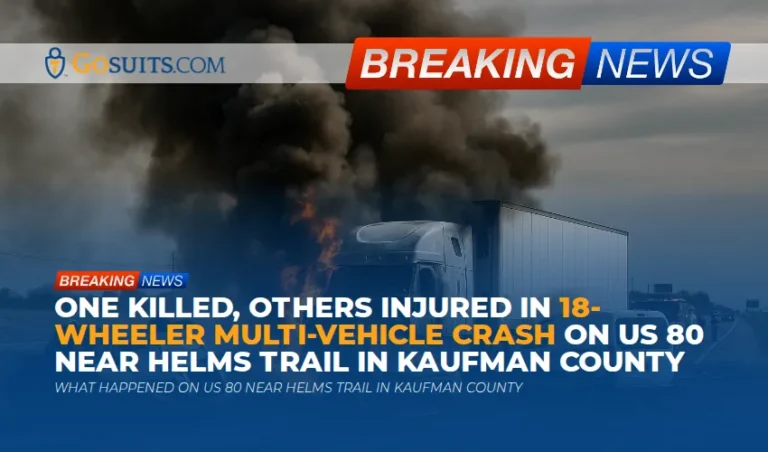
On a Thursday morning around 8 a.m., a major multi-vehicle crash in the eastbound lanes of US Highway 80 near Helms Trail, just east of Forney, led to several vehicles catching fire. Early reports indicated a collision involving an 18-wheeler, a pickup truck towing a trailer, a van, and a sedan. Aerial images reportedly showed a head-on collision between the 18-wheeler and a sedan on the service road. The pickup came to rest on its side in the center median, and the van had significant rear-side damage. The Texas Department of Public Safety confirmed one fatality. Two people were hospitalized with non-life-threatening injuries, and another was treated at the scene. The eastbound main lanes reopened in the early afternoon, while cleanup on the service road extended into the afternoon. The cause remains under investigation.
That stretch of US 80 serves workers commuting between Mesquite, Forney, and Terrell, and it is a familiar corridor for commercial truck traffic heading toward I-20 and beyond. When a crash like this shuts down main lanes and a frontage road, it ripples through morning routines in neighborhoods from Windmill Farms to downtown Forney, backs up school drop-offs, and strains local surface streets like FM 548 and FM 740 as drivers look for detours.
Traffic impacts and community context along the US 80 corridor
US 80 is a lifeline for Kaufman County commuters and small businesses. Many residents use it to reach job sites in Dallas County, schools in Forney ISD, and regional medical facilities in Terrell and Sunnyvale. Morning crashes at this hour intersect with school start times and deliveries by regional carriers. Detours often shift traffic onto John Wiley Price Loop, FM 548, FM 741, and the service roads that run parallel to the highway. When a crash involves fire and multiple vehicles, the investigation and cleanup can take hours because responders must ensure there is no secondary fire risk, fuel spill, or debris hazard.
In this incident, the extended closure underscored just how vulnerable the corridor can be when a single major crash shuts down a choke point. That is disruptive enough. When there is a loss of life, the toll is far more than traffic delays.
How serious multi-vehicle and 18-wheeler crashes are investigated in Texas
In Texas, serious injury and fatal crashes typically trigger a full investigation by the lead agency on scene, often the Texas Department of Public Safety for highway incidents. Troopers document the scene, measure skid and yaw marks, photograph final rest positions, and identify vehicle defects or cargo issues. For crashes involving commercial motor vehicles, investigators also collect carrier and driver information, bill of lading details, and may coordinate with federal regulators if warranted. Hours-of-service compliance, driver qualification status, and maintenance records can become relevant. Federal rules limit how long most truck drivers can drive without rest, and vehicles are often equipped with electronic logging devices that record duty status and driving hours [6], [13].
Crash reports are compiled under Texas Transportation Code Chapter 550, which governs reporting and records for motor vehicle crashes that cause injury, death, or significant property damage [2]. When a fatality occurs, an inquest is required under the Texas Code of Criminal Procedure Chapter 49, and depending on the county’s arrangements, a medical examiner or justice of the peace oversees that process [3].

Critical evidence to preserve after a Kaufman County truck crash
Evidence can fade in hours or days after a crash. For collisions involving an 18-wheeler, several technical sources of evidence may exist beyond the police report.
- Vehicle electronic control module data: Many heavy trucks and modern passenger vehicles store pre-crash and crash data such as speed, throttle, and braking events. Prompt preservation is important because subsequent operation or storage can overwrite data.
- Electronic logging device and hours-of-service records: Driver duty status, on-duty driving hours, and rest breaks may bear on fatigue issues. These materials are subject to federal recordkeeping rules that motor carriers must follow [6], [13].
- Dashcams and fleet telematics: Many fleets in North Texas run forward-facing and inward-facing cameras with GPS telematics that capture speed, hard braking, and following distance.
- Cargo and loading records: Bills of lading, weight tickets, and load securement logs may reveal whether cargo shift or overweight conditions contributed to loss of control.
- Maintenance and inspection files: Brake service logs, tire replacement records, and pre-trip inspection reports help determine if a mechanical issue played a role.
- Third-party video: Business security cameras and traffic cameras near Helms Trail, frontage road intersections, or gas stations can capture approach angles and signal phases.
- Scene evidence: Skid marks, debris fields, and fire patterns help reconstructionists analyze sequence of impacts, angles, and speeds.
For victims and families, one practical resource that aligns with the needs of this situation is the Dallas truck crash evidence checklist. It outlines the types of records to secure early, which can be especially useful in a multi-vehicle event like this one.
Practical steps for the first 72 hours
It is common to feel overwhelmed after a serious crash, especially one that has taken a life. The first few days are about safety, medical care, and sensible documentation. Consider the following actions, while avoiding speculation about fault until facts are gathered.
- Prioritize medical care: Even if injuries seem minor, get evaluated. Adrenaline can mask symptoms after a highway collision. Texas health providers document findings that can be important later.
- Secure the vehicles and property: If a loved one’s vehicle was towed from US 80, locate the storage yard promptly and request that the vehicle be preserved for inspection.
- Organize what you have: Photos, hospital discharge papers, employer notes, and any crash scene videos are easier to keep straight if you start a simple folder system.
- Request the official crash report: Texas crash reports are available through the TxDOT CRIS system. You will need key details like the date, location, and involved parties [1].
- Inquire about the inquest or autopsy: Fatal cases require an inquest under Texas law. Kaufman County coordinates inquests and, when needed, forensic examinations through a designated medical examiner system. In North Texas, many counties utilize the Southwestern Institute of Forensic Sciences in Dallas County for autopsy services [3], [4].
- Obtain certified death records: Death certificates in Texas are issued by the Department of State Health Services Vital Statistics Unit, either through the county clerk or directly from the state [5].
- Document employment and expenses: Start a list of missed work, mileage to appointments, and out-of-pocket costs.
- Avoid recorded statements to insurers before you are ready: What is said early can be used later to dispute claims. If you intend to pursue any claim, it is wise to speak with a qualified representative first.
When families feel pressure to make quick decisions or give statements, it can help to remember that investigation findings often evolve as evidence is analyzed. Patience protects the truth.
Texas civil claims overview: injury and wrongful death options
Texas law provides civil remedies for those injured or for certain family members after a fatal crash. While the specific cause of this Kaufman County crash is still under investigation and no conclusions should be drawn from early images alone, the following frameworks may apply generally in serious highway collisions.
- Personal injury claims: People injured can bring civil claims for medical costs, lost earnings, and other legally recognized damages, subject to proof and applicable defenses. Texas follows a proportionate responsibility system, which may reduce or bar recovery if a claimant is found more than 50 percent responsible [10].
- Wrongful death claims: In Texas, the decedent’s spouse, children, and parents may bring a wrongful death action for certain losses recognized by statute [11].
- Survival actions: The estate may bring a survival claim for the decedent’s own damages that accrued before death, under Texas Civil Practice and Remedies Code Section 71.021 [11].
Serious highway cases often involve multiple at-fault parties. Even a single collision sequence on US 80 can implicate a truck driver, the motor carrier, a maintenance contractor, a shipper or loader, and sometimes another motorist whose earlier maneuver set events in motion. The proportionate responsibility statute provides a framework for allocating fault across all responsible actors, including absent or settling parties, so thorough investigation matters [10].
Potential liability issues unique to big-rig collisions
When an 18-wheeler is part of a crash, several issues can come into play beyond those present in a typical passenger-car collision. These are examples in general terms and not conclusions about this specific event.
- Hours-of-service compliance and fatigue: Federal rules limit daily and weekly driving hours and require rest periods. ELDs record duty status and can show whether the driver was within the legal window [6], [13].
- Vehicle condition and maintenance: Brake performance, tire condition, and lighting are critical for heavy vehicles. Documentation of inspections and repairs can show whether the carrier met its obligations.
- Cargo loading and securement: Improperly distributed weight or unsecured cargo can destabilize a rig, lengthen stopping distances, or trigger jackknife scenarios.
- Carrier oversight and training: Hiring, supervision, and continuing training records may be relevant if unsafe practices contributed to the crash.
- Speed management and following distance: Telematics and ECM data often capture hard braking and close-follow events that may indicate inadequate space management.
- Route selection and local conditions: Construction zones, wet roads, morning glare, and congestion near frontage road intersections can require earlier braking and heightened vigilance.
Many motor carriers maintain layers of insurance because of the potential for severe losses in heavy-vehicle crashes. Understanding those layers is important before negotiating any claim.

Insurance layers that may apply in a Texas truck crash
Commercial motor carriers are subject to federal financial responsibility requirements. Most interstate carriers must maintain at least a federally required minimum amount of liability coverage, with higher limits for certain hazardous cargoes [7]. In practice, many carriers carry primary and excess policies. In a multi-vehicle collision with serious injuries and a fatality, identifying all potentially applicable coverages early is important.
For passenger vehicles, Texas requires minimum liability limits, and optional coverages like uninsured or underinsured motorist and personal injury protection can also be involved in multi-vehicle highway crashes. The Texas Department of Insurance provides consumer-facing explanations of these coverages and how they work [12]. Coordinating benefits across multiple policies takes careful documentation, especially where there are stacked medical bills and lost-income claims.
When communicating with any insurer after a major wreck, caution is sensible. Insurance carriers record calls, evaluate statements for inconsistencies, and may request broad medical authorizations. Before filing a notice of claim or giving a recorded statement, it is wise to consult with a seasoned representative who can help protect the record. The reality is simple: early misstatements can reduce valid recovery later. If a claim will be made, speak with someone you trust first.
How to obtain official records: crash report, inquest or autopsy, and vital records
Families often ask where to call first. In North Texas, a few state and county offices are key starting points.
- Texas crash report: TxDOT’s Crash Records Information System provides access to CR-3 crash reports for qualifying parties. You can search and purchase online by entering the crash date, county, and other details [1].
- Crash reporting law: When a crash involves injury, death, or significant damage, it triggers specific reporting requirements under Texas Transportation Code Chapter 550. This chapter also governs how records are maintained and released [2].
- Inquest or autopsy records: Under Chapter 49 of the Texas Code of Criminal Procedure, an inquest is conducted in fatality cases. Kaufman County coordinates with a designated medical examiner system for autopsies when required. The Southwestern Institute of Forensic Sciences in Dallas County provides medico-legal services for many North Texas counties [3], [4].
- Death certificates: Certified copies are available through the Texas Department of State Health Services Vital Statistics Unit. These are often needed for insurance and benefits claims [5].
- Public records requests: If you seek 911 audio, CAD logs, or certain agency records, requests are governed by the Texas Public Information Act handled through the respective agency. The Texas Attorney General provides guidance for members of the public on how to make requests [14].
For those who live in Forney, Terrell, or Crandall, it may also help to note that local police departments and the Kaufman County Sheriff’s Office can confirm whether they are the custodians of any supplemental records or whether DPS is the record holder for this highway crash.
Safety notes specific to the US 80 corridor east of Forney
US 80 is a high-speed divided highway with adjacent frontage roads and a mix of local and interstate-style traffic. Morning eastbound traffic often includes a blend of commuters and heavy trucks. That combination can elevate risk during:
- Rush hour surges: Stop-and-go pockets and sudden merges near on-ramps or frontage road intersections can catch drivers off guard.
- Low sun angle and wet pavement: In spring, morning glare and intermittent storms can reduce visibility and traction. Drivers should adjust following distances accordingly.
- Left-turns across frontage roads: The frontage roads parallel to US 80 have business and neighborhood access points. Complex turning movements in these areas require patience and attention.
- Emergency response corridors: When a crash blocks main lanes and a service road, emergency vehicles and tow operations need space. Secondary collisions can be prevented by slowing early and avoiding sudden lane changes.
Statewide, large-truck crashes remain a significant safety concern. National research from NHTSA highlights the severity of outcomes when heavy vehicles are involved, underscoring the need for careful speed and space management around big rigs [8]. TxDOT’s crash statistics also track where and when serious crashes occur across Texas each year, which helps agencies target safety improvements [9].
Step-by-step: organizing information after a Kaufman County highway crash
People often ask for a straightforward checklist that fits the reality of a North Texas highway collision. Here is a practical outline you can adapt.
- Medical first: Get medical care and follow up on any new or worsening symptoms. Keep all discharge instructions and prescriptions together.
- Identify the custodian of records: Confirm whether Texas DPS is the lead crash-reporting agency. If so, note your case number and the investigating office.
- Request the CR-3 crash report: Use TxDOT’s CRIS portal once the report is available [1]. Save both the PDF and purchase receipt.
- Secure vehicle inspections: If you intend to pursue any civil claim, request that your vehicle and any onboard devices not be altered until an inspection can occur.
- Track work and expenses: Keep simple logs of missed shifts, job duties you cannot perform, mileage to appointments, and out-of-pocket costs.
- Be cautious with insurers: Before giving recorded statements or signing blanket authorizations, consider getting guidance first. What you say can be used against you later.
- Stay organized: Create a running timeline of events: crash time, ER visit, follow-up appointments, conversations with adjusters, and receipt of documents.
If you are trying to understand who to call and in what order, one way to think about it is: health provider first, crash report next, then consider whether you need an independent vehicle inspection. Alongside those, think about how to preserve electronic data from vehicles and phones that captured the scene.
Within this broader conversation, people sometimes search online for car or truck accident lawyers. It is common to compare approaches, but remember that a calm, fact-based plan often matters more than speed. If you do explore options, research backgrounds, case approaches, and communication style rather than focusing on headlines about results.
In discussing resources, many also ask how to find or speak with truck accident lawyers. If you decide to explore that path, do it at a pace that lets you ask questions about investigation steps, preservation letters, and the specific experience a legal team has with heavy-vehicle cases.
Why acting promptly matters after a serious crash on US 80
There are time-sensitive reasons to act with intention after a significant collision. Acting promptly means taking a few focused steps rather than rushing into everything at once. What helps most, and why does it matter now?
- Preservation of electronic data: Vehicle ECM and fleet camera footage can be overwritten on a rolling basis. Early preservation requests reduce the risk of losing critical information.
- Accurate medical documentation: Early exams capture injuries before they evolve, anchoring your medical narrative to the days immediately after the crash. That can reduce disputes later.
- Coordinated insurance communications: When multiple carriers are involved, statements made to one can affect the others. Planning the order and content of communications prevents unnecessary contradictions.
- Meeting legal deadlines: Texas civil claims are subject to statutes that, if missed, can limit or eliminate options. Understanding those timelines at the outset preserves choices for the future.
- Managing costs and benefits: Early steps like vehicle storage holds, targeted records requests, and timely medical follow-ups can actually reduce long-term costs and confusion.
What exactly should get done? Secure the crash report when it is available through TxDOT CRIS, request preservation of key evidence from all involved fleets and towing yards, and organize your medical and employment records. Why now? Because each of those areas is time sensitive, and acting while records are being created or before they are overwritten makes a real difference.

References
- Crash Reports – TxDOT CRIS Purchase System
- Texas Transportation Code Chapter 550 – Accidents and Accident Reports
- Texas Code of Criminal Procedure Chapter 49 – Inquests Upon Dead Bodies
- Southwestern Institute of Forensic Sciences – Dallas County
- Death Records – Texas DSHS Vital Statistics
- Summary of Hours of Service Regulations – FMCSA
- Minimum Insurance Requirements – FMCSA
- Large Trucks – NHTSA Road Safety
- Crash Statistics – TxDOT
- Texas Civil Practice and Remedies Code Chapter 33 – Proportionate Responsibility
- Texas Civil Practice and Remedies Code Chapter 71 – Wrongful Death; Survival; Injuries Occurring Outside State
- Understanding Auto Insurance – Texas Department of Insurance
- Electronic Logging Devices – FMCSA
- Open Government in Texas – Office of the Attorney General
Commentary from Gosuits Forney, Texas Personal Injury Attorney
Our hearts go out to everyone affected by this crash on US 80, especially the family mourning a heartbreaking loss. This note is offered for educational purposes and general information. When a collision involves an 18-wheeler, multiple vehicles, and fire, families are often left with more questions than answers. That is normal. Early reports can be incomplete or even contradictory, and it takes time for investigators to gather and analyze the facts.
From a civil-injury perspective, a few themes tend to matter in a crash like this: preservation of electronic data from the truck and passenger vehicles, careful evaluation of hours-of-service and maintenance records, and a fair assessment of how the sequence of impacts unfolded. Multi-vehicle collisions often involve split-second reactions by several drivers. Getting the full picture requires patience and technical work, which is why families should not feel rushed into conclusions based solely on early images or social media commentary.
It is also important to recognize how insurance carriers and large companies approach serious highway losses. Adjusters gather statements quickly, capture recorded calls, and evaluate injuries through their lens. They know early uncertainty can lead people to say things in a rushed moment that later complicate an otherwise valid claim. That is not a criticism; it is their job to limit exposure. Understanding that dynamic helps people pace their communications, request preservation of critical data, and ensure that any settlement discussions happen on a fuller evidentiary record.
Finally, timing matters. A free consultation can help clarify what records to request and when, how to preserve vehicle and fleet data, and how to approach insurer communications in a way that protects the truth. Families do not need to navigate those steps alone, and there are professionals in our community who are skilled at guiding people through the first weeks with compassion and care.