- What we know about the crash at Manning and Mendocino
- Local roadway and seasonal conditions in rural Fresno County
- How the criminal case relates to civil wrongful death claims
- About California’s “Watson” warning to DUI offenders
- Who can bring a wrongful death or survival action in California
- Potential civil liability in a suspected DUI fatality
- Evidence families and representatives should preserve now
- Getting official records: collision reports, coroner/medical examiner, autopsy
- Insurance issues after a fatal DUI crash in California
- Support and financial help for families in Fresno County
- Community safety notes for Manning Avenue and similar intersections
- Filing timelines and why prompt action matters
- How civil cases may value losses without speculating on outcomes
- Commentary from Gosuits Fresno County, California Personal Injury Attorney
- Why timely action matters now
What we know about the crash at Manning and Mendocino
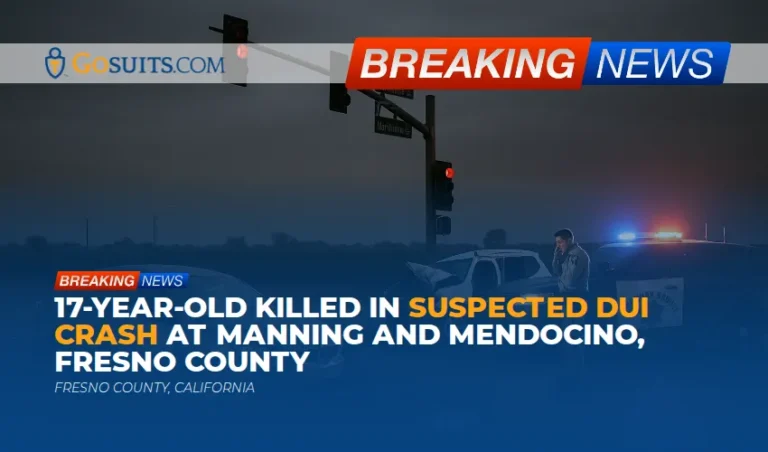
According to reporting from local broadcast media, a repeat DUI offender appeared in Fresno County court following a chain-reaction crash that began at the intersection of Manning and Mendocino on November 7. Investigators allege the driver struck a car that was stopped at a red light, fled at speed, then hit another vehicle, killing a 17-year-old driver. The initial arraignment was postponed, and the court set a seven-figure bail. Advocates in our community, including families who’ve lost children to impaired driving, have expressed outrage and grief in the aftermath.
Criminal proceedings will continue on a separate track. For the family of the teenager, the immediate civil-law questions include who may be held financially responsible, how to obtain official records, which insurance coverages may apply, and what steps to take to preserve their rights. This article walks through those issues in plain language, with Fresno County context, and links to authoritative government resources when appropriate.
Local roadway and seasonal conditions in rural Fresno County
Manning Avenue cuts east–west across the Valley, connecting farming towns and neighborhoods between Selma, Parlier, Sanger, and Reedley. Many intersections, like Manning and Mendocino, see a mix of local agricultural traffic, school and work commutes, and heavy trucks. Visibility can change quickly in late fall and winter. If you’ve lived here a while, you know tule fog can settle in near dawn and evenings, and even on otherwise clear days, dust, equipment turnouts, and orchard line-of-sight can complicate a driver’s reaction time.
When investigators reconstruct a crash at a rural signalized intersection, they often consider lighting, signal phasing, tire marks, vehicle data, and any video from nearby businesses or city traffic cameras. Where impairment is suspected, the focus includes time-stamped purchase history, toxicology, and prior advisements a driver may have received in earlier DUI cases.
How the criminal case relates to civil wrongful death claims
In California, a criminal prosecution for impaired driving and a civil wrongful death case are separate. A criminal conviction is not required to pursue a civil claim for wrongful death or a survival action. The civil case asks different questions: Did the driver act negligently or with conscious disregard? Did that conduct cause the death? What are the legally compensable losses?
Evidence from the criminal investigation can be used in the civil matter. Police reports, collision diagrams, toxicology results, and expert reconstructions frequently become exhibits. A guilty plea or conviction can affect civil liability analysis, but even absent a criminal conviction, civil recovery may still be possible if the available evidence shows negligence more likely than not.
About California’s “Watson” warning to DUI offenders
California courts commonly provide a formal warning to people convicted of DUI that impaired driving is extremely dangerous, and that a future death caused by impaired driving may support a murder charge under an implied-malice theory. This advisement is often called a “Watson” warning, derived from a California Supreme Court decision that recognized the legal basis for such prosecutions. While that is part of the criminal framework, it also has civil implications. If a driver is on notice of the lethal risk of impaired driving and chooses to drive intoxicated anyway, courts in civil cases may consider whether the conduct shows a conscious disregard for safety, which can be relevant in assessing punitive damages under California law.
For background on impaired-driving fatalities nationwide, see the National Highway Traffic Safety Administration’s overview, which reports thousands of deaths each year attributable to alcohol-impaired driving crashes in the United States. NHTSA: Drunk Driving.
Who can bring a wrongful death or survival action in California
California law identifies who may file a wrongful death lawsuit after a fatal crash and what types of losses may be claimed. Generally, the decedent’s spouse, domestic partner, children, and in some situations other dependent relatives may bring a wrongful death action. See California Code of Civil Procedure section 377.60 CCP § 377.60. A separate “survival” action, typically brought by the decedent’s personal representative or successor in interest, can seek certain losses the decedent sustained before death, such as economic damages from the time of injury until death. See CCP section 377.30 and related provisions.
These cases often proceed together but reflect different harms. Wrongful death addresses the family’s losses. Survival addresses the decedent’s own claim that survives their passing.

Potential civil liability in a suspected DUI fatality
In a crash that reportedly involved a vehicle stopped at a red light, then a subsequent collision during flight, several potential civil-liability theories may be analyzed. Each depends on the specific facts and evidence.
- Negligence and negligence per se. Operating a vehicle while impaired violates California law and can serve as evidence of negligence. Running a red light or failing to stop is similarly evidence of careless operation.
- Recklessness and conscious disregard. Where the conduct reflects appreciation of a high degree of risk and a decision to proceed, punitive damages may be considered under Civil Code section 3294, though they’re not automatic and require proof of malice, oppression, or fraud. See Civil Code § 3294.
- Employer or vehicle owner liability. If the at-fault driver was operating a vehicle in the course and scope of employment, an employer may face vicarious liability. If another person owned the vehicle, permissive-use rules and negligent entrustment may be considered.
- Alcohol provider liability. California’s dram shop laws generally shield bars and social hosts from civil liability for serving alcohol to adults who later drive drunk. However, there is a narrow exception for furnishing alcohol to obviously intoxicated minors. See Bus. & Prof. Code § 25602.1. Whether that exception applies depends on age and the evidence showing obvious intoxication.
- Public entity liability. Roadway design or signal timing is occasionally raised in serious collisions. Claims against public entities have a six-month claim-presentment deadline. See Gov. Code § 911.2.
Families should be cautious about drawing conclusions before a thorough investigation. Documented proof is what ultimately carries a civil case.
Evidence families and representatives should preserve now
If a family member or legal representative is in a position to protect evidence, a few practical steps can help, provided they don’t interfere with any law enforcement work.
- Vehicles and “black box” data. Modern vehicles often store crash data on an Event Data Recorder. Preserving the vehicles and requesting that insurers not destroy them until an inspection can take place may be critical. See NHTSA’s overview of EDRs: Event Data Recorder.
- Phone video and nearby cameras. Ask nearby residents or businesses along Manning and Mendocino if their cameras captured the intersection around the time of the crash. Many systems overwrite video in days.
- Witness lists. Write down names, phone numbers, and what each person recalls. Pass that information to investigators and counsel.
- Medical and funeral records. Keep invoices, programs, and receipts. These documents often prove expenses and non-economic impact.
- Social and work records. For a student or young worker, school records, extracurriculars, and awards can demonstrate the person’s life, relationships, and contributions to family and community.
Insurance companies often request recorded statements quickly. It’s generally wise to speak with an attorney first; what someone says to an insurer can be used against them later, even if they’re grieving and not ready for detailed questioning.
Getting official records: collision reports, coroner/medical examiner, autopsy
Official records can be essential for both understanding what happened and protecting legal rights. Agencies may vary, but these are common steps in Fresno County after a fatal crash.
Collision or police reports
Depending on who investigated, the primary report may be from the CHP or a city police department. If the crash occurred at a county intersection like Manning and Mendocino, CHP often handles the scene, though sometimes a local agency takes lead. The California Highway Patrol provides a statewide process for requesting collision reports. See CHP: Request a Collision Report (CHP 190). You can submit by mail or in person, and you’ll need to identify your relationship to the decedent and provide details like date, location, and involved names.
Coroner and autopsy documents
Fresno County’s coroner functions are administered through the Sheriff-Coroner. Families can typically request the death certificate, coroner’s report, and, when available, autopsy and toxicology results. Some findings may not be released until the criminal investigation permits. Calling the Sheriff-Coroner’s office during business hours is the usual first step to confirm availability, fees, and pickup or mailing options.
Traffic camera or public records
Some intersections have traffic cameras or city-owned equipment that may record portions of the roadway. Requests for public records are made under the California Public Records Act. Government agencies have specific timelines and exemptions, and footage may be overwritten quickly.
Insurance issues after a fatal DUI crash in California
Insurance coverage in a fatal crash may involve multiple layers. Understanding them helps set expectations and strategy.
- At-fault driver’s auto liability insurance. This is usually primary coverage for wrongful death claims. Limits vary by policy and may be insufficient in catastrophic losses.
- Employer policies. If the driver was working or driving a vehicle for an employer, commercial policies may apply.
- Vehicle owner’s coverage. If the at-fault driver borrowed a car, the owner’s policy may cover the loss under permissive use, subject to exclusions.
- Uninsured/Underinsured Motorist (UM/UIM). The decedent’s household auto policy may include UM/UIM coverage that can respond if the at-fault driver lacks adequate insurance. These claims are time-sensitive and have notice requirements.
- Umbrella policies. Some individuals carry umbrella policies that stack with auto coverage. Determining their existence often requires formal requests.
Insurers frequently try to contact families early. Before speaking with any insurance company, it is prudent to consult with an attorney. Insurance adjusters are trained to collect statements that limit their company’s liability. What’s said in the first days can affect the entire claim.
Support and financial help for families in Fresno County
In addition to any civil claim, California provides victim-centered assistance programs that can help with certain expenses after a violent crime like a DUI fatality. The California Victim Compensation Board may help with funeral and burial costs, some counseling, and related expenses, subject to eligibility and documentation. Learn more at California Victim Compensation Board.
Local prosecutors’ victim services units can also guide families through criminal court proceedings, provide case updates, and help with restitution forms. While each county’s program is different, victim advocates commonly help coordinate with CalVCB and answer procedural questions.
Grief support is also critical. Schools and faith communities across the Valley, from Parlier and Reedley to Selma and Sanger, often mobilize counselors quickly when a student’s death impacts classmates. It’s okay to ask those networks for help.
Community safety notes for Manning Avenue and similar intersections
Community members often ask whether design changes can help prevent future tragedies. At rural signalized intersections, the most effective protection remains sober, attentive driving and speed control. That said, patterns of collisions sometimes prompt:
- Signal timing review: yellow intervals, all-red phases, protected left turns, or longer clearance times where approach speeds are high.
- Visibility measures: trimming vegetation, improved backplates with retroreflective borders, and brighter signal heads.
- Advance warning: “Signal ahead” beacons or rumble strips on high-speed approaches.
If you’ve noticed a recurring hazard near Manning and Mendocino, documenting dates, conditions, and photos can help city and county engineers evaluate countermeasures.
Filing timelines and why prompt action matters
California’s statute of limitations for wrongful death is generally two years from the date of death. See CCP § 335.1. A survival action can have different deadlines depending on the facts. If a public entity might be responsible for a hazardous condition of public property, a government claim typically must be presented within six months. See Gov. Code § 911.2.
These time limits matter for more than paperwork. Vehicles can be scrapped. Convenience-store DVRs can overwrite after a week. Phone data gets lost. Early preservation letters and coordinated inspections make a real difference.
How civil cases may value losses without speculating on outcomes
No result is guaranteed, and every case is different. In general, California wrongful death law allows recovery for both economic and non-economic harms. Economic harms include funeral and burial costs, the financial support the decedent would have provided, and the loss of household services. Non-economic harms include loss of love, companionship, comfort, care, assistance, protection, affection, society, and moral support. These are profound losses that a jury may evaluate based on testimony and documented life evidence.
In circumstances where a driver’s conduct shows conscious disregard for life and safety, California law permits claims for punitive damages in a survival action, but only with appropriate proof. See Civil Code § 3294. This is a high standard and depends on the specific facts and evidence in the case record.
Commentary from Gosuits Fresno County, California Personal Injury Attorney
Our hearts are with the family and classmates of the 17-year-old whose life ended at Manning and Mendocino. There’s no easy way to take in news like this, especially when our county has already seen the pain that impaired driving inflicts. This article is meant to offer clear, general information for the community during a difficult time.
From a civil-law perspective, the reported facts point to multiple avenues of accountability. If investigators confirm impairment, red-light violations, and flight from an initial impact, the civil liability analysis will focus on negligence and possibly more aggravated conduct. The family’s rights do not depend on the pace of the criminal court. A careful investigation that preserves vehicle data, maps out impact points, and secures camera footage will help uncover every responsible party and every available insurance policy.
We’ve seen how insurance companies and large corporate defendants approach cases like this. Adjusters often call quickly, ask for recorded statements, and press for early settlements before the full extent of damages becomes clear. When a family is grieving, that pressure can feel overwhelming. Corporations and insurers know the rules, the deadlines, and the leverage points. People dealing with a loss often don’t, through no fault of their own. That knowledge gap can lead to undervalued claims or the loss of crucial evidence.
That’s why it’s important to get a free consultation before engaging with any insurer. An initial conversation can help you understand timelines, evidence needs, and the roles of different policies, without committing to any decisions. It’s a simple step that avoids missteps like recorded statements that later get used out of context.
Why timely action matters now
- Clarify the investigation plan. Decide who will secure vehicle inspections, request the CHP report, and follow up with the coroner for autopsy and toxicology documents. Coordinated requests prevent delays and lost records.
- Preserve time-sensitive evidence. Intersection and business cameras often overwrite within days. Letters to preserve footage, store vehicles, and retain phone records should go out quickly.
- Map out all insurance layers. Identify the at-fault driver’s policy, any owner’s policy, possible employer coverage, and UM/UIM coverage for the household. Early identification helps avoid missed notice requirements.
- Protect against recorded statements. Before speaking with any insurance company, consult an attorney. Statements given in grief can be misunderstood or used later to limit recovery.
- Track expenses from day one. Keep every invoice and receipt for funeral, burial, counseling, and travel. Accurate records support compensation requests and potential victim assistance benefits.
- Calendar the deadlines. Note the two-year wrongful death deadline and the six-month government-claim deadline if any public entity issues emerge. Missing a deadline can restrict recovery options.
Where to request key records
- Collision report: If the California Highway Patrol investigated, use the statewide process to request the report by mail or in person. Instructions and the CHP 190 form are available here: CHP: Request a Collision Report. If a city police department handled the scene, contact that department’s records unit for its request procedure.
- Coroner and autopsy: Contact the Fresno County Sheriff-Coroner to ask about report availability, fees, and timing. Autopsy and toxicology results may be held until the criminal investigation allows release. Staff can explain who may receive the documents and how.
- Victim compensation: Consider applying to the statewide program for help with funeral and related costs. Program details, eligibility, and application information are at the California Victim Compensation Board: victims.ca.gov.
Trusted government resources cited in this article
- National Highway Traffic Safety Administration: Drunk Driving for national impaired-driving data and safety information.
- California Code of Civil Procedure § 377.60 on who may file a wrongful death claim.
- California Code of Civil Procedure § 335.1 on the general two-year statute of limitations for wrongful death.
- Government Code § 911.2 for the six-month claim deadline when asserting claims against public entities.
- Civil Code § 3294 discussing punitive damages standards in California.
- California Highway Patrol: Request a Collision Report for obtaining CHP traffic collision reports.
- California Victim Compensation Board for victim assistance with funeral and related costs.
- NHTSA: Event Data Recorder for information about preserving crash data from vehicles.
- Bus. & Prof. Code § 25602.1 addressing civil liability for furnishing alcohol to obviously intoxicated minors.