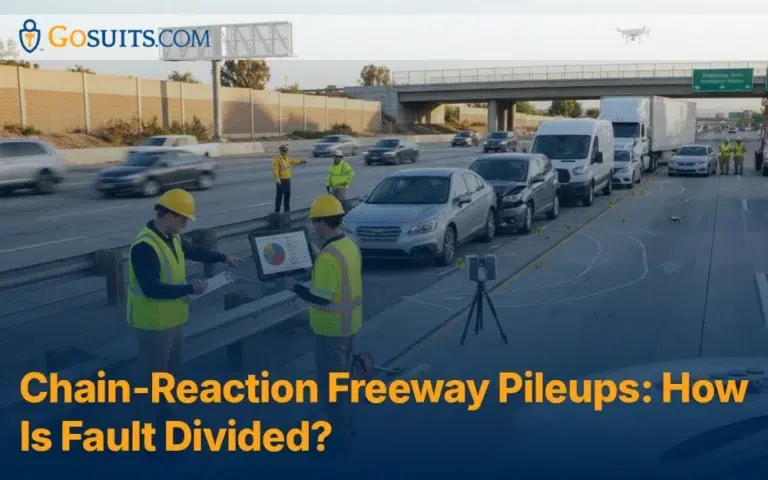
In California, fault in a chain-reaction collision is not assigned automatically to the driver who struck first. Instead, every driver whose negligence contributed to the crash may bear a percentage of responsibility for the harm caused. California follows a system of pure comparative fault, which means a jury or insurer must examine the conduct of each participant, including the injured claimant, and allocate a percentage to each. Proposition 51, now codified at California Civil Code § 1431.2, then splits the financial consequences in a specific way: each defendant is jointly and severally liable for all economic damages, but each defendant is only severally liable for non-economic damages in direct proportion to that defendant’s own percentage of fault. [1] [2]
Freeway pileups are their own animal. The evidence can point in five directions, every driver’s insurer is basically shrugging and pointing at somebody else, and by the time you add up all the available coverage across the defendants, there might still not be enough to cover the actual harm. And that’s a problem. If you were hurt in a chain reaction on the I-405, the I-5, SR-55, or the SR-73 toll road through Orange County, figuring out how these cases get reconstructed and how the money eventually gets split up isn’t optional. It’s kind of the whole ballgame.
Legal Snapshot
- Legal Topic: Multi-vehicle pileup fault allocation and damages apportionment
- Case Stage: Pre-litigation through trial
- Primary Legal Issue: Pure comparative fault; several liability for non-economic damages (Proposition 51)
- Primary Authority: California Civil Code § 1431.2; Li v. Yellow Cab Co., 13 Cal. 3d 804 (Cal. 1975)
- Governing Jurisdiction: California (Orange County – Irvine area)
- Trial Court Venue: Orange County Superior Court, Central Justice Center, Santa Ana
- Date Legal Authority Last Reviewed: June 2025
What Does Pure Comparative Fault Mean in California?
California abolished the old contributory-negligence rule in Li v. Yellow Cab Co., 13 Cal. 3d 804 (1975), replacing it with a pure comparative fault system. [2] Under that system, a plaintiff who is partly responsible for a crash is not barred from recovery. Instead, the total damages are reduced by the plaintiff’s own percentage of fault. If a jury finds that a plaintiff’s carelessness contributed 20 percent to the collision, the plaintiff recovers 80 percent of total damages no more, no less.
The word “pure” matters. Unlike states that bar recovery once a claimant is found more than 50 percent at fault, California allows recovery at any level of fault, even if the plaintiff is 99 percent responsible. This rule directly affects pileup cases, where courts and insurers must distribute responsibility across many actors. Personal injury lawyers who handle these cases regularly work with reconstruction data to build or challenge the fault picture assigned to each driver.
What Does California Law Say About Multiple Defendants?
When multiple defendants share responsibility, two separate rules apply.
Joint and several liability – economic damages. For economic losses (medical expenses, lost wages, property damage, and similar out-of-pocket costs), California retains traditional joint and several liability among defendants. Each defendant can be held responsible for the full amount of economic damages, regardless of that defendant’s individual percentage of fault. [1] A plaintiff who cannot collect from one defendant may collect the shortfall from another defendant.
Non-economic damages work differently. Way differently. Think pain and suffering, emotional distress, loss of consortium, physical impairment, the stuff that’s real but doesn’t come with a bill. Proposition 51 (voters approved it in ’86, and it’s sitting in California Civil Code § 1431.2) says each defendant only pays their proportional share. So a defendant found 15 percent at fault? They pay 15 percent of the non-economic damages. That’s it. Nothing more. [1]
So what does this actually mean? Take a serious pileup. Five defendants, all with different fault percentages. If somebody has significant non-economic losses, and a few of those defendants are barely at fault, uninsured, or basically insolvent, that plaintiff may never see the full amount they were awarded. Car accident lawyers in Irvine and throughout Orange County deal with this all the time on freeway pileup cases. It’s just the shape of the problem.
Economic vs. Non-Economic Damages Under Proposition 51
| Damage Type | Examples | Liability Rule |
|---|---|---|
| Economic | Medical bills, future care, lost income, property damage | Joint and several – each defendant can be liable for the full amount |
| Non-economic | Pain and suffering, emotional distress, impairment, loss of consortium | Several only – each defendant pays only that defendant’s proportionate share |
How Is the Impact Sequence Reconstructed in a Chain-Reaction Crash?
The first practical question in any pileup claim is: in what order did the vehicles collide, and which collisions caused which injuries? Reconstruction experts use several categories of evidence to answer that question.
Crush Profiles and Contact Damage Patterns
Each vehicle involved in a multi-car crash shows a physical story on its body panels, frame rails, and bumper structures. Crush depth, direction of force, and contact marks can be matched against other vehicles in the sequence to determine which vehicle struck which surface. A vehicle that shows both front crush and rear crush has been involved in at least two separate impacts, and the relative severity of each crush can suggest the order of events. Experts measure crush dimensions using industry-standard formulas to estimate the change in velocity during each impact.
Debris Fields
Broken glass, plastic trim, fluid spills, and tire marks do not move after a crash without external intervention. The position of debris clusters on the roadway shows where each impact occurred, and the spacing between debris fields can indicate whether multiple impacts happened simultaneously or in sequence. On a high-speed corridor such as the I-405 through Irvine or the I-5 near the SR-133 interchange, the debris field from an initial collision may extend several hundred feet before later-arriving vehicles have time to react.
Event Data Recorder Downloads
Most modern passenger vehicles and commercial trucks contain an event data recorder (EDR), sometimes called a vehicle black box. The EDR captures data in the seconds before and during a crash: vehicle speed, throttle position, brake application, steering wheel angle, and whether occupant restraints were buckled. In a chain-reaction event, EDR data from multiple vehicles can reveal the sequence in which braking and impact events occurred, as well as which drivers had time to respond before the collision. EDR data must typically be preserved quickly through a litigation hold or court order, because some systems overwrite data after subsequent vehicle starts. [3]
The value of EDR evidence in California personal injury litigation has grown significantly as vehicles have added more sophisticated modules. A case involving injury claims on stop-and-go traffic on the I-405 between Irvine and Costa Mesa, for example, may yield speed and braking data from half a dozen vehicles, each providing a piece of the impact sequence.
Camera Coverage
Freeway and intersection cameras operated by Caltrans, local agencies, and private businesses record continuous footage in many areas. Dashcam footage from vehicles in the pileup or from uninvolved vehicles nearby can capture the precise moment each vehicle became involved and can show pre-crash movements that written reports miss. Requests for this footage must be made promptly because many systems retain recordings for only a short period before they overwrite.
Why the First Driver Is Not Automatically the Only Party at Fault
A common misconception is that the driver whose initial action triggered the chain reaction bears all responsibility. California law does not work that way. A driver who rear-ended a slowing vehicle at high speed on a freeway has independent responsibilities: maintain a safe following distance, stay alert to traffic conditions ahead, and reduce speed when visibility drops. If that driver was following too closely, speeding, or distracted, their own conduct is an independent basis for fault even if another driver’s earlier error created the congested conditions. Multiple drivers can each commit separate negligent acts that, taken together, are all contributing causes of the eventual injuries. Courts weigh each actor’s conduct independently.
How Is a Fault Percentage Assigned to Each Driver?
In litigation, the trier of fact, usually a jury, receives the reconstruction evidence, expert testimony, witness accounts, and applicable traffic laws, then assigns a percentage of fault to each party, including the claimant if the evidence supports it. The percentages must total 100 percent across all named parties.
Factors courts consider when assigning percentages include:
- Speed at impact – was the driver exceeding the speed limit or traveling too fast for conditions?
- Following distance – did the driver maintain a reasonable gap given traffic and road conditions?
- Distraction – was the driver using a mobile device, eating, or otherwise inattentive?
- Reaction time – did the driver brake, steer, or take evasive action when the hazard became visible?
- Vehicle condition – were brakes, tires, or lights in disrepair?
- Lane position and signaling – did a lane change without adequate warning contribute to the chain reaction?
- Impairment – was any driver under the influence of alcohol or drugs?
- Commercial vehicle regulations – if a semi-truck or large commercial vehicle was involved, did the driver or carrier comply with federal hours-of-service, load-securement, or equipment-maintenance rules?
How Does Proposition 51 Split Damages Across Multiple Defendants?
Once a jury assigns percentages, Proposition 51 determines what each defendant actually owes. Assume a verdict of $1,000,000 in economic damages and $500,000 in non-economic damages, with three defendants at fault percentages of 50 percent, 30 percent, and 20 percent respectively.
Sample Damage Allocation Under Civil Code § 1431.2
| Defendant | Fault % | Economic Share (joint & several) | Non-Economic Share (several only) |
|---|---|---|---|
| Driver 1 | 50% | Up to $1,000,000 (full amount recoverable from this defendant) | $250,000 (50% of $500,000) |
| Driver 2 | 30% | Up to $1,000,000 (full amount recoverable from this defendant) | $150,000 (30% of $500,000) |
| Driver 3 | 20% | Up to $1,000,000 (full amount recoverable from this defendant) | $100,000 (20% of $500,000) |
The table above is illustrative only and assumes all defendants are solvent and adequately insured. In practice, available insurance policy limits are frequently lower than the judgment, defendants may be insolvent, and the interaction of these rules with insurance coverage requires careful legal analysis. The outcome in any specific case depends entirely on its facts, the applicable evidence, and the decisions of the trier of fact.
What Practical Insurance Problems Arise in Multi-Vehicle Pileups?
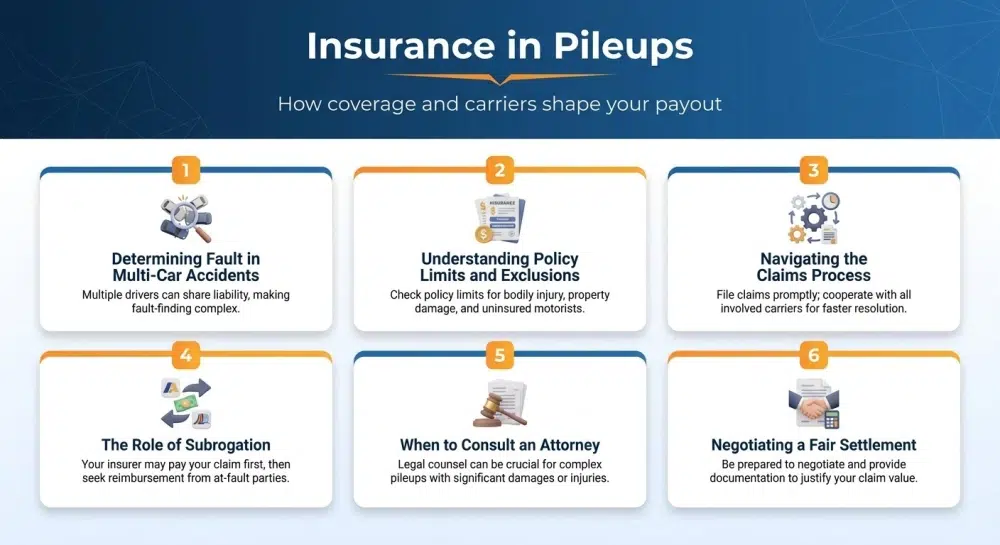
Chain-reaction crashes create insurance dynamics that single-vehicle accidents do not. Several recurring problems deserve attention.
Multiple Insurers Blaming Each Other
Each defendant’s insurer has a financial incentive to shift as much fault as possible to the other defendants’ insurers. Insurers accomplish this by hiring their own reconstruction experts, challenging the validity of EDR downloads, or arguing that their insured’s conduct was not a proximate cause of the claimant’s specific injuries. When five or six insurers are pointing fingers at one another, the investigation and negotiation phase of a claim can extend for months or years. Claims that in a two-car crash might resolve within six months can stall in a pileup because no single insurer is willing to move first.

Limited Policy Limits Shared Across Many Claimants
California’s minimum required liability coverage is relatively low, and many drivers carry only the minimum. [4] When a single driver’s negligence injures multiple occupants of multiple vehicles, that driver’s policy limit must be shared across every claimant. California Insurance Code provisions govern the order and method of distribution, but even a policy with what appears to be adequate limits can be quickly exhausted when three, four, or five injured parties have serious claims.
The order in which claims are paid matters. California law does not automatically require an insurer to pay smaller claims first to preserve funds for larger ones, but an insurer that exhausts its limits through bad-faith handling of one claimant while ignoring others may face additional legal exposure. [5]
Underinsured Motorist Coverage as the Real Source of Recovery
When the at-fault drivers collectively carry insufficient insurance to cover all the damages, an injured person’s own underinsured motorist (UIM) coverage often becomes the primary practical source of recovery. California requires insurers to offer UIM coverage, though policyholders may reject it in writing. [4]
UIM coverage pays the difference between the injured person’s actual damages and the amount collected from the at-fault drivers’ policies, up to the UIM limit on the injured person’s own policy. In a severe pileup on the I-405 near the Irvine Spectrum, where damages can easily reach or exceed a million dollars and multiple at-fault drivers carry only minimum limits, UIM coverage frequently bridges the gap between the actual harm suffered and the insurance money available from third-party policies.
Stacking of UIM coverage across multiple policies may also be available in some circumstances. California’s rules on stacking are complex and depend on the specific policy language. Personal injury lawyers who represent injured Irvine claimants routinely review all available policies, including policies covering household members to identify every potential source of UIM recovery.
Our knowledge base article on which insurance pays first after a multi-car crash provides additional detail on payment priority across multiple insurance sources.
What Evidence Can Matter in a California Pileup Claim?
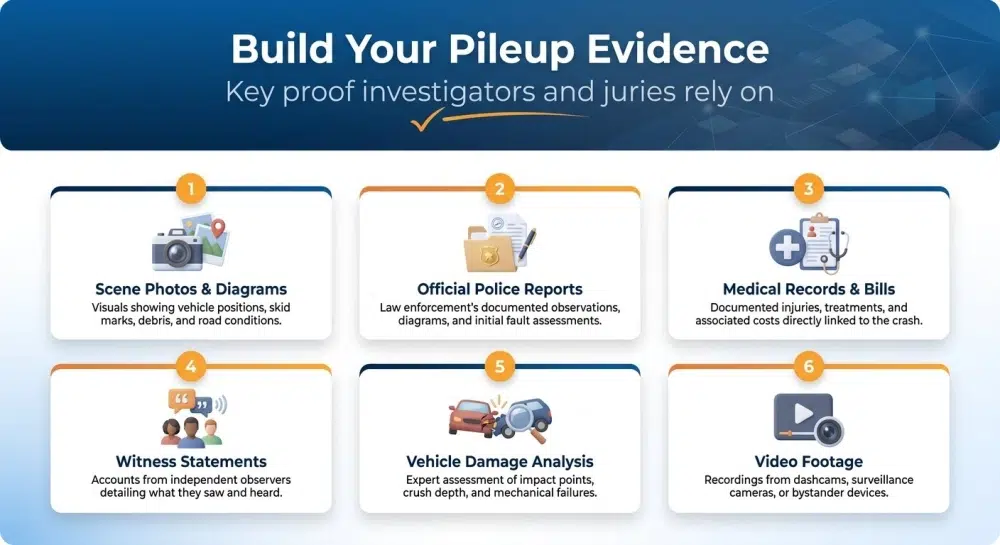
The outcome of a fault allocation dispute often depends on which party builds the stronger evidentiary record. Key categories include:
- Police and CHP collision reports – document the investigating officer’s observations, statements from drivers and witnesses, and initial fault determinations.
- EDR/black box downloads – as discussed above, capture pre-impact speed, braking, and other data for each vehicle.
- Dashcam and surveillance footage – can contradict driver accounts and show the sequence of events in real time.
- Photographs and video from the scene – including post-impact positions of vehicles, crush damage, fluid spills, and road conditions.
- Witness statements – passengers, other motorists, and bystanders may have seen the initial precipitating event.
- Medical records and bills – establish the nature and severity of injuries and connect them to specific impacts where multiple collisions occurred.
- Expert reconstruction analysis – a qualified accident reconstruction engineer can quantify energy transfer, assign probable impact sequences, and explain the results to a jury.
- Commercial vehicle logs and maintenance records – if a semi-truck or commercial van was involved, federal motor carrier safety regulations require the preservation of driver logs, inspection records, and maintenance histories.
- Cell phone and telematics data – may show distraction or the precise GPS track and speed of a vehicle in the moments before impact.
Identifying and preserving this evidence is time-sensitive. Some data overwrites automatically; physical vehicles are repaired or totaled and may be released by an insurer within weeks of the crash. A formal demand to preserve evidence, sometimes called a spoliation letter, should reach each potentially responsible party promptly after a serious crash. [3]
What Damages or Remedies May Be Available?
California law recognizes several categories of compensable harm in a personal injury claim arising from a freeway pileup. Recoverability in any specific case depends on the evidence, applicable law, and the facts established at trial or in settlement.
- Past medical expenses – reasonable and necessary costs of treatment already received.
- Future medical expenses – projected costs of ongoing or future care, including surgery, rehabilitation, and long-term management of permanent injuries.
- Lost wages and earnings – income lost because of the injury, from the date of injury through the date of trial.
- Loss of earning capacity – the difference between what a person could have earned over their working life and what they can now earn because of permanent limitations caused by the injury.
- Physical pain – past and future pain resulting from the injuries.
- Mental anguish and emotional distress – psychological suffering, anxiety, depression, and related harm.
- Physical impairment and disfigurement – loss of physical function, permanent disability, and visible scarring or deformity.
- Property damage – the cost to repair or replace the vehicle and any personal property destroyed in the crash.
- Wrongful death damages – if the crash was fatal, California law provides a separate cause of action for surviving family members, including loss of financial support, loss of companionship, and funeral expenses. Fatal crashes on Orange County freeways may give rise to wrongful death lawyers’ claims on behalf of surviving spouses, children, or other dependents. [6]
No specific dollar amount can be guaranteed in any case. The facts, the evidence, the credibility of witnesses, the severity of injuries, and the applicable legal standards all affect what a claimant may ultimately recover.
How Long Do I Have to Act in California?
The general statute of limitations for a personal injury claim in California is two years from the date of injury under California Code of Civil Procedure § 335.1. [7] Missing this deadline ordinarily bars the claim permanently.
Several circumstances can modify this timeline:
- If the injured person was a minor at the time of the crash, the limitations period may be tolled until the minor reaches age 18.
- If a government entity – such as a state agency, city, or county, may have contributed to the crash through road design or maintenance defects, a separate government tort claim must be filed with the entity within six months of the injury under California’s Government Claims Act (Cal. Gov. Code § 911.2). Failure to file this claim within six months can bar an otherwise valid claim against the government entity. [8]
- Discovery of injuries that were not immediately apparent may affect how the limitations period is measured, but relying on this exception without legal guidance is risky.
Cases filed in Orange County Superior Court – including those arising from crashes on the I-405 near Newport Beach, SR-55 through Santa Ana, or the SR-73 toll road, are subject to these same deadlines. Waiting to consult an attorney can reduce the time available to gather evidence, identify all potentially liable parties, and preserve critical data.
Important: The deadlines above are general summaries. The applicable deadline in any specific case depends on the particular facts, the parties involved, and current California law. Legal verification of the applicable deadline is required in every case.
What If the Other Parties Dispute Liability?
Disputed liability is the norm, not the exception, in multi-vehicle pileup cases. Each driver’s insurer typically opens its own investigation, and those investigations rarely produce the same conclusions. Common defense arguments include:
- The claimant contributed to the crash through their own following distance or speed.
- A different driver in the sequence, not the insurer’s policyholder, initiated the chain reaction.
- The claimant’s injuries were caused by a later impact in the sequence, not by the insured driver’s contact.
- Pre-existing medical conditions account for some or all of the claimed injuries.
California’s pure comparative fault system means that disputed liability does not necessarily defeat a claim, it affects the percentage each party pays. But building the strongest possible factual record, through early evidence preservation, expert retention, and witness interviews, is the foundation for effectively contesting these arguments.
Cases involving injury claims from multiple vehicles: for example, a rear-end collision in heavy traffic on the I-405 that triggers a secondary crash involving a rideshare vehicle, also involve questions about whether the rideshare driver’s additional insurance coverage applies and at what tier. A secondary motorcycle accident involving a lane-splitting rider who encounters the stopped vehicles can complicate the scene further and add another layer of fault allocation.
What Should I Do After a Multi-Vehicle Freeway Crash in California?
- Seek medical care immediately. Some injuries, including traumatic brain injuries, internal bleeding, and spinal injuries, are not obvious at the scene. A medical evaluation creates a contemporaneous record.
- Preserve evidence. Photograph your vehicle, the crash scene, road conditions, and any visible injuries. Keep clothing worn during the crash. Note the names and contact information of every driver and witness.
- Do not give recorded statements to other drivers’ insurers without first consulting an attorney. These statements can be used against you to reduce your recovery.
- Report the crash to your own insurer promptly, as required by your policy, but understand that your own insurer may have interests that differ from yours in a UIM claim.
- Demand EDR preservation. A formal written demand to all potentially responsible parties should go out as soon as possible after the crash to prevent data from being lost.
- Review your own coverage. Identify all policies that may provide UIM or other first-party benefits, including policies held by household members.
- Consult a California personal injury attorney. The interaction of pure comparative fault, Proposition 51, multiple insurers, and UIM claims is complex. A lawyer can assess the specific evidence, identify all parties and coverage sources, and explain the options available under California law.
How does Proposition 51 affect what I can collect for pain and suffering?
Under California Civil Code § 1431.2, pain and suffering and other non-economic damages are “several only.” Each defendant pays only the share that corresponds to that defendant’s own fault percentage. If you have $500,000 in non-economic damages and one defendant is only 10 percent at fault, that defendant owes you $50,000 for non-economic harm, no matter how large the total judgment is. This becomes a serious practical problem when multiple defendants each carry small percentages of fault and minimal insurance. Economic damages, by contrast, remain jointly and severally collectible from any defendant.
What is an event data recorder and why does it matter?
An event data recorder (EDR) is an electronic module, installed in most modern vehicles, that records vehicle speed, braking force, throttle position, and other data in the moments before and during a crash. In a chain-reaction pileup, EDR downloads from multiple vehicles can establish the sequence of braking and impact events and reveal which drivers had time to react. This evidence can support or undermine the fault percentages each party argues for. Because EDR data can be overwritten when the vehicle is started after the crash, a formal preservation demand must go to all parties quickly. Read about how a serious 405 freeway crash unfolded to understand why preserving electronic evidence matters in high-speed freeway incidents.
What if the most at-fault driver has inadequate insurance?
For economic damages, California’s joint and several rule means you can try to collect the full economic judgment from any defendant with ability to pay, not just the most at-fault driver. For non-economic damages, however, each defendant pays only their proportionate share, which means a deeply at-fault but underinsured defendant may leave a gap. Your own underinsured motorist (UIM) coverage is often the most important resource in these situations. UIM coverage pays the difference between your total covered losses and the amounts you can actually collect from the at-fault drivers’ policies. Reviewing all potentially applicable policies, including household member policies is essential after a serious pileup. More background is available in this overview of Orange County car accident claims and the insurance layers they involve.
Can my own fault percentage bar my recovery in California?
No. California’s pure comparative fault rule, established by Li v. Yellow Cab Co. allows recovery even if you are found substantially at fault. Your damages are simply reduced by your own percentage of fault. If a jury finds you 40 percent at fault for the crash, you collect 60 percent of your total damages. California does not bar recovery at any threshold of plaintiff fault, which distinguishes it from states that bar recovery above 50 or 51 percent. That said, a high assigned fault percentage substantially reduces the dollars you recover, which is why building the strongest possible factual record is important from the start.
Does it matter which car hit me first versus which caused more severe injuries?
Both questions matter independently. The order of impacts affects which driver caused the initial collision and how subsequent drivers had time or opportunity to avoid the crash. The severity of each impact, which can be measured through crush analysis and EDR data, affects which collision actually caused each injury. A claimant who suffered a concussion in the first impact and a spinal injury in a second impact has two separate injury events potentially attributable to two different drivers. Each defendant’s responsibility extends only to the harms their conduct caused or contributed to. Separating these injury events through medical and engineering evidence is a central task in serious pileup litigation. A look at a wrong-way crash on SR-73 in Newport Beach illustrates how a single triggering incident can generate a cascade of secondary collisions and injuries.

Can I file a claim if a family member was killed in a freeway pileup?
Yes. California Code of Civil Procedure § 377.60 allows certain surviving family members, including a spouse, domestic partner, children, and in some circumstances parents or siblings, to bring a wrongful death action when a person dies because of another party’s negligence. Wrongful death damages in California include the pecuniary loss to survivors, loss of the decedent’s companionship and household services, and funeral expenses. Non-economic wrongful death damages are also subject to Proposition 51’s several-liability rule across multiple defendants. A separate survival action under CCP § 377.30 may also be available for damages the decedent suffered before death. These cases involve strict deadlines and complex apportionment issues. For context on how families navigate fatal crash claims in the region, see this report on a fatal multi-vehicle crash in Anaheim.
Talk With a GoSuits Attorney
A chain-reaction freeway crash can involve multiple insurers, disputed impact sequences, Proposition 51 apportionment, and insufficient policy limits all at once. If you or someone in your family was injured in a multi-vehicle collision on the I-405, I-5, SR-55, or any other Orange County corridor, a GoSuits personal injury lawyer can review the circumstances of your case, identify all available insurance sources, and explain your options under California law.
The Irvine personal injury lawyers at GoSuits serve clients throughout Orange County, including Newport Beach, Santa Ana, Costa Mesa, Fullerton, Huntington Beach, and surrounding communities. Our team represents injured people on a contingency-fee basis you pay no attorney’s fees unless we recover for you.
Related California Personal Injury Resources
- Irvine Personal Injury Lawyers – GoSuits Irvine Personal Injury
- Irvine Car Accident Lawyers – GoSuits Irvine Car Accident
- Irvine Wrongful Death Lawyers – GoSuits Irvine Wrongful Death
- Which Insurance Pays First After a Multi-Car Crash – GoSuits Knowledge Base
- California Comparative Negligence in Car Accidents – GoSuits Knowledge Base
- California Car Accident Statute of Limitations – GoSuits Knowledge Base
References and Authoritative Sources
- California Civil Code § 1431.2 – Several Liability for Non-Economic Damages (Proposition 51) – California Legislature
- Li v. Yellow Cab Co., 13 Cal. 3d 804 (1975) – California Supreme Court – CourtListener
- Event Data Recorders – National Highway Traffic Safety Administration (NHTSA)
- California Insurance Code § 11580.2 – Uninsured and Underinsured Motorist Coverage – California Legislature
- California Insurance Code § 790.03 – Unfair Insurance Practices – California Legislature
- California Code of Civil Procedure § 377.60 – Wrongful Death Action – California Legislature
- California Code of Civil Procedure § 335.1 – Two-Year Statute of Limitations for Personal Injury – California Legislature
- California Government Code § 911.2 – Six-Month Deadline for Government Tort Claims – California Legislature
- Richards v. Owens-Illinois, Inc., 14 Cal. 4th 985 (1997) – California Supreme Court on Proposition 51 Scope – CourtListener
- California Civil Jury Instructions (CACI) – Comparative Fault and Apportionment of Fault – Judicial Council of California