Texas law requires insurers to work to specific statutory deadlines when handling first-party claims. When an insurer misses those deadlines, the Texas Prompt Payment of Claims Act (TPPCA) imposes penalty interest and allows recovery of attorney fees. When an insurer goes further and handles a claim unreasonably or deceptively, a separate set of rules under Texas Insurance Code Chapter 541 and the Texas Deceptive Trade Practices Act may apply. These are overlapping but distinct frameworks, and understanding where one ends and the other begins matters in every personal injury claim involving insurance.
Legal Snapshot
- Legal Topic: Texas Insurance Bad Faith, Unfair Claims Settlement Practices, and Prompt Payment of Claims
- Case Stage: Pre-litigation through trial
- Primary Legal Issue: Insurer obligations under Texas Insurance Code Chapters 541, 542, and 542A; first-party versus third-party claim distinctions
- Primary Authority: Tex. Ins. Code §§ 541.060, 542.055–542.060; USAA Tex. Lloyds Co. v. Menchaca, 545 S.W.3d 479 (Tex. 2018)
- Date Legal Authority Last Reviewed: July 2025
What Is a Lowball Settlement Offer, and Does It Automatically Mean Bad Faith?
A settlement offer that is substantially lower than the documented value of a claim raises questions, but it does not automatically constitute bad faith under Texas law. Texas courts distinguish between a dispute about the amount owed and an insurer’s failure to deal fairly with a policyholder. In Dallas County and across Texas, adjusters frequently offer initial amounts that do not fully account for future medical costs, lost earning capacity, or non-economic damages. That alone is a negotiation position, not necessarily a statutory violation.
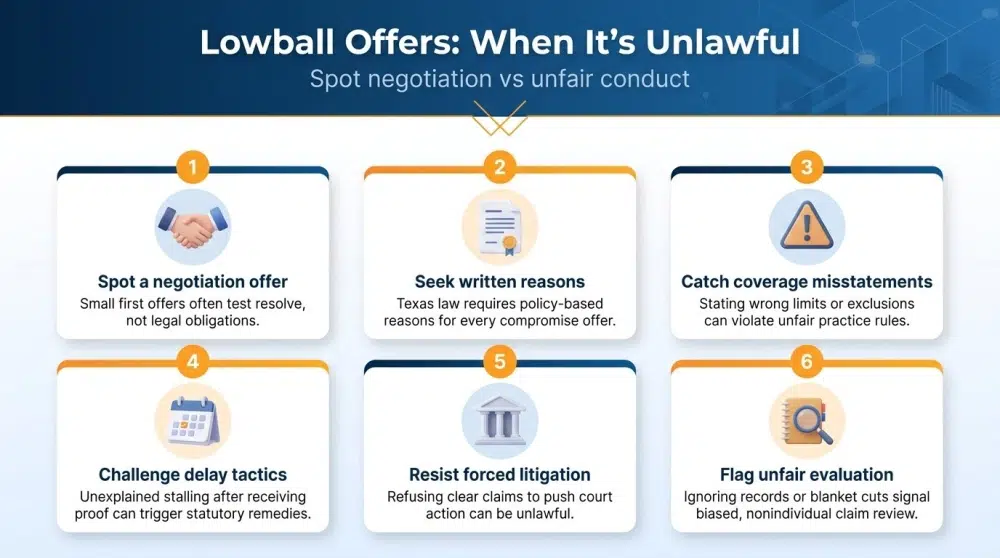
Bad faith under Texas law requires more: the insurer must have acted unreasonably in evaluating, denying, or delaying the claim in a way the statutes specifically prohibit. The Texas Supreme Court clarified in USAA Tex. Lloyds Co. v. Menchaca, 545 S.W.3d 479 (Tex. 2018), that an insured generally cannot recover extra-contractual damages for bad faith unless the insurer’s conduct caused harm independent of the denial of policy benefits, or the insurer denied a claim when liability was reasonably clear. Understanding these boundaries helps injured Texans and their attorneys identify which theory, or combination of theories, applies to a given claim.
What Texas Insurance Code Chapter 542 Requires: Prompt Payment Deadlines
Here’s the framework. Chapter 542, Subchapter B of the Texas Insurance Code is the rulebook for prompt payment on first-party claims. First-party just means you’re filing with your own insurer, whether that’s PIP, MedPay, UM/UIM, or property damage under your collision coverage. Third-party liability claims, the ones you’d file against the other driver’s carrier, play by a totally different set of rules. [1] #ref-1
The personal injury lawyers in our Dallas personal injury team regularly see insurers miss these statutory windows in claims originating from collisions on the LBJ Freeway (I-635), Central Expressway (US-75), and I-30 through downtown Dallas. The deadlines are strict regardless of where in Texas the loss occurred.
The Three Core Deadlines Under Chapter 542
| Step | Deadline | Statutory Reference |
|---|---|---|
| Acknowledge and request information | 15 calendar days after notice of claim | Tex. Ins. Code § 542.055 [1] |
| Accept or reject in writing | 15 business days after receiving all requested items; may extend to 45 days with written explanation | Tex. Ins. Code § 542.056 [1] |
| Pay accepted claim | 5 business days after notifying the claimant of acceptance | Tex. Ins. Code § 542.057 [1] |
| Overall late-payment trigger | If the insurer delays payment more than 60 days after receiving all requested items, penalty interest begins to run | Tex. Ins. Code § 542.058 [1] |
The PIP-Specific 30-Day Rule
Different rule for PIP. Faster clock. Texas Insurance Code §§ 1952.156–1952.157 says the insurer has 30 days to pay personal injury protection benefits after getting reasonable proof of the fact and amount of expenses incurred, and if they miss that mark, overdue benefits start racking up 12 percent interest per year. This timeline doesn’t wait on the general Chapter 542 framework. It runs on its own, kicking in the second the carrier has what it reasonably needs to decide. [2]
What Happens When the Deadlines Are Missed
If an insurer violates the prompt-payment requirements, the claimant may recover 18 percent per year in statutory interest on the delayed amount, plus reasonable attorney fees. See Tex. Ins. Code § 542.060. [1] This remedy is available even if the insurer eventually pays, provided the statutory deadline was missed. The Texas Supreme Court confirmed this principle in Barbara Technologies Corp. v. State Farm Lloyds, 589 S.W.3d 806 (Tex. 2019), and again in Hinojos v. State Farm Lloyds, 619 S.W.3d 651 (Tex. 2021). [3]
For weather-related property claims governed by Chapter 542A, the interest rate is tied to the Texas post-judgment rate under Texas Finance Code § 304.003 rather than the flat 18 percent figure, and specific presuit notice requirements apply. [4]
What Texas Insurance Code Chapter 541 Prohibits: Unfair Settlement Practices
While Chapter 542 focuses on timing, Chapter 541 addresses the quality of an insurer’s conduct during claim handling. Section 541.060 lists specific unfair settlement practices that constitute violations of the statute. [5] These include:
- Misrepresenting to a claimant a material fact or the insurance policy’s provisions relating to the coverage at issue
- Failing to attempt in good faith to effectuate a prompt, fair, and equitable settlement of a claim for which the insurer’s liability has become reasonably clear
- Failing to promptly provide to a policyholder a reasonable explanation of the basis in the policy or applicable law for the insurer’s denial of a claim or a compromise settlement offer
- Failing within a reasonable time to affirm or deny coverage of a claim to a policyholder
- Refusing a reasonable settlement offer or compelling an insured to litigate to recover an amount the insurer is obligated to pay under the policy
In the Dallas area, insurers handling claims involving rear-end collisions on the Dallas North Tollway or multi-vehicle incidents on I-30 near the High Five interchange have been known to cite coverage disputes where coverage is straightforward. Section 541.060 is designed to address exactly that conduct.
First-Party Bad Faith Versus Third-Party Disputes
The distinction between a first-party and a third-party claim fundamentally affects which remedies are available. A first-party bad faith claim involves the insurer’s obligation to its own policyholder under the policy the policyholder purchased. When your own insurer unreasonably denies a PIP, MedPay, or UM/UIM claim, Chapter 541 may provide a cause of action. [5]
Third-party claims are a different animal. You’re suing, or negotiating with, the other guy’s insurance. And Texas courts have generally said a third-party claimant just doesn’t have a direct bad-faith cause of action against that carrier. The reason’s kind of straightforward. The insurer owes duties to its own insured, not to the person who got hurt. Fraud can change that, and so can misrepresentations the insurer makes directly to the third-party claimant. But those are the exceptions. Your actual remedy against the at-fault driver’s insurer is the liability claim itself, plain and simple.
Understanding this distinction is essential. If a Dallas car accident involves both your own UM/UIM coverage and an at-fault driver’s liability policy, the TPPCA and Chapter 541 claims attach to your own insurer’s conduct, while the claim against the at-fault driver’s insurer proceeds as a standard liability matter.
When Does a Low Offer Become a Statutory Violation?
An insurer can make a conservative settlement offer and still comply with Texas law if the offer reflects a genuine evaluation of liability and damages. The conduct crosses into a statutory violation when the insurer:
- Makes an offer it knows does not reflect reasonably clear liability, without providing an explanation grounded in the policy or the law (§ 541.060)
- Delays reaching a coverage decision or paying an accepted claim beyond the statutory windows (§§ 542.055–542.060)
- Misrepresents the coverage available under the policy in connection with the offer
- Forces litigation to recover an amount the insurer knows or should know it is obligated to pay
Not every disagreement is bad faith. Say you and the adjuster genuinely see the soft-tissue injuries from a Deep Ellum rear-ender differently. That’s a good-faith dispute about damages, and by itself it doesn’t get you anywhere near a statutory violation. But when the insurer flat-out refuses to look at your treating physicians’ records, brushes off objective imaging, or just runs your claim through a blanket reduction formula without ever engaging with the actual facts? That’s a different story. That kind of conduct is what the statute is really aimed at.
What Evidence Supports a Bad Faith or Prompt-Payment Claim?
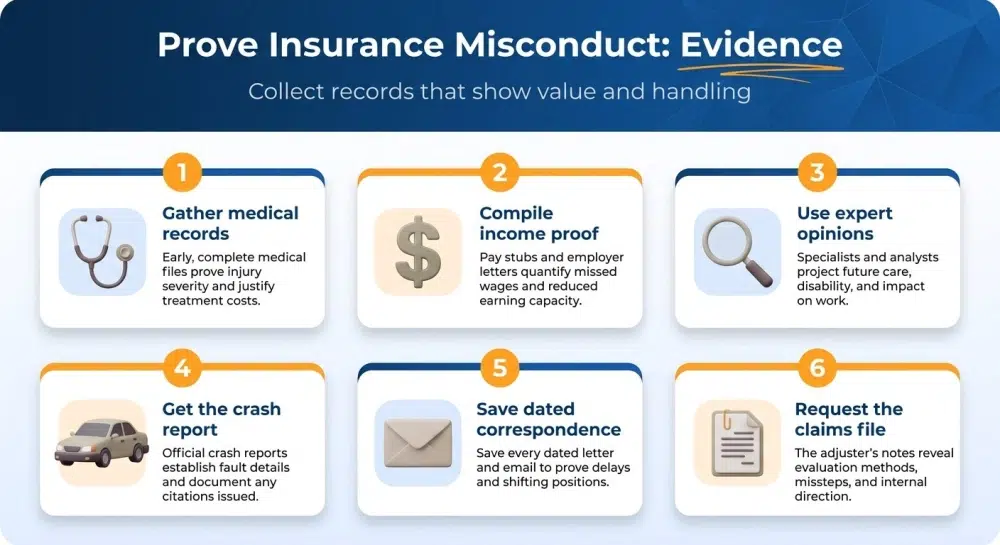
Documentation drives both types of claims. In any personal injury claim in Dallas County or surrounding Texas counties, the following categories of evidence can establish both the underlying claim value and the insurer’s conduct in handling it.

Documenting the Claim Value
- Medical records and billing: Itemized bills, treatment notes, diagnostic imaging, and specialist reports that establish what care was provided and why
- Employment and income records: Pay stubs, employer statements, and tax records supporting lost wage claims
- Expert opinions: Life care plans and vocational assessments for future damages, accident reconstruction reports where liability is disputed
- Police crash reports: Establish initial facts of the collision and any citations issued
Documenting the Insurer’s Conduct
- Date-stamped correspondence: Written claim submissions, insurer acknowledgments, reservation of rights letters, denial letters, and any settlement offers
- Claims file records: Obtained through litigation discovery; reveal the adjuster’s notes, evaluation methods, and any internal communications about claim strategy
- Timeline reconstruction: A chronological chart showing each statutory deadline against the dates the insurer actually responded, establishing which deadlines were missed and by how many days
- Communications log: Notes of all phone calls with adjusters, including date, time, and substance of the conversation
- Recorded statements and examination under oath: Transcripts of statements given to the insurer; context for any later claim that a representation was made
Car accident lawyers who handle insurance disputes know that the claims file – obtained through discovery under the Texas Rules of Civil Procedure – often contains the most powerful evidence of how the insurer evaluated the claim and whether its conduct was reasonable.
What Damages and Remedies Are Available?
The remedies available depend on which theory a claimant pursues and whether Texas courts ultimately find the conduct actionable.
Under Chapter 542 (Prompt Payment)
- Statutory interest at 18 percent per year on delayed amounts (or Finance Code rate for Chapter 542A weather-related property claims)
- Reasonable and necessary attorney fees incurred in establishing the violation
Under Chapter 541 (Unfair Settlement Practices) and Common Law Bad Faith
- Actual damages arising from the violation – which can include mental anguish damages if the insurer’s conduct was particularly egregious
- Under certain circumstances, up to three times the amount of actual damages where the trier of fact finds the insurer knowingly committed the prohibited conduct
- Attorney fees and court costs
Here’s what Menchaca actually locked in. The Texas Supreme Court said you don’t get extra-contractual bad-faith damages just because policy benefits were denied. There has to be either an independent harm or a denial made when liability was already reasonably clear. [6] Pretty narrow window, honestly. It kind of forces the inquiry away from the coverage dispute itself and onto whether the insurer’s behavior, standing on its own, actually did measurable damage.
How Does a UM/UIM Claim Interact With These Rules?
Uninsured and underinsured motorist claims present a specific procedural challenge under Texas law. The Texas Supreme Court held in Brainard v. Trinity Universal Insurance Co., 216 S.W.3d 809 (Tex. 2006), that an insurer’s obligation to pay UM/UIM benefits does not arise until the insured establishes the liability of the uninsured motorist and the amount of the claimant’s damages. [7] As a result, the statutory prompt-payment deadlines do not begin running on a UM/UIM claim until those prerequisite elements are established.
This matters practically: if the at-fault driver disputes liability, the clock for UM/UIM payment may not start until liability is resolved through a judgment, agreed resolution, or other proof. Attorney fee recovery in UM/UIM disputes may run through Chapter 542, breach of contract, or the Declaratory Judgments Act depending on the procedural posture, as clarified in Allstate Insurance Co. v. Irwin, 627 S.W.3d 263 (Tex. 2021). [8]
What Deadlines Apply Before Filing a Lawsuit?
Chapter 542 does not generally impose a universal presuit notice requirement for most first-party claims, though a well-documented demand letter that tracks the statutory deadlines and identifies each missed step strengthens the record and often prompts a response. [1]
For weather-related property claims subject to Chapter 542A, Texas law requires written presuit notice to the insurer at least 61 days before filing suit. That notice must include specific information about the claim, the amount sought for each type of damage, and attorney fees claimed. Failure to provide compliant notice can affect the claimant’s ability to recover attorney fees. [4]
For Chapter 541 and DTPA claims, the Texas Deceptive Trade Practices Act also requires written presuit notice at least 60 days before filing, stating the specific complaint and the amount of economic damages, mental anguish damages, and expenses sought. [9]
The core deadline to remember is two years from the date of injury for a general Texas personal injury claim. First-party insurance claims based on the policy contract, including UM/UIM, may actually carry a four-year limitations period, but don’t get comfortable, because the policy’s own notice and proof-of-loss language can shorten the real window you’ve got to work with. These clocks run at the same time. Track them from the incident date, not from the day the insurer says no. [10]
What to Do After a Dispute With Your Insurer
Whether a claim arises from a collision on the LBJ Freeway, a crash near Oak Cliff, or an accident anywhere in Dallas County or the surrounding DFW Metro area, the following steps apply when an insurer is not responding appropriately:
- Document every communication. Keep written records of claim submission, including dates and method of delivery. Confirm verbal conversations in writing.
- Submit organized, complete documentation. Provide itemized medical records and bills, employment verification for wage claims, and any vehicle damage estimates in a single, indexed package to avoid a valid argument that the insurer lacks the information it needs.
- Track the statutory deadlines. Note the date of notice and count forward to identify when the 15-day acknowledgment window, 15-business-day decision window, and 60-day payment cap expire.
- Preserve the written record of any offer. If an insurer makes a settlement offer, obtain it in writing. Request a written explanation of how the adjuster valued the claim and why the offer reflects that value.
- Consult legal counsel before signing any release. Signing a release in exchange for a settlement extinguishes future claims, including any prompt-payment or bad-faith claim that may have already accrued.
Personal injury lawyers who handle insurance coverage disputes regularly advise clients in Dallas, Plano, Carrollton, and throughout the DFW area on how to preserve these statutory claims from the earliest stages of the case.

Related Texas Personal Injury Resources
- Lowball Insurance Offers: Signs and How to Counter
- Types of Damages Available in Texas Personal Injury Cases
- The Personal Injury Claims Process in Texas Courts
- Statute of Limitations for Personal Injury in Texas
- Understanding Negligence Laws in Texas: A Comprehensive Guide
- Texas Modified Comparative Fault and the 51 Percent Bar
Talk With a GoSuits Attorney
Insurance claim disputes in Texas involve overlapping statutory frameworks, strict deadlines, and procedural pitfalls that can affect the value of a case if not addressed early. If your insurer is delaying, undervaluing, or mishandling a first-party claim after a Dallas car accident or another injury event, the GoSuits Dallas personal injury lawyers can review the circumstances of your claim and explain your options – including whether prompt-payment interest, attorney fees, or bad-faith remedies may apply to your situation.
No evaluation of your claim costs anything. Schedule a free consultation with our team today.
Learn more about prior cases handled by GoSuits, our attorneys, about our firm, and our practice areas.
If your own insurer has stalled on a PIP, MedPay, or UM/UIM claim, those statutory deadlines are already running. The Dallas personal injury lawyers at GoSuits handle car accident claims involving first-party coverage disputes and can identify whether wrongful death lawyers may also need to be engaged when fatalities arise from the same event. Connecting with counsel early protects both your right to policy benefits and any prompt-payment or bad-faith remedies that may have already begun to accrue. Personal injury lawyers who focus on insurance coverage disputes handle the claim file review, statutory timeline tracking, and, where necessary, litigation – allowing injured clients to focus on recovery.
References
- Texas Insurance Code Chapter 542, Subchapter B – Prompt Payment of Claims: statutes.capitol.texas.gov
- Texas Insurance Code §§ 1952.156–1952.157 – PIP Payment Deadline and Interest: statutes.capitol.texas.gov
- Supreme Court of Texas – Opinions (Barbara Technologies; Hinojos): txcourts.gov
- Texas Insurance Code Chapter 542A – Certain Consumer Actions Related to Property Insurance: statutes.capitol.texas.gov
- Texas Insurance Code § 541.060 – Unfair Settlement Practices: statutes.capitol.texas.gov
- USAA Tex. Lloyds Co. v. Menchaca, 545 S.W.3d 479 (Tex. 2018) – Supreme Court of Texas: txcourts.gov
- Brainard v. Trinity Universal Ins. Co., 216 S.W.3d 809 (Tex. 2006) – Supreme Court of Texas: txcourts.gov
- Allstate Ins. Co. v. Irwin, 627 S.W.3d 263 (Tex. 2021) – Supreme Court of Texas: txcourts.gov
- Texas Business & Commerce Code Chapter 17 – Texas Deceptive Trade Practices Act: statutes.capitol.texas.gov
- Texas Civil Practice & Remedies Code § 16.003 – Two-Year Statute of Limitations: statutes.capitol.texas.gov
- Texas Finance Code § 304.003 – Post-Judgment Interest Rate (applicable in Chapter 542A claims): statutes.capitol.texas.gov
- Texas Civil Practice & Remedies Code § 15.002 – General Venue Rule: statutes.capitol.texas.gov