- What is California DUI accident liability?
- Why do DUI crashes create civil liability in California?
- What laws matter most after a DUI crash?
- How often do alcohol related crashes happen in California?
- Who can be sued after a drunk driving crash?
- Can bars, restaurants, or parties be liable?
- How do plaintiffs prove a DUI injury claim?
- How do defendants respond in civil DUI cases?
- What damages can be recovered?
- When are punitive damages possible?
- What should you do after a California DUI crash?
- Why does legal help matter in civil cases?
- How can GoSuits help after a serious crash?
- References
What is California DUI accident liability?
California DUI accident liability is the civil responsibility a drunk or impaired driver carries when they cause a crash that injures or kills someone. The criminal DUI case and the civil injury case are two separate tracks. They run at the same time, and the result of one doesn’t decide the other.
In a civil case, the question is usually whether the driver failed to use ordinary care and whether that failure caused the harm. California’s general negligence statute says about the same thing — everyone is responsible for injuries they cause by failing to manage themselves or their property with ordinary care [1].
Drunk driving fits that definition cleanly. Intoxication, slow reactions, bad judgment, blown stop signs — any of it can support a DUI injury claim in California for medical bills, lost wages, and pain and suffering. Punitive damages are also possible, which is part of why drunk driving cases are valued differently from a routine fender-bender. The short version: an impaired driver is usually facing the criminal case and a civil personal injury lawsuit at once.
If you’re looking for help after a bad crash, “personal injury lawyers” is probably the first thing you searched. When a vehicle and serious injuries are involved, “car accident lawyers” usually shows up next. A drunk driving wreck lives in both categories.
Why do DUI crashes create civil liability in California?
Civil liability comes from harm. Driving after drinking or using impairing drugs is a known risk, and California treats it that way. State law makes it a crime to drive under the influence of alcohol, at or above the legal blood alcohol limit, under the influence of drugs, or with both in your system [2]. That is the criminal side. The same conduct is usually strong evidence on the civil side.
An impaired driver who runs a red light and T-bones another car has breached the duty of ordinary care. The arrest, the chemical test, what the officer saw, what witnesses heard, and any later conviction all feed into that. They don’t decide the civil case by themselves, but they carry weight.
California is also a comparative fault state, so responsibility can be split between more than one party [3]. Even in drunk driving cases, the defense will often try to push some blame onto another driver or a road condition. Get an investigator out early.
What laws matter most after a DUI crash?
Several California rules repeatedly come up in civil DUI crash cases.
- General negligence rule. California Civil Code section 1714 states that people are responsible for injuries caused by a want of ordinary care or skill [1].
- DUI statutes. California Vehicle Code section 23152 prohibits driving under the influence of alcohol, drugs, or a combination of both, and sets out blood alcohol thresholds for certain drivers [2].
- Punitive damages rule. California Civil Code section 3294 allows punitive damages in noncontract cases if the plaintiff proves oppression, fraud, or malice by clear and convincing evidence [4].
- Wrongful death and survival claims. When a DUI crash proves fatal, California Code of Civil Procedure provisions govern who may sue and what damages may be claimed [5].
- Social host and furnishing alcohol rules. California generally limits claims against social hosts and providers of alcohol, with a narrow exception involving adults who knowingly furnish alcohol at their residence to underage persons [1].
These rules shape both plaintiff and defense strategy. A plaintiff may focus on impairment evidence, causation, and damages. A defendant may attack causation, dispute the extent of injuries, or argue comparative negligence.
How often do alcohol related crashes happen in California?
The numbers help explain why this subject matters so much. The National Highway Traffic Safety Administration reports that in 2022, 13,524 people were killed in alcohol impaired driving crashes nationwide, accounting for about 32 percent of all traffic deaths in the United States [6]. NHTSA also explains that even a small amount of alcohol can affect driving ability, including judgment, coordination, and reaction time [6].
California’s own public safety materials warn that alcohol and drugs slow reflexes, reduce concentration, and impair vision and judgment, which directly raises crash risk [7]. The California Office of Traffic Safety publishes statewide crash and impaired driving data that regularly show alcohol involved in a substantial number of fatal and injury collisions each year [8]. These are not abstract risks. They appear in emergency rooms, police reports, and civil court filings across the state.
For a victim, those statistics do not reduce the personal disruption. They do show that California DUI accident liability is not a rare issue. It is part of a recurring safety problem. That is also why car accident lawyers in Los Angeles often see cases where a routine negligence claim becomes more serious because impairment evidence supports broader damages arguments.
Who can be sued after a drunk driving crash?
In most cases, the primary defendant is the impaired driver. If that driver caused the collision, plaintiffs usually pursue a claim against that person and their auto insurer. But depending on the facts, additional defendants may be part of the case.
Can the impaired driver be sued directly?
Yes. That is the core claim in most cases. The civil suit may seek compensation for bodily injuries, property damage, lost wages, future treatment, pain and suffering, and if the injuries are fatal, damages tied to a wrongful death claim [5]. If the facts are severe enough, the plaintiff may also plead punitive damages under Civil Code section 3294 [4].
Can an employer be sued too?
Sometimes. If the driver was acting within the course and scope of employment at the time of the crash, an employer may face vicarious liability under general agency principles. But punitive damages against an employer involve stricter standards. California law requires proof such as advance knowledge of employee unfitness with conscious disregard, authorization, ratification, or personal wrongdoing by certain high level personnel [4].
What if the crash involved a company car or delivery vehicle?
That can change the insurance picture and possibly the list of defendants. Ownership, permission to use the vehicle, and the purpose of the trip all matter. In some cases, additional insurance policies may apply. For a broader explanation of claim handling after a crash, see what to do after a car accident in los angeles california.
People also search drunk driving accident lawyer California when they want to understand whether a case should include only the driver or other parties too. That issue is fact specific and should be evaluated carefully from the outset.
Can bars, restaurants, or parties be liable?
This is where California law surprises many people. In general, California sharply limits dram shop liability California claims and social host liability California claims. Civil Code section 1714 says the furnishing of alcoholic beverages is generally not treated as the proximate cause of injuries resulting from intoxication. Instead, consumption is treated as the proximate cause [1]. That means bars, restaurants, and social hosts are usually not liable just because they served alcohol to an adult who later caused a crash.
What is the main exception for social hosts?
The major statutory exception involves adults who knowingly furnish alcohol at their residence to a person under 21 when they knew or should have known the person was underage. In that narrow setting, the furnishing of alcohol may be found to be a proximate cause of resulting injuries or death [1].
Why does this matter in a civil case?
Because victims often ask whether the establishment or party host can be added as a defendant. In many California cases, the answer is no. A plaintiff may still investigate the issue, but counsel should confirm whether the facts fit the statutory exception before adding those claims. From the defense side, this limitation is often a powerful response to attempts to expand the case beyond the driver.
So while dram shop liability California and social host liability California are important search terms, California is not a state where those claims are broadly available.
How do plaintiffs prove a DUI injury claim?
A plaintiff still has to prove the usual civil elements, even where impairment seems obvious.
What evidence is most useful?
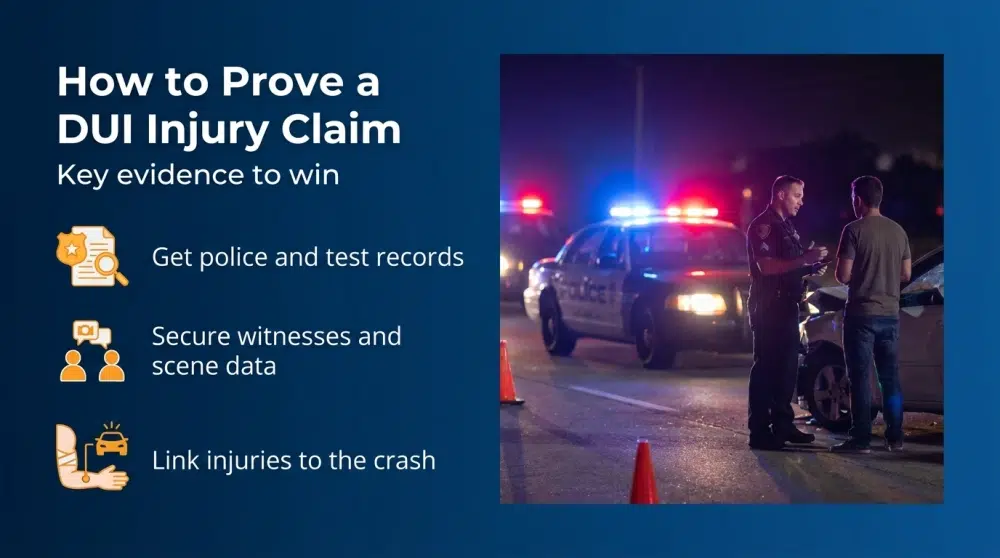
- Police reports and arrest information. These may include observations of odor of alcohol, field sobriety issues, statements, and citations.
- Chemical test results. Blood or breath results can support impairment claims, though civil lawyers still look closely at timing and accuracy issues.
- Criminal case records. A plea or conviction can be relevant, though not every case will have one by the time the civil claim begins.
- Witness testimony. Bystanders, passengers, or first responders may describe erratic driving or post crash behavior.
- Scene evidence. Skid marks, debris, vehicle damage, surveillance footage, and event data can help show how the crash happened.
- Medical evidence. Treatment records connect the crash to the injuries and help explain the extent of harm.
Does a criminal conviction have to happen first?
No. Civil and criminal proceedings are separate. A plaintiff can pursue a DUI injury claim California courts recognize without waiting for a conviction. Still, if a conviction or plea happens later, it may become useful evidence.
How does causation get argued?
That is often the main battlefield. Plaintiffs argue the defendant’s intoxication and driving choices caused the wreck. Defendants may counter that the crash would have happened regardless, that another driver caused the collision, or that the injuries claimed were not all caused by the crash. This is one reason evidence preservation matters early.
For serious motor vehicle claims, car accident lawyers is often the core practice area. In Los Angeles car accident lawyers discussions, impaired driving cases tend to draw closer scrutiny because the facts may support both compensatory and punitive damages theories.
How do defendants respond in civil DUI cases?
Civil DUI cases are not one sided. Defendants and insurers usually test every part of the claim.
What are common defense arguments?
- The driver was not impaired at the time of impact. A defense may challenge the timing or reliability of testing.
- The plaintiff also contributed to the crash. Comparative fault can reduce damages [3].
- The injuries are overstated. Defendants may argue that treatment was excessive, delayed, or unrelated.
- Punitive damages are not justified. The defense may argue the conduct does not rise to the level required by Civil Code section 3294 [4].
- Other defendants should not be included. This is common where plaintiffs try to add employers, hosts, or alcohol providers without a solid legal basis.
Do insurance issues complicate the case?
Often. Liability limits may be too low to cover severe harm. There may be disputes about permissive use, coverage exclusions, umbrella policies, or uninsured and underinsured motorist benefits. These questions affect both plaintiffs and defendants because they shape settlement discussions and case value.
What damages can be recovered?
In a civil DUI crash case, recoverable damages usually fall into two broad categories.
What compensatory damages are available?
- Medical expenses. Emergency care, hospital bills, surgery, rehab, medications, and future treatment.
- Lost income. Wages already lost and reduced earning capacity going forward.
- Property damage. Repair or replacement of the vehicle and related losses.
- Pain and suffering. Physical pain, emotional distress, disruption to daily life, and similar non economic harm.
- Wrongful death related damages. In fatal cases, eligible family members may seek damages allowed by California law [5].
How is drunk driving car accident compensation evaluated?
It depends on injury severity, treatment needs, work impact, insurance coverage, and available evidence. There is no valid one size fits all number. That is true whether you are a plaintiff trying to document loss or a defendant trying to assess exposure. If the crash caused life changing harm, the value can be far greater than a typical soft tissue collision because future damages may be substantial.
For many readers, California personal injury lawyer and personal injury claim are the broad phrases that connect this issue to the larger civil system. A drunk driving case is still a personal injury case, but one with potentially sharper liability facts.
When are punitive damages possible?
Punitive damages drunk driving California cases are often discussed because DUI facts can support a stronger argument for punishment and deterrence. Under Civil Code section 3294, punitive damages may be available in a noncontract action when the plaintiff proves by clear and convincing evidence that the defendant acted with oppression, fraud, or malice [4].
Why can drunk driving support a punitive claim?
The argument is that choosing to drive while impaired can show a willful and conscious disregard for the safety of others. The exact facts matter. Prior similar conduct, highly dangerous driving behavior, very high intoxication levels, fleeing the scene, or other aggravating facts may strengthen the claim. But punitive damages are not automatic.
What standard of proof applies?
Clear and convincing evidence. That is a higher burden than the ordinary preponderance standard for most civil claims [4]. Defendants often fight hard at this stage because punitive exposure can substantially change case risk.
Can employers face punitive exposure too?
Only under stricter statutory rules. The plaintiff must show more than ordinary vicarious liability. California law requires proof such as authorization, ratification, conscious disregard, or similar conduct by certain high level personnel [4].
What should you do after a California DUI crash?
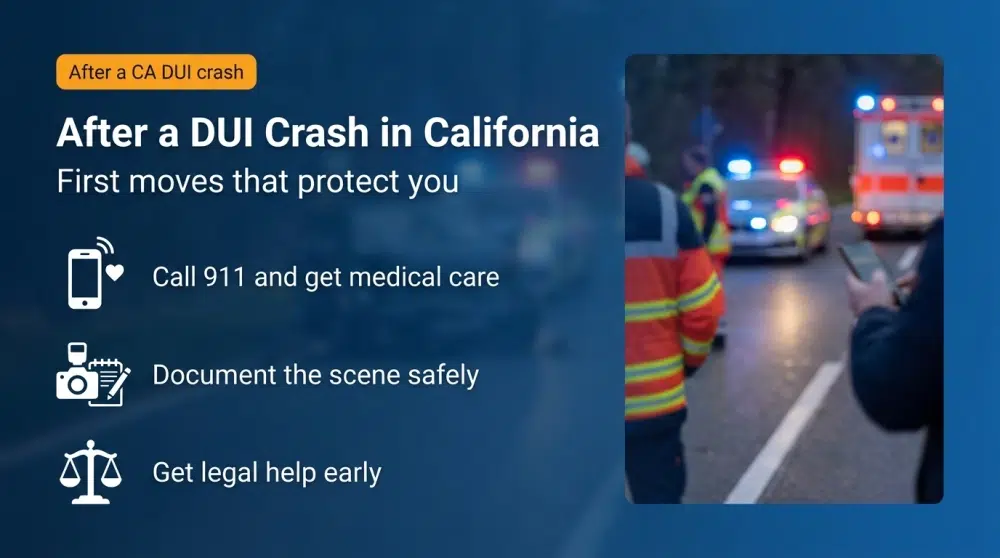
Your immediate focus should be safety, medical care, and evidence preservation.
- Call 911 and seek medical evaluation. Some serious injuries are not obvious in the first hour.
- Cooperate with law enforcement factually. Avoid speculation.
- Document the scene if you can do so safely. Photos, videos, witness names, and vehicle positions can matter later.
- Keep all treatment and expense records. Civil cases rise or fall on documentation.
- Avoid casual statements to insurers. Especially before you understand the full scope of injury.
- Get legal guidance early. That helps preserve evidence and avoid mistakes that can weaken a claim or defense.
If you are trying to understand the first steps after a collision, what to do after a car accident in los angeles california gives a practical overview.
Why does legal help matter in civil cases?
Because these are not simple paperwork disputes. A DUI crash can trigger overlapping medical, insurance, evidentiary, and procedural problems. Plaintiffs need to value damages correctly, secure records, and anticipate defenses. Defendants need to protect against overreach, inaccurate allegations, and unsupported damages demands. The stakes can rise quickly in catastrophic injury or death cases.
That is why many people turn to accident lawyers or California personal injury lawyer searches after an impaired driving collision. It is also why plaintiffs may look for auto accident attorneys or vehicle accident injury claims information when a crash involves major bodily harm.
In the Los Angeles market, personal injury lawyers in Los Angeles and auto accident attorneys in Los Angeles are common search patterns because local medical providers, insurers, courts, and collision patterns all shape how these cases move. If the crash was fatal, wrongful death claim and wrongful death lawyers are also relevant terms in civil litigation.
How can GoSuits help after a serious crash?
If you were hurt in a California DUI crash and want practical guidance, a free consultation can help you understand what evidence matters, what insurance issues may come up, and what deadlines may apply. GoSuits handles personal injury matters in California, Texas, and Illinois. We use a technology driven approach built around exclusive proprietary software designed to move cases forward faster and more efficiently, while keeping your case organized from day one.
Even with that technology, your case is handled by a designated attorney, not a case manager. Every client has direct access to their attorney. That matters when you need answers about liability, treatment, insurance delays, or litigation strategy. Our team has 30 years of combined experience across practice areas, and our trial background matters because insurers evaluate cases differently when they know a firm is prepared to take a case into court when needed.
We also encourage you to review our prior cases, learn more about our attorneys, and read about us to understand how we work. If you need to speak with someone about the next steps after a serious collision, you can schedule a free consultation.
References
- California Civil Code Section 1714 – California Legislative Information
- California Vehicle Code Section 23152 – California Legislative Information
- CACI No. 405 Comparative Fault of Plaintiff – Justia California Civil Jury Instructions
- California Civil Code Section 3294 – California Legislative Information
- California Wrongful Death and Survival Statutes, Code of Civil Procedure Title 3 – California Legislative Information
- Drunk Driving – National Highway Traffic Safety Administration
- DUI General Information – California Department of Motor Vehicles
- Crash Rankings Results and Statewide Traffic Safety Data – California Office of Traffic Safety
- Drunk Driving Campaign Resources – California Office of Traffic Safety
- Alcohol Use and Your Health – Centers for Disease Control and Prevention
- Wrongful Death – California Courts Self Help Guide
- Punitive Damages – Cornell Law School Legal Information Institute