- What We Know About the SR-78 Multi-Vehicle Crash in Vista
- Timeline, Location, and Traffic Impacts
- Law Enforcement and Agency Response
- What Causes Multi-Vehicle Crashes on Freeways Like SR-78?
- If You Were Involved: Immediate Health and Safety Steps
- How to Obtain Official Records and Information
- Insurance and Liability Basics After a Multi-Car Collision
- Common Mistakes That Can Weaken a Claim
- Local Context: SR-78 and North County Driving Patterns
- When Could a Public Entity Be Part of the Case?
- What to Document Now: Practical Checklist
- Why Taking Action Early Matters
- Commentary from Gosuits Vista, California Personal Injury Attorney
- References
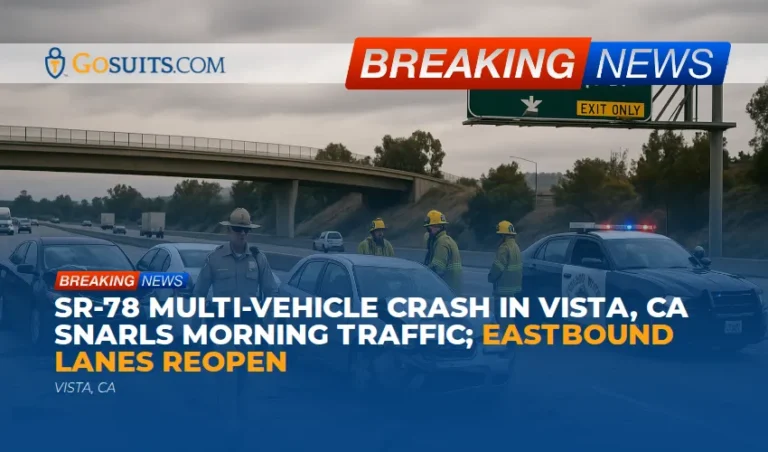
What We Know About the SR-78 Multi-Vehicle Crash in Vista
On Thursday morning, April 16, 2026, a multi-vehicle collision on State Route 78 in the Vista area blocked multiple eastbound lanes just west of Vista Village Drive. The incident was reported shortly before 7:30 a.m., during the busiest part of the North County morning commute. According to officials, traffic was temporarily diverted at Melrose Drive while emergency crews worked to clear vehicles and debris. By about 8:20 a.m., the No. 1 and No. 2 lanes had reopened, allowing traffic to begin moving again. These updates align with how the California Highway Patrol and Caltrans typically manage significant freeway incidents in San Diego County, especially along key commuter corridors like SR-78 [1] [2].
At the time of reporting, details about injuries, the number of vehicles involved, and potential causes had not been publicly confirmed. For anyone directly affected, official records such as a CHP collision report or Caltrans incident logs will provide the most reliable information once available.
Timeline, Location, and Traffic Impacts
Based on information shared by transportation agencies, here is how the morning unfolded for drivers traveling through Vista toward Escondido and points east:
- Approx. 7:25 a.m. A multi-vehicle crash is reported on SR-78 eastbound, just west of Vista Village Drive. CHP initiates a response and coordinates incident command. In many such events, a SigAlert may be issued to alert motorists to significant lane closures and delays [1].
- Traffic diversion at Melrose Drive Caltrans and CHP direct eastbound traffic off the freeway at Melrose Drive to relieve backup and provide space for emergency crews to operate safely [2].
- Approx. 8:20 a.m. Officials report the reopening of the No. 1 and No. 2 lanes, easing the bottleneck and reducing delays as cleanup progresses.
Impacts spread quickly on SR-78 because it serves as a vital east-west link between Oceanside, Vista, San Marcos, and Escondido. When lanes close near Vista Village Drive, congestion often backs up toward Shadowridge and through the Melrose Drive interchange. Local arterials like South Santa Fe Avenue, Sycamore Avenue, and East Vista Way typically see spillover when traffic is diverted. Caltrans’ QuickMap often displays real-time congestion and closures for these events [2].
Law Enforcement and Agency Response
On California’s state highways, the California Highway Patrol manages traffic collisions, coordinates tow operations, and documents the scene for collision reports. Caltrans District 11 handles traffic control devices, changeable message signs, and lane closures so first responders can work safely. CHP’s Traffic Incident Information Page is the central hub for ongoing updates about active freeway incidents throughout the region [1] [12].
In North County, the CHP Oceanside Area office typically covers the SR-78 corridor, including the segment through Vista. Their public contact page and office listing are maintained on the CHP website for records requests and community information [13].
What Causes Multi-Vehicle Crashes on Freeways Like SR-78?
While investigators will determine what actually occurred in this crash, there are well-documented patterns in multi-vehicle freeway collisions. National data show that traffic density, speed variance, following distance, and secondary braking behavior can all contribute to chain-reaction impacts. In heavier commute periods like weekday mornings, even a minor initial collision can trigger rapid slowdowns that catch drivers off guard.
According to NHTSA’s Traffic Safety Facts 2022 overview, multi-vehicle crashes remain a substantial share of serious roadway incidents nationwide. Speeding, impaired driving, and driver distraction are consistently cited behavioral factors in fatal and injury crashes. Data overviews like these help frame the broader safety context, even when a single incident’s root cause is still under review [10].
California’s Office of Traffic Safety tracks crash trends by city and county so communities can understand where and when problems concentrate. North County’s blend of freeway commuting and busy surface streets means spikes can occur in specific corridors like SR-78, I-5, and SR-76. OTS’ public dashboards provide a useful lens on those long-term trends [11].
If You Were Involved: Immediate Health and Safety Steps
When multiple vehicles collide, adrenaline can mask pain. If you were in this crash and walked away, it is still smart to get a same-day medical evaluation. Primary care clinics, urgent care, or emergency departments near Tri-City area or Escondido can document injuries and rule out conditions that do not show symptoms right away. Keep all visit summaries, imaging records, prescriptions, and work-notes together in a folder.
California requires a driver or owner to report a crash to DMV within 10 days using the SR-1 form if the collision involves injury, death, or property damage of $1,000 or more. This is separate from insurance claims and police reports. The DMV provides the SR-1 online and explains how to complete it [3]. Also, the Vehicle Code requires that certain injury or death collisions be reported to law enforcement within 24 hours, which CHP typically handles for freeway crashes like this one [4].
If you are unsure about next steps after a freeway collision in California, see this practical guide: what to do after a california car accident. It covers scene safety, evidence to gather, and how to protect your claim path.

How to Obtain Official Records and Information
CHP Collision Report
For crashes on state routes, the investigating agency is almost always CHP. If you were a driver, passenger, or registered owner, you can request the official collision report. CHP uses the CHP 190 process for collision report requests. The agency explains who is eligible and how to submit identification and payment, if required [5].
To find the right office, consult the CHP Oceanside Area listing, which serves the SR-78 corridor in North County. Their page provides mailing addresses and contact details for public records requests [13].
911 Recordings and CAD Logs
Computer Aided Dispatch (CAD) logs and 911 audio, when available, can clarify timelines, reported hazards, and early observations by witnesses. Requests are typically made to the investigating law enforcement agency through a Public Records Act request. The CHP’s public records portal explains procedures for seeking incident-related records, subject to exemptions [5] [12].
Caltrans Incident and Lane Closure Information
Caltrans’ QuickMap provides real-time lane closures, traffic speeds, and incident markers. While it is primarily a live traffic tool, it can help corroborate the time windows when closures were active. For agency background and district-level updates, Caltrans District 11’s page covers maintenance and operations in San Diego County [2] [12].
Vehicle Towing and Release
CHP can confirm which tow providers responded and where vehicles were taken. If your vehicle was towed from the SR-78 scene, call the investigating CHP office with your case number to locate the storage yard and confirm release requirements.
If a Fatality Occurred: Autopsy, Death Certificate, and Next Steps
At this time, no fatality has been publicly reported. Generally, if a death occurs in a traffic collision in San Diego County, the San Diego County Medical Examiner would handle the investigation and issue the death certificate after determining cause and manner of death. Families can find instructions for requesting examination reports, next-of-kin assistance, and certified copies on the Medical Examiner’s website [6].
City or County Police Reports for Related Incidents
If the crash had related incidents off the freeway or on surface streets in Vista, those may fall under the San Diego County Sheriff’s Department, which provides policing services in Vista. Public records requests to the Sheriff can be made through their PRA portal for qualifying records [7].
Insurance and Liability Basics After a Multi-Car Collision
Multi-vehicle crashes can raise complicated fault and insurance questions. California’s comparative negligence system allows fault to be shared across multiple drivers, and liability insurers will often point fingers at one another while they investigate. In chain-reaction collisions, adjusters study damage patterns, vehicle positions, and witness statements to determine which impacts were primary versus secondary.
It is common for each insurer to request recorded statements right away. Before giving any statement, it is prudent to consult with a trusted attorney so you understand how your words can affect fault allocation and injury valuation later. Many people search for car accident lawyers at this stage because a coordinated approach to statements and documentation can help avoid avoidable coverage disputes.
Here are general coverage paths that often come into play in freeway multi-car crashes:
- Liability coverage The at-fault driver’s liability policy is primary for bodily injury and property damage, up to policy limits.
- Medical payments (MedPay) Optional coverage on your own policy that can pay medical bills quickly, often without regard to fault.
- Uninsured/Underinsured Motorist (UM/UIM) If the at-fault driver has low or no coverage, UM/UIM can stand in to address medical losses and sometimes pain and suffering, depending on policy language.
- Collision coverage Addresses your own vehicle repairs, subject to deductible, especially useful when liability is still being sorted out.
Sorting priority of payments when multiple insurers are involved can be confusing. If you want a deeper dive on how carriers coordinate after pileups, this resource may help: which insurance pays first after a multi car crash gosuits.
Given the proximity to Orange County and frequent cross-county commutes, many North County drivers carry policies purchased or serviced in neighboring areas. For some, the reassurance of working with car accident lawyers in Irvine lies in proximity and familiarity with Southern California freeway corridors like SR-78, I-5, and the 405 that tie our region together.
Common Mistakes That Can Weaken a Claim
- Delaying medical care Gaps in treatment invite arguments that injuries were minor or unrelated. Get checked and follow the care plan.
- Talking to adjusters before understanding your rights What you say can be used to dispute fault or minimize injuries later. Consider speaking with an attorney first.
- Posting on social media Photos or comments can be misinterpreted and used against you by insurers.
- Not documenting the scene In multi-vehicle crashes, photos of all involved cars, debris fields, skid marks, and traffic control are crucial to reconstruct events.
- Failing to file required forms Do not miss the DMV SR-1 reporting requirement when it applies [3].
Working with seasoned advocates can help you avoid these pitfalls. Many people turn to car accident lawyers when multiple insurers want statements, medical bills start arriving, and there is uncertainty around who pays for what.
Local Context: SR-78 and North County Driving Patterns
SR-78 is a lifeline through North County, connecting Oceanside, Vista, San Marcos, and Escondido. At Vista Village Drive, volumes are consistently heavy because of access to the city center and nearby shopping corridors. Morning traffic funnels in from Melrose Drive, Emerald Drive, and Sycamore Avenue, and then merges into the two- and three-lane segments that create friction during peak times.
Commuters from the Vista and Shadowridge neighborhoods often head east toward the I-15 corridor or southeast toward San Marcos and Palomar College. The NCTD SPRINTER rail parallels much of SR-78, and when the freeway slows, some residents opt for stations near Vista Transit Center or Buena Creek to avoid backups. Around school start times and during wet winter mornings, congestion and risk can spike along this corridor.
Locals know that even a short closure west of Vista Village Drive can create gridlock through Rancho Vista and stretches of Melrose. If you are ever detoured at Melrose Drive, allow extra time and be mindful of pedestrians and cyclists along the surface streets that see sudden increases in traffic.
When Could a Public Entity Be Part of the Case?
Most freeway collisions are caused by driver behavior. In more limited situations, potential claims may involve roadway conditions, traffic control, or debris that raise questions about a public entity’s role. Caltrans is responsible for maintaining and operating state highways like SR-78 within District 11. If someone believes a roadway defect or maintenance issue played a role, California’s Government Claims Program outlines how to present a claim to the state. Strict timelines apply, and the process is different from a typical insurance claim [8].
Under California’s Government Claims Act, claims for money or damages against public entities generally must be presented within six months for personal injury causes of action, with defined exceptions. The California Government Code provides details on these deadlines and procedures. Anyone considering this path should pay close attention to statutory timing and filing requirements [9].
What to Document Now: Practical Checklist
Evidence gets harder to find with each passing day, especially after multi-vehicle freeway collisions. Consider gathering the following:
- Scene photos and videos Vehicle positions, damage to all sides, license plates, debris, tire marks, lane closure signs, and any visible hazards.
- Contact details Names, phone numbers, and insurance information for all drivers and independent witnesses.
- Medical records Visit summaries, imaging, prescriptions, and work restrictions. Keep a simple daily pain journal to track symptoms.
- Work and expense proofs Pay stubs, time-off records, tow and storage bills, rental car invoices, and repair estimates.
- Agency records Your CHP report number, any tow yard receipts, and notes from calls with insurers.
- Traffic data snapshots If you captured maps or live traffic screens during the incident window, save them with timestamps. Caltrans QuickMap is a useful live source [2].
Why Taking Action Early Matters
What should people do next after a multi-vehicle freeway crash? Act quickly to preserve evidence, understand your rights, and keep options open.
- Secure official records Request the CHP collision report and related records as soon as they are available. Timelines vary, and requests sometimes take weeks to process [5].
- Protect your statements Insurers move fast to collect recorded statements. Consulting with an attorney first can help you avoid unintentional admissions and ensure key facts are framed clearly.
- Meet legal deadlines DMV crash reporting rules and, in rare cases, public entity claim deadlines have strict timelines [3] [9]. Missing them can limit certain avenues of recovery.
- Control the narrative with documents Photos, medical notes, and work-loss proof speak louder than memory months later. Gathering early creates a stronger foundation for any claim.
- Evaluate coverage strategically Layering liability, MedPay, UM/UIM, and collision is easier when you know policy terms up front. A brief consult can help clarify which policies may apply and in what order.
The benefit of moving early is simple: better evidence, clearer medical records, fewer avoidable disputes, and reduced stress from guesswork. When to act is now, while the scene is fresh and memories are accurate. Where to act is through the proper channels: CHP for reports, Caltrans for roadway information, healthcare providers for documentation, and insurance carriers with care and preparation after you understand your rights. Why it matters is that these steps can materially influence how insurers evaluate fault, injury causation, and damages down the line.

Commentary from Gosuits Vista, California Personal Injury Attorney
First, our thoughts are with everyone affected by this morning’s SR-78 pileup. Crashes like this disrupt lives in an instant, and the uncertainty that follows can be overwhelming. This article is intended for general information and educational purposes only.
From a civil injury perspective, multi-car freeway collisions present a familiar set of questions: Which impact came first, how did traffic conditions contribute, and what role did driver behavior play in the chain reaction? Reconstruction depends on damage patterns, independent witnesses, on-scene measurements, and the official CHP report. Early documentation by those involved often makes a meaningful difference in how liability gets allocated.
In our experience, insurance companies and large corporations know the information asymmetry that exists right after a crash. They move quickly to gather statements, ask broad medical questions, and push for early resolutions before full injuries and long-term costs are known. Without guidance, people may accidentally downplay symptoms, accept repair estimates that miss frame or suspension damage from a freeway-speed impact, or sign authorizations that are not in their best interest.
That is why a free consultation can matter. A short, no-obligation conversation helps clarify coverage options, reporting requirements, and what to say or not say to insurers. It does not promise a result. It simply arms people with a plan so they are not navigating a complex process alone or on the insurer’s terms.
References
- California Highway Patrol Traffic Incident Information
- Caltrans QuickMap
- Traffic Accident Report SR-1 – California DMV
- California Vehicle Code § 20008 – Duty to Report Accidents
- CHP 190 – Request a Collision Report
- San Diego County Medical Examiner – Official Site
- San Diego County Sheriff – Public Records Act Requests
- California Government Claims Program – How to File a Claim
- California Government Code § 911.2 – Claims Presentation Deadline
- Traffic Safety Facts 2022: A Compilation of Motor Vehicle Crash Data – NHTSA
- California Office of Traffic Safety – Crash Rankings
- Caltrans District 11 – San Diego and Imperial Counties
- CHP Oceanside Area Office – Contact and Information