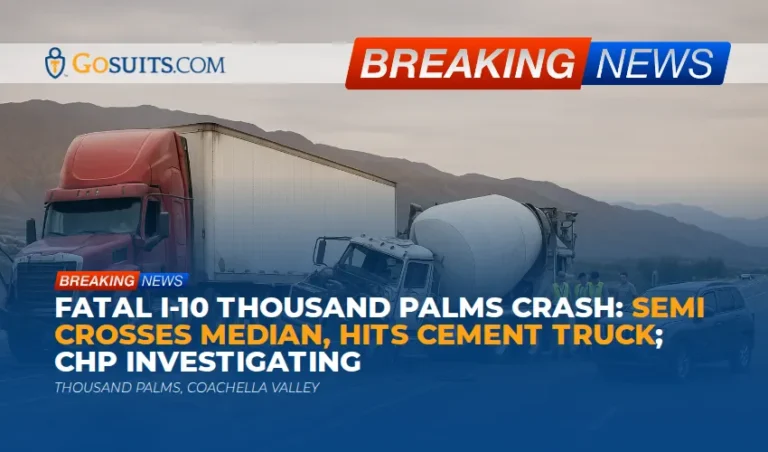
- What we know about the I-10 Thousand Palms crash
- Where and when it happened, and how traffic was impacted
- How CHP and crash investigators determine what happened
- Why cross-median truck crashes are so dangerous
- Rights and options for injured people and families after a fatal truck crash
- Which insurance policies may apply in a multi-vehicle truck collision
- Essential steps to protect a claim in the Coachella Valley
- How to get key records: CHP report, medical records, and coroner information
- Grief, logistics, and local support around Palm Springs and Thousand Palms
- Common pitfalls with insurers after a serious crash
- Click to action: Why timely action matters now
- Commentary from Gosuits Thousand Palms, California Personal Injury Attorney
- Resources and References
What we know about the I-10 Thousand Palms crash
Morning commutes through Thousand Palms are familiar to many in the Coachella Valley. You pass the Washington Street interchange, see the mountains catching early sun, and share the road with local workers, visitors, and heavy trucks moving freight across the I-10 corridor. On Tuesday morning, that routine was shattered by a violent multi-vehicle collision west of Washington Street.
According to information shared by authorities, around 7:50 a.m. a semi-truck traveling eastbound on Interstate 10 for unknown reasons veered left, crossed the center median, and entered the westbound lanes. The semi broadsided a cement truck. While the semi was left perpendicular across the freeway, it was then struck by a Jeep. The incident also triggered additional crashes in the eastbound lanes, ultimately affecting multiple vehicles.
The driver of the cement truck, a 62-year-old man from Yucca Valley, tragically died at the scene. The semi-truck driver, a 38-year-old man from Menifee, was transported to Desert Regional Medical Center in Palm Springs with major injuries. In total, six patients were taken to local hospitals with injuries ranging from major to precautionary. The California Highway Patrol confirmed that all lanes reopened by early evening, but not before a day of heavy disruption for drivers throughout the Coachella Valley.
CHP is asking anyone with information to contact Officer J. Paz at the Indio Area office at 760-772-5300. If you witnessed the crash, saw the vehicles just before impact, or have dashcam video from around 7:40 to 8:00 a.m. in the Thousand Palms area of I-10, that information can be particularly valuable to investigators.
Where and when it happened, and how traffic was impacted
The crash unfolded on Interstate 10 near Thousand Palms, west of the Washington Street interchange. That stretch serves thousands of drivers each morning coming from communities like Palm Desert, Rancho Mirage, and Cathedral City, as well as workers heading toward job sites in Indio and Palm Springs. It is also a primary trucking route connecting the Inland Empire’s logistics hubs with points east.
Because lanes in both directions were affected, backups rippled across local surface streets. Washington Street and Varner Road typically bear the brunt when I-10 stalls, and Tuesday was no exception. With the corridor closed for hours, congestion persisted until evening when CHP confirmed all lanes had reopened.
How CHP and crash investigators determine what happened
When a heavy truck crosses a median and multiple vehicles are involved, investigators focus on careful, methodical evidence gathering. In major injury or fatal crashes, California Highway Patrol may bring specialized resources to the scene, review vehicle modules, and reconstruct the sequence of impacts.
Typical components of a serious-collision investigation include:
- Scene measurements and mapping including tire marks, gouge marks, vehicle rest positions, and roadway features. These details help reconstruct speeds, directions, and timing.
- Event Data Recorder (EDR) downloads from equipped vehicles. Many heavy trucks and modern passenger vehicles store short bursts of pre-crash data such as speed, throttle position, and brake application. California law recognizes privacy interests in EDR data and regulates who may access it and when [12].
- Vehicle inspections to check brake condition, steering components, tires, cargo securement, lighting, and any mechanical failures that could have contributed.
- Driver-related factors including medical events, fatigue, distraction, and compliance with federal hours-of-service rules that limit driving time for commercial drivers [11].
- Witness statements and video from nearby motorists, dashcams, and potentially fixed cameras on the corridor. This is where community help can make a difference.
Investigations into large truck crashes often reference national research to understand common contributing factors. The Federal Motor Carrier Safety Administration’s Large Truck Crash Causation Study identified driver decision errors, recognition errors, and vehicle condition issues among recurrent contributors in serious truck collisions [3]. National data from NHTSA provides broader context on how often large trucks are involved in fatal and injury crashes and the typical dynamics of those events [4].
Why cross-median truck crashes are so dangerous
A heavy truck entering oncoming lanes is among the most catastrophic roadway scenarios. Even at moderate speeds, mass and momentum are unforgiving. Cross-median intrusions can lead to head-on or broadside impacts that occur with little warning.
Highway medians are engineered to reduce these events. Depending on the corridor, agencies use concrete barriers, guardrail, or cable median systems. The Federal Highway Administration highlights median barriers as a proven countermeasure for reducing the severity of cross-median crashes, especially on high-speed divided highways [10]. Still, no system eliminates all risk. Factors such as roadway geometry, barrier spacing, maintenance, and extraordinary vehicle dynamics can allow intrusions in certain conditions.
Locally, I-10 through the Coachella Valley experiences everything from intense seasonal traffic to powerful winds near the San Gorgonio Pass. While the cause here remains under investigation, the physics of a large truck deviating across the median explain why multiple lanes and vehicles were affected so quickly.
Rights and options for injured people and families after a fatal truck crash
California law provides a framework for injury and wrongful death claims when negligence contributes to a crash. Every driver owes a basic duty to use reasonable care under the circumstances [6]. When that duty is breached and causes harm, the law allows injured people and eligible surviving family members to pursue compensation through civil claims.
In a fatal crash, California’s wrongful death statute permits certain close family members to bring a wrongful death action for the harms they suffer because of the death, such as loss of companionship and support [7]. A separate but related survival action may address the decedent’s own pre-death losses if applicable, brought by the estate.
Two timing rules are critical:
- General statute of limitations: In most California personal injury and wrongful death matters, the deadline to file suit is two years from the date of injury or death [8].
- Shorter deadlines for public entities: If a public agency may be implicated in any part of the claim, specialized notice rules and shorter deadlines can apply. Families should be aware that these timelines can be far shorter than two years.
Nothing here is case-specific legal advice. It is educational information to help the community understand the civil process that follows a serious highway tragedy. Every situation is unique.
Which insurance policies may apply in a multi-vehicle truck collision
Multi-vehicle crashes involving a tractor-trailer can trigger several layers of insurance. Depending on the facts, potential coverages and policies may include:
- Commercial auto liability carried by the trucking company or owner-operator for the tractor and possibly a separate policy for the trailer.
- Motor carrier coverage and endorsements addressing interstate trucking operations and federal financial responsibility requirements.
- Employer liability theories such as vicarious liability or negligent hiring, retention, training, or supervision, where evidence supports those claims.
- Other involved drivers’ auto liability policies if their actions contributed to additional impacts.
- Uninsured or underinsured motorist coverage on a victim’s own policy, which may apply if at-fault coverage is insufficient.
- Medical payments coverage and health insurance for immediate medical bills while liability is sorted out.
Because coverage analysis can get complex quickly after a chain-reaction crash, many families turn to seasoned counsel for help tracing all potentially available insurance and preserving evidence. In serious cases, coordination among investigators and claims professionals starts within hours, so understanding how these pieces fit together can be important early on.
In truck crash cases that involve hours-on-duty questions, federal rules limiting the driving and on-duty time for commercial drivers may also become relevant [11]. That is one reason thorough evidence collection about the driver’s work schedule, logs, and electronic tracking systems often occurs soon after a crash.

Essential steps to protect a claim in the Coachella Valley
Here are practical steps many people follow in the first days after a serious highway crash. Everyone’s situation is different, so take what fits and leave the rest.
- Preserve physical evidence. Ask that vehicles be preserved without destructive repairs until inspections are completed. Event Data Recorder information can be overwritten or lost if the vehicle is powered and driven after a crash, so timely steps matter [12].
- Collect and organize your records. Keep hospital discharge papers, imaging reports, medication receipts, and any work absence notes together. That also includes photos, dashcam files, and contact info for witnesses.
- Be careful with recorded statements. Insurance adjusters may contact people quickly. Many prefer to consult with counsel before giving any recorded statement because statements can be used in ways that affect a claim later.
- Report the crash to the DMV when required. California requires drivers involved in a collision to submit an SR-1 form to the DMV within 10 days if there is injury, death, or property damage of at least a statutory threshold [2].
- Request the official CHP Traffic Collision Report. CHP uses Form 190 for public requests. You will need case details and your role to qualify for a copy [1].
- Mind the timelines. The two-year statute for most injury and wrongful death claims in California runs quickly, and important evidence is easiest to gather early [8].
Many people seek guidance from truck accident lawyers before engaging with any insurance company. Doing so helps ensure that what is said to an adjuster does not unintentionally narrow or undermine a valid claim.
For a deeper primer tailored to our state, see this in-depth resource: Legal overview for truck accident victims in California. It explains how evidence, liability, and insurance often intersect after a heavy-vehicle crash here.
How to get key records: CHP report, medical records, and coroner information
CHP Traffic Collision Report
The California Highway Patrol provides collision reports to involved parties and their legal representatives. To request a copy, complete the CHP 190 form and submit it to the appropriate Area office with the report number and proof of involvement. CHP explains eligibility, privacy limitations, and the process for obtaining reports on its public guidance page [1].
DMV SR-1 crash reporting
California drivers must submit a DMV SR-1 Traffic Accident Report within 10 days for collisions involving death, injury, or qualifying property damage. Filing is required even if law enforcement took a report, and failure to comply can affect driving privileges. You can review the requirements and submission options through the DMV’s official information page [2].
Medical records from hospitals and clinics
Patients or authorized representatives can request treatment records directly from healthcare providers such as hospitals and clinics. For this crash, some patients were taken to Desert Regional Medical Center. Hospitals typically have a Health Information Management or Medical Records department that processes requests. Expect to provide identification, dates of service, and signed authorization if you are requesting for a family member.
Coroner’s office and autopsy information
In California, coroners investigate certain deaths, including those from sudden, unexpected, or traumatic causes. The California Government Code and related statutes define coroner responsibilities and investigative scope. While each county’s processes differ, families can usually request information about the cause and manner of death, as well as obtain certified copies of reports according to local procedures and applicable privacy rules. California’s statutory framework recognizes both public access and privacy limits in death investigations; families may pursue records by following county-specific protocols and California Public Records Act provisions where they apply [13].
911 audio and dispatch logs
Some families and counsel request 911 audio, Computer Aided Dispatch logs, or radio traffic. These are often held by public agencies and may be requested under the California Public Records Act, subject to exemptions for active investigations and privacy. Always follow the agency’s published instructions and include dates, times, and locations to narrow the request [13].
Grief, logistics, and local support around Palm Springs and Thousand Palms
When a tragedy like this hits close to home, people across the Coachella Valley feel it. Thousand Palms sits between Palm Desert and Cathedral City, with I-10 acting as a daily lifeline for commuting, deliveries, and visitors heading to Palm Springs or Indio. The human toll of a fatal crash reaches co-workers, friends, and neighbors alike.
Medical care in our area often runs through facilities like Desert Regional Medical Center in Palm Springs and Eisenhower Health in Rancho Mirage, depending on injury severity and trauma protocols. California’s trauma system designates hospitals with specialized resources to manage critical injuries, allowing first responders to route patients where they can receive the highest level of care available in the region [9].
If transportation was impacted for your household on the day of the crash, you likely felt the gridlock along Washington Street and Varner Road. Those alternate routes get overwhelmed quickly when the freeway is closed. When incidents coincide with seasonal events, commute stress compounds for local workers and service staff. It is one more reminder of how a single crash on I-10 can ripple through daily life here.
Common pitfalls with insurers after a serious crash
Insurance companies are trained to move quickly. In multi-vehicle truck collisions, multiple adjusters may call. They will ask for statements, authorizations for records, and sometimes propose quick property damage or general release documents. It is natural to want to get things resolved, but speed is not always your friend in high-stakes cases.
Some common pitfalls include providing broad recorded statements before understanding injuries, signing blanket medical authorizations, or accepting early settlement offers that do not account for future care, wage loss, or the full impact of a wrongful death claim. Many people prefer to coordinate communications through counsel to avoid unintentional missteps. In California’s larger injury cases, families often consult with Irvine truck accident lawyers who regularly manage heavy-vehicle evidence and complex insurance layers.
Preserving and understanding technical evidence
In serious truck crashes, technical evidence can make or break liability questions. Here are a few examples of what is commonly preserved or evaluated:
- Event Data Recorder and telematics. EDR and fleet telematics may track speed, hard braking, engine fault codes, and duty status. California law addresses ownership and access to EDR data at the vehicle level [12].
- Maintenance and inspection logs. Brake and tire condition, steering components, and load securement are routinely examined for defects or failures.
- Hours-of-service compliance. Electronic Logging Devices and related documents establish whether a driver complied with federal hours-of-service limits [11].
- Roadway and barrier design context. Crash reconstruction sometimes considers how median barriers, shoulder width, and geometry may have affected vehicle paths or severity, tied to engineering guidance on barrier performance [10].
Because assembling these pieces takes time, many people consult truck accident lawyers early to help request preservation of vehicles and data while the trail is still warm.
Legal context: duties on divided highways and negligence basics
California’s Vehicle Code includes rules for divided highways and medians. Drivers on divided highways must remain on the correct roadway and are prohibited from driving across median strips except where official openings or crossings are provided [5]. California’s general negligence rule states that everyone is responsible for injury caused by their lack of ordinary care in the management of their person or property, subject to comparative fault considerations in a given case [6].
In a multi-vehicle scenario like Tuesday’s crash, investigators assess each driver’s conduct, vehicle condition, and the chain of events. It is not unusual for fault determinations to involve multiple parties. Families and injured people often keep in mind the two-year civil filing deadline for injury and wrongful death claims [8].
Community questions we often hear after a major I-10 crash
Will CHP finish the report before insurance starts calling?
Insurance companies often begin their process quickly, sometimes before the Traffic Collision Report is finalized. You can let adjusters know you are awaiting the official report and that you prefer to coordinate communication through your representative once you have consulted with counsel [1].
Why was the freeway closed for so long?
Fatal and serious-injury truck crashes require extended scene work to document evidence safely, clear heavy vehicles, and make roadway repairs if needed. The goal is to capture data now that cannot be recreated later, while reopening lanes as soon as safely possible. Median-related impacts and multiple directions affected can lengthen closures [10].
How do I know where my loved one was taken?
First responders transport patients based on injury severity and destination protocols. In the Coachella Valley, patients with major trauma are often routed to designated trauma facilities in the regional system [9]. Families can contact hospitals in Palm Springs, Rancho Mirage, and the greater Inland Empire depending on timing and transport direction.
Click to action: Why timely action matters now
Crashes like the one near Washington Street unfold in seconds, but the aftermath stretches for months or years. Taking focused steps early can preserve options and reduce confusion later. Here is what timely action can do and why it matters.
- Preserve critical evidence before it is lost. Vehicle data, dashcam footage, and roadway markings can disappear quickly due to repairs, weather, or routine data overwriting [12].
- Prevent avoidable paperwork problems. Submitting the DMV SR-1 when required and promptly requesting the CHP report helps prevent bureaucratic snags that can slow insurance processing [2], [1].
- Protect against insurer tactics. Early recorded statements or broad releases can be used to limit a claim later. Coordinating communications and understanding your rights first can avoid costly mistakes.
- Stay ahead of legal timelines. The two-year statute for most injury and wrongful death cases in California may sound long, but investigation and negotiation take time. Starting early helps ensure thoughtful decisions, not rushed ones [8].
- Document medical care accurately. Keeping a consistent treatment path and saving all records strengthens any later demonstration of injury and need for care.
What should be done next? Secure copies of essential records, ensure vehicles and electronic data are preserved, organize medical documentation, and speak with a qualified legal professional about how to proceed before engaging with any insurance company. Acting now helps protect rights and options while memories and data are still fresh.
Commentary from Gosuits Thousand Palms, California Personal Injury Attorney
Our hearts are with the family of the driver who lost his life and with every person injured in this devastating crash. We extend sincere sympathy to coworkers, friends, and community members throughout Thousand Palms, Palm Desert, and across the Coachella Valley who are affected by this tragedy. This commentary is shared for educational purposes and general information only.
Based on the information publicly described, a semi-truck crossed the median and entered oncoming lanes, broadsiding a cement truck and triggering additional collisions. When a heavy truck intrudes across a divided highway, the physics and limited reaction time for others on the roadway create a high risk of catastrophic outcomes. Pinpointing why a truck left its lane typically requires a detailed look at the driver’s condition, vehicle systems, maintenance, cargo, and hours-of-service records. It is appropriate that investigators are working to determine the cause before any definitive conclusions are drawn.
In our experience, insurance companies and corporate defendants often get to work immediately. They may assign multiple adjusters and start seeking statements even while families are in shock or receiving medical care. It is not unusual for early offers to focus on property damage while larger questions about medical needs, lost income, or a family’s wrongful death losses are left for later. That dynamic can disadvantage people who are unfamiliar with the process. Coordinating communications, preserving evidence, and understanding the full scope of potential claims helps level the playing field.
When someone is unsure where to begin, obtaining a free consultation with a seasoned personal injury lawyer can bring clarity. It helps people understand timelines, evidence preservation, and the sequence of steps to keep options open. It also ensures that anything said to an insurer is accurate, complete, and not used out of context later. While no outcome can be promised, informed decisions early on tend to produce better, more durable paths forward.
Resources and References
- How to Obtain a Traffic Collision Report – California Highway Patrol
- Submit an SR-1 Traffic Accident Report – California DMV
- Large Truck Crash Causation Study – FMCSA
- Traffic Safety Facts: Large Trucks – NHTSA
- California Vehicle Code § 21651 Driving on Divided Highways – California Legislature
- California Civil Code § 1714 General Duty of Care – California Legislature
- California Code of Civil Procedure § 377.60 Wrongful Death – California Legislature
- California Code of Civil Procedure § 335.1 Two-Year Limitations Period – California Legislature
- California Trauma System Overview – California EMS Authority
- Median Barriers and Cross-Median Crash Reduction – Federal Highway Administration
- Summary of Hours of Service Regulations – FMCSA
- California Vehicle Code § 9951 Event Data Recorders – California Legislature
- California Public Records Act Overview – California Legislature