








































What areas in northern Illinois do our Rockford slip and fall lawyers serve?
If you were injured in a fall anywhere in the Rockford metro area or across northern Illinois, GoSuits is ready to help. While our Illinois office is in Chicago, our legal team serves clients throughout Winnebago County and the surrounding region, and cases involving Rockford properties are filed in the Winnebago County Circuit Court.
We understand that slip and fall accidents happen everywhere: in grocery stores and big-box retailers, in apartment building stairwells, on unshoveled commercial walkways, in restaurant parking lots, and even on public sidewalks maintained by the City of Rockford. No matter where your fall occurred, we bring local legal knowledge and a thorough understanding of Illinois premises liability law to protect your rights and pursue the compensation you deserve.
Winnebago County sees a substantial number of fall-related injury claims each year, and the combination of aging commercial infrastructure and long, icy winters makes Rockford one of the more active northern Illinois markets for premises liability cases.
Areas we commonly serve
- Rockford (all neighborhoods, including Auburn, Midtown, Riverview, and the East State Street corridor)
- Loves Park and Machesney Park (northern Winnebago County communities with dense commercial retail zones)
- Belvidere (Boone County, just east of Rockford along I-90)
- South Beloit and Roscoe (northern Winnebago County corridor)
- Cherry Valley, Winnebago, and Pecatonica
- Surrounding Boone, Ogle, and Stephenson County communities
Wherever you are in the greater Rockford area, we’re just a call away and ready to step in when you need legal guidance after a fall injury.
What types of slip and fall cases do Rockford premises liability lawyers handle?
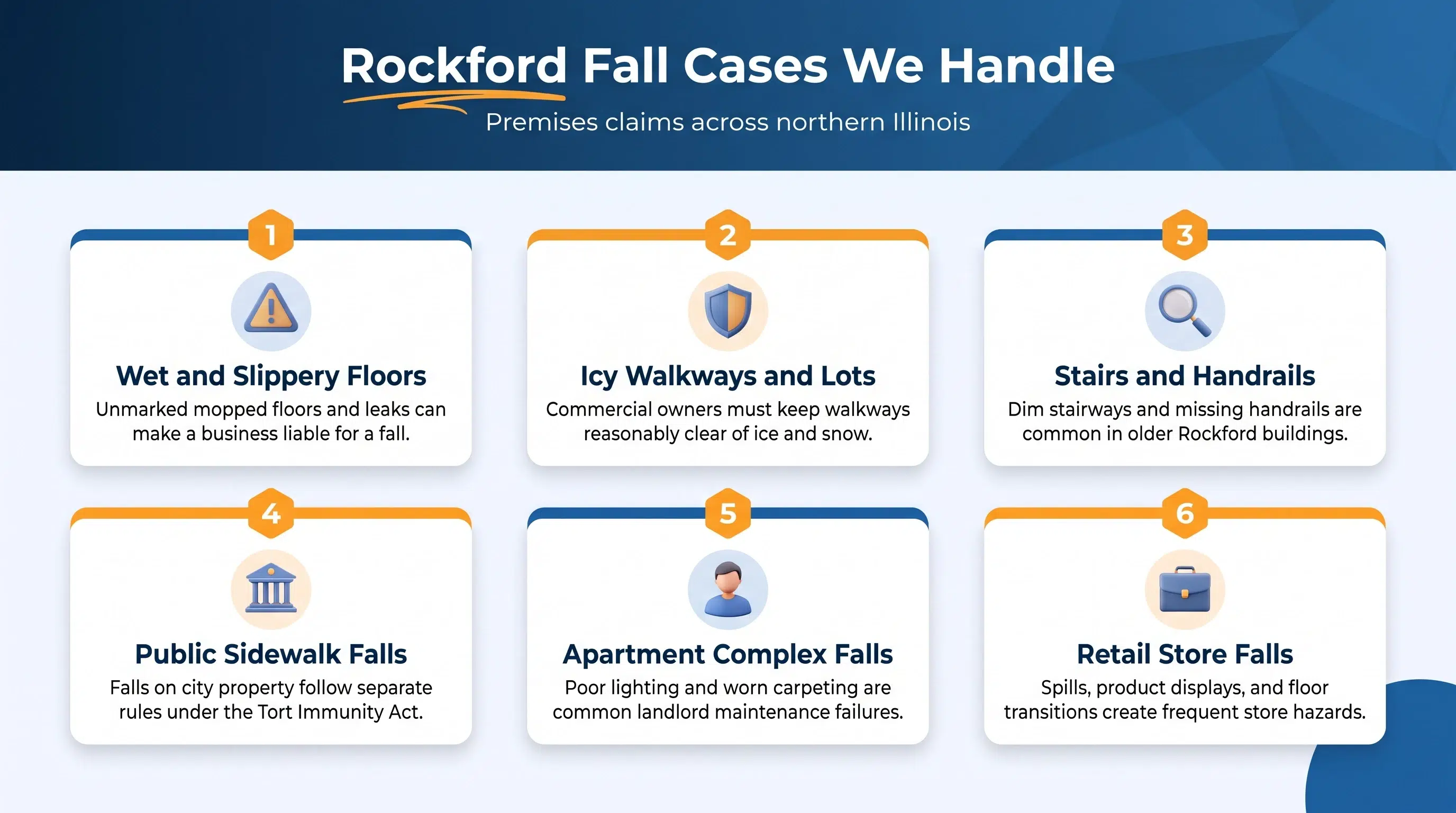
Slip and fall claims cover a wide range of situations, but they all share a common thread: a property owner or operator failed to maintain a reasonably safe environment, and someone was hurt as a result. At GoSuits, we’ve helped clients across Rockford recover from fall injuries caused by wet floors, hazardous stairways, icy walkways, and negligent property maintenance. Here is a closer look at the most common types of premises liability cases we handle across northern Illinois.
Wet and slippery floor injuries in stores and restaurants
A freshly mopped tile floor without a warning sign, a refrigeration leak in a grocery store aisle, or a wet entryway during a rainstorm can each cause a serious fall in seconds. Illinois courts have consistently held that business owners must inspect their premises regularly and warn customers of known hazards. Under the Illinois Premises Liability Act (740 ILCS 130/2), property owners owe a duty of reasonable care to people who enter their property with permission. If a business knew or should have known about the slippery condition and failed to address it in a reasonable time, they may be liable for your injuries. We gather surveillance footage, incident reports, maintenance logs, and witness statements to show when the hazard existed and why the owner is responsible.
Icy and snow-covered walkways and parking lots
Northern Illinois winters are severe, and Rockford regularly sees prolonged stretches of ice and snow from November through March. Illinois property owners, including businesses, generally have no duty to remove naturally accumulated snow and ice. They can be liable when ice forms unnaturally because of the property, such as poor drainage or plow piles that melt and refreeze, or when they choose to clear it and do so negligently. However, the Snow and Ice Removal Act (745 ILCS 75) creates an important limitation: homeowners who voluntarily clear residential sidewalks cannot be held liable for injuries that result from that removal effort unless their conduct was willful or wanton. This protection generally does not extend to commercial properties, apartment complexes, or landlords operating for profit. If you slipped on an icy strip mall walkway, a restaurant parking lot, or an apartment common area, the Snow and Ice Removal Act’s homeowner carve-out likely does not shield the property owner, and you may have a valid claim.
Broken stairs, missing handrails, and structural hazards
Apartment buildings and older commercial structures across Rockford frequently have stairways that are poorly lit, lack adequate handrails, or have steps that are uneven or broken. A landlord who ignores a tenant’s written complaint about a damaged staircase and then fails to fix it before a fall occurs has clear notice of the hazard and a strong case of liability can follow. We document the condition of the stairway through photographs, city inspection records, and building code violation histories, then pursue recovery for your medical bills, lost wages, and other damages.
Trip hazards on public sidewalks and government property
Falls on public sidewalks, in government-owned buildings, or on city-maintained property involve a separate and shorter legal deadline. Under the Local Governmental and Governmental Employees Tort Immunity Act (745 ILCS 10/8-101), claims against local government entities in Illinois must be filed within one year of the date of injury. This is significantly shorter than the two-year statute of limitations that applies to most private premises liability claims under 735 ILCS 5/13-202. If you fell on a cracked city sidewalk, a public park path, or in a government-owned facility in Rockford, missing this one-year deadline can eliminate your claim entirely. Contacting an attorney quickly is critical in these situations.
Negligent property maintenance in apartment complexes
Rockford has a large rental housing market, and landlord-tenant fall injuries are among the most common premises liability claims we see in Winnebago County. Common failure points include inadequate lighting in parking areas and hallways, worn-out carpeting on stairs, broken door thresholds, water damage that creates slick flooring, and delayed responses to reported maintenance issues. Illinois landlords are required to maintain rental properties in compliance with local building codes and in a habitable condition. When they fail to do so and a tenant or guest is injured, the landlord can face a negligence claim under Illinois premises liability law.
Falls in retail stores and commercial spaces
Big-box retailers, grocery stores, and strip mall businesses in Rockford and Loves Park see heavy foot traffic, and the risk of fall injuries is higher in environments where spills, product displays, and floor transitions create frequent hazards. Store owners are expected to conduct regular inspections and correct or warn customers about dangerous conditions promptly. A claim against a national retailer can be complicated by their internal incident response teams and experienced insurance adjusters who move quickly to limit exposure. We move just as fast, gathering store surveillance footage, floor inspection logs, and manager reports before that evidence is lost or overwritten.
What Illinois laws apply to slip and fall cases in Rockford?
Illinois premises liability law is built on a combination of statutes and case law, and understanding the legal framework that applies to your fall is an important part of evaluating your claim. Below are the key laws that govern most slip and fall cases in Rockford and Winnebago County.
The Illinois Premises Liability Act (740 ILCS 130/2)
The Illinois Premises Liability Act is the foundation for most slip and fall claims in Illinois. It establishes that property owners and occupiers owe a duty of reasonable care to all people who enter their property lawfully, whether as customers, tenants, guests, or licensees. The Act eliminated the old common-law distinction between invitees and licensees, replacing it with a single standard: the owner must exercise ordinary care in maintaining the property and must warn visitors of known hazards that a visitor would not reasonably discover on their own. Whether you fell in a Rockford restaurant, a Machesney Park retail center, or a Belvidere apartment building, the Premises Liability Act is the starting point for your claim.
Comparative fault under 735 ILCS 5/2-1116
Illinois uses a modified comparative fault rule. Under 735 ILCS 5/2-1116, you can recover compensation as long as you are not more than 50% at fault for your own injury. If you are found to be 51% or more responsible for the fall, you are barred from recovering anything. If your fault is 50% or less, your compensation is reduced proportionally by your percentage of fault. For example, if a jury determines you suffered $80,000 in damages but you were 20% at fault for not watching where you were walking, your net recovery would be $64,000. Illinois’s modified comparative fault system differs from California’s pure comparative negligence framework, where a plaintiff can recover even if 99% at fault. Understanding where your conduct fits in this analysis is something our attorneys address early in every Rockford slip and fall case.
The Snow and Ice Removal Act (745 ILCS 75)
This statute is frequently misunderstood and is sometimes invoked by commercial property owners to avoid liability when they should not be able to. The Snow and Ice Removal Act protects only residential property owners and homeowners who voluntarily clear snow and ice from sidewalks adjacent to their homes. The protection is not unlimited even for homeowners: it only shields against ordinary negligence, not willful or wanton misconduct. Commercial landlords, business owners, and apartment complex operators do not receive the same protection. Their liability still depends on whether the ice was a natural or unnatural accumulation.
The one-year deadline for city property claims (745 ILCS 10/8-101)
If your fall occurred on property owned or maintained by the City of Rockford, Winnebago County, or another local government entity, you have just one year from the date of the injury to file your lawsuit. This deadline is not extended by the discovery rule in most circumstances, and courts apply it strictly. Missing it means losing your right to sue, regardless of how serious your injuries are. If there is any possibility that a government entity bears responsibility for your fall, contacting a premises liability attorney promptly is not optional.
The two-year statute of limitations for private claims (735 ILCS 5/13-202)
Most slip and fall claims against private property owners and businesses in Illinois must be filed within two years from the date of injury. While two years sounds like a significant window, building a strong premises liability case takes time: gathering surveillance footage that may be overwritten within days, preserving physical evidence at the scene, identifying and interviewing witnesses, and obtaining complete medical records. Waiting until close to the deadline creates serious practical obstacles. Our Rockford slip and fall attorneys recommend reaching out as soon as possible after your injury so none of that evidence is lost.
How do you prove a slip and fall case in Illinois?
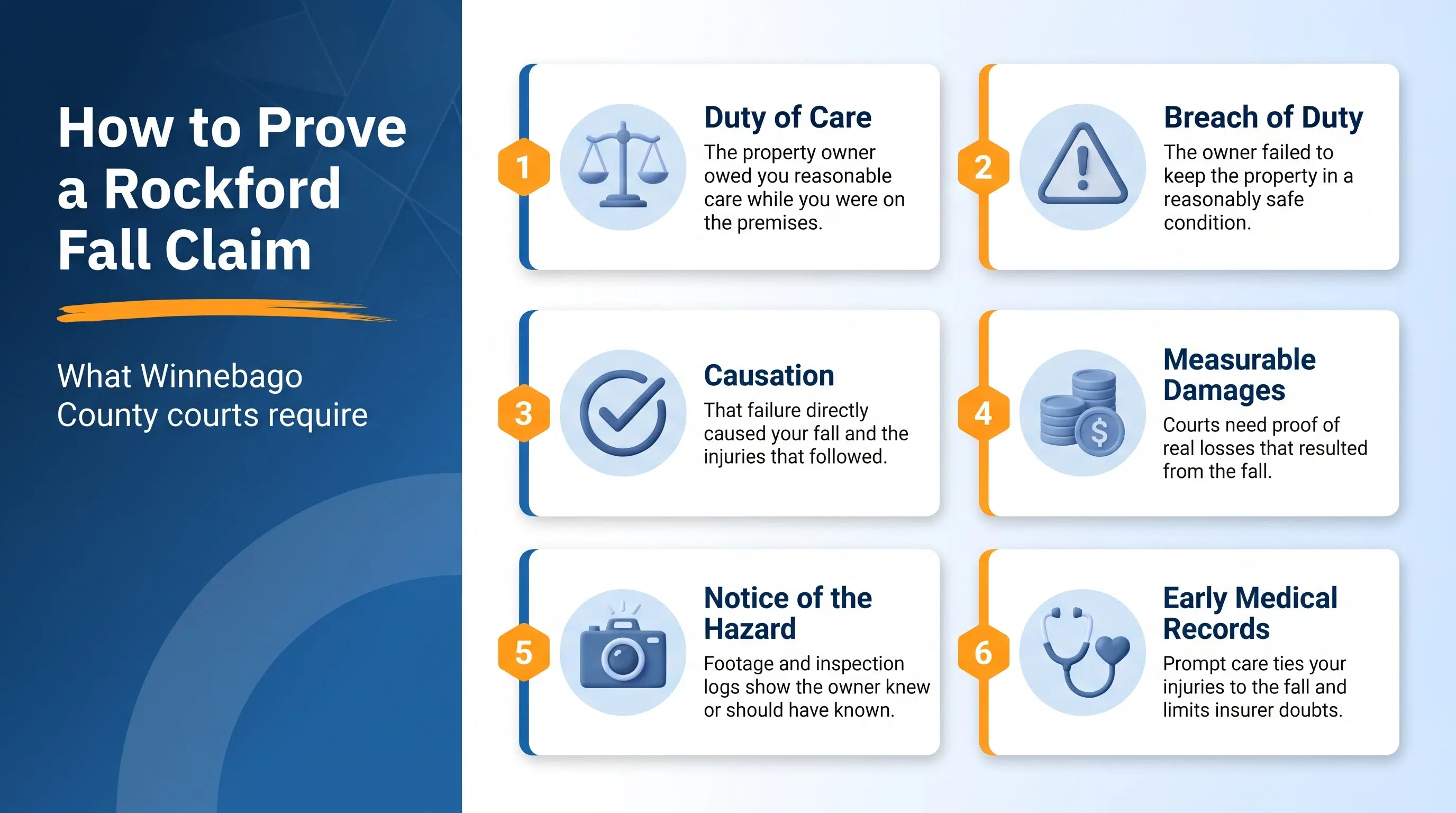
Proving a premises liability claim in Illinois requires more than showing that you fell and were injured on someone else’s property. Courts in Winnebago County require proof of four core elements: the property owner owed you a duty of care; the owner breached that duty by failing to maintain the premises in a reasonably safe condition; that breach directly caused your fall; and you suffered measurable damages as a result. Attorneys at GoSuits evaluate each element systematically from the first day we take a case.
Establishing notice: did the owner know about the hazard?
One of the most contested issues in any slip and fall case is whether the property owner had notice of the dangerous condition before the fall occurred. Notice can be “actual” (someone told the owner, or the owner saw the hazard directly) or “constructive” (the hazard had been present long enough that the owner should have discovered it through reasonable inspection). A spill that had been sitting on a store floor for two hours before you fell is very different from one that occurred 30 seconds before you stepped on it. Surveillance footage, employee testimony, and maintenance inspection logs are often the most powerful tools for establishing the timeline and proving constructive notice.
Documenting your injuries thoroughly and early
The medical record you build in the days and weeks immediately following a fall is central to your damages claim. Fractures, soft tissue injuries, head trauma, and spinal injuries may not fully manifest until hours or days after the incident. Seeking prompt medical care at a Rockford-area emergency room or urgent care center, and then following up with specialists as directed, creates the documentation necessary to connect your injuries to the fall. Gaps in treatment are frequently used by insurance adjusters to argue that your injuries were not serious or were caused by something other than the fall.
Preserving the scene and physical evidence
If you are physically able to do so at the time of the fall, photograph the hazard, the surrounding area, any warning signs (or the absence of them), and your injuries. If you are unable to do so, ask someone nearby to help. Report the incident to the property manager or business on-site, and request a written incident report. Our attorneys act quickly after you retain us to send preservation letters to property owners and their insurers, demanding that surveillance footage, maintenance records, and inspection logs be preserved and not destroyed. In Illinois, a party’s failure to preserve evidence after being put on notice can support an “adverse inference” argument at trial, meaning the jury may be allowed to assume the destroyed evidence would have been unfavorable to the property owner.
What compensation can I recover after a fall in Rockford?
Illinois law allows slip and fall injury victims to pursue several categories of damages, depending on the nature and severity of the injury.
Economic damages
Economic damages compensate for measurable financial losses. These include current and future medical expenses (emergency room bills, imaging, surgery, physical therapy, and ongoing rehabilitation), lost wages from time missed at work during recovery, loss of future earning capacity if the injury causes long-term disability, and out-of-pocket costs such as prescription medications, assistive devices, and home care. Illinois courts do not cap economic damages in premises liability cases, so the full scope of your financial losses can be pursued.
Noneconomic damages
Noneconomic damages address the human cost of the injury beyond the dollar figures: pain and suffering, emotional distress, loss of enjoyment of life, and loss of normal daily functioning. These damages are particularly relevant in fall cases involving fractures, hip replacements, traumatic brain injuries, or spinal injuries that produce lasting physical limitations. Illinois has no cap on noneconomic damages in personal injury cases (unlike some states), so a Rockford slip and fall victim with permanent injuries can seek the full measure of noneconomic harm.
Punitive damages
In rare circumstances, where the property owner’s conduct was willful, wanton, or reckless (rather than merely negligent), Illinois courts may allow punitive damages. These are intended to punish particularly egregious behavior and deter similar conduct. Punitive damages are uncommon in standard slip and fall cases but may be available where, for example, a landlord repeatedly ignored documented safety complaints and deliberately deferred repairs to cut costs.
Choosing the right slip and fall attorney in Rockford, IL
Finding a premises liability lawyer in Rockford after a fall can feel overwhelming, particularly when you’re dealing with pain, medical appointments, and time off work simultaneously. The attorney you choose will have a direct impact on how efficiently your claim moves and how much compensation you ultimately recover.
Look for a firm that focuses on personal injury and premises liability, not one where your case is one of dozens of practice areas competing for attention. Ask how the firm handles insurance adjusters who dispute liability, how they calculate long-term medical costs, and how frequently they communicate case updates. A law firm with proprietary case management technology and a dedicated intake team can move faster and communicate more clearly than one relying on manual processes.
Illinois premises liability law has specific deadlines, local procedural rules in the Winnebago County Circuit Court, and insurance defense tactics that require familiarity to counter effectively. Choosing a firm with a track record of litigated premises liability cases in northern Illinois gives your case a meaningful advantage. Most firms that handle slip and fall cases, including GoSuits, take them on a contingency basis, meaning no attorney fee unless we recover compensation for you. Case costs and medical bills may still be owed.
If your injuries occurred while you were working or as a result of someone else’s vehicle (for example, a delivery driver who caused you to fall), there may also be workers’ compensation or auto liability components. Our attorneys identify all applicable coverage sources from the start, so no recovery avenue is missed. For context on how fall injuries can intersect with other personal injury claims, our team also handles Chicago construction accident cases where fall hazards and premises liability overlap significantly with workplace injury law.
How GoSuits Rockford slip and fall lawyers can help you
When you call GoSuits after a fall, the work begins immediately. Our attorneys and intake team start gathering information about the incident while the scene evidence is still fresh: we send preservation demand letters to property owners, request surveillance footage before it is overwritten, and document the condition of the hazard through photographs and any available incident reports. From that first conversation, our goal is to build an airtight record of what happened, who is responsible, and what your injuries have cost you.
We coordinate your medical care from day one, connecting you with Rockford-area providers who treat on a medical lien, so you receive the care you need without paying out of pocket while your case is pending. Our team monitors your treatment, collects records as they become available, and works with care planners to project the full cost of your recovery, including future physical therapy, follow-up imaging, and any long-term accommodations your injuries require.
Once we have a complete picture of your damages, we prepare a detailed demand package for the property owner’s insurer, backed by medical documentation, expert opinions, and a clear account of how the owner’s negligence caused your injuries. Illinois insurers handling Rockford premises liability claims are experienced at disputing both liability and damages, and our attorneys are equally prepared. We negotiate aggressively, and when an insurer refuses to offer fair value, we are fully prepared to file suit in the Winnebago County Circuit Court and try your case before a jury.
Throughout the entire process, from your first call through the day your settlement funds are disbursed, we negotiate your medical liens at the end of the case to maximize the amount that actually reaches your pocket. Many clients are surprised to find that lien negotiation can meaningfully improve their net recovery even after attorney fees. That comprehensive approach, combining rapid evidence preservation, coordinated medical care, aggressive negotiation, and lien reduction, is what sets GoSuits apart from firms that simply file claims and wait for a check.
You will receive regular updates in plain language, secure access to your case file, and a direct line to your attorney. As part of our full Chicago personal injury practice, our Rockford slip and fall clients benefit from the same resources, technology, and trial infrastructure that supports complex litigation across Illinois.
If your situation involves circumstances beyond a slip and fall, such as a fall that resulted in a fatality, our team can also review Chicago wrongful death claims to determine whether your family may have additional recovery options under Illinois law. And if you or a family member was also hurt in a vehicle collision around the time of or related to the incident, our Chicago car accident lawyers can evaluate whether a separate motor vehicle claim applies.
To get started, schedule a free consultation with our team. There is no cost to speak with us, and no attorney fee unless we recover. Case costs and medical bills may still be owed.
