

































What areas in Winnebago County do our Rockford car accident lawyers serve?
If you were injured in a car crash anywhere in or around Rockford, GoSuits is ready to help. Our legal team, operating from our Illinois office, serves clients throughout Winnebago County and the broader northern Illinois region. Distance is never a barrier to getting the representation you deserve.
We know that crashes happen everywhere: on the merge lanes and interchange ramps of I-90, on the commercial strips along East State Street, at residential intersections throughout the city, and on the rural county roads that connect smaller communities to Rockford. No matter where your collision occurred, we bring knowledge of Illinois law and Winnebago County Circuit Court procedure to protect your rights and pursue full compensation.
Winnebago County and the surrounding area are home to over 290,000 people. The Illinois Department of Transportation reports that Winnebago County consistently records among the highest crash counts of any non-metropolitan county in the state. We understand the risks specific to this corridor and tailor our approach to the facts of each case.
Areas we commonly serve
- Rockford and central Winnebago County
- Loves Park and Machesney Park
- Belvidere and Boone County
- Cherry Valley, Roscoe, and South Beloit
- Winnebago village and surrounding townships
- Byron, Oregon, and Ogle County communities
- Freeport and Stephenson County
- Elgin, Naperville, Waukegan, Joliet, and Cicero
- Northern and central Illinois communities statewide
What types of car accident cases do we handle in Rockford and Winnebago County?
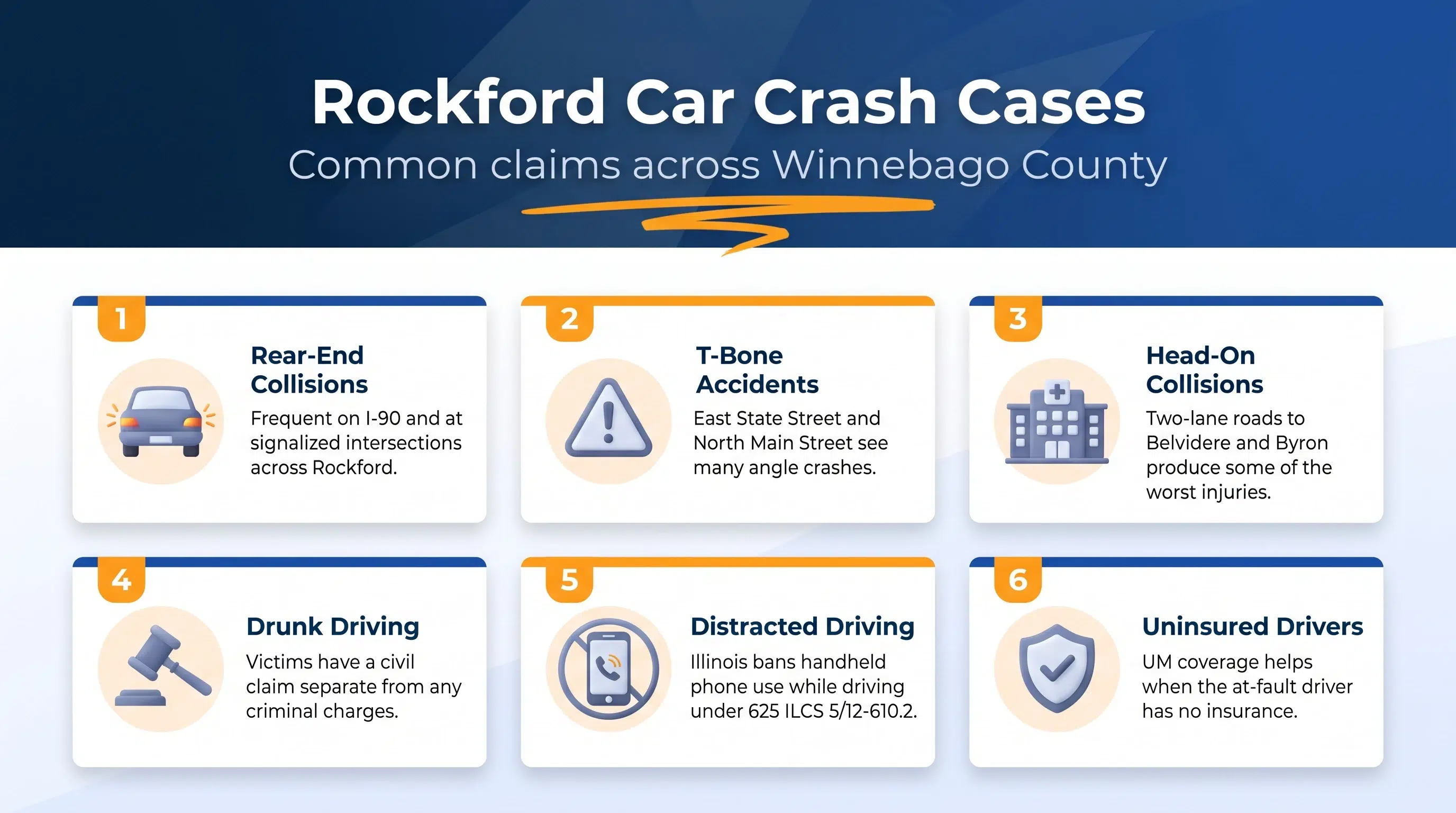
Car crashes in the Rockford area take many forms, and the legal issues involved vary significantly depending on how the collision occurred, who was responsible, and what insurance coverage applies. At GoSuits, we handle the full range of vehicle collision claims that arise along Illinois roadways, from minor fender-benders that conceal serious injuries to catastrophic multi-vehicle crashes that permanently change lives.
Rear-end collisions
Rear-end crashes are among the most frequent collision types on I-90 and at signalized intersections throughout Rockford. Illinois courts apply a general duty-of-care standard that typically places responsibility on a following driver who strikes a vehicle ahead. These crashes frequently produce whiplash, herniated discs, and soft-tissue injuries that are not always apparent in the hours immediately after impact. We gather medical records, vehicle-damage assessments, and accident reconstruction data to document your injuries and build a damages calculation that covers both current treatment and projected future care.
Intersection and T-bone accidents
Rockford’s busy intersections, including those along East State Street, North Main Street, and the US-20 corridor, see a disproportionate share of angle crashes. According to IDOT crash statistics, intersection-related collisions account for roughly one-third of all injury crashes in Winnebago County in a typical year. T-bone impacts often produce serious injuries to occupants of the struck vehicle because door panels offer far less protection than front and rear crumple zones. We secure traffic-camera footage, signal-timing records, and eyewitness accounts to establish exactly who had the right of way.
Head-on collisions on rural roads
The two-lane county roads connecting Rockford to Belvidere, Byron, and communities in Ogle County are the sites of some of the most severe crashes in the region. Head-on collisions at highway speeds produce catastrophic injury patterns, including traumatic brain injuries, spinal fractures, and serious internal injuries. When a driver crosses the center line because of impairment, distraction, or fatigue, the liability picture is often clear, but the insurance battle can still be intense. We move quickly to preserve skid marks, vehicle event data recorder output, and toxicology records before evidence is lost.
Drunk-driving crashes
Illinois law at 625 ILCS 5/11-501 prohibits operating a vehicle with a blood-alcohol concentration at or above 0.08%. When an impaired driver causes a crash in the Rockford area, the injured victim has a civil claim that runs independently of any criminal prosecution. A conviction or guilty plea by the at-fault driver can be powerful evidence in your civil case, but you do not need to wait for the criminal process to conclude before pursuing compensation. We pursue economic damages including medical bills and lost wages, as well as non-economic damages for pain and suffering.
Distracted-driving accidents
Illinois enacted a ban on handheld cell phone use while driving under 625 ILCS 5/12-610.2, making it unlawful to hold and use a phone for any purpose while operating a vehicle. Under Illinois law, a violation of this statute is generally treated as prima facie evidence of negligence in a civil case, which can make fault easier to prove if the violation caused the crash. Our team subpoenas phone records and preserves vehicle telematics data to document distracted driving before that evidence becomes unavailable.
Uninsured and underinsured motorist claims
Illinois requires drivers to carry uninsured motorist coverage at minimum limits of 25/50 per 215 ILCS 5/143a, and many policies also include underinsured motorist coverage. When the at-fault driver carries no insurance, has fled the scene, or carries limits too low to cover your losses, your own insurer steps in under these provisions. Illinois minimum liability requirements under 625 ILCS 5/7-203 are 25/50/20: $25,000 per person and $50,000 per accident in bodily injury coverage, plus $20,000 in property damage coverage. These minimums are often inadequate for serious injuries. We have extensive experience navigating UM and UIM claims in Illinois and know how to counter the tactics insurers use to minimize these payouts.
Multi-vehicle pileups and highway crashes
Interstate 90 through Winnebago County, along with the I-39 interchange south of Rockford, carries significant commercial truck traffic alongside passenger vehicles. Winter weather, fog, and construction-zone congestion create conditions for chain-reaction pileups in which fault is spread across several parties. Determining proportionate responsibility in these situations requires careful accident reconstruction and a review of each driver’s conduct. Illinois’s modified comparative fault framework under 735 ILCS 5/2-1116 allows you to recover as long as your own fault does not exceed 50%, though your award is reduced by your percentage of fault.
How do Illinois car accident laws affect your Rockford crash claim?
Understanding the legal rules that govern Illinois car accident cases helps you make informed decisions at every stage of your claim. The framework below reflects the statutes and doctrines that Illinois courts, including the Winnebago County Circuit Court, apply to motor-vehicle collision cases.
Illinois statute of limitations: two years to file
Under 735 ILCS 5/13-202, personal injury claims in Illinois must generally be filed within two years of the date of the injury. If you were injured in a Rockford car crash and the two-year window closes before you file a lawsuit, your claim is time-barred with very limited exceptions. Some exceptions apply when the injured person is a minor or when a defendant fraudulently conceals their identity, but these exceptions are narrow. Acting promptly protects your rights and gives your legal team time to gather evidence while it is still available.
Modified comparative fault: the 51% bar rule
Illinois follows a modified comparative fault system under 735 ILCS 5/2-1116. You can recover compensation even if you were partly responsible for the crash, as long as your share of fault is 50% or less. If a jury finds you 51% or more at fault, you recover nothing. When you are partially at fault but below the 51% threshold, your damages are reduced proportionately. For example, if your total damages are $80,000 and you are found 20% at fault, you recover $64,000. Insurance adjusters regularly try to inflate a claimant’s assigned fault percentage to reduce or eliminate the payout. Having an attorney who knows how to contest fault assignments is important in these negotiations.
Illinois minimum insurance requirements
Every driver in Illinois must carry liability coverage of at least 25/50/20 under 625 ILCS 5/7-203: $25,000 per person for bodily injury, $50,000 per accident for bodily injury, and $20,000 for property damage. Illinois also requires uninsured motorist coverage at 25/50 minimum limits. These floors often fall far below the actual cost of a serious crash. When an at-fault driver carries minimum-limits coverage, recovering full compensation typically requires invoking your underinsured motorist policy or pursuing the driver’s personal assets, both of which our team handles regularly.
What damages can you recover after a Rockford car crash?
Illinois law allows car accident victims to pursue both economic and non-economic damages. Economic damages cover quantifiable losses: emergency room and hospital bills, surgical costs, physical therapy, future medical care, lost wages during recovery, and diminished future earning capacity if a long-term disability results. Non-economic damages cover pain and suffering, emotional distress, loss of enjoyment of life, and, where a spouse is affected, loss of consortium. Illinois does not cap non-economic damages in ordinary personal injury cases. In rare situations where the at-fault driver’s conduct was particularly reckless or intentional, punitive damages under 735 ILCS 5/2-604.1 may be available.
Common causes of car accidents on Rockford area roads
The physical layout of Rockford’s road network, combined with weather patterns and traffic volumes, produces predictable crash clusters. Knowing where and why crashes happen most often helps our team anticipate the evidence issues that arise in each type of case.
Interstate 90 and the Tri-State corridor
I-90 is the most heavily traveled highway in the Rockford area, carrying both local commuter traffic and long-haul commercial trucks between the Chicago metropolitan area and the Wisconsin state line. Speed differentials between passenger vehicles and large trucks, frequent lane changes at interchange ramps, and congestion near the East Riverside Boulevard interchange all contribute to collision risk. IDOT’s crash data for Winnebago County consistently shows I-90 as the site of a significant share of the county’s fatal and serious-injury crashes. When a commercial truck is involved, federal FMCSA regulations under 49 CFR Parts 390-399 impose additional duties on carriers and drivers, and preserving electronic logging device data quickly is essential.
Interstate 39 and the Winnebago-Boone County corridor
I-39 runs south from Rockford toward DeKalb and central Illinois. The interchange zone where I-90 and I-39 diverge south of Rockford is a known high-crash area because of merging traffic and abrupt speed changes. Commercial traffic is heavy on this corridor, and rural sections see higher speeds that make crashes more severe when they occur. If you were hurt in a crash involving a semi-truck on I-39, our Chicago truck accident attorneys are experienced in the federal regulations and carrier liability issues that arise in those cases.
US Route 20 and the East State Street corridor
US-20 through Rockford and into neighboring Loves Park and Machesney Park is one of the region’s busiest surface streets. The East State Street corridor is lined with commercial development, generating frequent left-turn conflicts, pedestrian crossings, and stop-and-go patterns that produce rear-end and angle crashes. Access-management issues at commercial driveways contribute to unexpected braking and lane-change collisions throughout this corridor.
Winter weather and black ice
Rockford averages roughly 37 inches of snowfall per year, and IDOT’s annual statistics consistently show elevated injury and fatal crash rates in Winnebago County during the winter months. Illinois courts have held that adverse weather conditions do not eliminate a driver’s duty of care. A driver who fails to reduce speed on an icy road may be found negligent even if operating at the posted limit, because a reasonable driver would have slowed for conditions.
Choosing the right car accident lawyer in Rockford, IL
After a crash in Winnebago County, you will likely be contacted by the at-fault driver’s insurance company within days, sometimes hours. The adjuster’s job is to resolve your claim as quickly and cheaply as possible. Without legal representation, you may be pressured into a recorded statement, asked to sign a broad medical release, or offered a quick settlement that covers only a fraction of your actual losses. Once you accept and sign a release, you generally cannot go back and ask for more, even if your injuries turn out to be more serious than they appeared at first.
Choosing a car accident attorney who focuses on personal injury law, rather than a general practitioner who handles auto claims as a sideline, gives you a meaningful advantage at every stage of the case. Look for an attorney who can explain Illinois’s comparative fault rules, who has experience with Winnebago County Circuit Court procedures, and who communicates clearly and regularly rather than leaving you to wonder what is happening with your case.
At GoSuits, we take car accident cases on a contingency fee basis, meaning no attorney fee up front and none unless we recover compensation for you. Case costs and medical bills may still be owed. The initial consultation is free. Our attorneys are accessible directly, and our technology platform gives every client real-time visibility into their case status.
If you lost a family member in a crash in northern Illinois, our Chicago wrongful death lawyers handle those claims throughout the state. And if you were injured while riding a motorcycle in the Rockford area, our Chicago motorcycle accident attorneys are available to discuss your case as well.
How GoSuits Rockford car accident lawyers can help you
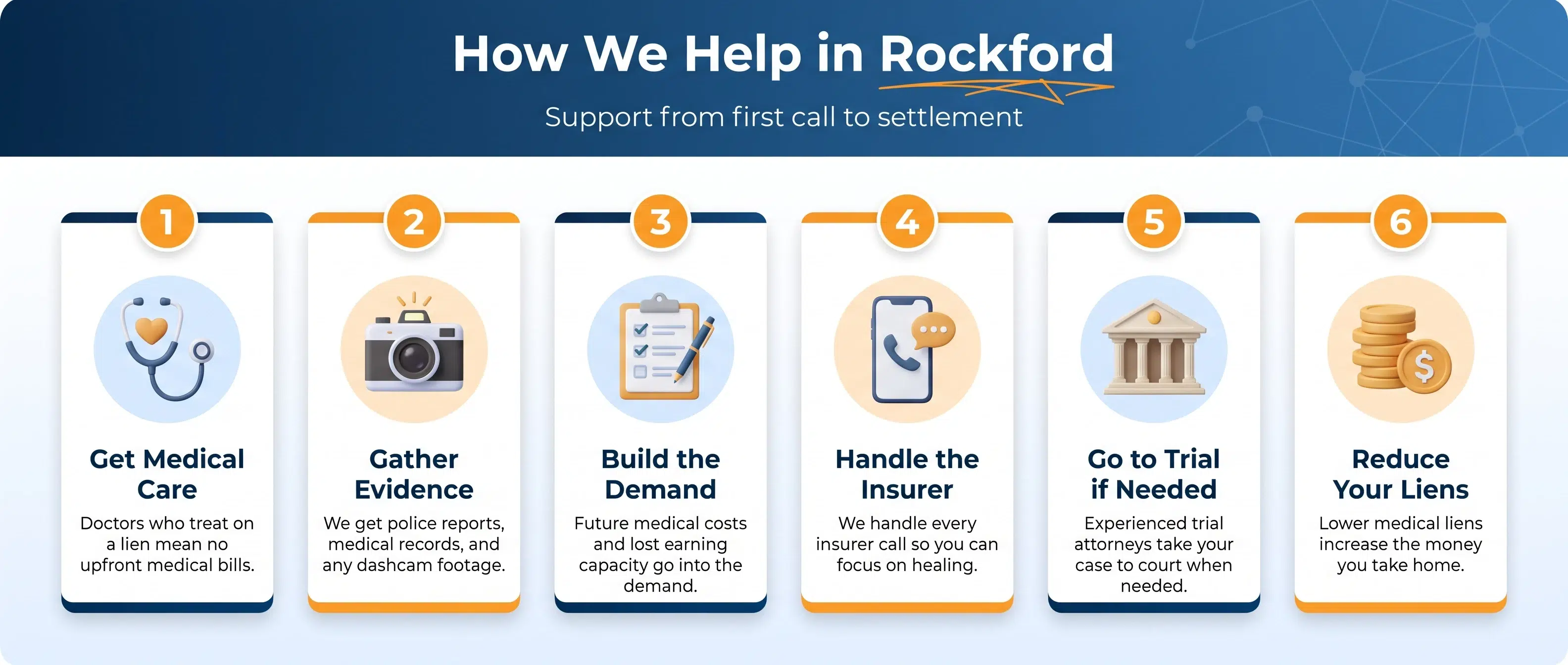
From the moment you call us, we begin working on the practical and legal steps that protect your claim. Our first priority is making sure you have access to medical care. We connect clients with physicians and specialists who treat on a medical lien, meaning you receive treatment now with no out-of-pocket cost and the provider is paid from your eventual settlement. This arrangement removes the financial barrier that causes many crash victims to delay or skip care, and it keeps your treatment records current and well-documented throughout your recovery.
While you focus on getting better, our team is gathering evidence. We obtain the police report from the Rockford Police Department or the Winnebago County Sheriff’s Office, request medical records, secure any available surveillance or dashcam footage, and preserve vehicle black box data before it is overwritten. When commercial trucks are involved, we serve litigation hold notices to preserve electronic logging device records and driver qualification files under applicable FMCSA requirements.
Once we have a complete picture of your damages, including projected future medical costs and any reduction in your earning capacity, we prepare a formal demand package and open negotiations with the at-fault insurer. We handle all communications with the insurance company so you are never put in a position of saying something that could be used against you. If the insurer makes a lowball offer, we counter with documented evidence and, when necessary, file suit in Winnebago County Circuit Court to apply additional pressure.
As part of our Chicago personal injury team, Rockford-area clients benefit from the same technology-driven case management, multilingual support, and experienced trial attorneys that handle complex injury claims throughout Illinois. When cases go to trial, we present your story using medical records, reconstructionist testimony, and the documented facts to give the jury a complete understanding of how the crash happened and what it has cost you.
At the end of your case, when a settlement or verdict is reached, we negotiate with your medical providers to reduce the amounts owed under any liens. That reduction directly increases the money you take home. We review every term of the settlement with you before anything is signed, making sure current bills, future costs, lost wages, and legal fees are all accounted for. To get started with a free case evaluation, contact our team today.
What to do after a car accident in Rockford, IL
The steps you take in the hours and days after a crash in Winnebago County can significantly affect the strength of your claim. Here is what matters most from a legal standpoint.
Call 911 and stay at the scene
Illinois law at 625 ILCS 5/11-401 requires drivers involved in crashes resulting in injury or death to stop and remain at the scene, and other provisions of the Illinois Vehicle Code require crashes to be reported to law enforcement. A police report from the Rockford Police Department or Winnebago County Sheriff’s Office becomes an important piece of evidence that documents the scene, the parties involved, any citations issued, and the officer’s preliminary observations about fault.
Seek medical care on the day of the crash
Some injuries, including concussions, soft-tissue damage, and internal injuries, do not produce obvious symptoms at the crash scene. Adrenaline can mask pain for hours. Seeking evaluation at a Rockford-area emergency room or urgent care facility on the same day as the crash creates a medical record that links your injuries to the collision. Delayed treatment is one of the most common arguments insurers use to dispute or minimize a claim.
Document the scene and collect information
Photograph the vehicle positions, road conditions, traffic signals, skid marks, and any visible injuries before vehicles are moved. Collect the other driver’s name, address, license number, plate number, insurance company, and policy number. If there are witnesses, note their names and contact information. This documentation can be invaluable when memories fade and physical evidence is no longer preserved.
Avoid giving a recorded statement to the other insurer
You are not legally required to give a recorded statement to the at-fault driver’s insurance company. If an adjuster contacts you before you have counsel, politely decline to give a recorded statement and contact an attorney first. Anything you say in a recorded statement can be used to dispute or reduce your claim.
