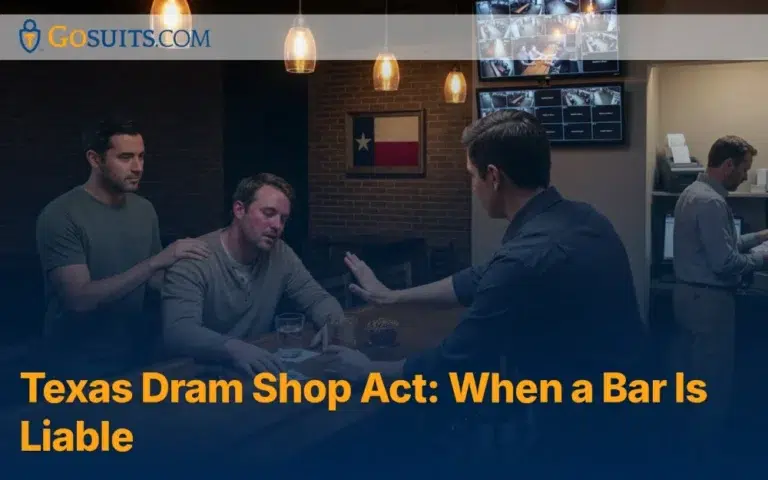
- What is Texas dram shop law, and where does it come from?
- What must a plaintiff prove under Chapter 2 of the Texas Alcoholic Beverage Code?
- What does “obviously intoxicated” mean in practice?
- What does “clear danger to himself and others” require?
- What is the safe harbor defense, and how can a bar use it?
- What TABC records and other documentation matter in a dram shop case?
- Why do bar receipts and surveillance video disappear so quickly?
- How does social host liability differ from dram shop liability in Texas?
- What defenses does an alcohol provider typically raise?
- What should you know about filing a dram shop claim in Dallas County?
- Frequently Asked Questions
- How GoSuits Dallas Handles Dram Shop Injury Cases
- References
What is Texas dram shop law, and where does it come from?
Texas dram shop law lives in Chapter 2 of the Texas Alcoholic Beverage Code, a short but carefully worded statute that holds licensed alcohol providers civilly accountable when they serve a visibly intoxicated person who later injures someone. [1] The name “dram shop” is historical, drawn from the old English unit of liquid measure, the dram, that taverns once used to sell spirits. In modern Texas litigation, it refers to any licensed establishment – a bar, restaurant, nightclub, liquor store, or convenience store – that sells or serves alcohol for on-premises or off-premises consumption.
Before Chapter 2 existed, Texas courts generally held that alcohol providers owed no civil duty for harm caused by their customers. The legislature changed that in 1987 when it enacted the dram shop statute, creating a narrowly drawn cause of action that plaintiffs must fit precisely. The Texas Supreme Court has repeatedly described Chapter 2 as the exclusive civil remedy against an alcohol provider, so common-law negligence theories generally cannot expand its reach. [2]
Understanding this framework matters whether you are the person injured by a drunk driver who left a Deep Ellum bar at closing time, or a business defending itself after a patron caused a crash on I-35E on the way home to Carrollton. The statute draws a line – not a wide one – and the facts on both sides of that line determine everything about how civil litigation proceeds.
Victims who have been injured by a drunk driver often have personal injury lawyers on their side who know how to follow that evidentiary trail from the hospital back to the establishment that served the last drink. That path matters more than most people realize when they first call for help.
What must a plaintiff prove under Chapter 2 of the Texas Alcoholic Beverage Code?
Section 2.002 of the Texas Alcoholic Beverage Code sets out what a plaintiff must establish. The provider must have sold or served an alcoholic beverage to an individual when it was apparent to the provider that the individual was obviously intoxicated to the point that he presented a clear danger to himself and others, and that the intoxication of the individual was a proximate cause of the damages suffered. [1]
Break that down and you get four real questions a jury will answer:
- Did the defendant sell or serve alcohol? This must be an actual transaction or service, not merely presence in an establishment.
- Was the customer obviously intoxicated? Not just impaired – obviously intoxicated, meaning the condition was visible and apparent to a reasonable server at the time of service.
- Did that obvious intoxication present a clear danger? The statute requires more than impairment; it requires a danger level that was apparent at the moment of continued service.
- Was that intoxication a proximate cause of the plaintiff’s injury? Texas courts have held this is a but-for causation standard tied specifically to the intoxication, not just the sale. [3]
Each element carries its own weight. Missing any one of them ends the plaintiff’s claim against the provider, regardless of how badly the plaintiff was hurt. That is by design – the legislature wrote the statute to impose liability only on providers who crossed a clear line, not those who served a customer who appeared fine and later turned out to have been drinking elsewhere first.
What does “obviously intoxicated” mean in practice?
The Texas Alcoholic Beverage Code does not define “obviously intoxicated” in a clinical sense. Courts have interpreted it through factual records: slurred speech, stumbling gait, glassy or bloodshot eyes, belligerence, an inability to count correct change, visible vomiting, or falling asleep at the bar. A blood alcohol content level alone, without corresponding behavioral evidence that was apparent to the server, generally is not enough. [4]
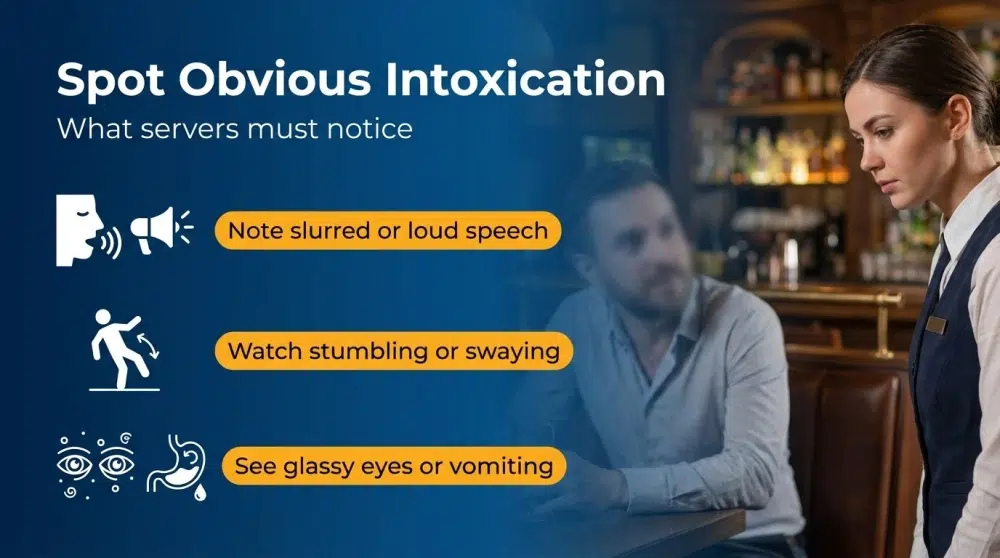
This creates a practical asymmetry. A bar can argue that the patron seemed fine when served, even if a toxicology report later shows a very high BAC, because alcohol affects people differently, and some individuals function with few outward signs at levels that would incapacitate others. The plaintiff’s burden is to show that whatever the patron’s internal state, the visible signs were there and a reasonable server would have recognized them.
In practice, the most useful evidence comes from people who were there – other patrons, bartenders on shift, security staff, parking attendants, valet workers. Surveillance footage is the strongest single piece of evidence when it exists and is preserved. A video of someone lurching across the bar top, dropping a glass, or having an argument with the bouncer is worth more than ten witness statements describing a person who “seemed fine” twenty minutes earlier.
Dallas County courts that handle these civil cases – filed in the Dallas County District Court at the George L. Allen Sr. Courts Building on Commerce Street – see both sides of this argument routinely. Juries look for concrete behavior, not just chemistry.
What does “clear danger to himself and others” require?
The phrase “clear danger to himself and others” is a second threshold layered on top of obvious intoxication. Texas courts have described it as meaning that the person’s state, at the time of continued service, was such that harm to themselves or a third party was a foreseeable and apparent consequence of that service. [2]
Think of it this way: a person can be obviously intoxicated and still not be a clear danger in every circumstance. Someone who is visibly drunk, sitting in a booth with a designated driver at the table and no car keys in sight, presents a different risk profile than someone who is slurring words, insisting they are fine, and just asked the bartender to move their car around back. The second scenario is where Chapter 2 liability becomes much stronger – the establishment knew, or should have known, that continued service raised the probability of a serious crash on a highway like I-30 or US-75 down the road.
Courts have addressed the tension between individual autonomy and third-party protection in the context of this statute. The Texas Supreme Court in F.F.P. Operating Partners, L.P. v. Duenez reaffirmed that the intoxication – not merely the sale – must be the proximate cause of the harm, and that the clear-danger element focuses on what was apparent at the time of sale. [3]
A wrongful death claim arising from a fatal crash often turns on exactly this point. If the decedent’s family can show that the bar continued serving a patron who was stumbling, shouting, or otherwise clearly impaired – and that the driver then caused a fatal collision – the clear-danger element becomes a question of fact for the jury rather than a legal barrier to the claim.
What is the safe harbor defense, and how can a bar use it?
Section 2.06 of the Texas Alcoholic Beverage Code creates what practitioners call the safe harbor defense. [1] Under it, a provider is not liable if it can show that the employee who sold or served the alcohol:
- Was TABC-certified at the time of the sale, having completed an approved seller-server training program;
- Was not otherwise acting in violation of any provision of the Alcoholic Beverage Code at the time of the sale; and
- Was in compliance with all reasonable written policies of the employer governing sales to intoxicated persons.
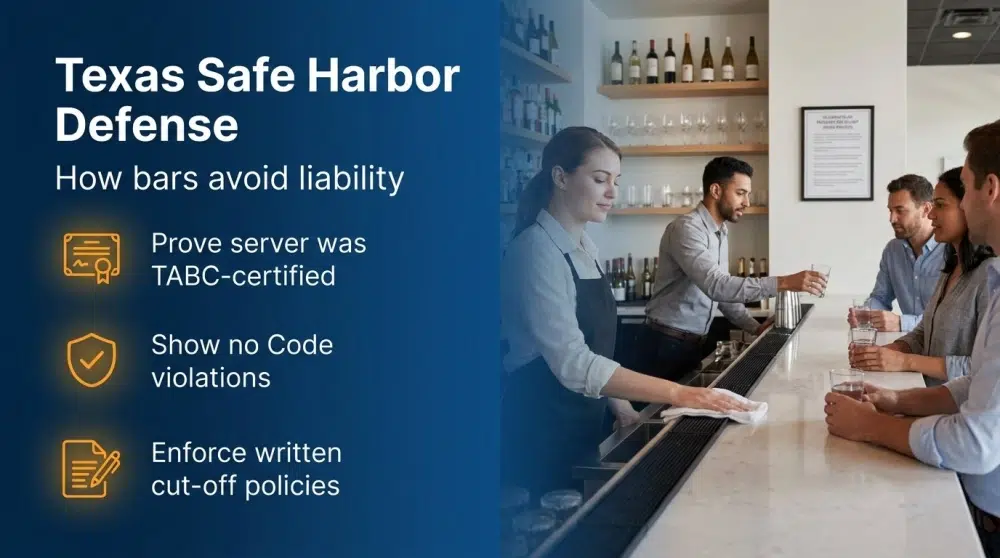
This defense is available only if the establishment itself was in compliance with the Code and the employee completed an approved TABC program. Texas law treats this as an affirmative defense, meaning the burden of proving it shifts to the defendant once a plaintiff establishes the prima facie case. [5]
The defense has real teeth. A well-run bar that genuinely trains its staff, maintains current TABC certifications, and has written cut-off policies that employees follow can use this defense to avoid liability even when something goes wrong. But the defense falls apart quickly when the training records are incomplete, when the server’s certification had lapsed, or when the establishment’s written policies were never actually enforced.
From a plaintiff’s standpoint, the investigation into safe harbor eligibility starts immediately. You want personnel records, TABC certification logs, shift schedules, and any internal communications about cutting off specific patrons. From a defendant’s standpoint, the time to build this defense is before any incident occurs – not after a lawsuit lands in Dallas County District Court.
What TABC records and other documentation matter in a dram shop case?
The Texas Alcoholic Beverage Commission maintains licensing records, inspection reports, violation histories, and administrative hearing outcomes for permitted establishments. [6] In litigation, these records serve several functions.
Here’s the thing about prior TABC violations. If an establishment has a track record, particularly one that includes serving people who were already visibly intoxicated, that’s fair game. It tends to show a pattern management probably knew about and didn’t fix. Courts have let this kind of evidence in to establish notice, or at least awareness of the risk. A citation from some recent inspection, a consent order sitting in the file, a suspended license from last year, all of it becomes part of what plaintiff’s attorneys start assembling pretty much the day after the crash.
Beyond TABC records, the critical documentation in most dram shop cases includes:
- Point-of-sale receipts showing the timing, quantity, and type of drinks served to the patron’s table or tab;
- Credit card records identifying who paid and when each transaction cleared;
- Shift logs and bartender assignments identifying which staff member served which customer;
- Guest check records in restaurants that track tables over time;
- Security incident reports created the night of the event;
- Staff training certifications through TABC-approved programs.
The Texas pattern jury charge for dram shop cases tracks the statutory language closely, and any of these records can feed directly into what the jury hears. A thorough legal team identifies every category of documentation on day one, sends preservation demands immediately, and follows up with formal discovery requests before the other side can argue the records no longer exist.
Why do bar receipts and surveillance video disappear so quickly?
This is one of the most urgent practical realities of dram shop cases, and it is where cases are won or lost before most clients even realize litigation has started.
Most bar and restaurant point-of-sale systems overwrite transaction records on a rolling basis – commonly 30 to 90 days, sometimes less. Credit card processors retain data longer, but the detailed per-drink breakdown tied to a specific server and time may be gone long before the 30-day mark.
Surveillance video is even more perishable. Many establishment security systems operate on loop recording with storage cycles as short as 7 to 14 days. A camera covering the bar area, the parking lot, or the front entrance records constantly and then overwrites itself. If no one requests preservation within that window, the footage is simply gone. There is no reconstruction. [7]
On a Friday night in Dallas – Uptown, Deep Ellum, or Lower Greenville – bars serving large volumes of patrons do not manually preserve recordings unless a manager decides to. After a crash, unless law enforcement demands the footage immediately or a civil attorney sends a litigation hold letter, the default setting is overwrite and continue.
Send the letter. Certified mail, email, the day you retain counsel, all of it. What it does is put the establishment formally on notice that relevant electronically stored information has to be preserved. Under Texas rules, once a party knows litigation is reasonably anticipated, destroying evidence can trigger a spoliation argument that a jury might eventually hear. But the letter has to arrive before the recording loop finishes. Seven days out from the crash, no demand on file, and that Friday night parking lot video is pretty much already overwritten.
This is not a secondary concern. It is the reason anyone injured in a crash involving a suspected intoxicated driver – on I-30, I-35E, the Dallas North Tollway, or anywhere else in the Dallas-Fort Worth area – should speak with an attorney as soon as possible after receiving medical care. The evidence timeline starts the moment the crash happens, not the moment someone decides to file a lawsuit.
How does social host liability differ from dram shop liability in Texas?
Texas draws a firm line between licensed commercial providers and private social hosts. Chapter 2 of the Alcoholic Beverage Code applies to providers – entities holding a TABC license or permit who sell or serve alcohol in a commercial context. Private individuals who host parties at their homes and serve alcohol to guests are generally not covered by the dram shop statute at all. [1]
Section 2.03 of the Code addresses this explicitly. It states that providing, selling, or serving alcoholic beverages is not the proximate cause of damages suffered by third parties when the sale was made to an adult who is not obviously intoxicated. For social hosts, the statute’s reach extends only to a very narrow circumstance: furnishing alcohol to a minor.
Section 2.002(b) is where it gets interesting for private parties. The statute does impose liability on a social host or other non-commercial provider who knowingly served alcohol to someone under 18, if the minor was obviously intoxicated and that intoxication was a proximate cause of the damages. [1] It’s pretty much the primary avenue for civil liability when a private party served a visibly drunk teenager who then caused a crash. Everything else in the statute basically gives social hosts a wide pass.
The practical difference is enormous. Bar patron in Dallas gets over-served and leaves? Chapter 2 liability is potentially in play. Same patron at a private house party where a homeowner was serving drinks, no commercial license involved? Civil options are much narrower, unless alcohol was furnished to a minor. It’s a distinction that shapes litigation strategy from the start, honestly, because the identity of the provider kind of determines which theory of liability is even available and what evidence actually matters.
What defenses does an alcohol provider typically raise?
Understanding how establishments defend these cases helps explain why investigation and preservation move so quickly. The most common defenses include:
Was the patron actually “obviously intoxicated” at the time of service?
This is the most frequently litigated element. The defense will argue that the patron was in no visible state of distress when served, that other customers saw nothing unusual, and that the crash resulted from events after the patron left – such as combining alcohol with medication, or drinking elsewhere. The argument pins the plaintiff to the specific moment of service, not to a general history of intoxication.
Did an intervening cause break the chain of causation?
If the patron made a deliberate choice after leaving – stopping at another bar, driving onto a highway in the wrong direction – the defendant argues that the proximate causation required by the statute was severed by the patron’s own subsequent choices. Texas courts have analyzed this carefully, and the question of whether continued service or an intervening act was the dominant cause of the harm is one the jury typically decides.
The safe harbor defense under Section 2.06
As discussed above, if the establishment can show that its server was TABC-certified, was following reasonable written policies, and was not otherwise violating the Code, the defense can extinguish liability even if the plaintiff proves all other elements. Establishments with good training programs and documentation lean heavily on this.
Comparative fault and the plaintiff’s own intoxication
In cases where the injured plaintiff was also a patron who had been drinking, Texas’s modified comparative fault rules apply. Under Texas Civil Practice and Remedies Code Chapter 33, a plaintiff’s recovery is reduced proportionally to their percentage of fault, and recovery is barred entirely if the plaintiff’s fault exceeds 51%. [8] Defense attorneys in Dallas County District Court use this to argue that the plaintiff bears substantial responsibility for their own injury, particularly in cases where both drivers had been drinking.
What should you know about filing a dram shop claim in Dallas County?
Civil dram shop claims in Dallas are filed in the Dallas County District Court. The clerk’s office is at the George L. Allen Sr. Courts Building at 600 Commerce Street in downtown Dallas. Cases involving personal injury and wrongful death from alcohol-related crashes generally go through the civil district courts on the upper floors of that building, which handle cases with amounts in controversy over $200 in district court jurisdiction.
The two-year statute of limitations under Texas Civil Practice and Remedies Code Section 16.003 applies to personal injury and wrongful death claims. [9] For dram shop claims specifically, the clock runs from the date of the crash or injury. Two years sounds like a long time, but the evidence-preservation problem means the practical deadline for getting counsel involved is days or weeks, not months. A claim filed on day 700 of a two-year window is legally timely; it is practically far weaker than one where bar footage, receipts, and staff identifications were preserved within the first week.
If you or someone in your family was injured or killed in a crash involving a drunk driver who came from a bar, restaurant, or other licensed establishment on Lower Greenville, in Deep Ellum, on Uptown’s McKinney Avenue, or anywhere else in the Dallas area, connecting with car accident lawyers who handle dram shop claims quickly is not optional if evidence is to be gathered while it still exists.
Victims who may also have wrongful death claim rights – parents, spouses, or children who lost someone to a drunk driver – face the same urgent timeline. Our team handling wrongful death lawyers in Dallas has worked cases where the critical surveillance footage was preserved only because a demand reached the establishment on day three after a crash.
How GoSuits Dallas Handles Dram Shop Injury Cases
Dram shop cases require two things from a legal team: speed and precision. You need someone who can send a litigation hold letter to a Deep Ellum bar the morning after a crash while simultaneously securing the police report, the TABC license history, and the crash reconstruction. That is not a case for slow intake processes or case managers who relay messages. It is a case where the client needs to reach their attorney directly, the same day.
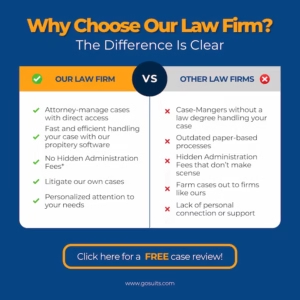
At GoSuits, every client has a designated attorney – not a case manager, not a paralegal phone tree. You have unfettered access to the attorney handling your matter. That matters most in the first 72 hours of a dram shop case, when evidence decisions get made and when the difference between preserved footage and an overwritten drive can determine whether the case succeeds.
Our team serves clients across Texas, and our Dallas personal injury attorneys handle claims filed in Dallas County District Court at the George L. Allen Sr. Courts Building and throughout the greater DFW metroplex. We also serve clients in Plano, McKinney, Carrollton, Irving, and across North Texas. Our attorneys bring 30 years of combined experience and have handled cases that went to trial – not just settlement. Trial experience is a genuine strategic asset. When an opposing counsel knows your team has tried dram shop cases to verdict, the dynamics of negotiation change.
GoSuits is built around proprietary technology that accelerates case development – gathering and organizing evidence, identifying coverage layers, tracking TABC records, and building the factual timeline faster than traditional processes allow. This is not automation replacing lawyers. It is technology doing the administrative work so attorneys spend their time on strategy, advocacy, and client communication. The result is a client experience where you are heard, informed, and actually able to reach the person responsible for your case.
Our prior cases reflect recoveries across a range of personal injury and wrongful death claims, and we are transparent about what our team has accomplished and how we work. Our our attorneys page gives you a direct look at who would handle your matter.
We handle personal injury lawyers cases that include car accident claims, wrongful death, premises liability, and alcohol-related crash injuries. If you were hurt, or you lost someone, in a crash involving a drunk driver who came from a licensed establishment in Dallas or anywhere in the region, the conversation with our team is free. You can learn more about who we are at about us, review the full scope of what we handle at practice areas, or take the next step and schedule a free consultation with a Dallas personal injury attorney today. The sooner that conversation happens, the better the chances the evidence that matters is still there.
References
- Texas Alcoholic Beverage Code Chapter 2 – Texas Constitution and Statutes
- D. Houston, Inc. v. Love, 92 S.W.3d 450 (Tex. 2002) – CourtListener
- F.F.P. Operating Partners, L.P. v. Duenez, 237 S.W.3d 680 (Tex. 2007) – CourtListener
- Steak & Ale of Texas, Inc. v. Borneman, 62 S.W.3d 898 (Tex. App. 2001) – CourtListener
- Texas Alcoholic Beverage Code Section 2.06 (Safe Harbor) – Texas Constitution and Statutes
- Texas Alcoholic Beverage Commission – Official Website
- Drink, Drive and Get Away With It – GoSuits Knowledge Base
- Texas Civil Practice and Remedies Code Chapter 33 (Proportionate Responsibility) – Texas Constitution and Statutes
- Texas Civil Practice and Remedies Code Section 16.003 (Statute of Limitations) – Texas Constitution and Statutes
- Texas Judicial Branch – Official Website
- Raoger Corporation v. Barrie Myers, No. 23-0662 (Tex. 2025) – CourtListener
- Texas Court Rules – State Law Library