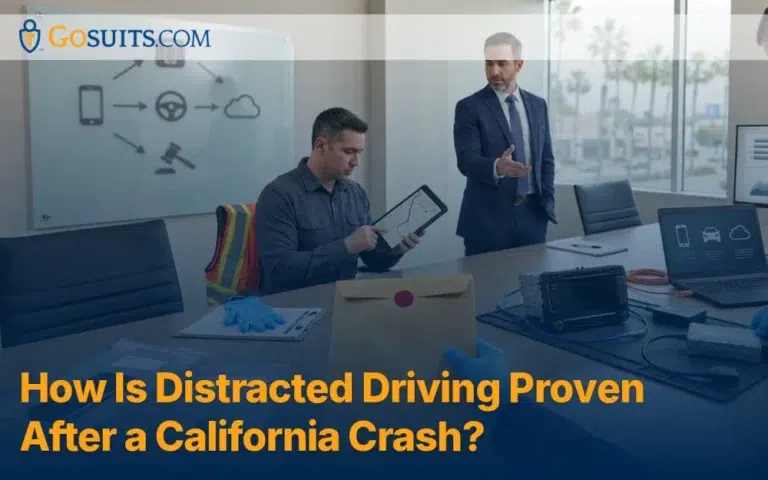
Proving that the other driver was distracted at the moment of a crash in California is not a simple matter of pointing to a phone. The law sets specific prohibitions, but a citation alone rarely settles a civil case. What actually decides liability is the evidence a party is able to preserve, subpoena, and present. That process begins in the first hours after the collision, and the window for securing the most critical records closes faster than most people realize.
Legal Snapshot
- Legal Topic: Proving Distracted Driving in a California Personal Injury Claim
- Case Stage: Pre-litigation investigation and civil discovery
- Primary Legal Issue: Negligence and negligence per se arising from handheld or texting device use while driving
- Primary Authority: California Vehicle Code §§ 23123, 23123.5; California Evidence Code § 669 (negligence per se); California Code of Civil Procedure § 1985.3 (subpoena for consumer records)
- Date Legal Authority Last Reviewed: 2025
What Do Vehicle Code Sections 23123 and 23123.5 Prohibit?
California Vehicle Code section 23123 prohibits a person from driving a motor vehicle while using a wireless telephone unless the telephone is specifically designed and configured to allow hands-free listening and talking and is used in that manner while driving. A first offense carries a base fine of twenty dollars; a subsequent offense carries fifty dollars. [1]
California Vehicle Code section 23123.5, as amended effective January 1, 2018, goes further. It prohibits a driver from holding and operating a handheld wireless telephone or any electronic wireless communications device while driving. The hands-free exception for section 23123.5 is narrower than it may appear: a driver may interact with a properly mounted device only through a single swipe or tap of one finger to activate or deactivate a feature. Any broader manual engagement while holding the device is prohibited. [2]
Drivers under eighteen face a complete prohibition on all wireless device use, including hands-free, under Vehicle Code section 23124. Emergency use exceptions apply to both adult statutes.
Why a Citation Alone Rarely Settles a Civil Case
A traffic citation for a cell phone violation is useful evidence, but it is not a substitute for a full evidentiary showing in a civil personal injury claim. In a civil proceeding, the injured party must still establish duty, breach, causation, and damages. A citation documents that an officer observed or cited the conduct, but it does not speak to whether that conduct was the proximate cause of the specific crash, whether the device use was continuous or incidental, or whether the injured person’s own conduct contributed to the collision under California’s pure comparative fault rule established in Li v. Yellow Cab Co., 13 Cal.3d 804 (1975). [3]
California Evidence Code section 669 does permit a court to presume negligence when a statute is violated, the violation proximately caused the injury, the injury resulted from a type the statute was designed to prevent, and the injured person belongs to the class the statute was designed to protect. [4] That presumption is rebuttable, and defendants routinely contest causation even when a device violation is established. The practical result is that you need independent, corroborating evidence of both the violation and its role in causing the crash.
Along the I-405 through Irvine’s industrial corridors, on surface streets near the Irvine Spectrum, or approaching exits on SR-55 during afternoon congestion, collisions happen quickly. The evidence that proves how they happened disappears almost as fast.
Why the First Two Weeks Determine What Evidence Survives
The most consequential decision in a distracted driving case is often made before a lawsuit is ever filed: whether a preservation letter goes out immediately after the crash. Wireless carriers, vehicle manufacturers, fleet operators, and telematics providers all operate on retention schedules. When those schedules expire, the data is gone.
Carriers typically retain detailed call records for twelve to eighteen months. However, session-level data records showing when a data connection was active, which applications were in use, and at what time are often retained for far shorter windows, sometimes sixty to ninety days for granular session logs, and sometimes not at all beyond internal business purposes. A carrier’s standard litigation hold, if triggered by a preservation demand, suspends routine destruction. Without that demand, the routine destruction continues on schedule.
A preservation letter sent within the first week of a crash can stop that destruction. One sent three months later often cannot retrieve records that have already cycled off the carrier’s servers.
What a Preservation Letter Must Cover
An effective preservation demand addresses the device itself, the carrier account, all associated cloud backups, and any telematics or navigation systems in the at-fault vehicle. It should identify the date, time, and approximate location of the collision and demand that no relevant records be altered, overwritten, or destroyed pending the resolution of legal proceedings. Sending the letter does not guarantee production, but it creates both a legal obligation and a discoverable record of the obligation.
If the opposing party then destroys evidence after receiving a preservation demand, California Evidence Code section 413 permits a trier of fact to draw an adverse inference from that willful suppression. [5] Discovery misconduct is separately sanctionable under California Code of Civil Procedure sections 2023.010 and 2023.030. [6]
For residents of Newport Beach, Irvine, Costa Mesa, and surrounding Orange County communities, the court where a civil claim would be filed is the Orange County Superior Court, with the Central Justice Center located in Santa Ana. Preservation demands need to be enforceable in that forum, which reinforces the need for prompt legal involvement.
Carrier Call and Data Records: Subpoenas and Short Retention Windows
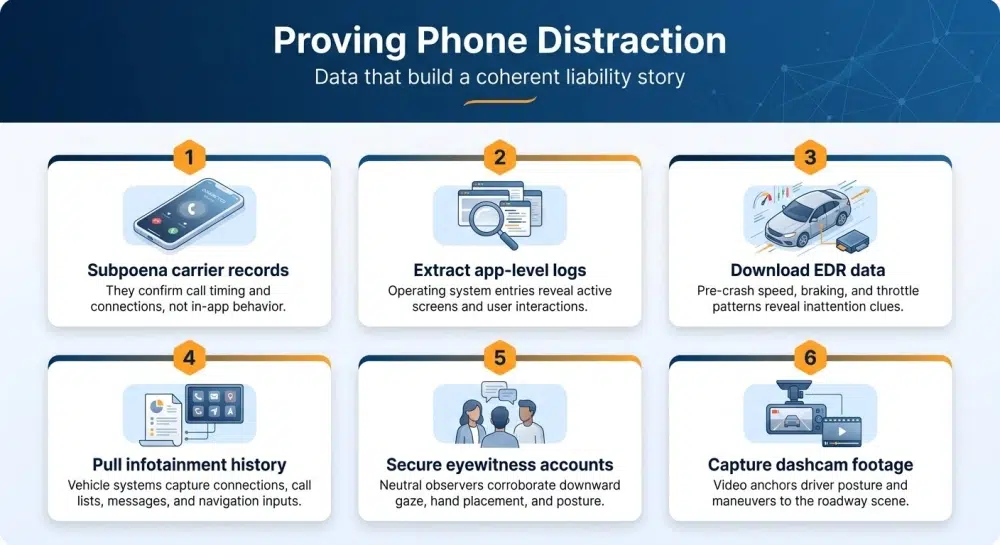
Once litigation is underway, the primary mechanism for obtaining a driver’s phone records from their wireless carrier is a subpoena for consumer records under California Code of Civil Procedure section 1985.3. [7] That statute requires that the consumer receive advance notice before the subpoena is served on the carrier, giving the consumer an opportunity to object. The process takes time, which is another reason early action is critical.
Call detail records obtained through this process typically show the time, duration, and number of calls, and whether a call was connected. They can confirm that the at-fault driver was on an active call in the minutes preceding or during the crash. The limitation is that standard call records document voice calls, not the full picture of how the device was being used.
What Carrier Records Do Not Show
Carriers do not retain application-level activity logs that would show whether a driver was scrolling through social media, reading a text message, or watching a video at the moment of impact. That data lives on the device itself and in associated cloud accounts, not on the carrier’s billing servers. Standard call detail records show that a session was active, not what the user was doing within that session.
For cases where application-level distraction is suspected, including navigation app use, messaging, or video streaming, the evidence must come from sources other than the carrier: the device itself, cloud backups, and forensic extraction of the phone’s internal logs.
Application-Level Activity the Carrier Does Not Hold
Modern smartphones generate extensive logs of application use, screen-on events, and input activity that are stored locally on the device and synchronized to cloud accounts. This data can show, with timestamped precision, that a specific application was active on the screen at the time of the crash. Navigation apps, messaging platforms, and social media applications each create activity logs at the application and operating system level.
Obtaining this data requires either voluntary production, a court order compelling production of the device for forensic examination, or a subpoena directed at the cloud provider associated with the device. iCloud, Google Account backups, and manufacturer-specific services retain synchronized data under their own policies, which may differ significantly from carrier retention schedules.
Application-level data is particularly valuable because it can rebut claims that a driver was merely using the device hands-free or that the device was in a pocket. A log showing active screen interaction with a messaging application two seconds before impact is qualitatively different from evidence that a call was technically connected.
The SR-73 toll road and the I-5 corridor through South Orange County see stop-and-go patterns that are precisely the conditions in which drivers are most likely to look down at a device. If you were injured in those conditions and suspect the other driver was using a phone or an application, the app-level logs on their device may be the most probative evidence available and also the evidence most at risk of loss.
Car accident lawyers who handle these cases work with digital forensics professionals to preserve and analyze this data within the applicable legal procedures.
Event Data Recorders: The Seconds Before Impact
Most vehicles manufactured in the last fifteen years contain an event data recorder, commonly called an EDR or black box. California Vehicle Code section 9951 governs access to EDR data and requires either the owner’s consent, a court order, or a lawful discovery subpoena to obtain a download. [8] The data itself covers the final seconds before a crash, typically five to ten seconds depending on the system, and can include:
- Vehicle speed
- Brake application and timing
- Throttle position
- Steering input
- Seatbelt status
- Airbag deployment data
EDR data does not directly identify phone use. What it can show is that the driver did not apply brakes before impact, that the vehicle was traveling at a speed inconsistent with observed road conditions, or that no evasive steering maneuver occurred. Those patterns, combined with phone records showing an active call or data session, build a consistent picture of inattentive driving.
In a rear-end collision, for example, EDR data showing zero brake application in the seconds before impact on a road where traffic had slowed ahead is strong circumstantial evidence of distraction. That evidence, combined with a contemporaneous data session on the at-fault driver’s phone, provides the kind of corroborated, multi-source proof that moves a civil case.
EDR preservation is time-sensitive for a different reason. When a vehicle is repaired after a crash, the repair process may overwrite the EDR data. When a vehicle is totaled and sent to a salvage yard, access becomes practically difficult even with legal authorization. Preservation demands directed at the vehicle owner or the insurance carrier holding the vehicle should go out as early as possible.
Attorneys who handle injury claims, including those serving clients throughout personal injury claims in Irvine and across Orange County, typically issue simultaneous preservation demands covering the vehicle, the device, and the carrier account in the days immediately following a crash.
Infotainment Systems and Telematics Forensic Extraction
Vehicle infotainment systems present a separate and increasingly rich source of forensic evidence. Modern systems running Apple CarPlay, Android Auto, or proprietary manufacturer platforms log connection events, application activity through the in-vehicle interface, call history, message previews, and navigation inputs. Some systems retain this data in the vehicle’s onboard memory even after the device is disconnected.
Forensic extraction of infotainment data requires specialized hardware and software tools and must be performed by qualified digital forensics professionals. The extraction process, and the chain of custody for the resulting data, must be documented to withstand evidentiary scrutiny. Improper collection can render the data inadmissible or create authentication problems at trial.

Telematics and Fleet Vehicle Data
Commercial vehicles and fleet vehicles often contain additional telematics systems beyond the OEM infotainment unit. These may include GPS tracking with timestamped location data, acceleration and braking event logs, and driver behavior monitoring systems. In a commercial vehicle crash, the telematics data can corroborate or contradict the driver’s account of events with a level of precision that is difficult to challenge.
If the at-fault vehicle was a rideshare vehicle, a delivery van, or any other commercially operated vehicle, the telematics data held by the operator or fleet management provider is a distinct target for preservation and discovery. That data may be subject to different retention schedules than personal vehicle EDR data, and the responsible party for preservation may be the operator rather than the individual driver.
Families across Irvine, Santa Ana, Fullerton, and neighboring Orange County communities who are dealing with serious injury or wrongful death crashes involving commercial vehicles should understand that the evidence universe in those cases extends well beyond the personal phone of the at-fault driver.
Admissions in Deposition and Discovery
Documentary evidence is often the most persuasive form of proof in a distracted driving case, but statements by the at-fault driver can be equally significant. At-fault drivers sometimes admit device use in conversations at the scene, in recorded statements to insurers, or in responses to written discovery. More commonly, inconsistencies between their stated account and the objective data, including phone records, EDR data, and physical evidence, surface during deposition.
California Code of Civil Procedure section 2025.010 and related provisions govern oral depositions and permit wide-ranging examination of a witness’s conduct before, during, and after the crash. Interrogatories and requests for production of documents can require the at-fault driver to produce their own phone records, device logs, and cloud account information, subject to proper objections and court oversight.
Deposition preparation in distracted driving cases requires careful correlation of the driver’s expected account with all available documentary evidence. Inconsistencies between deposition testimony and device data are often the pivot point that drives settlement or trial strategy.
Requests for Admission
Requests for admission under California Code of Civil Procedure section 2033.010 can require the opposing party to admit or deny specific facts, including whether they were holding a device, whether a specific application was active, or whether they received a notification before the crash. Responses to requests for admission become binding admissions in the litigation and can narrow the issues that must be proven at trial.
Handheld Use Versus Hands-Free Distraction
The distinction between handheld and hands-free use is legally significant under sections 23123 and 23123.5, but it does not resolve the civil question of whether distraction caused the crash. California’s distracted driving statutes prohibit handheld use as a per se violation, creating the potential for negligence per se under Evidence Code section 669. Hands-free use, by contrast, is generally permitted by statute but is not immune from negligence claims.
Research consistently demonstrates that cognitive distraction from any phone conversation, whether handheld or hands-free, reduces driver responsiveness and situational awareness. A driver who was conducting a hands-free call through a properly mounted device may nonetheless have been cognitively distracted to a degree that constitutes negligence under Civil Code section 1714’s ordinary care standard. [9]
In practice, proving hands-free distraction is more difficult than proving a handheld violation, because there is no statutory presumption and the evidence must establish that the driver’s attention was compromised in a way that caused the crash. Expert testimony from accident reconstruction specialists and human factors professionals is often required in those cases.
The more common scenario involves handheld use, where the statutory violation creates a presumption that simplifies the negligence analysis, and the remaining work is corroboration of the violation and proof of causation.
Independent Witnesses and Dashcam Footage
Objective, third-party evidence of device use is among the most persuasive available. Witnesses who observed the at-fault driver looking down at a device in the moments before impact provide contemporaneous, non-partisan accounts that are difficult for defendants to challenge. Identifying those witnesses at the scene, obtaining their contact information, and preserving their accounts is a priority that cannot be delegated to a later time.
Dashcam footage from the involved vehicles, from vehicles traveling nearby, or from fixed cameras in the area can capture the at-fault driver’s posture, hand position, and apparent gaze direction. Footage from business security cameras and traffic monitoring systems may also be available, but those sources have their own short retention windows, sometimes as brief as twenty-four to seventy-two hours before overwriting occurs.
Preservation demands for dashcam and surveillance footage must go out within twenty-four to forty-eight hours of the crash to have any realistic chance of success. GoSuits attorneys handle this preservation work as part of early case investigation, recognizing that delay in this context means permanent evidence loss.
Along corridors like Jamboree Road, Alton Parkway, and Harvard Avenue in Irvine, business density means that security camera coverage is relatively high. That coverage, however, only becomes usable evidence if it is identified and preserved before the footage cycles over.
How the Evidence Works Together: A Hypothetical Scenario
Hypothetical example for illustration purposes only. This does not represent an actual GoSuits case or client:
A driver traveling northbound on the SR-55 approaching the I-405 interchange rear-ends a vehicle that had slowed in stop-and-go traffic. The at-fault driver says she did not see the vehicle stop. The injured driver’s attorney sends a preservation letter within forty-eight hours, directed to the at-fault driver, her carrier, and her vehicle’s manufacturer.
The EDR download shows zero brake application in the eight seconds before impact, at a speed fifteen miles above the posted limit. Carrier call records show a data session active on the at-fault driver’s phone beginning six minutes before the crash and ending forty seconds after impact. Application logs extracted from the vehicle’s infotainment system show an active connection to a social media application during the same window. A witness who was traveling in an adjacent lane saw the driver’s head angled downward and both hands in her lap in the seconds before the collision.
Each piece of evidence alone is contestable. Together, they tell a coherent story of inattentive driving with multiple corroborating sources. That convergence is what distinguishes a provable case from an arguable one.
What Damages May Be Available in a California Distracted Driving Claim?
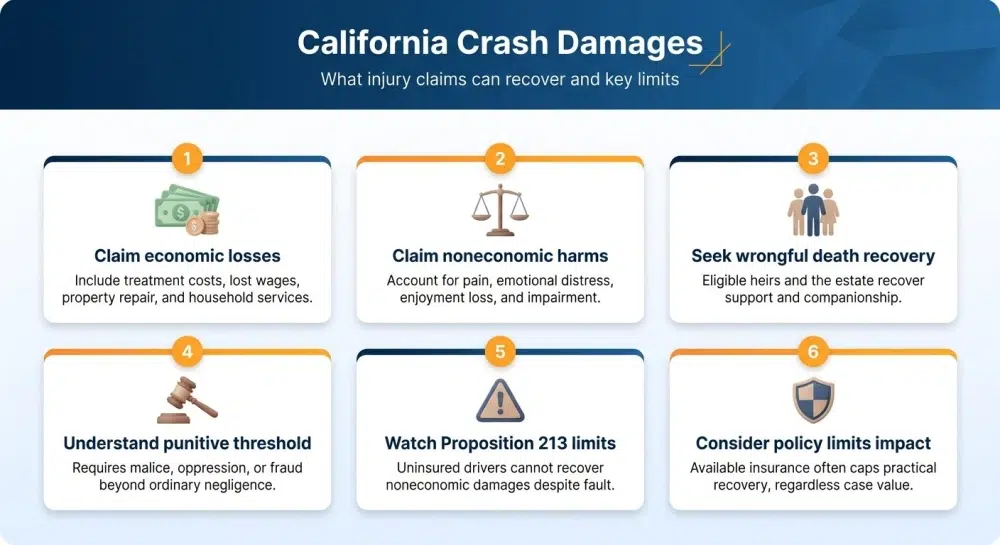
If liability is established, a California personal injury claim for a distracted driving crash may support recovery of:
- Economic damages: Current and future medical expenses, lost wages, loss of earning capacity, property damage, and reasonable household service expenses.
- Noneconomic damages: Pain and suffering, emotional distress, loss of enjoyment of life, and physical impairment.
- Wrongful death damages: Under California Code of Civil Procedure sections 377.60 and 377.30, eligible heirs and the decedent’s estate may recover for financial support, household services, companionship, and, through the estate, the decedent’s own losses. [10]
- Punitive damages: Available only in exceptional cases under Civil Code section 3294 where the defendant acted with malice, oppression, or fraud. Ordinary negligence, even serious negligence, does not satisfy that standard. [11]
The recoverability and extent of each category depend on the facts of the specific case, applicable law, policy limits, and, in some circumstances, whether the injured party was insured at the time of the crash. California Civil Code section 3333.4, enacted under Proposition 213, restricts recovery of noneconomic damages by uninsured drivers even when they are not at fault. [12]
The statute of limitations for personal injury claims in California is two years from the date of injury under Code of Civil Procedure section 335.1. For property damage only, the period is three years under section 338. Claims involving public entities have substantially shorter notice requirements and should be reviewed by counsel without delay. [13]
Talk With a GoSuits Attorney About Your Distracted Driving Claim
A distracted driving claim in California involves time-sensitive evidence, multiple data sources, and legal procedures that govern how each source can be obtained and used. The evidence that matters most is also the evidence most likely to be lost without prompt action. If you were injured by a driver you believe was using a phone or another device, the decisions made in the days immediately following the crash will affect what can be proven later.
GoSuits represents injured people across Orange County and Southern California as personal injury lawyers. Our approach to distracted driving cases combines immediate preservation action, coordinated evidence gathering across device, carrier, and vehicle data sources, and preparation for litigation if insurance negotiations do not resolve the claim fairly.
Schedule a free consultation to discuss the circumstances of your crash, what evidence may be available, and what steps should be taken to protect your claim.

Related California Personal Injury Resources
References
- California Vehicle Code § 23123 – Wireless Telephone Use While Driving – California Legislative Information
- California Vehicle Code § 23123.5 – Handheld Device Use While Driving – California Legislative Information
- Li v. Yellow Cab Co., 13 Cal.3d 804 (1975) – Google Scholar
- California Evidence Code § 669 – Negligence Per Se – California Legislative Information
- California Evidence Code § 413 – Adverse Inference from Willful Suppression – California Legislative Information
- California Code of Civil Procedure § 2023.010 – Misuse of Discovery – California Legislative Information
- California Code of Civil Procedure § 1985.3 – Subpoena for Consumer Records – California Legislative Information
- California Vehicle Code § 9951 – Event Data Recorder Access and Privacy – California Legislative Information
- California Civil Code § 1714 – General Duty of Ordinary Care – California Legislative Information
- California Code of Civil Procedure § 377.60 – Wrongful Death Actions – California Legislative Information
- California Civil Code § 3294 – Punitive Damages Standard – California Legislative Information
- California Civil Code § 3333.4 – Proposition 213 Limitation on Noneconomic Damages – California Legislative Information
- California Code of Civil Procedure § 335.1 – Statute of Limitations for Personal Injury – California Legislative Information