- What is the eggshell plaintiff rule, and does Texas follow it?
- What is the difference between causing a new injury and aggravating an old one?
- How do doctors and attorneys build a medical baseline from prior records?
- How do treating physicians separate new crash damage from pre-existing findings?
- Does degenerative disc disease eliminate a car accident claim in Texas?
- What insurer tactic blames everything on pre-existing conditions, and how is it countered?
- How does Texas comparative fault interact with pre-existing condition claims?
- What evidence helps prove new injury versus old degeneration?
- Where are pre-existing condition injury cases filed in Dallas?
- Frequently Asked Questions
- How GoSuits Dallas Personal Injury Attorneys Approach These Cases
- References
What is the eggshell plaintiff rule, and does Texas follow it?

Texas courts apply a doctrine commonly called the eggshell plaintiff rule, sometimes called the thin skull rule. Under this principle, a defendant who negligently or intentionally harms another person must accept that plaintiff as they find them – including any physical vulnerabilities, prior injuries, or medical conditions the plaintiff had before the accident. [1]
The rule’s name comes from an extreme hypothetical: imagine someone with a skull so thin it shatters under an impact that would not even bruise an average person. The negligent party cannot escape liability simply because the harm was far worse than it would have been to a healthy individual. As long as the defendant’s wrongful act was the proximate cause of the harm, the full extent of the resulting injury belongs to the defendant. [1]
The Fifth Circuit – whose jurisdiction covers federal civil litigation arising from Texas – applied this doctrine in Koch v. United States, 857 F.3d 267 (5th Cir. 2017), reinforcing that foreseeability of the severity of the harm is not required; only foreseeability that some harm could result from the negligent act matters. [2]
For practical purposes in a Texas personal injury claim, this means that if you had a prior back condition, a degenerative knee, a history of headaches, or any other physical vulnerability, a negligent driver who rear-ends your vehicle on I-635 or I-30 cannot argue that your pre-existing condition breaks the chain of their liability. They take the risk of hurting you as you actually are, not as they imagine a healthier person might be. That protection matters, because injury claims often surface or worsen dormant conditions.
What is the difference between causing a new injury and aggravating an old one?
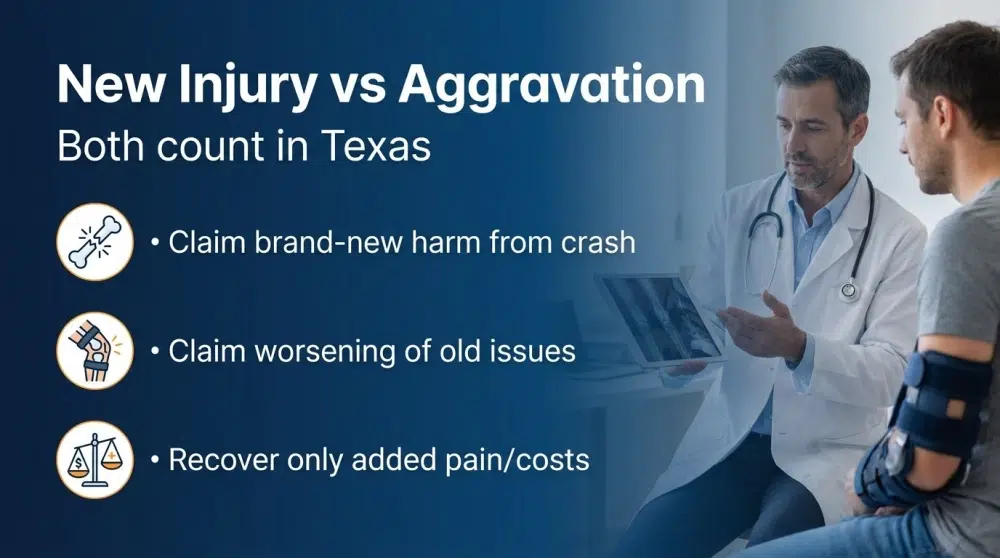
This distinction shapes how damages are calculated and how a claim is presented, though both categories are recoverable under Texas law.
Causing a new injury means the accident produced a physical problem that did not exist before the collision. A broken collarbone, a new disc herniation in someone who had a healthy spine before the crash, or a traumatic perforation – these are injuries that arise entirely from the event at hand.
Aggravating a pre-existing condition means the accident worsened or accelerated a condition already present in the plaintiff’s body. A person with mild lumbar arthritis may have been managing their pain with over-the-counter medication and light stretching before a collision on the Dallas North Tollway. After the crash, that same area may require steroid injections, physical therapy three times a week, and eventually surgery. The arthritis existed; its severity, functional limitation, and treatment costs did not exist at that level before the accident.
Texas courts recognize both scenarios as compensable. The defendant is liable for the aggravation – the worsening – not for the pre-existing condition itself. A defendant cannot be charged for the discomfort a plaintiff was already experiencing before the crash; they can be charged for every increment of additional suffering, reduced function, and medical cost the crash added on top of the baseline. [3]
This distinction has real stakes for both sides. From the plaintiff’s perspective, the goal is to show as precisely as possible how much worse things became after the collision. From the defense perspective, the goal is to argue that the plaintiff’s current condition is indistinguishable from what would have occurred without the accident anyway, due to the natural progression of the underlying disease.
How do doctors and attorneys build a medical baseline from prior records?
Before you can show how much worse an accident made you, you need a clear picture of how you were before the accident. That picture comes from your prior medical records, and it is one of the most important pieces of evidence in any aggravation-of-injury claim.
A medical baseline is built by gathering all treatment records, imaging studies, prescription histories, and physician notes that predate the accident. These records typically come from primary care doctors, orthopedic surgeons, pain management providers, chiropractors, and any specialists who treated the relevant body part before the crash. If you had never been treated for back problems before the collision, those empty records are themselves a form of baseline – the absence of prior treatment history is evidence.
Attorneys who handle these cases in Texas generally send preservation letters and medical authorization requests as early as possible after signing with a client. In Dallas County civil litigation filed at the George L. Allen Sr. Courts Building, both parties will exchange prior medical records during the discovery phase. Texas Rule of Civil Procedure 194 governs mandatory disclosures, and medical records from the years before the injury are routinely requested. [4]
If you received imaging – X-rays, MRI scans, CT scans – before the accident, those studies are particularly valuable because they provide a literal picture of the condition of your spine, joints, or other structures at a known point in time. A radiologist or treating physician can compare those pre-crash images to post-crash images and describe specifically what changed and what did not.
One reason it matters to gather this evidence early is that medical records can be lost, storage systems change, and small practices sometimes close. Acting quickly protects the integrity of the baseline evidence that anchors your entire aggravation claim.
How do treating physicians separate new crash damage from pre-existing findings?
This is where medicine and law intersect most directly. Treating physicians – the doctors who actually care for you after the accident – are often called upon to give opinions about causation: what did this collision do to your body that would not have happened otherwise?
Physicians approach this question through several methods.
- Comparison of imaging studies. If an MRI taken before the accident shows mild disc bulging at L4-L5 with no neural compromise, and an MRI taken two weeks after the accident shows a new herniation at the same level with significant nerve compression, the physician can point to that structural change as evidence of new damage caused by the traumatic event.
- Timing and mechanism of symptom onset. A condition that had been stable for years and that became acutely painful within days of a specific accident has a temporal relationship that supports causation. Doctors document this by noting the patient’s reported onset of new or substantially worsened symptoms following the collision.
- Functional capacity changes. Prior to the accident, a patient may have been working full-time, exercising regularly, and managing mild discomfort without significant limitation. After the crash, those same activities may be impossible. The treating physician documents the functional decline and ties it to objective physical findings from the examination.
- Response to treatment. If a prior condition was managed conservatively with minimal intervention, but after the accident the same body part requires surgical intervention, the escalation of care is itself evidence of a worsening that the accident caused.
Physicians use language carefully in these reports. Texas courts have addressed the standard for causation opinions in personal injury cases, and treating physicians are generally expected to state their opinions to a “reasonable medical probability” – meaning it is more likely than not that the accident caused or contributed to the condition being treated. [3]
It is worth noting that personal injury claims encompass many different scenarios where this analysis applies – stop-and-go rear-end collisions on I-35E near downtown Dallas, side-impact crashes at busy intersections in Deep Ellum, and high-speed freeway collisions on I-30 each produce different injury patterns, but the analytical framework for separating new damage from prior conditions remains the same.
Does degenerative disc disease eliminate a car accident claim in Texas?
No. Degenerative disc disease, or DDD, is one of the most common pre-existing conditions cited by insurance adjusters in an attempt to minimize or deny claims. The presence of degenerative findings on an MRI does not, by itself, defeat a claim for crash-related spinal injuries in Texas. [3]
Degenerative disc disease is extraordinarily common. The National Institute of Arthritis and Musculoskeletal and Skin Diseases, part of the National Institutes of Health, notes that age-related degeneration of spinal discs is nearly universal with increasing age. Many people with significant degenerative changes on imaging live without pain or functional limitation until a traumatic event accelerates the deterioration or causes an acute injury superimposed on the degenerated structure. [5]
The relevant legal question is not whether degenerative disc disease exists, but whether the accident aggravated that condition, produced a new symptom, caused a herniation in a degenerated disc, or accelerated the need for treatment. A disc that was degenerating slowly may have been years away from causing significant symptoms. A crash can compress or shear that disc in a way that causes acute herniation and immediate nerve compression. The defendant who caused the crash is responsible for that acceleration and that new acute harm.
Texas pattern jury instructions – published and approved by the State Bar of Texas – address aggravation of existing conditions directly, allowing juries to award damages specifically for the aggravation or exacerbation of a pre-existing condition attributable to the defendant’s negligence. [6]
People with prior spinal conditions who are injured in crashes involving commercial trucks, 18-wheelers, or large freight vehicles tend to sustain more severe spinal trauma because of the forces involved. Brain injury lawyers and car accident lawyers alike see this pattern regularly – degenerative structures absorb trauma differently than healthy ones, and the results are often more severe, not less.

What insurer tactic blames everything on pre-existing conditions, and how is it countered?
Insurance adjusters and defense counsel regularly deploy what practitioners call the “all pre-existing” argument: the claim that every symptom the plaintiff is experiencing after the accident was already present before it, and the crash changed nothing. It is a tactic, not a medical opinion, and it relies on the assumption that the plaintiff’s own prior records will be used against them.
The tactic typically works like this:
- Blanket record demands. The insurer requests every medical record you have ever generated – not just records related to the injured body part, but your entire history. The goal is to find any reference, however minor, to the area of the body now at issue. A single notation of mild back soreness at a routine visit years earlier may be used to argue that your current disc herniation has nothing to do with the accident.
- Defense medical examination (DME). Insurance companies can request an independent medical examination by a physician of their choosing. These physicians are paid by the defense and statistically produce findings favorable to the insurer. They may review your prior records and conclude that your current condition reflects natural disease progression rather than crash-related injury.
- Arguing stability versus acceleration. A common defense position is that the pre-existing condition was “stable” before the accident and that any changes are merely the natural progression of the disease, not the result of the crash. This argument ignores the temporal relationship between the accident and the onset or worsening of symptoms.
Countering these tactics requires the same tools that built the baseline in the first place: objective imaging comparisons, well-documented functional history, detailed treating-physician opinions, and the records of treatment you were actually receiving – or not receiving – for the injured area before the crash. A plaintiff who had no recent treatment, no recent imaging, no medications prescribed for the injured structure, and no reported symptoms in the years before the accident has a powerful response to a claim that “it was all pre-existing.” The records say otherwise.
The eggshell plaintiff doctrine is the legal shield against this argument. Even if the pre-existing condition made you more vulnerable to injury from the crash, that vulnerability is your defendant’s problem, not your disqualification from recovery. [1]
If you’ve been injured and an adjuster is telling you that your MRI results are “just wear and tear,” speaking with personal injury lawyers who understand how to present this evidence to a Dallas County jury is a practical next step – not something to put off while the adjuster’s position hardens.
How does Texas comparative fault interact with pre-existing condition claims?
Texas follows a modified comparative fault system with a 51% bar. Under Texas Civil Practice and Remedies Code Chapter 33, a plaintiff who is found to be 51% or more at fault for their own injuries cannot recover damages. If the plaintiff is 50% or less at fault, their damages are reduced by their proportionate share of fault. [7]
This system does not directly address pre-existing conditions, but it interacts with them in one important way: defendants sometimes argue that a plaintiff’s pre-existing physical vulnerability contributed to their own injuries, effectively suggesting the plaintiff shares fault for being more fragile. Texas courts have generally treated this argument skeptically, because the eggshell plaintiff doctrine places the risk of the plaintiff’s physical condition squarely on the defendant. A person is not comparatively at fault for having a prior medical condition.
The more common intersection between comparative fault and pre-existing conditions arises from the facts of the accident itself – the speeds involved, whether the plaintiff was properly restrained, the lane positions of the vehicles. Those facts govern comparative fault. The pre-existing condition governs the extent of the damages once fault is assigned. The two questions are analytically separate, and keeping them separate is important for presenting a claim clearly to a jury in Dallas County District Court.
What evidence helps prove new injury versus old degeneration?
The strength of any pre-existing condition injury claim rises and falls on evidence. These are the categories that carry the most weight in Texas personal injury litigation.
- Pre-accident imaging with post-accident comparisons. An MRI from 18 months before the accident versus one taken three weeks after provides a contemporaneous comparison that no amount of argument can fully undercut. Structural changes visible on imaging speak for themselves.
- Treatment history gap. If you had not sought treatment for the injured area in the year or two before the accident, that gap is powerful evidence that your condition was not causing you significant problems before the crash. Records showing no recent prescriptions, no recent physical therapy, and no recent imaging for that area undermine the “all pre-existing” narrative.
- Witnessed functional history. Employers, coworkers, family members, and friends who observed your physical capabilities before the accident can testify about what you were doing – the physical work, the recreational activities, the daily tasks – that you can no longer perform.
- Pain journal entries contemporaneous with the accident and treatment. Courts allow plaintiffs to describe their experience of pain and functional loss. A detailed, consistently maintained record of daily limitations helps quantify non-economic damages tied specifically to the crash’s effects, separate from baseline discomfort.
- Expert medical testimony. In cases where the causation question is genuinely complex, a retained treating specialist may provide more formal opinions about the biomechanics of the injury, the difference between degenerative changes and traumatic changes visible on imaging, and the expected trajectory of the plaintiff’s condition with and without the accident.
- Employment and wage records. If the pre-existing condition was not affecting your ability to work before the crash, payroll records showing consistent full-time employment followed by lost time after the accident help establish that the accident – not the underlying condition – changed your earning capacity.
Our knowledge base covers how pain and suffering damages are calculated in Texas, which is directly relevant when a portion of the claim involves separating pre-existing discomfort from accident-caused suffering.
Where are pre-existing condition injury cases filed in Dallas?
Civil personal injury claims in Dallas County are filed in the Dallas County District Court. For most cases, the physical location for filing is the George L. Allen Sr. Courts Building at 600 Commerce Street in downtown Dallas. The district courts in Dallas hear general civil matters including negligence and personal injury claims, and the filing deadlines set by Texas law apply uniformly.
Under Texas Civil Practice and Remedies Code Section 16.003, the statute of limitations for most personal injury claims is two years from the date of injury. [8] Filing after that date – absent a recognized exception – bars the claim entirely. This is why the timing of obtaining and preserving medical records, building the baseline, and retaining legal representation matters. An aggravation-of-injury case often involves more records, more medical history, and more preparation than a straightforward new-injury case. Starting early gives the time needed to gather that evidence properly.
Discovery in Dallas County civil cases follows the Texas Rules of Civil Procedure, and courts there routinely see disputes over the scope of prior medical record disclosure. Judges have broad discretion to limit discovery to records relevant to the injured body part and the period reasonably preceding the accident, rather than allowing wholesale fishing expeditions through a plaintiff’s entire medical history. [4]
The Texas Department of Transportation has tracked crash data across Dallas County for years, and heavy freeway corridors like I-35E, the LBJ Freeway (I-635), and I-30 consistently appear in crash statistics. Stop-and-go traffic on these routes creates conditions where rear-end collisions are frequent – exactly the type of impact that compresses spinal structures and often worsens existing degenerative disc disease or prior vertebral injuries. [9]

How GoSuits Dallas Personal Injury Attorneys Approach These Cases
When a crash worsens a condition you were already managing, the legal and medical picture becomes layered in ways that straightforward new-injury cases are not. Building the before-and-after contrast, working with your treating physicians to document causation properly, and presenting that contrast convincingly to a Dallas County jury or at a settlement conference requires both preparation and the kind of trial experience that comes from actually trying these cases – not just settling them under pressure.
Our Dallas personal injury team handles these layered claims across the Dallas-Fort Worth metroplex. We represent clients injured in collisions on I-635, I-30, I-35E, the Dallas North Tollway, and surface streets throughout Dallas County, Collin County, and beyond. Our prior cases reflect the range of pre-existing condition claims we have managed, from degenerative disc aggravation in rear-end collisions to traumatic worsening of prior orthopedic conditions in commercial vehicle crashes.
Here’s where we work a little differently. We’ve built our own software that handles case intake, record organization, and evidence tracking, so by the time we’re across the table from an adjuster or walking into Dallas County District Court, everything supporting your claim is already organized and ready to go. The tech moves things along. It doesn’t replace the person doing the work. Every GoSuits client gets a designated attorney on their case. No case managers, no staff relays sitting between you and your lawyer. You talk to your attorney directly, whenever you need to.
Our attorneys bring more than 30 years of combined experience in personal injury representation, including jury trials in Texas state courts. Trial experience shapes how we prepare these cases from the beginning – because we build every file as if it is going before a jury, which tends to produce better outcomes even when cases settle before trial.
GoSuits handles cases involving car accidents, truck and 18-wheeler collisions, brain injury claims, workplace injuries, wrongful death, slip-and-fall incidents, and other personal injury matters across Texas, California, and Illinois. Our attorneys and the firm’s overall approach are outlined on our about us page, and our full range of practice areas is available for review.
Got hurt in a crash that made an old condition worse? And now the insurance adjuster is telling you the MRI just shows wear and tear? Talking to us doesn’t cost anything. Schedule a free consultation with our Dallas personal injury team and we’ll walk through what actually happened to you. Figuring out how Texas law looks at your claim is honestly the first real step toward knowing if there’s a recovery path for the harm the crash caused.
References
- Eggshell Skull Rule – Legal Information Institute, Cornell Law School
- Koch v. United States, 857 F.3d 267 (5th Cir. 2017) – CourtListener
- Pattillo v. Franco, Texas Court of Appeals 14th District – CourtListener
- Texas Rules of Civil Procedure – Texas Judicial Branch Rules & Standards
- Back Pain – National Institute of Arthritis and Musculoskeletal and Skin Diseases (NIH)
- Texas Court Rules – Texas State Law Library Research Guide
- Texas Civil Practice and Remedies Code, Chapter 33 – Proportionate Responsibility
- Texas Civil Practice and Remedies Code, Section 16.003 – Statute of Limitations
- Texas Department of Transportation – Traffic Records and Crash Data
- Proximate Cause – Legal Information Institute, Cornell Law School