
- What Are Pain and Suffering Damages in Texas?
- What Types of Non-Economic Damages Can You Recover in Texas?
- How Is Pain and Suffering Compensation Calculated in Texas?
- Are There Caps on Pain and Suffering Damages in Texas?
- How Do You Prove Pain and Suffering in a Dallas Personal Injury Case?
- How Does Pain and Suffering Apply to Car Accident Claims in Dallas?
- How Does Texas Comparative Fault Affect Your Pain and Suffering Recovery?
- Can Families Recover Pain and Suffering Damages in a Texas Wrongful Death Case?
- What Makes a Serious Injury Lawsuit Different in Texas?
- What Is the Deadline to File a Texas Personal Injury Claim?
- How GoSuits Dallas Helps Injury Victims Pursue Full Compensation
- References and Resources
What Are Pain and Suffering Damages in Texas?
When someone suffers a serious injury because of another person’s negligence, the financial harm goes far beyond medical bills and missed paychecks. The physical agony, the sleepless nights, the anxiety about whether life will ever feel normal again, these are real losses too, and Texas law recognizes them as compensable. These losses are collectively referred to as pain and suffering damages, and they fall within the broader category of non-economic damages under Texas civil law.
Here’s the framework. Chapter 41 of the Texas Civil Practice and Remedies Code handles exemplary damages. Chapter 33 is the proportionate responsibility piece, which is basically how the law splits up damages when more than one person is at fault. [1] And non-economic damages? Texas law lumps in physical pain, mental anguish, physical impairment, disfigurement, and loss of consortium. Real losses. The kind you can’t really stick on a receipt or pull off a pay stub.
Cornell’s Legal Information Institute keeps the definition clean. Pain and suffering is the physical discomfort plus the emotional distress tied to an injury, and courts recognize both as compensable even without a built-in price tag. [2] Texas leaves the math to a jury. Twelve people, the evidence, the court’s instructions, and a number they think fairly compensates the plaintiff for harms that don’t come with a receipt.
For residents of Dallas and the surrounding DFW metroplex, understanding how pain and suffering compensation works in Texas personal injury cases is essential before accepting any settlement offer from an insurance company. Personal injury lawyers who handle these cases know how insurers attempt to minimize or dismiss non-economic damages, and they know how to counter those arguments with admissible evidence and well-developed legal arguments.
What Types of Non-Economic Damages Can You Recover in Texas?
Texas law groups pain and suffering into several distinct categories of non-economic harm. While these categories overlap and reinforce each other, courts and juries evaluate them separately to arrive at a fair total. Understanding what falls under this umbrella helps you and your attorney identify and document every compensable loss. [3]
What is physical pain and suffering in a Texas injury claim?
Physical pain and suffering encompasses the bodily discomfort, aching, burning, or sharp pain that flows directly from the injury itself. This includes pain experienced at the time of the collision, during surgical procedures or medical treatment, and as an ongoing condition if the injury is permanent or causes recurring flare-ups. The severity, duration, and daily impact of physical pain are all factors a jury weighs when assigning a dollar value.
Stop-and-go traffic conditions on the LBJ Freeway and high-speed collisions on I-35E near downtown Dallas produce some of the most severe crash-related injuries in the region, from spinal cord damage and traumatic brain injuries to crush injuries and internal organ damage. The physical suffering associated with those injuries can persist for years and in some cases lasts a lifetime.
What is mental anguish in Texas personal injury law?
Mental anguish refers to the emotional and psychological harm that flows from the injury, not merely from learning that you were hurt. Texas courts have defined mental anguish as a high degree of mental pain and distress something more than ordinary worry or embarrassment. It includes diagnosed conditions such as post-traumatic stress disorder, clinical depression, generalized anxiety disorder, and adjustment disorders that follow serious accidents. Evidence of mental anguish typically comes from treating therapists, psychiatrists, and the plaintiff’s own testimony about daily emotional struggles.
What is physical impairment as a damage category in Texas?
Physical impairment compensation addresses the loss of physical capacity itself, distinct from the pain that accompanies it. If an injury limits your ability to walk, lift, bend, exercise, or perform activities you previously enjoyed or needed to perform for work, that impairment is separately compensable. Physical impairment damages acknowledge that the loss of functional capacity is itself a harm separate from the pain you feel and separate from your lost wages.
What does disfigurement mean as a category of damages?
Disfigurement covers permanent physical changes to your body that affect your appearance, including significant scars, amputations, burns, or other visible alterations caused by the accident or its treatment. Texas law recognizes that disfigurement carries lasting emotional and social consequences beyond any physical pain, and juries may award substantial sums to reflect the permanence of those changes.
What is loss of consortium in Texas civil cases?
Loss of consortium compensates a spouse or, in some cases, a child or parent for the loss of the injured person’s companionship, affection, and support. It is a separate claim that derives from the underlying personal injury but belongs to the family member rather than the injured party. In cases involving serious injuries on Dallas highways such as US-75 or the Dallas North Tollway, where victims are left with permanent disabilities, loss of consortium claims can be a significant component of total damages.
How Is Pain and Suffering Compensation Calculated in Texas?
Texas law does not use a fixed formula or multiplier to calculate pain and suffering damages. There is no statute that says multiply your medical bills by three and you have your non-economic damages. Instead, a jury evaluates the totality of the evidence and decides what amount of money fairly and reasonably compensates the plaintiff for each category of non-economic harm. [4]
In practice, lawyers and adjusters commonly use two informal frameworks as starting points in negotiations, though neither is legally binding on a Texas jury:
- The multiplier method — Multiply total medical expenses by a number, typically ranging from 1.5 to 5, based on severity. A more serious and permanent injury commands a higher multiplier.
- The per diem method — Assign a daily dollar amount to the plaintiff’s suffering and multiply it by the number of days the plaintiff has suffered and is expected to continue suffering.
Neither method binds the court or jury. Texas juries receive instructions directing them to award a fair and reasonable sum based on the evidence, and both the plaintiff and defense present arguments about what that figure should be.
Factors that consistently influence how high or low a pain and suffering award will be in Dallas County civil cases include:
- Severity and permanence of the injury — A spinal cord injury producing permanent paralysis commands far more than a soft-tissue strain that resolves in a few weeks.
- Credibility and consistency of testimony — Plaintiff testimony that is detailed, consistent, and corroborated by medical records carries more weight than vague or shifting accounts.
- Quality and quantity of medical documentation — Treating physicians who document pain levels, limitations, and prognosis with specificity provide the foundation for a strong non-economic damages presentation.
- Expert witness support — In serious injury cases, vocational rehabilitation specialists, neuropsychologists, and life care planners can quantify the ongoing impact of pain on the plaintiff’s daily functioning.
- Impact on daily life — Photographs, video, journals, and testimony from family members describing how the injury has changed the plaintiff’s ability to work, parent, recreate, and maintain relationships can be highly persuasive.
The Texas Department of Transportation reports that thousands of serious injury crashes occur on Texas roadways each year, with Dallas County consistently ranking among the highest-volume counties for traffic collisions statewide. [5] Cases arising from those crashes regularly involve substantial non-economic damages claims that require careful preparation and experienced advocacy.
Are There Caps on Pain and Suffering Damages in Texas?
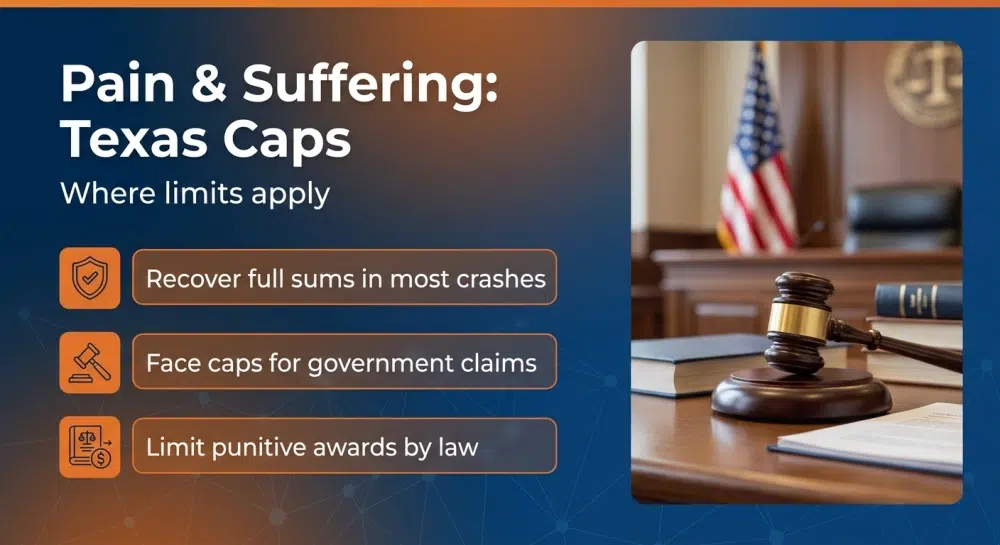
Whether Texas caps apply to your pain and suffering compensation depends critically on the type of case you have and who the defendant is. The answer is not the same for every personal injury claim. [1]
Are there damage caps in ordinary negligence car accident cases in Texas?
For standard negligence claims arising from car accidents involving private parties such as a rear-end collision on I-30 near downtown Dallas or a T-bone crash at a Garland intersection, Texas does not impose a statutory cap on non-economic damages. A jury can award whatever amount it finds fair based on the evidence.
Texas courts and the Texas Supreme Court have held that juries have wide discretion in valuing non-economic harms. The only check on excessive awards is the judicial remittitur process, through which a court may reduce a verdict that is so disproportionate to the evidence that it reflects passion, prejudice, or speculation rather than fair compensation.
Do Texas damage caps apply to claims against government entities?
Yes. When a defendant is a governmental entity such as the City of Dallas, Dallas County, the Texas Department of Transportation, or another public agency. The Texas Tort Claims Act imposes strict caps on total recoverable damages. Under Texas Civil Practice and Remedies Code Section 101.023, total damages are capped at $250,000 per person and $500,000 per occurrence for governmental units other than the state itself. The state’s own cap is $250,000 per claimant. [6] These caps limit both economic and non-economic damages combined.
If your accident involved a city-owned vehicle, a TxDOT truck, or a Dallas Area Rapid Transit bus, the Tort Claims Act governs your claim, and strict notice deadlines apply. Missing those notice deadlines can forfeit your right to pursue the claim entirely, so acting promptly is critical.

What about exemplary damages in Texas personal injury cases?
Exemplary damages sometimes called punitive damages are different from pain and suffering. They are not compensation for your losses but rather a punishment for conduct that is fraudulent, malicious, or grossly negligent. Texas Civil Practice and Remedies Code Section 41.003 sets the standard for obtaining exemplary damages, and Section 41.008 caps them at two times economic damages plus up to $750,000 in non-economic damages, or $200,000, whichever is greater. [1]
Drunk driving crashes and incidents involving deliberate or reckless disregard for others’ safety sometimes qualify for exemplary damages consideration in addition to compensatory damages for pain and suffering.
How Do You Prove Pain and Suffering in a Dallas Personal Injury Case?
Unlike medical bills, which you can simply hand over as documentary evidence, pain and suffering is inherently subjective. Proving it requires building a comprehensive picture of how the injury has affected your life from every angle. Experienced personal injury lawyers take a systematic approach to this evidence-gathering process.
What types of evidence support a pain and suffering claim?
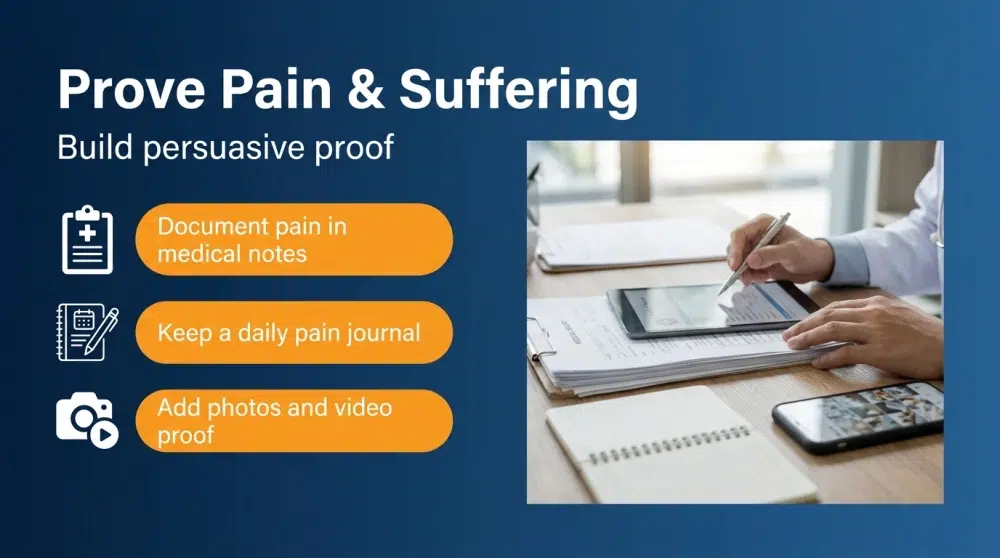
- Medical records documenting pain levels — Treatment notes that systematically record pain ratings on standardized scales, limitations in range of motion, the need for pain medications, and referrals for pain management create an objective record of ongoing suffering.
- Physician testimony — A treating physician or medical specialist who can explain in plain language the nature of the injury, the pain it causes, and the expected prognosis lends credibility that no other evidence can fully replace.
- Mental health records and psychologist testimony — If the injury has produced documented psychiatric conditions, records of diagnosis and treatment support mental anguish damages specifically.
- A personal pain journal — Keeping a daily or weekly journal that records how you feel, what activities you could not perform, and how the injury interfered with your life can be powerful evidence at trial or in settlement negotiations.
- Testimony from family members and close friends — People who see you every day are uniquely positioned to describe changes in your personality, mood, mobility, and participation in family life since the accident.
- Photographs and video — Visual documentation of visible injuries, before-and-after comparisons showing changes in physical ability, and footage of activities you can no longer perform can make an abstract harm tangible to a jury.
- Life care plans — In catastrophic injury cases, a certified life care planner can project the ongoing costs and limitations of your injury, which supports both economic damages and contextualizes the severity of non-economic harm.
The George L. Allen Sr. Courts Building in downtown Dallas, where Dallas County District Court civil cases are tried, is where these evidence packages ultimately go before juries composed of Dallas County residents. Building a case that resonates with those jurors, people who understand DFW traffic, local driving conditions, and the real impact of a life-altering injury requires thoughtful, locally grounded preparation.
How Does Pain and Suffering Apply to Car Accident Claims in Dallas?
Car accident personal injury compensation in Texas is an at-fault system. [7] The driver whose negligence caused the collision is responsible for all categories of the injured person’s damages including pain and suffering. You pursue that compensation through the at-fault driver’s liability insurance carrier, and if the insurer disputes the value of your claim, through litigation in Dallas County District Court or another court of appropriate jurisdiction.
Texas requires minimum liability coverage of $30,000 per person and $60,000 per accident, commonly referenced as 30/60 coverage. [8] In serious injury cases, those minimums are often exhausted by medical bills alone, leaving no coverage available for pain and suffering. An attorney can help identify additional sources of recovery, including underinsured motorist coverage from your own policy, commercial liability coverage from an employer if the at-fault driver was on the job, or dram shop liability if alcohol was served.
Stop-and-go traffic on I-635, congestion at the High Five interchange, and the volume of commercial truck traffic through the Dallas-Fort Worth metroplex all contribute to crash scenarios that produce serious injuries. When those crashes involve significant force such as rear-end collision at highway speed, a side-impact at a busy Plano intersection, or an 18-wheeler rollover near Deep Ellum. The resulting pain and suffering can be severe, permanent, and worth pursuing aggressively.
Insurance adjusters routinely open negotiations with offers that dramatically undervalue non-economic damages. They may argue that your pain resolved faster than your own account suggests, that your injuries were pre-existing, or that you failed to mitigate your harm by not following a treatment plan. Having personal injury lawyers who understand these tactics puts you in a far stronger negotiating position from the very start of the claims process.
How Does Texas Comparative Fault Affect Your Pain and Suffering Recovery?
Texas follows a modified comparative fault system, sometimes called the proportionate responsibility doctrine, codified in Texas Civil Practice and Remedies Code Chapter 33. [9] Under this system, a jury assigns each party a percentage of fault for the accident. Your total damages including pain and suffering are then reduced by your own percentage of fault.
The critical threshold is 51 percent. If a jury finds you more than 50 percent responsible for causing the accident, you are completely barred from recovering any damages, including pain and suffering. If your fault is 50 percent or less, you recover but with a proportionate reduction.
For example, if a jury values your pain and suffering at $200,000 and finds you 25 percent at fault for the collision, your recovery for pain and suffering is reduced to $150,000. The defendant’s insurance carrier and defense team will frequently argue that you contributed to the crash to reduce what they owe you. Common defense arguments in Dallas-area cases include claims that you were speeding on I-35E, that you failed to use your turn signal before the at-fault driver struck you, or that you failed to keep a proper lookout.
Understanding the proportionate responsibility framework is essential to evaluating any settlement offer. If the insurer has internally assessed your fault at an inflated percentage, their settlement offer will reflect that assessment and you may be accepting far less than you are entitled to receive. A skilled injury attorney analyzes the fault picture from both sides before advising you on whether to accept, counter, or litigate. Our knowledge base article on Texas modified comparative fault and the 51% bar explains this rule in greater detail.
Can Families Recover Pain and Suffering Damages in a Texas Wrongful Death Case?
When a serious injury proves fatal, the legal landscape for recovering pain and suffering compensation shifts. Texas recognizes two distinct avenues of recovery for surviving families: wrongful death claims and survival actions.
What is a survival action and how does it relate to pain and suffering?
A survival action allows the estate of the deceased to continue the personal injury claim the person would have brought if they had survived. Under Texas Civil Practice and Remedies Code Section 71.021, the decedent’s own claim for pain and suffering endured between the moment of injury and the moment of death can be pursued by the estate. [10] The key requirement is evidence that the person was conscious and experienced pain and suffering during that interval. EMS records, emergency department charts, Glasgow Coma Scale scores, and eyewitness testimony from first responders can establish conscious pain for this purpose.
Our knowledge base resource on Dallas survival action pain and suffering damages provides detailed guidance on how this claim works in practice for Texas families.
What damages can family members recover in a Texas wrongful death claim?
Under Texas Civil Practice and Remedies Code Chapter 71, the surviving spouse, children, and parents of a person killed by another’s negligence may pursue a wrongful death claim for their own losses. [10] These losses include loss of companionship and society, mental anguish experienced by the surviving family members, loss of financial support, and loss of services the deceased provided to the household.
The mental anguish suffered by a spouse who loses a partner, or children who lose a parent, in a fatal crash on the LBJ Freeway or the Dallas North Tollway is itself a compensable form of pain and suffering recognized by Texas law as a real and serious harm that deserves fair compensation.
Wrongful death claims in Texas must be filed within two years of the date of death. Given the complexity of these cases and the critical importance of early evidence preservation, families should connect with wrongful death lawyers promptly after a fatal accident. Our team regularly handles these matters for Dallas-area families facing the devastating aftermath of a collision.
What Makes a Serious Injury Lawsuit Different in Texas?
Not every personal injury case is the same. A minor fender bender producing soft-tissue soreness that resolves within weeks presents very different legal considerations than a crash that causes a traumatic brain injury, paraplegia, or permanent disfigurement. In cases involving serious, lasting injuries, the stakes of getting the pain and suffering analysis right are dramatically higher and the process is correspondingly more complex.
In a serious injury lawsuit, non-economic damages often constitute the largest portion of total recovery. A plaintiff with $150,000 in medical expenses but a permanent spinal cord injury may be entitled to five or ten times that amount in pain and suffering, physical impairment, and mental anguish. Presenting that case persuasively requires:
- Life care planning — A certified life care planner projects future medical needs, adaptive equipment, home modifications, and attendant care over the plaintiff’s lifetime.
- Vocational rehabilitation assessment — If the injury has eliminated or limited the plaintiff’s ability to work, a vocational expert evaluates what occupations remain accessible and what earning capacity has been lost.
- Neuropsychological evaluation — Traumatic brain injury cases require documentation of cognitive deficits, personality changes, and emotional disruption that a jury would not otherwise understand or appreciate.
- Medical expert testimony — Neurosurgeons, orthopedic specialists, and physiatrists who can explain the mechanism of injury, the permanence of the damage, and the ongoing pain it causes give the jury the foundation they need to award meaningful damages.
Texas follows the eggshell plaintiff rule, which holds that defendants must take plaintiffs as they find them. If a pre-existing degenerative condition made you more susceptible to serious injury from a collision that would have produced only minor harm in a healthier person, that does not reduce the defendant’s responsibility for the actual harm caused to you. [11]

What Is the Deadline to File a Texas Personal Injury Claim?
Texas Civil Practice and Remedies Code Section 16.003 sets a two-year statute of limitations for personal injury claims. [12] That means you generally have two years from the date of the accident to file suit in Dallas County District Court or another court of appropriate jurisdiction. If you miss that deadline, the court will almost certainly dismiss your claim, and you will lose the right to recover anything including all of your pain and suffering damages.
There are limited exceptions. The statute of limitations may be tolled paused for minors and for individuals who are legally incapacitated. The discovery rule may extend the limitations period when an injury was not discoverable through reasonable diligence at the time it occurred, though this exception is rarely applied in traffic accident cases where the harm is immediately apparent.
Claims against governmental entities carry an additional trap: the Texas Tort Claims Act requires written notice of a claim to be submitted to the governmental unit within six months of the incident, unless the unit had actual notice. Missing that notice requirement can independently forfeit your claim even if you file suit within the two-year window. [6]
Given these strict deadlines, and the time required to properly investigate a crash, gather evidence, obtain medical records, and build a complete damages picture, reaching out to personal injury lawyers soon after an accident is far safer than waiting until the deadline approaches. Evidence deteriorates, witnesses move or forget, and surveillance footage is routinely overwritten within days of an incident.
How GoSuits Dallas Helps Injury Victims Pursue Full Compensation
If you or someone you love has been seriously injured in a Texas accident, understanding your right to pain and suffering compensation is only the first step. Building the evidence necessary to recover what you are actually owed in a state where juries decide without a formula and insurers negotiate aggressively requires legal representation that combines deep knowledge of Texas personal injury law with the organizational and analytical resources to prepare a compelling case from day one.
GoSuits serves clients throughout Texas, California, and Illinois, with a strong focus on the Dallas-Fort Worth metroplex, handling personal injury claims arising from car and truck accidents, motorcycle crashes, construction site injuries, product liability, workplace injuries, and wrongful death. Our attorneys handle cases arising throughout Dallas County and the surrounding region, from Plano and McKinney in the north to Irving and Carrollton to the west.
What distinguishes our approach is our commitment to both technology-driven efficiency and direct attorney access. We developed proprietary case management software that accelerates evidence organization, medical record analysis, damages modeling, and demand preparation. Our clients benefit from faster case development without sacrificing thoroughness. And unlike firms that hand you off to a case manager or paralegal, every GoSuits client has a designated attorney, someone you can reach directly throughout the entire process.
Our team carries more than 30 years of combined experience in personal injury litigation. We prepare every case as if it will go to trial, which strengthens our negotiating position and keeps every option open. Our prior cases reflect results across a wide range of serious personal injury and wrongful death matters, and our attorneys bring the courtroom experience that makes a difference when an insurer refuses to fairly compensate a deserving client.
Handling personal injury claims whether for pain and suffering, lost wages, or future medical costs requires personal injury lawyers who understand both the legal framework and the human reality of what you are going through. We take cases on contingency, which means you pay nothing unless we recover for you.
If you have been injured in a Dallas-area accident and want to understand what your pain and suffering damages may be worth, schedule a free consultation with our team today. You can also learn more about who we are and how we work on our about us page, and review the full range of our practice areas to understand how we may be able to help with your specific situation.
References and Resources
- Texas Civil Practice and Remedies Code, Chapter 41 — Exemplary Damages — Texas Legislature Online
- Pain and Suffering — Legal Information Institute, Cornell Law School
- Types of Damages Available in Texas Personal Injury Cases — GoSuits Knowledge Base
- Texas Rules and Standards — Texas Judicial Branch
- Texas Motor Vehicle Crash Data and Statistics — Texas Department of Transportation
- Texas Civil Practice and Remedies Code, Chapter 101 — Texas Tort Claims Act — Texas Legislature Online
- Auto Insurance Guide — Texas Department of Insurance
- Buying Auto Insurance in Texas — Texas Department of Insurance
- Texas Civil Practice and Remedies Code, Chapter 33 — Proportionate Responsibility — Texas Legislature Online
- Texas Civil Practice and Remedies Code, Chapter 71 — Wrongful Death; Survival — Texas Legislature Online
- Eggshell Skull Rule — Legal Information Institute, Cornell Law School
- Texas Civil Practice and Remedies Code, Chapter 16 — Limitations — Texas Legislature Online
- Texas Court Rules — Texas State Law Library