A Letter of Protection (LOP) is a written agreement between an injured person, their attorney, and a medical provider under which the provider agrees to defer payment for treatment until the injury claim is resolved. The provider is paid from the settlement or judgment proceeds. If there is no recovery, the patient remains obligated to pay the full billed amount. An LOP is a tool that can help injured people access necessary care, but it carries real financial obligations that every patient should understand before signing.
Legal Snapshot
- Legal Topic: Letter of Protection; Medical Liens; Deferred Billing
- Case Stage: Pre-Litigation / Active Treatment Phase
- Primary Legal Issue: Contractual obligation to repay provider from settlement proceeds; interaction with PIP, MedPay, and health insurance
- Primary Authority: Texas Insurance Code § 1952 (PIP); [1] Texas Civil Practice & Remedies Code Chapter 146 (Medical Lien); [2] General contract law principles
- Date Legal Authority Last Reviewed: July 2025
What Is a Letter of Protection?
A Letter of Protection is a contractual document, typically issued by the injured person’s attorney, that instructs a medical provider to render treatment now and wait for payment until the personal injury case concludes. In exchange, the attorney commits that any settlement or judgment funds will be used first to satisfy the provider’s bill before the client receives a net payment.
LOPs are common in Texas personal injury cases for a straightforward reason: many crash victims lack health insurance, have exhausted their Personal Injury Protection (PIP) and MedPay benefits, or face providers who will not bill a liability insurer directly. Without an LOP, these patients may be unable to access ongoing chiropractic care, orthopedic treatment, surgery, or pain management while their claim is pending.
The document is not a guarantee of payment from any insurer. It is a promise from the injured person and their attorney that a valid lien on the settlement proceeds exists. Providers accept LOPs voluntarily. Many major hospital systems, emergency rooms, and diagnostic imaging centers in the Dallas area do not accept them and require payment at the time of service or through traditional insurance billing.
What Does a Letter of Protection Obligate You To?
This is the part of an LOP that surprises many patients who think of it primarily as a way to receive free treatment.
When you sign a Letter of Protection, you are agreeing to several obligations:
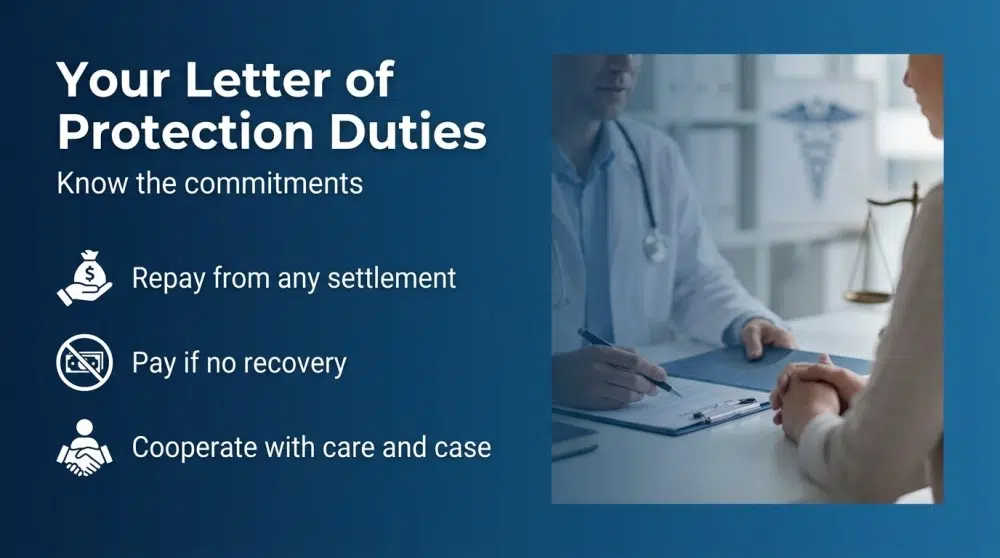
- Repayment from proceeds. You agree that the attorney will pay the provider directly from any settlement or judgment before you receive your share. The amount paid is the billed LOP rate, which may differ from what a health insurer would negotiate.
- Personal liability if there is no recovery. If your case settles for zero, is dismissed, or produces insufficient proceeds to cover all liens, you remain personally obligated for the balance. The provider can pursue that balance like any other unpaid debt, which may affect your credit or lead to a collection action.
- Cooperation with your attorney. Most LOP agreements require you to cooperate with treatment, attend appointments, and cooperate in the legal case. Failing to do so can jeopardize both your health and the enforceability of the LOP arrangement.
- Disclosure to the liability insurer. The existence and amount of medical liens are discoverable in litigation. High LOP balances relative to the severity of injury can become a negotiation obstacle or a target of defense scrutiny.
Important: A Letter of Protection is a legally binding contract. Before signing one, ask your attorney to explain the LOP billing rate, how the lien will be handled at settlement, and what happens if the case does not recover enough to cover all expenses and fees. This is not individualized legal advice for your case; it is information you should discuss directly with your attorney.
When Do Providers Agree to Accept a Letter of Protection?
Providers that accept LOPs typically do so when they believe the underlying claim is credible and the likelihood of recovery is reasonable. Factors that influence a provider’s willingness to accept an LOP include:
- The apparent strength of the liability case (for example, a rear-end collision on I-35E in Dallas where the at-fault driver received a citation is generally viewed as more straightforward than a disputed-fault intersection crash)
- The nature of the injuries and the projected cost of treatment
- The available insurance coverage of the at-fault driver and any applicable underinsured motorist coverage on the patient’s own policy
- The reputation and track record of the referring attorney in paying liens on time
- Whether the patient has made prior appointments and complied with prior treatment plans
Specialized clinics that primarily serve personal injury patients are more likely to accept LOPs than large hospital systems, major radiology groups, or surgical centers that have established managed-care contracts and consistent revenue streams. Choosing a provider based solely on LOP availability rather than on medical appropriateness is a decision that can affect both recovery and the credibility of your claim.
Why PIP and MedPay Should Come Before a Letter of Protection
Texas law requires auto insurers to offer Personal Injury Protection (PIP) coverage to every policyholder, though drivers may reject it in writing. [3] If you have PIP on your policy, it pays your medical bills, a portion of lost wages, and certain other costs regardless of who caused the accident, and the insurer cannot recover that payment from your injury settlement. In other words, PIP money that pays a medical bill does not create a lien on your case.
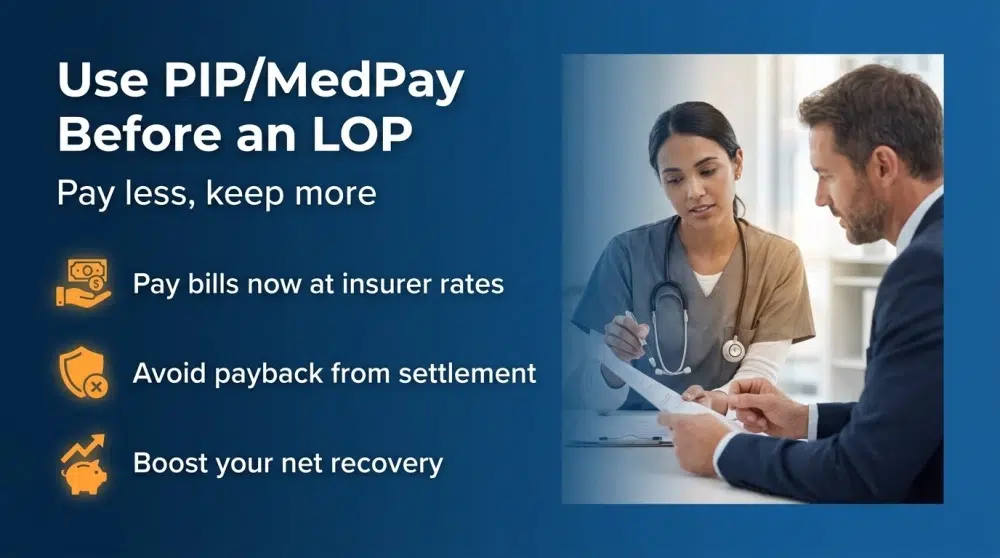
MedPay functions similarly: it is a first-party benefit that covers medical bills up to the policy limit without the insurer asserting a right to reimbursement from your settlement in most standard Texas policies. [AUTHORITY TO VERIFY: Review specific policy language and any applicable subrogation provision before relying on this for any individual case]
Using PIP and MedPay first produces a better outcome for most clients:
- Medical bills are paid immediately at whatever rate the provider normally charges insurance, not at a potentially higher LOP billing rate
- No lien attaches to the settlement proceeds from these payments
- Your net recovery after paying liens is larger
- Providers who receive timely payment are more likely to produce complete records promptly
If you are personally injured in a Dallas crash, our Dallas car accident lawyers can help you understand what first-party coverages may be available to you and how to use them in the right order before turning to an LOP arrangement.
What Happens to the LOP Balance If the Case Does Not Recover?
This is the risk that often receives insufficient attention before a client starts treatment under a Letter of Protection.
If a case does not produce a recovery, the injured person still owes the full billed amount to the provider. The LOP does not convert the debt into a gift. The provider’s agreement to wait for payment was conditioned on the availability of settlement proceeds. When no proceeds exist, the underlying debt remains.
Potential outcomes in a no-recovery scenario include:
- The provider may write off the balance as a business decision, particularly for smaller amounts
- The provider may negotiate a reduced lump-sum payment
- The provider may pursue the patient through a collection process, which can affect credit
- In rare circumstances, a provider may sue the patient directly for the unpaid balance
The outcome depends heavily on the provider, the dollar amount involved, and the patient’s specific financial circumstances. There is no blanket rule that relieves a patient of LOP debt when a case fails. Patients who have accumulated substantial LOP balances across multiple treating providers can face significant personal exposure if the case does not resolve favorably.
Cases can fail to recover for many reasons: the at-fault driver may be uninsured with no assets, the patient’s own uninsured motorist coverage may be insufficient, liability may be genuinely disputed, or the case may not proceed to full resolution. Before accumulating a large LOP balance, discuss these risk scenarios candidly with your attorney. Our Dallas personal injury lawyers work with clients throughout Collin County, Denton County, and the greater DFW metro to evaluate coverage available before recommending an LOP arrangement.
How a Letter of Protection Compares to Other Payment Options
| Payment Method | Repayment Required from Settlement? | Creates Medical Lien? | Patient Owes Balance if Case Fails? |
|---|---|---|---|
| PIP (Texas) | No (insurer cannot generally recover from your settlement) | No | No (benefit already paid) |
| MedPay | Typically no (check policy language) | Generally no | No (benefit already paid) |
| Health Insurance | Possible subrogation claim | Yes, through subrogation / ERISA lien in some cases | No personal balance if insurer pays |
| Letter of Protection | Yes, paid from settlement proceeds at close | Yes, contractual lien on proceeds | Yes, patient remains personally obligated |
The table illustrates why first-party coverages are generally more favorable to the injured person’s net recovery. Health insurance subrogation is a real cost but is often negotiable through processes available under Texas law and, where applicable, federal ERISA law. An LOP is a direct contractual obligation that attaches immediately to the settlement proceeds and reduces net recovery dollar for dollar at the billed rate. Understanding how medical bills are paid after a car accident can help you make more informed decisions about which payment pathway to pursue. You can read a more detailed treatment of this subject in our resource on how medical bills are paid after a car accident.
How This Works in Practice
Illustrative Example (Hypothetical)
A driver rear-ended in stop-and-go traffic on the LBJ Freeway sustains cervical spine injuries requiring orthopedic evaluation, physical therapy, and an MRI. The driver has no health insurance but carries $2,500 in PIP on her auto policy. She first exhausts her PIP benefit, which pays the emergency room bill and first two weeks of physical therapy. Her attorney then secures an LOP agreement with an orthopedic clinic for ongoing treatment at rates the clinic bills LOP patients.
By the time her case resolves, the PIP has paid $2,500 (no lien on her settlement), and the orthopedic clinic holds an LOP lien of $14,000. Her attorney negotiates a reduction of the lien to $9,000 as part of the settlement process. She recovers a gross settlement amount, from which attorney’s fees, case expenses, and the $9,000 lien are deducted to arrive at her net payment.
Had the case resolved for the liability policy limit, which was insufficient to cover all liens and fees, her net recovery might have been reduced to zero after liens. The clinic would then need to decide whether to pursue the remaining balance or accept what was paid.
This is a hypothetical scenario for educational purposes only. It does not represent any actual GoSuits case or a guaranteed outcome.
Why Treatment Gaps Damage Both Your Health and Your Claim
Consistent medical treatment serves two simultaneous purposes in a personal injury case: it facilitates actual physical recovery, and it creates a contemporaneous medical record of your injury, its severity, and its progression over time.
When a gap in treatment exists, whether caused by inability to find a provider willing to accept an LOP, financial concerns, scheduling difficulties, or a patient’s personal decision to stop treatment, that gap can be used against the claim in several ways:
- Argument that the injury resolved. An insurance adjuster or defense attorney may argue that if you felt well enough to stop treating for four to six weeks, your symptoms had resolved by that point.
- Argument that later treatment is unrelated. If you resume treatment after a gap, the defense may argue that any symptoms being treated after the gap are from a new incident or a pre-existing condition, not the crash.
- Reduction in claimed damages. Medical records that show sporadic treatment rather than a consistent recovery arc often produce lower settlement valuations than records showing steady, clinically directed progress.
If you are struggling to find a provider who will treat you on an LOP or afford copays while your claim is pending, speak with your attorney immediately. There may be options available, including providers in the Dallas area willing to accept LOPs for specific types of care, activation of any available MedPay, or other coverage resources that have not yet been identified. Letting a treatment gap develop without discussing it with your attorney first is one of the most avoidable ways to reduce the value of an otherwise legitimate claim.
Personal injury lawyers can sometimes help arrange access to care through their network of providers, but doing so creates obligations that should be clearly explained before any treatment begins. The attorney cannot guarantee a specific outcome or the adequacy of any particular provider’s care.
The Downsides of LOP Billing You Should Know Before You Start
The Letter of Protection system serves a genuine need, but it carries documented risks that practitioners who represent injured clients acknowledge candidly:
- LOP billing rates can exceed health insurance rates substantially. Some providers bill LOP patients at rates several times higher than what managed-care contracts would produce. Higher billed amounts mean a larger lien, a larger reduction from gross settlement proceeds, and a smaller net recovery. The injured person does not receive the difference between the LOP bill and a hypothetical health-insurance-negotiated rate.
- High LOP balances can sink a case into negative territory. If an injured person receives $45,000 in LOP-billed treatment, has $15,000 in attorney’s fees and costs, and recovers a $35,000 settlement, net recovery to the client may be zero or negative before lien negotiations.
- Lien negotiations are not guaranteed. Providers may decline to reduce their LOP lien, particularly if the treatment was extensive and they had a reasonable belief in a large recovery.
- The LOP may disincentivize seeking the most clinically appropriate care. Some patients are directed to specific LOP-accepting providers who may or may not be the best clinical option for their injury type. Medical decisions should always be driven by clinical need, not by who will defer billing.
- A failed case leaves real debt. As discussed above, if the case produces no recovery, the patient remains personally responsible for the full billed amount.
- Third-party payors with subrogation rights still apply. If health insurance or an ERISA plan paid any bills, those entities may still have subrogation rights even in the presence of an LOP from other providers. Multiple simultaneous payment obligations can create a complicated picture at settlement.
Texas Deadlines: Do Not Let the Statute of Limitations Expire
A Letter of Protection does not pause or extend the time you have to file a personal injury lawsuit in Texas. Under Texas Civil Practice and Remedies Code Section 16.003, a personal injury claimant generally has two years from the date of the accident to file suit. [4] If you are still treating under an LOP and your attorney has not evaluated whether a lawsuit is necessary before that deadline, your claim could be barred entirely.
The two-year deadline applies to cases filed in district courts throughout Texas, including the Dallas County District Court, which handles civil matters at the George L. Allen Sr. Courts Building in downtown Dallas. Individual exceptions to the general two-year rule may exist in specific circumstances, such as cases involving government entities, minors, or certain discovery rules. Those exceptions require attorney review for any specific claim. [DEADLINE REQUIRES LEGAL VERIFICATION for your specific facts]
What Should You Do Next?
If you were injured in a crash and are considering treatment under a Letter of Protection, or if a provider has already asked you to sign one, the following steps are worth taking before you proceed:
- Identify all first-party coverages first. Review your auto insurance declarations page for PIP and MedPay. If you have health insurance, determine whether the plan covers accident-related treatment and what the subrogation terms are.
- Understand the LOP billing rate before treatment begins. Ask what the provider charges LOP patients, whether that rate is subject to reduction at settlement, and whether the provider has a written lien-reduction policy.
- Ask your attorney to explain the no-recovery scenario specifically. If the case does not settle favorably, what is the plan for the outstanding LOP balance?
- Stay consistent with your treatment schedule. Do not stop treatment without discussing it with your doctor and your attorney. Treatment gaps create evidentiary problems that are difficult to overcome later.
- Do not delay legal consultation. The two-year Texas statute of limitations begins running on the date of the accident. Addressing it early preserves all your options.
Discuss Your Case With a GoSuits Attorney
A personal injury claim involving medical treatment under a Letter of Protection can involve complicated questions about coverage priority, lien negotiation, and the interaction between available insurance benefits. If you were involved in a crash in the Dallas area or anywhere in Texas, a GoSuits personal injury attorney can review the circumstances of your case and explain what your options may be. There is no attorney fee unless there is a recovery on your case.
Related Texas Personal Injury Resources
- Dallas Personal Injury Lawyers
- Dallas Car Accident Lawyers
- Dallas Wrongful Death Lawyers
- How Medical Bills Are Paid After a Car Accident
- PIP Insurance Texas: Key Takeaways
- Texas Injury Settlement: What Do I Actually Net?
- Contingency Fees in Texas: What Do I Owe If My Case Is Lost?
- Statute of Limitations for Personal Injury in Texas
- Our Attorneys
- Prior Cases
- About GoSuits
- Practice Areas
References and Legal Authority
- Texas Insurance Code Chapter 1952 – Personal Injury Protection – Texas Legislature
- Texas Civil Practice and Remedies Code Chapter 146 – Medical Lien – Texas Legislature
- Texas Insurance Code § 1952.152 – Required Offering of Personal Injury Protection Coverage – Texas Legislature
- Texas Civil Practice and Remedies Code § 16.003 – Two-Year Limitations Period – Texas Legislature
- Subrogation – Legal Information Institute, Cornell Law School
- 29 U.S.C. § 1132 – ERISA Civil Enforcement (Subrogation Liens) – Cornell Legal Information Institute
- Texas Civil Practice and Remedies Code Chapter 33 – Proportionate Responsibility – Texas Legislature
- Texas Courts – Rules and Standards – Supreme Court of Texas
- Texas Department of Insurance – Auto Insurance Consumer Guide
- Texas Law – Court Rules – State Law Library of Texas