No. California law prohibits evidence of a person’s immigration status from being admitted in a civil action for personal injury or wrongful death, and it bars any discovery that probes that status. The rule is codified in Evidence Code section 351.2, which took effect on January 1, 2017. A companion body of law: Civil Code section 3339 and Labor Code section 1171.5 – confirms that all state-law rights and remedies are available to every person regardless of immigration status. An injured person’s right to recover for medical expenses, lost income, pain and suffering, and other damages does not disappear because of where they were born or whether they hold lawful status.
Legal Snapshot
- Legal Topic: Immigration Status and California Personal Injury Claims
- Jurisdiction: California (state civil law)
- Primary Legal Issue: Admissibility and discoverability of immigration status in civil injury proceedings
- Primary Authority: California Evidence Code § 351.2 (effective January 1, 2017, Stats. 2016, Ch. 132, AB 2159)
- Supporting Authorities: California Civil Code § 3339 (as amended, Stats. 2024, Ch. 853, effective January 1, 2025); California Labor Code § 1171.5 (as amended, Stats. 2017, Ch. 160, effective January 1, 2018)
- Date Legal Authority Last Reviewed: July 2025
- Court Where Civil Claims Are Filed (Orange County): Orange County Superior Court; the Central Justice Center in Santa Ana
What Does Evidence Code Section 351.2 Mean?
Evidence Code section 351.2 creates a categorical rule with two parts. First, evidence of a person’s immigration status is inadmissible in any civil action for personal injury or wrongful death. Second, discovery into that status is not permitted in those cases. The statute was added to the Evidence Code by AB 2159 and became operative January 1, 2017.[1]
The practical effect is that a defendant in a personal injury case cannot introduce, ask about, or subpoena records that reveal whether the injured person is a lawful permanent resident, a visa holder, an asylum seeker, or an undocumented individual. A defense attorney who attempts to ask about immigration status during a deposition, or who requests immigration documents in written discovery, faces a well-founded objection. The trial court has authority to exclude that line of inquiry entirely.
The statute also confirms that courts cannot permit discovery into immigration status in wrongful death cases. Families pursuing wrongful death lawyers for the death of a loved one in a crash or workplace accident are protected by the same rule.
What Does California Law Say?
Three statutes work together to establish the legal framework.
Evidence Code Section 351.2
The full text of subdivision (a) reads: “In a civil action for personal injury or wrongful death, evidence of a person’s immigration status shall not be admitted into evidence, nor shall discovery into a person’s immigration status be permitted.”[1]
Subdivision (b) clarifies that the section does not disturb the standards of relevance, admissibility, or discovery set out in Civil Code section 3339, Government Code section 7285, Health and Safety Code section 24000, or Labor Code section 1171.5.[1] Rather than creating a conflict, those statutes share the same goal: immigration status is to be kept out of civil proceedings except in the narrow circumstance where federal immigration compliance affirmatively requires disclosure.
Civil Code Section 3339
Civil Code section 3339 provides that all protections, rights, and remedies available under state law are available to all individuals regardless of immigration status who have applied for employment, or who are or have been employed, in California (except any reinstatement remedy prohibited by federal law).[2] For purposes of enforcing state labor, employment, civil rights, consumer protection, and housing laws, the statute declares that immigration status is irrelevant to the issue of liability, and that no inquiry into immigration status shall be permitted in proceedings or discovery unless the party seeking to make that inquiry shows by clear and convincing evidence that the inquiry is necessary to comply with federal immigration law.[2] The statute was most recently amended by AB 3281, effective January 1, 2025.
Labor Code Section 1171.5
Labor Code section 1171.5 mirrors Civil Code 3339 within the employment context. The Legislature declared that all state-law protections, rights, and remedies are available regardless of immigration status, and that immigration status is irrelevant to the issue of liability when enforcing state labor and employment laws.[3] The clear-and-convincing-evidence standard applies in proceedings or discovery: a party cannot probe immigration status unless they can show that inquiry is necessary to comply with federal immigration law. The statute was most recently amended by AB 1690, effective January 1, 2018.
How Do Discovery Objections Work When the Defense Probes Immigration Status Indirectly?
Defense attorneys sometimes attempt to reach immigration status through indirect routes rather than asking directly. Common tactics include:
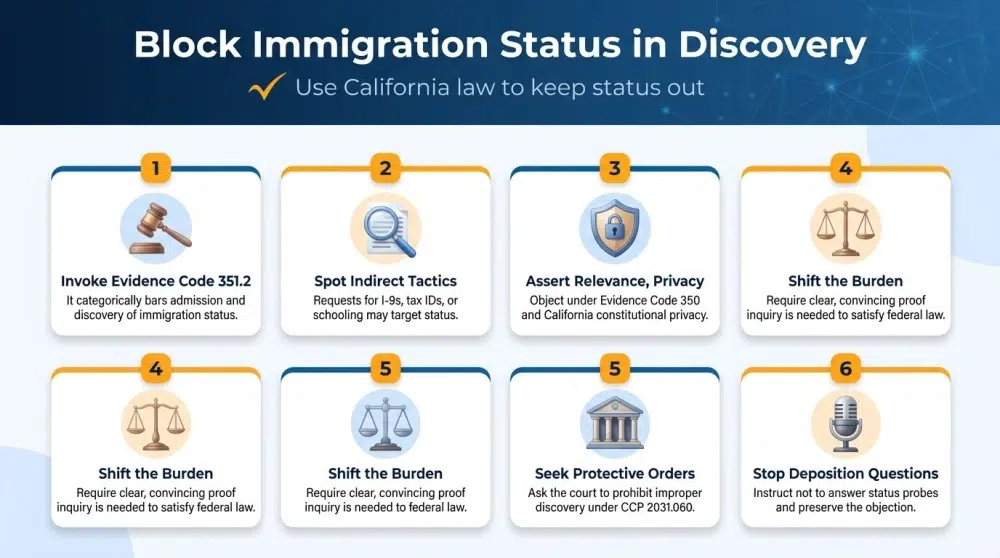
- Requesting employment records that reveal whether the plaintiff held work authorization
- Seeking tax records that might show the absence of a Social Security number or the use of an Individual Taxpayer Identification Number (ITIN)
- Asking during deposition where the plaintiff attended school, how they entered the country, or the dates they lived in specific locations
- Subpoenaing I-9 employment eligibility forms from employers
The governing rule is that each of these requests – to the extent they are designed to uncover immigration status, is subject to a relevancy and admissibility objection under Evidence Code sections 351.2 and 350, and a privacy objection under the California Constitution, Article I, Section 1. The objecting party typically argues that the request seeks information that is not admissible, not reasonably calculated to lead to admissible evidence, and that any minimal relevance is outweighed by the significant prejudice and chilling effect of allowing the inquiry.
Under Civil Code section 3339 and Labor Code section 1171.5, the burden then shifts to the party seeking the information: they must demonstrate by clear and convincing evidence that the inquiry is necessary to comply with federal immigration law. That is a demanding standard. Curiosity about whether the plaintiff will be able to remain in the country, or argument that the plaintiff’s earning capacity should be measured by wages in a foreign country, generally does not satisfy the standard.
Protective orders are another tool. A court can enter an order under California Code of Civil Procedure section 2031.060 limiting or prohibiting a category of discovery where good cause appears. When immigration status is the target, the statutory prohibition in Evidence Code 351.2 provides that good cause.
Workers who were injured at job sites in Irvine, Santa Ana, or anywhere else in Orange County, and who are navigating a civil claim alongside questions about their employment history, can consult the employee rights and workplace injury guide for California for additional context on how the law protects injured workers regardless of status.
How Are Lost Earnings Proven When Income Was Paid in Cash?
A common concern for injured workers paid in cash is whether they can prove lost income without formal payroll documentation. California damages law does not require a W-2 or a formal employer-employee relationship to establish lost earnings; it requires evidence sufficient for the jury to calculate a reasonable estimate of what the plaintiff lost.
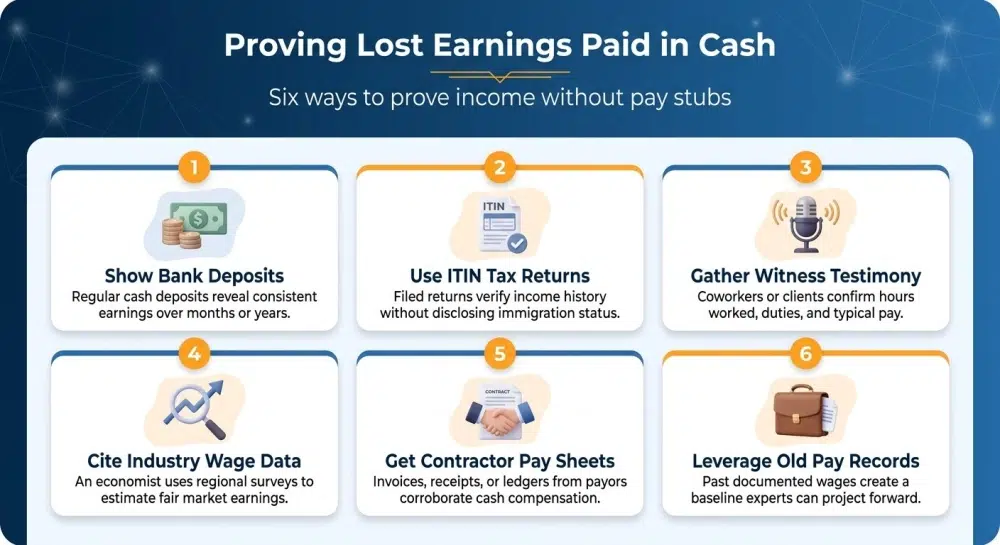
Several categories of evidence can establish cash income:
- Bank records and cash deposits. Regular deposits in similar amounts over time can corroborate a pattern of income.
- ITIN-based tax returns. Undocumented workers who filed returns using an Individual Taxpayer Identification Number have reported income to the IRS. Those returns are evidence of earnings without disclosing immigration status.
- Witness testimony. Co-workers, supervisors, or contractors can testify about the type of work performed, the going rate for that work, and the hours the plaintiff worked.
- Industry wage data. Expert economists may rely on U.S. Bureau of Labor Statistics occupational wage surveys for the applicable region and occupation to establish a reasonable income baseline.
- Contractor payment records. General contractors, subcontractors, or clients who paid the plaintiff may have their own records, even if formal payroll documents were never created.
- Prior deposition or prior employment records. Records from a job held with formal payroll, even years earlier can provide a baseline that an expert can bring forward to the date of injury.
The key legal concept is that uncertainty in the exact amount of lost earnings does not defeat the claim. California law allows damages to be calculated based on reasonable inference where the defendant’s conduct caused the difficulty in establishing the precise figure. The Supreme Court of California has long recognized this principle in the damages context. A plaintiff does not lose the right to lost earnings damages simply because their employer paid cash and kept no records.
Where the plaintiff was a day laborer or informal worker in a field common to the Irvine Spectrum area or the construction corridors along the 405 or the 73 Toll Road, an economic expert can compile regional wage data for comparable workers to give the jury a reliable figure.
Can a Claim Be Pursued If the Injured Person Is Outside California or Outside the Country?
A person does not have to be physically present in California at every stage of litigation to maintain a civil personal injury claim here. California courts exercise jurisdiction based on where the injury occurred, where the defendant is located, or where the contract or tort arose, not based on the plaintiff’s citizenship or physical location at the time the case is pending.
Practical considerations do arise, however:
- Discovery participation. A plaintiff located abroad may need to participate in depositions by video, arrange for document production, or travel for certain proceedings. Courts routinely accommodate remote participation in civil discovery.
- Medical evaluations. Insurance companies and defendants may request independent medical examinations (IMEs). A plaintiff outside the country at the time of such a request may need to return to California or negotiate alternative arrangements, which can be contested.
- Settlement and disbursement. Settlement funds can be wired internationally. There are no California legal rules that prohibit payment of a settlement to a person residing abroad.
- Statute of limitations. The case must be filed within the applicable limitations period regardless of where the plaintiff lives. Physical absence from the state does not automatically toll the statute of limitations, though California Code of Civil Procedure section 351 provides limited tolling when a defendant is absent from the state.
If the plaintiff is deported or leaves California after the injury and before the case is resolved, the claim survives. The injury occurred; the right to compensation attached at the time of the tort. Deportation does not extinguish a cause of action that has already vested under California law.
What Information Does a Court File Actually Make Public?
A question that often prevents injured people from coming forward is whether filing a lawsuit will expose their immigration status or personal information to government agencies. Understanding what a civil court file actually contains, and what it does not – is important.
California superior court civil files are generally accessible to the public under the California Rules of Court. However, Evidence Code section 351.2 and the discovery rules that implement it mean that immigration-related documents are not supposed to appear in the file in the first place: they are inadmissible and undiscoverable in a personal injury or wrongful death case. A civil court file will typically contain:
- The complaint, which describes the incident and the claims
- Pleadings and motions filed by both sides
- Court orders
- Any deposition transcripts filed with the court
- Judgments and settlement records (where formally filed)
What a civil file generally will not contain, assuming proper objections have been raised, is immigration documents, visa records, passport information, or any document that identifies immigration status. The plaintiff’s name will appear; the defendant’s name will appear; the facts of the injury will appear. Immigration status, if objections are properly asserted and the court applies Evidence Code 351.2, should not.
Cases filed in the Orange County Superior Court – including those handled through the Central Justice Center in Santa Ana – follow the same public access rules as other California trial courts. Confidential settlement agreements, when filed, may be sealed by court order under California Rules of Court, rule 2.550.
Civil court files are not routinely shared with federal immigration enforcement agencies, and filing a personal injury case does not trigger a report to those agencies under California law. The California Values Act (Government Code section 7284 et seq.) limits state and local agencies’ cooperation with federal immigration authorities.
What Evidence May Matter in a California Personal Injury Case?
Immigration status aside, the evidence that shapes a personal injury case in California is the same for every plaintiff. Gathering and preserving that evidence promptly is critical.
- Police and incident reports. Reports generated at the scene establish the basic facts of the incident, the parties involved, and any immediate observations about fault.
- Photographs and video. Scene photographs, surveillance footage from nearby businesses, and dashcam recordings can show exactly how the collision or incident occurred.
- Medical records and bills. Records document the injuries sustained, the care received, and the cost of that care. They also establish the connection between the incident and the injuries.
- Witness statements. Testimony from people who saw the incident can corroborate or contradict a defendant’s account.
- Employment and income records. As discussed above, these establish the economic losses the plaintiff suffered, even when income was paid informally.
- Expert testimony. Accident reconstruction experts, physicians, vocational rehabilitation experts, and economic experts can explain complex issues to a jury and provide scientific or professional support for damages calculations.
- Communications. Text messages, emails, and phone records can be relevant, particularly in cases involving distracted driving or workplace negligence.
None of this evidence is affected by a plaintiff’s immigration status. The strength of a California personal injury case depends on the quality of the evidence about the incident and the injuries – not on where the injured person was born or whether they hold a visa.
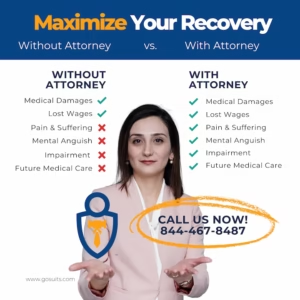
What Damages or Remedies May Be Available?
California personal injury law permits recovery for a broad range of economic and non-economic losses. The availability of each category depends on the facts of the case and the applicable law.
Economic Damages
- Medical expenses. Reasonable and necessary medical costs, including emergency care, surgery, hospitalization, rehabilitation, medication, and assistive devices.
- Future medical expenses. Projected costs of ongoing or future treatment, established through expert medical testimony.
- Lost income. Earnings the plaintiff was unable to earn because of the injury, from the date of the incident through the date of trial.
- Loss of earning capacity. The reduction in the plaintiff’s ability to earn income in the future, even if they have not yet returned to work or are currently unemployed.
- Property damage. The cost of repairing or replacing damaged property, such as a vehicle.
Non-Economic Damages
- Physical pain and suffering. Compensation for the physical discomfort caused by the injuries and their treatment.
- Mental anguish. Emotional distress, anxiety, depression, and fear caused by the incident and its aftermath.
- Physical impairment. Compensation for the loss of physical function, mobility, or ability.
- Disfigurement. Permanent scarring or changes in appearance.
Wrongful Death Damages
When an injury proves fatal, surviving family members may bring a wrongful death claim under California Code of Civil Procedure section 377.60. Wrongful death damages can include the economic value of the deceased’s support and services, as well as the loss of companionship, comfort, and society. The same protections of Evidence Code 351.2 apply to wrongful death cases. Personal injury attorneys in Irvine who handle wrongful death cases can explain how those claims are evaluated under California law.
Recoverability of any specific item of damages depends on the evidence presented and the applicable legal rules. Nothing in this article guarantees a specific outcome in any particular case.
How Long Do I Have to Act?
California’s statute of limitations for most personal injury claims is two years from the date of injury. California Code of Civil Procedure section 335.1 governs this deadline for actions arising from personal injury or death caused by the wrongful act or neglect of another.
Important exceptions and shorter deadlines exist:
- Government entity claims. If the at-fault party is a public agency, a city, county, or state entity, a government tort claim must be filed within six months of the injury under Government Code section 911.2. Failure to file within that window can bar the claim entirely. This deadline applies in cases involving municipal vehicles, defective public roads like a poorly maintained stretch of the 405 or I-5, or publicly operated facilities.
- Minors. The statute of limitations for personal injury claims by minors is generally tolled until they turn 18, subject to specific rules.
- Discovery rule. In some cases, the limitations period begins when the plaintiff discovered, or reasonably should have discovered, the injury and its cause – not necessarily when the incident occurred.
Immigration status does not extend or shorten the statute of limitations. The deadlines are the same for every plaintiff.
[DEADLINE REQUIRES LEGAL VERIFICATION] – The applicable statute of limitations and any shorter government claims deadlines should be confirmed by an attorney based on the specific facts of the case, including the identity of all potentially liable parties and the date and nature of the incident.
What Should I Do Next?
If you or a family member was injured in an accident in Irvine, Newport Beach, Huntington Beach, or anywhere else in Orange County, certain steps can protect a potential claim regardless of immigration status:
- Seek medical care. Medical records documenting injuries at the time of the incident are foundational to any claim. Delays in treatment can create gaps that a defendant may try to exploit.
- Report the incident. For vehicle accidents, a police report creates a contemporaneous record. For workplace injuries, report the injury to a supervisor promptly to create a record and preserve workers’ compensation rights.
- Preserve evidence. Take photographs of injuries, the scene, and any property damage. Identify and obtain contact information for witnesses.
- Do not provide recorded statements to insurance companies without legal guidance. Insurance adjusters work for the opposing party; a recorded statement can be used to limit the value of a claim.
- Consult an attorney promptly. California’s statute of limitations and government claim deadlines are unforgiving. Early consultation allows an attorney to assess the claim, send preservation letters to prevent the destruction of evidence, and advise on the appropriate next steps.
A personal injury claim in California involves questions of liability, evidence, damages, insurance coverage, and legal deadlines that interact in ways that are difficult to navigate without legal training. personal injury lawyers who understand the full range of California’s legal protections can evaluate whether a claim is viable and what options are available.
Related California Personal Injury Resources
- Negligence Laws in California: A Comprehensive Guide
- What Is Considered Personal Injury in California?
- How Long Do You Have to Sue for Personal Injury in California?
- Dealing with Insurance Companies After an Accident in California
- Employee Rights and Workplace Injury in California

Talk With a GoSuits Attorney
California law gives every injured person, regardless of immigration status, access to the civil justice system. Evidence Code section 351.2 protects that access by keeping immigration status out of injury and wrongful death cases. Civil Code section 3339 and Labor Code section 1171.5 reinforce those protections across the full spectrum of employment and civil rights claims.
If you were injured in an accident in Irvine, Newport Beach, Santa Ana, or anywhere in Orange County, a GoSuits personal injury attorney can review the circumstances of your case, explain your rights under California law, and help you understand your options. Questions about lost earnings, discovery objections, the government claims process, or pursuing a claim from abroad can all be addressed in a confidential consultation.
Irvine personal injury lawyers at GoSuits work on a contingency fee basis, which means there is no fee unless you recover. To discuss your situation, schedule a free consultation with the GoSuits team.
GoSuits serves clients throughout California. Our Irvine team handles personal injury claims across Orange County, and our broader California personal injury team supports clients in Los Angeles, Dallas, and Chicago.
References
- California Evidence Code § 351.2 – California Legislative Information (leginfo.legislature.ca.gov)
- California Civil Code § 3339 – California Legislative Information (leginfo.legislature.ca.gov)
- California Labor Code § 1171.5 – California Legislative Information (leginfo.legislature.ca.gov)
- California Government Code § 7284 (California Values Act) – California Legislative Information (leginfo.legislature.ca.gov)
- California Code of Civil Procedure § 335.1 (Statute of Limitations, Personal Injury) – California Legislative Information (leginfo.legislature.ca.gov)
- California Government Code § 911.2 (Government Tort Claim Deadline) – California Legislative Information (leginfo.legislature.ca.gov)
- California Code of Civil Procedure § 377.60 (Wrongful Death Standing) – California Legislative Information (leginfo.legislature.ca.gov)
- California Rules of Court – California Courts (courts.ca.gov)
- California Code of Civil Procedure § 2031.060 (Protective Orders in Discovery) – California Legislative Information (leginfo.legislature.ca.gov)
- California Government Code § 7285 (Immigration Status and State Law Protections) – California Legislative Information (leginfo.legislature.ca.gov)