Yes. Under Texas law, a person injured by an intoxicated driver may pursue a separate civil personal injury claim regardless of what happens in the parallel criminal DWI prosecution. The two proceedings operate under entirely different rules, different burdens of proof, and different goals. A criminal conviction is not required to win in civil court, and a criminal acquittal does not automatically defeat a civil claim. What matters in each proceeding is the applicable legal standard and the evidence available to meet it.
This article explains how the criminal DWI process and a Texas civil injury claim interact, why they can produce different outcomes, and what legal tools – including a guilty plea, a stay of the civil case, and Fifth Amendment rights in a civil deposition – may affect both proceedings.
Legal Snapshot
- Legal Topic: DWI Criminal Prosecution & Civil Injury Claim Interaction
- Primary Criminal Authority: Texas Penal Code § 49.04 (DWI); § 49.07 (Intoxication Assault); § 49.08 (Intoxication Manslaughter)
- Primary Civil Authority: Texas Civil Practice & Remedies Code § 41.003 (Exemplary Damages); § 16.003 (Statute of Limitations)
- Civil Burden of Proof: Preponderance of the Evidence
- Criminal Burden of Proof: Beyond a Reasonable Doubt
- Civil Venue (Dallas): Dallas County District Court; George L. Allen Sr. Courts Building
- Last Reviewed: July 2025
Two Separate Legal Systems, One Crash
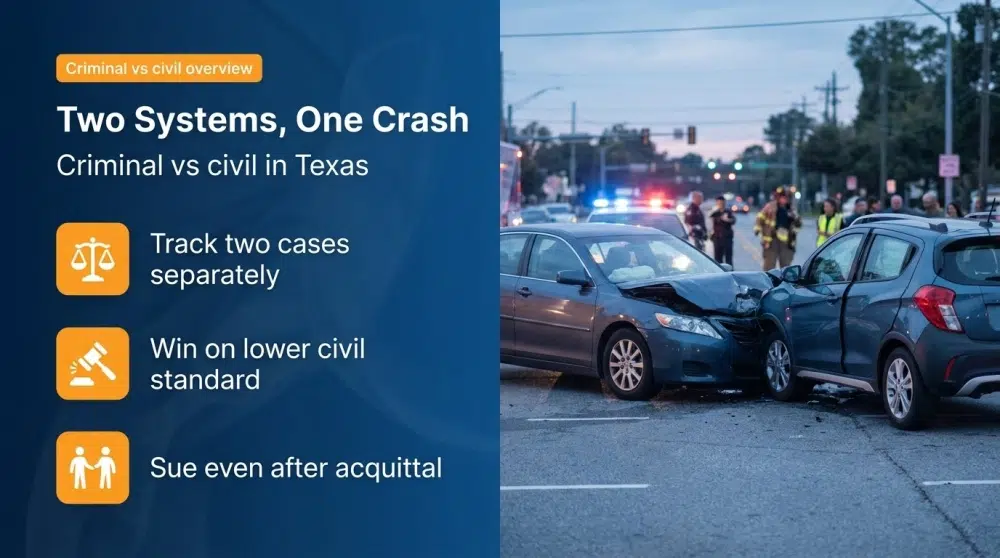
When a driver on I-635 or the Dallas North Tollway causes a crash while intoxicated, two entirely separate legal processes can begin at almost the same time. The state criminal system – managed by the Dallas County District Attorney – focuses on punishing the driver for violating Texas Penal Code § 49.04 (Driving While Intoxicated) or, if someone was seriously injured, § 49.07 (Intoxication Assault). [1] A death on the road triggers Intoxication Manslaughter under § 49.08. [2]
The civil system, by contrast, is driven by the injured person and focuses on making the victim financially whole. The State of Texas is not a party to the civil case. The injured person – or the family, if the driver was killed – files suit in their own name in Dallas County District Court seeking compensation for medical bills, lost income, pain and suffering, and potentially more. These two tracks run independently of each other, but they share some evidence and can influence each other in significant ways.
Because personal injury lawyers handle only the civil side, understanding both tracks helps injured people make informed decisions about timing and strategy. People who have been injured should speak with an attorney before taking any steps in either proceeding that could affect the other.
The Burden of Proof: Why the Civil Case Is Easier to Win
The most important structural difference between the two systems is the burden of proof. In a criminal DWI prosecution, the State must prove every element of the offense beyond a reasonable doubt – the highest standard in American law. Even a BAC test reading above the legal limit does not automatically guarantee a conviction if the defense raises a credible challenge to how the test was administered.
In a civil personal injury claim, the injured person must prove their case only by a preponderance of the evidence – meaning that it is more likely than not that the defendant drove while intoxicated and that the intoxication caused the plaintiff’s injuries. This is sometimes described as tipping the scales just past 50 percent. The same facts that fall short of a criminal conviction can still be more than sufficient to establish civil liability.
| Standard | Criminal DWI (Texas Penal Code § 49.04) | Civil Personal Injury Claim |
|---|---|---|
| Who must prove | State of Texas (District Attorney) | Injured person (plaintiff) |
| What must be proven | Each element of the criminal offense | Negligence, causation, and damages |
| Standard | Beyond a reasonable doubt | Preponderance of the evidence (>50%) |
| Outcome if proven | Criminal conviction; possible jail, fines, license loss | Civil judgment; compensatory and possibly exemplary damages |
| If the other track fails | Acquittal does not bar civil claim | Civil loss does not reverse criminal conviction |
How a Guilty Plea or Conviction Can Help a Civil Case
If the defendant pleads guilty to DWI or Intoxication Assault, or if a jury convicts them, that record becomes powerful evidence in the civil case. Under Texas law and general rules of evidence, a criminal conviction for an offense arising from the same conduct that underlies a civil suit is admissible. The conviction or plea does not automatically establish liability in the civil case, but it can be highly persuasive because the criminal standard is higher than the civil standard. If the State proved the defendant was intoxicated beyond a reasonable doubt, it follows that a preponderance standard is very likely met on the intoxication issue.
A guilty plea entered in open court is a party admission and may be offered against the defendant in a subsequent civil proceeding. Defense counsel often advise criminal clients of this possibility when negotiating a plea deal. The civil attorney for the injured person will typically request certified copies of the criminal judgment, the plea transcript, and any associated documents as early as possible, because stop-and-go traffic on I-35E or LBJ Freeway crashes that result in DWI charges often generate a substantial criminal file with useful evidence.
A deferred adjudication – where the defendant is placed on probation without a formal conviction – is legally different from a conviction and its admissibility in a civil case is a nuanced question that depends on the specific facts and Texas evidentiary rules. This is a topic requiring an attorney’s analysis.
Restitution vs. Civil Damages: What Is the Difference?
The criminal court may order the defendant to pay restitution as part of a criminal sentence under Texas Code of Criminal Procedure Article 42.037. [3] Restitution is a criminal penalty meant to compensate victims for out-of-pocket losses such as medical bills and lost wages. Federal restitution authority in applicable federal prosecutions comes from 18 U.S.C. § 3663. [4]
Restitution, however, is not the same as a full civil recovery. It typically covers economic losses only, is limited by the defendant’s demonstrated ability to pay, and does not include compensation for pain and suffering, mental anguish, physical impairment, disfigurement, or other noneconomic damages. It does not include exemplary (punitive) damages, which are discussed below.
Civil damages are far broader. In a Texas personal injury case against an intoxicated driver, a plaintiff may pursue: past and future medical expenses, lost income, loss of earning capacity, physical pain, mental anguish, physical impairment, and disfigurement. When the evidence shows gross negligence – which an intentional decision to drive while intoxicated can support – the plaintiff may also seek exemplary damages under Texas Civil Practice and Remedies Code § 41.003. [5]
Exemplary (Punitive) Damages in Texas DWI Civil Cases
Texas Civil Practice and Remedies Code § 41.003 permits exemplary damages when the plaintiff proves by clear and convincing evidence that the defendant’s conduct involved malice, fraud, or gross negligence. [5] Texas courts have held that driving while intoxicated, particularly with prior offenses or an extremely high BAC, can rise to the level of gross negligence sufficient to support an exemplary damages award.
Exemplary damages are separate from, and in addition to, compensatory damages. They are not available in every case and must be specifically pleaded and proven. An attorney can evaluate whether the facts of a particular crash on roads like the High Five interchange or the Dallas North Tollway support an exemplary damages claim.
For related analysis on how Texas courts approach this, see our knowledge base article on exemplary damages in drunk driving cases in Dallas.
Timing: Should the Civil Case Wait for the Criminal Case?
One of the most practical questions in a combined DWI and civil injury situation is timing. Criminal cases typically move faster than civil cases at the outset because an arrested defendant has constitutional speedy trial rights. A Dallas County DWI prosecution may resolve – by plea or trial – within months, while a civil lawsuit can take one to several years.
Voluntary Stays of the Civil Case
Civil plaintiffs and defendants sometimes agree to pause, or “stay,” the civil lawsuit while the criminal case is pending. The reasons are practical:
- If the civil case proceeds first, the defendant can invoke their Fifth Amendment right against self-incrimination in every deposition question related to the collision, effectively stonewalling the civil discovery process until the criminal case ends.
- If the criminal case concludes with a conviction or guilty plea first, the civil plaintiff gains the benefit of the criminal record, which is admissible evidence and difficult for the defense to overcome.
- Staying the civil case protects both sides from conflicting testimony and gives both parties time to assess the criminal outcome before litigating the civil claim.
A stay is not automatic. It requires a motion and a court order in the civil case. In Dallas County District Court, judges have discretion over whether to grant such a stay. An attorney can advise on whether a stay serves the injured person’s interests in any particular situation.
Why Waiting Can Also Carry Risks
Staying the civil case indefinitely is not always beneficial for the injured person. Evidence can be lost. Witnesses move away or their memories fade. Vehicle damage is repaired. Electronic data from the defendant’s vehicle event data recorder – commonly called a “black box” – may be overwritten. Early action by a civil attorney to send evidence preservation letters and begin investigation can protect the civil case even while the criminal case is pending.
The civil statute of limitations also continues to run during any voluntary stay unless the court tolls (pauses) the limitations period by order. Under Texas Civil Practice and Remedies Code § 16.003, personal injury claims generally must be filed within two years of the injury. A wrongful death claim under § 16.003 also carries a two-year period running from the date of death. [6] Missing these deadlines permanently bars recovery regardless of how strong the underlying claim may be.
The Fifth Amendment Problem in a Civil Deposition
The Fifth Amendment to the United States Constitution protects any person – including a civil defendant – from being compelled to testify against themselves in any proceeding when their answers could expose them to criminal prosecution. [7] This applies in civil cases as well as criminal cases.
When a DWI prosecution is pending, the defendant in the parallel civil lawsuit faces a genuine dilemma in any civil deposition. If they answer questions about the collision honestly, those answers can be used in the criminal case. If they invoke their Fifth Amendment right and refuse to answer, a Texas civil court may allow the jury to draw an adverse inference from the refusal – meaning the jury can infer that the defendant refused to answer because the answer would have been harmful.
This dynamic is one of the main reasons that defense counsel in both proceedings often seek to stay the civil case until the criminal matter is resolved. Once the criminal case ends – whether by conviction, acquittal, or plea – the defendant’s Fifth Amendment basis for refusing to answer civil deposition questions is typically gone.

Evidence That Matters in Both Proceedings
Many of the same categories of evidence are relevant to both the criminal DWI prosecution and the civil personal injury claim. Key evidence categories include:
- Police report: Documents the officer’s observations at the scene, including odor of alcohol, field sobriety test results, and any statements made by the driver.
- Blood or breath alcohol test results: Core evidence in the criminal case; also admissible in the civil case to show intoxication.
- Dashcam and surveillance video: Footage from other vehicles, business cameras near the collision, or Texas Department of Transportation roadway cameras near the LBJ Freeway or I-30 corridor can be critical.
- Witness statements: Other drivers, passengers, and bystanders may have observed the impaired driving behavior before the crash occurred.
- Vehicle event data recorder (black box) data: Records vehicle speed, throttle position, and braking inputs just before impact. This data should be preserved as soon as possible.
- Medical records: Establish the nature and extent of the plaintiff’s injuries, necessary treatments, and prognosis.
- Cell phone records: May reveal whether the driver was using a phone in addition to being intoxicated.
- Prior DWI convictions: Relevant to exemplary damages and to the defendant’s pattern of conduct.
- Criminal file: Includes charging documents, plea transcripts, and sentencing records that become part of the civil evidence once the criminal case concludes.
Evidence does not automatically prove liability in either proceeding. Each piece of evidence must be properly authenticated, disclosed through discovery, and presented in accordance with the Texas Rules of Evidence. An attorney manages this process in the civil case.
Hypothetical Examples
Example A: Guilty Plea, Then Civil Recovery
Hypothetical scenario (not a GoSuits case): Imagine a driver rear-ends another vehicle at a stop light near downtown Dallas during evening rush hour. The driver is arrested for DWI. Blood tests later confirm a BAC well above the legal limit. Six months later, the driver pleads guilty to Intoxication Assault under Texas Penal Code § 49.07 and is sentenced to probation. The injured person’s civil attorney obtains a certified copy of the plea and judgment. In the subsequent civil trial, the criminal record is presented to the jury as evidence that the driver was intoxicated and that the intoxication caused the crash. The jury awards compensatory damages for medical bills, lost wages, and pain and suffering, and also awards exemplary damages because the evidence supports a finding of gross negligence.
Example B: Criminal Acquittal, Civil Recovery Still Possible
Hypothetical scenario (not a GoSuits case): A driver causes a serious crash on a North Texas highway. The criminal jury acquits on the DWI charge after the defense successfully challenges the field sobriety test administration. The criminal case is over. However, the civil plaintiff’s attorney retains an accident reconstruction expert and a toxicologist who testify that, based on the physical evidence and witness accounts, the defendant was more likely than not impaired at the time of the crash. Because the civil standard is only a preponderance of the evidence, the civil jury finds liability and awards damages even though the criminal jury did not convict. The civil proceeding is entirely separate from the criminal one.
What Damages May Be Available in a Texas DWI Civil Case?
Recoverable damages in a Texas personal injury claim against an intoxicated driver can include:
- Past medical expenses: Hospital bills, surgery, emergency care, rehabilitation.
- Future medical expenses: Ongoing treatment, long-term care, or future surgeries reasonably expected as a result of the injuries.
- Lost income: Wages or salary missed because of the injuries.
- Loss of earning capacity: If the injuries permanently reduce the plaintiff’s ability to work and earn.
- Physical pain and suffering: Compensation for pain experienced from the injury to the date of trial and projected into the future.
- Mental anguish: Emotional distress, anxiety, and psychological harm caused by the crash and its aftermath.
- Physical impairment: Loss of the ability to perform activities of daily life or recreational activities.
- Disfigurement: Scarring or permanent physical changes caused by the injuries.
- Property damage: Repair or replacement cost for a vehicle or other personal property destroyed in the crash.
- Wrongful death damages: If the injured person died, family members may have separate claims for pecuniary loss, loss of companionship, mental anguish, and other damages under Texas Civil Practice and Remedies Code § 71.004. [8]
- Exemplary (punitive) damages: Available when gross negligence is proven by clear and convincing evidence under Tex. Civ. Prac. & Rem. Code § 41.003. [5]
The recoverability of each category depends on the specific facts, the applicable Texas law, and the evidence produced during the litigation. No outcome is guaranteed.
Wrongful Death and the DWI Driver
When a collision caused by an intoxicated driver results in death, the legal landscape expands further. The criminal prosecution escalates to Intoxication Manslaughter under Texas Penal Code § 49.08, a second-degree felony. [2] On the civil side, the surviving family members may bring a wrongful death claim under Texas Civil Practice and Remedies Code Chapter 71. [8]
Wrongful death claims in Texas can be brought by a surviving spouse, children, and parents of the deceased. Damages can include the economic support the deceased would have provided, loss of companionship and society, and the mental anguish suffered by the surviving family. Fatal crashes on Dallas freeways – whether on the LBJ Freeway, I-30, or surface streets in Oak Cliff or Deep Ellum – can produce severe wrongful death claims.
Families dealing with wrongful death claims related to drunk driving may also find our resource on understanding these intersecting legal proceedings in Dallas helpful as a starting point.
How Long Do I Have to File a Civil Claim in Texas?
The general personal injury limitations period in Texas is two years from the date the cause of action accrues – typically the date of the crash. Texas Civil Practice and Remedies Code § 16.003 governs. [6] This deadline applies regardless of the status of the criminal DWI case. Waiting for the criminal case to resolve does not pause the civil clock unless the court specifically tolls the limitations period.
Different rules may apply if:
- A government entity (city, county, or state agency) is involved, because Texas Government Code Chapter 101 and related notice provisions impose shorter deadlines and pre-suit notice requirements. [9]
- The injured person was a minor at the time of the crash, because the limitations period for a minor plaintiff is tolled until they reach age 18.
- The claim is for wrongful death, which also runs two years from the date of death under § 16.003.
Missing the statute of limitations typically results in a complete loss of the civil claim. Any person who believes they may have a claim should speak with an attorney promptly to confirm what deadline applies to their specific situation.
What Should I Do After Being Injured by a Drunk Driver in Dallas?
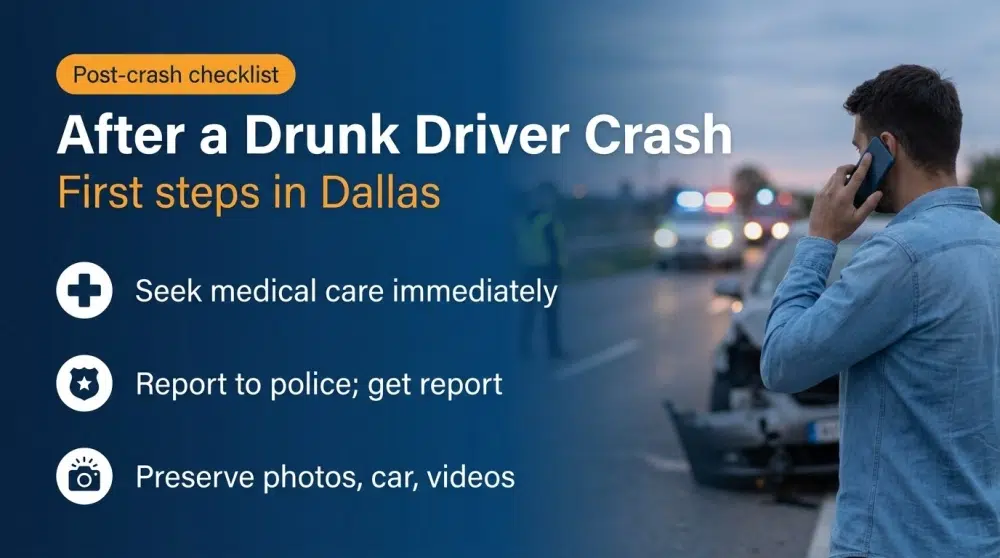
The steps taken immediately after a crash can significantly affect both the criminal investigation and a future civil claim. If you or a family member has been injured:
- Seek medical attention immediately. Injuries from crashes can be more serious than they appear. Medical records are foundational evidence in a civil claim.
- Contact law enforcement and ensure a police report is filed. The crash report documents the officer’s observations, including any indications of impairment.
- Preserve everything you can. Photograph the scene, all vehicles, your injuries, and any visible property damage. If there is a dashcam, preserve that footage.
- Do not give recorded statements to the other driver’s insurance company without speaking with an attorney first.
- Do not dispose of your vehicle before a civil attorney has had the opportunity to inspect it and preserve any vehicle data.
- Contact a personal injury attorney as soon as possible. An attorney can send preservation letters to protect evidence, notify insurers, and advise on how the criminal proceedings may affect the civil claim.
You do not need to wait for the criminal case to resolve before taking these protective steps. Acting quickly protects your legal options. Car accident lawyers in Dallas who handle personal injury claims involving intoxicated drivers can advise on timing strategy.

Talk With a GoSuits Personal Injury Attorney in Dallas
A collision involving an intoxicated driver raises complex questions about timing, evidence preservation, the use of criminal records in a civil case, and the interplay between restitution and civil damages. These issues require careful analysis by an attorney who understands both how Texas criminal DWI cases proceed and how to build a civil personal injury claim in Dallas County.
If you or someone you care about was injured by a drunk driver in Dallas, our Dallas personal injury team can review the circumstances of your case and explain your options. You deserve clear answers about your rights, the applicable deadlines, and what evidence may support your claim.
Personal injury lawyers at GoSuits represent injured Texans on a contingency basis – you owe no fee unless there is a recovery. Schedule a free consultation today.
Related Dallas Personal Injury Resources
- Personal injury lawyers in Dallas: GoSuits Dallas Personal Injury Overview
- Car accident claims in Dallas: car accident lawyers serving Dallas County and surrounding areas.
- Fatal collision claims: wrongful death lawyers handling Texas fatal accident cases, including those caused by intoxicated drivers.
- Exemplary Damages in Drunk Driving Cases – Dallas (GoSuits Knowledge Base)
- Types of Damages Available in Texas Personal Injury Cases
- The Personal Injury Claims Process in Texas Courts
- Understanding Negligence Laws in Texas
- Statute of Limitations for Personal Injury in Texas
References & Legal Authorities
- Texas Penal Code Chapter 49 – Intoxication and Alcoholic Beverage Offenses (Sections 49.04, 49.07, 49.08) – Texas Legislature Online
- Texas Penal Code § 49.08 – Intoxication Manslaughter – Texas Legislature Online
- Texas Code of Criminal Procedure Article 42.037 – Restitution – Texas Legislature Online
- 18 U.S. Code § 3663 – Order of Restitution – Legal Information Institute, Cornell Law School
- Texas Civil Practice and Remedies Code Chapter 41 – Damages (§ 41.003 Exemplary Damages) – Texas Legislature Online
- Texas Civil Practice and Remedies Code § 16.003 – Two-Year Limitations Period – Texas Legislature Online
- U.S. Constitution, Fifth Amendment – Right Against Self-Incrimination – Legal Information Institute, Cornell Law School
- Texas Civil Practice and Remedies Code Chapter 71 – Wrongful Death; Survival – Texas Legislature Online
- Texas Government Code Chapter 101 – Texas Tort Claims Act – Texas Legislature Online
- Texas Court Rules Guide – Texas State Law Library
- Texas Courts – Rules and Standards – Office of Court Administration
- Texas Constitution and Statutes – Texas Legislature Online