





































What areas near Springfield, IL do our truck accident lawyers serve?
If you were injured in a truck crash anywhere in or around Springfield, Illinois, GoSuits is ready to help. Our Illinois attorneys are based in Chicago and serve clients throughout central Illinois, appearing in Sangamon County Circuit Court when your case requires it. Truck accidents on I-55 and I-72 can scatter injury victims across a wide geographic area, and distance is never a barrier when the injury is serious.
We commonly serve truck accident victims in and around:
- Springfield and Sangamon County (Sherman, Chatham, Rochester, Auburn, Williamsville, Riverton)
- Logan County (Lincoln), Macon County (Decatur), and Morgan County (Jacksonville)
- Christian County (Taylorville), Menard County (Petersburg), and Cass County (Virginia)
- Litchfield, Virden, Pawnee, Carlinville, and communities along the I-55 corridor
- Northern Illinois communities including Elgin, Naperville, Waukegan, Cicero, and Joliet
Wherever your crash occurred along the I-55 or I-72 freight corridor, our team knows the roads, the federal regulatory framework governing commercial carriers, and the Sangamon County Circuit Court.
Why are truck accidents on I-55 and I-72 in Sangamon County so dangerous?
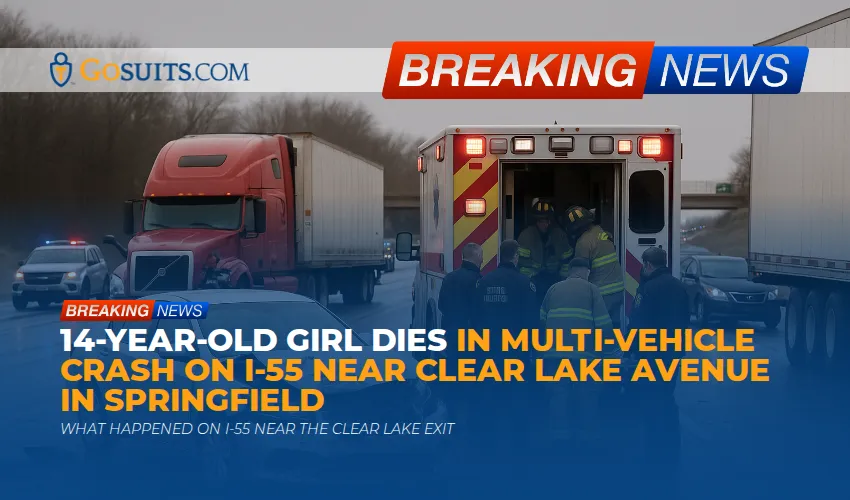
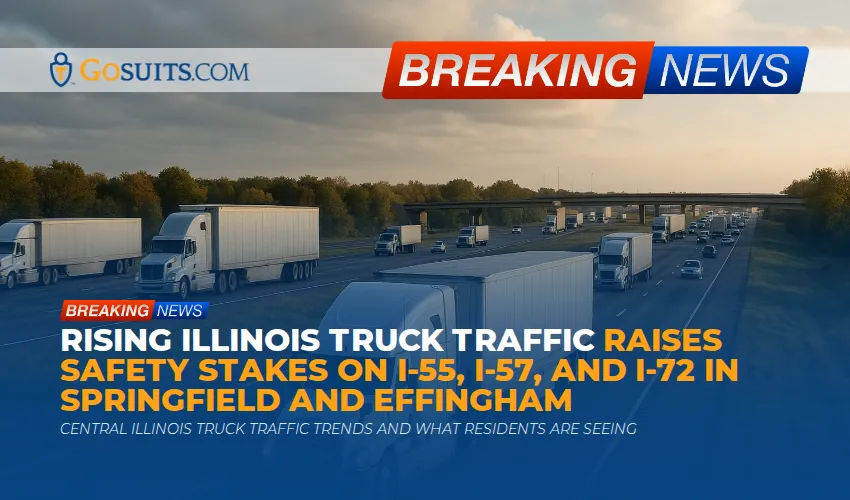
Springfield, Illinois is not a typical midsize city when it comes to commercial truck traffic. I-55 is one of the primary north-south freight arteries in the central United States, running from Chicago to St. Louis and carrying a continuous stream of 18-wheelers, tanker trucks, and flatbed rigs through Sangamon County around the clock. I-72 adds significant east-west freight movement, connecting Springfield to Decatur, Champaign, and communities further east.
According to the Federal Motor Carrier Safety Administration, large trucks and buses were involved in crashes that killed 5,837 people across the United States in 2022, the highest annual total in over three decades. The Illinois Department of Transportation consistently identifies the I-55 corridor through central Illinois as a high-volume commercial vehicle route where crash severity is above the statewide average. When a fully loaded tractor-trailer traveling at highway speed collides with a passenger vehicle, the weight disparity is catastrophic: a commercial semi-truck can weigh up to 80,000 pounds under federal limits, compared to roughly 4,000 pounds for a typical car. The occupants of the smaller vehicle absorb a wildly disproportionate share of the forces involved.
Injuries in Springfield-area truck crashes include traumatic brain injuries, spinal cord damage, internal organ injuries, multiple fractures, crush injuries, and severe burns from fuel-tank fires. Many survivors face months or years of rehabilitation, permanent disability, or the permanent loss of their ability to work in their prior occupation. These cases require the full resources of a legal team willing to go the distance.
Who can be held liable in a Springfield truck accident case?
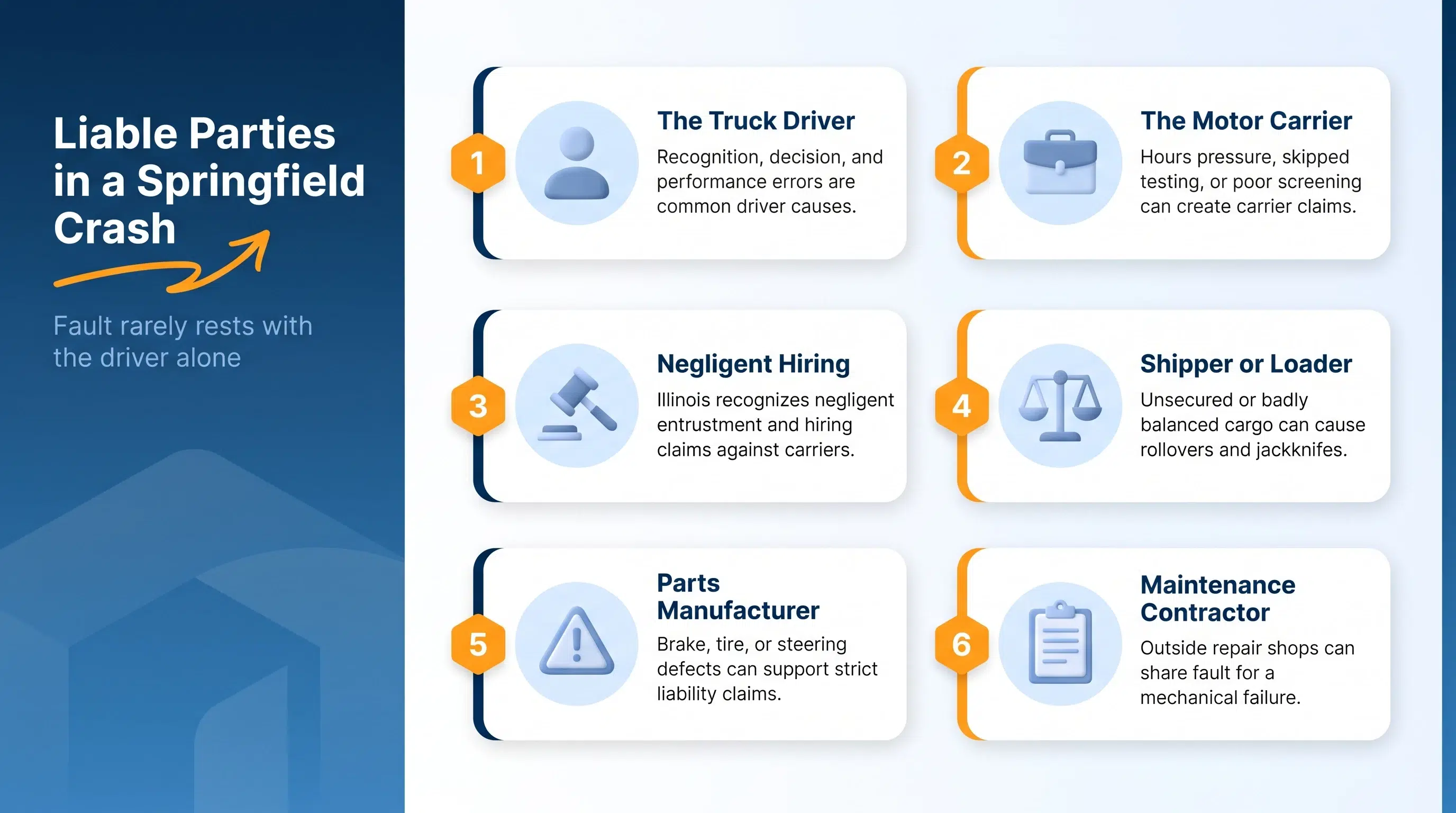
One of the most significant differences between a truck accident claim and a standard car accident case is the number of potentially liable parties. In a commercial vehicle crash, fault rarely rests with the driver alone. Depending on the facts, multiple parties may share legal responsibility, and identifying all of them is critical to recovering full compensation.
The truck driver
Driver error remains the most commonly identified proximate cause of commercial vehicle crashes. The FMCSA’s Large Truck Crash Causation Study identified recognition errors, decision errors, and performance errors as the three most frequent driver-related causes. Illinois law allows an injured victim to pursue the at-fault driver directly for negligence, and when a driver violated a federal safety regulation, that violation is generally treated as prima facie evidence of negligence under Illinois law.
The motor carrier
Under federal law, motor carriers bear responsibility for their drivers’ conduct within the scope of employment. But carrier liability often extends further. If the company pressured drivers to violate hours-of-service rules, failed to conduct required drug and alcohol testing, hired a driver with a disqualifying record without proper screening, or failed to maintain the vehicle in safe operating condition, those failures give rise to independent negligence claims. Illinois courts recognize negligent entrustment and negligent hiring as viable theories against carriers whose practices fall below the standard of care.
The shipper or cargo loader
Improperly loaded or unsecured cargo is a documented cause of truck rollovers and jackknife crashes. When a shipper or third-party loader fails to distribute weight within FMCSA limits or secures cargo negligently, they can be independently liable for resulting injuries. Federal cargo securement standards under 49 CFR Part 393 set specific requirements for every cargo category, and a shipper whose load violates those standards bears responsibility separate from the carrier’s liability.
The vehicle or parts manufacturer
If a mechanical defect, such as a brake failure, tire blowout caused by a manufacturing flaw, or a defective steering component, contributed to the crash, the truck manufacturer or component supplier may face product liability claims under Illinois strict liability doctrine, running parallel to negligence claims against the driver and carrier.
Maintenance contractors
Many carriers outsource vehicle maintenance to third-party shops. If a negligent inspection or faulty repair contributed to a mechanical failure that caused your crash, the maintenance contractor may share liability alongside the carrier. Identifying every link in that chain is part of the strategic groundwork our attorneys build from the moment we are retained.
How do FMCSA regulations shape a Springfield truck accident case?
Federal Motor Carrier Safety Administration regulations govern virtually every aspect of commercial trucking in the United States, and violations of those rules are among the most powerful evidence available in a truck accident case.
Hours-of-service rules under 49 CFR Part 395
Fatigue is one of the most dangerous conditions a truck driver can be in behind the wheel. The FMCSA has addressed this with detailed hours-of-service limits codified at 49 CFR Part 395. Under current rules, a property-carrying commercial driver may not drive more than 11 hours after 10 consecutive hours off duty, may not drive beyond the 14th consecutive hour after coming on duty, and must take a 30-minute rest break after 8 cumulative hours of driving. The weekly limit is 60 hours on duty in 7 consecutive days or 70 hours in 8 consecutive days, with a mandatory 34-hour restart provision.
When a driver exceeds these limits, the violation is direct evidence that they were operating in a fatigued state prohibited by federal law. Illinois courts generally treat hours-of-service violations as prima facie evidence of negligence, meaning the violation can be strong evidence that the driver breached the duty of care.
Electronic logging device requirements
The FMCSA’s ELD mandate, phased in under 49 CFR Part 395 Subpart B, requires most commercial drivers to use a certified electronic device that automatically records engine hours, vehicle movement, miles driven, and on-duty and off-duty status in real time. ELD data is far more difficult to falsify than paper logs, and it produces a precise, timestamped record of a driver’s activity in the hours and days before a crash.
Critically, ELD data is retained on the device and in carrier systems for a limited period before it is overwritten. FMCSA regulations require carriers to retain driver records of duty status for six months, but raw device data can be lost sooner if the vehicle returns to service and the logs cycle. This is why our team sends preservation demand letters to carriers within hours of being retained, demanding that all ELD data, satellite tracking records, communication logs, and trip data be preserved and not altered or destroyed. Spoliation of evidence, meaning the intentional or negligent destruction of records subject to a litigation hold, can result in adverse jury instructions in Illinois courts allowing a jury to infer the destroyed evidence was unfavorable to the carrier.
Driver qualification records under 49 CFR Part 391
49 CFR Part 391 sets minimum qualifications for commercial drivers and requires carriers to maintain a driver qualification file that includes the commercial driver’s license, medical examiner’s certificate, annual driving record review, and pre-employment drug test results. If a driver who caused your crash had a prior DUI conviction, a revoked CDL, or a positive drug test the carrier overlooked during hiring, those records are powerful evidence of negligent hiring under Illinois law.
Vehicle inspection and maintenance records under 49 CFR Part 396
49 CFR Part 396 requires motor carriers to inspect, repair, and maintain every vehicle in their fleet in safe operating condition. Drivers must complete pre-trip and post-trip driver vehicle inspection reports for every trip, and carriers must retain those reports for 90 days. Annual inspection records must be kept for 14 months. If brake wear, tire condition, lighting failures, or coupling defects contributed to your crash, the maintenance file documents the history. We subpoena those records early, before they reach the retention deadline and are legally destroyed.
What evidence does our team preserve immediately after a Springfield truck crash?
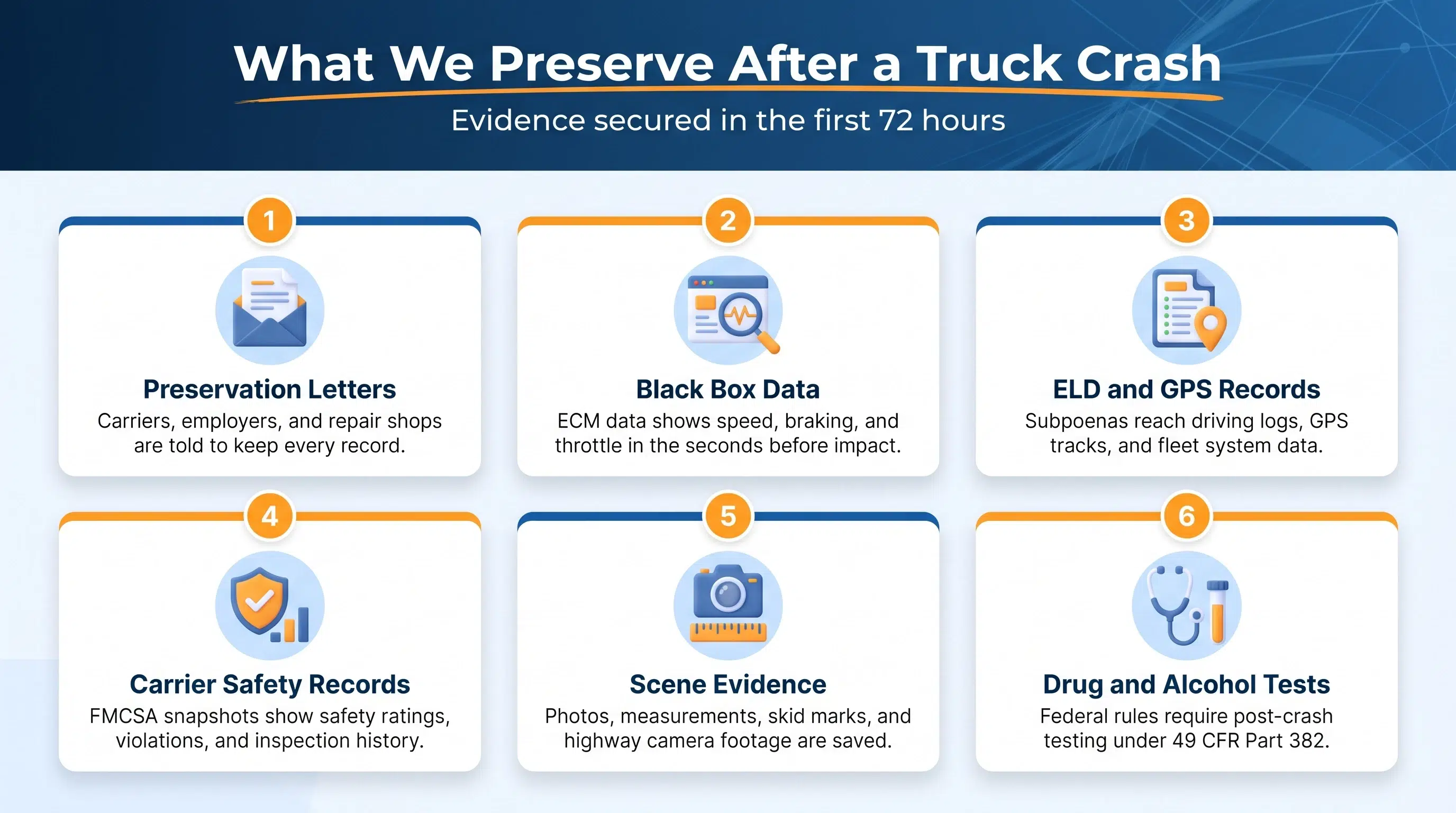
The first 72 hours after a serious truck accident are critical from an evidence standpoint. Commercial vehicles generate far more data than passenger cars, and much of that data is subject to short retention windows. Our attorneys and investigative staff move on several fronts simultaneously:
- Preservation demand letters to the carrier, the driver’s employer, and any third-party maintenance contractors
- Download requests or court orders for the electronic control module (ECM / black box), which records speed, braking, throttle, and engine data in the seconds before impact
- Subpoenas for ELD data, satellite GPS records, and fleet management system logs
- FMCSA carrier snapshot pulls showing the carrier’s safety rating, out-of-service violation history, and inspection records
- Illinois State Police crash report and any supplemental reports from Sangamon County Sheriff’s deputies
- Scene photographs, roadway measurements, skid mark documentation, and any available highway camera footage
- Witness identification and recorded statements, taken before memories fade
- Post-crash drug and alcohol testing records, which federal law requires the carrier to obtain after a qualifying crash under 49 CFR Part 382
Every piece of evidence we secure early is one fewer gap a defense attorney can exploit at trial in Sangamon County Circuit Court.
What types of truck accident cases do we handle near Springfield?
18-wheeler and tractor-trailer collisions
Fully loaded tractor-trailers account for the most severe crashes on I-55 and I-72. These crashes can produce override and underride injuries, cab crush events, and multi-vehicle pileups when a jackknifed trailer blocks multiple lanes. We handle claims arising from rear-end impacts, head-on collisions, sideswipes, and rollovers involving 18-wheelers on every road in Sangamon County.
Tanker truck accidents and hazardous material spills
Tanker trucks carrying fuel, chemicals, or agricultural products are a frequent presence on central Illinois highways. A tanker rollover or collision can produce explosion and fire hazards, chemical exposure injuries, and environmental contamination that complicates the legal case alongside the physical cleanup. We understand the regulatory framework under 49 CFR Parts 171 through 180 governing hazardous materials transportation and use that framework to identify carrier violations that strengthen your claim.
Flatbed and oversize load accidents
Flatbed carriers transporting construction equipment, steel beams, or oversize loads operate under specialized permit and securement rules. Load shifts, falling cargo, and oversize-load escort failures have caused serious crashes on the I-72 corridor west of Springfield. We identify cargo securement violations under 49 CFR Part 393 and pursue the shipper, the carrier, and any escort vehicle operator who contributed to the crash.
Fatal truck accidents
When a crash on I-55 or I-72 takes a family member’s life, the legal process must move alongside grief. Illinois’s Wrongful Death Act, 740 ILCS 180, allows surviving spouses, children, and dependents to recover for lost income, lost companionship, funeral and burial expenses, and the economic contributions the deceased would have made over their lifetime. Our attorneys handling Chicago wrongful death claims are here to help your family understand those rights and pursue full accountability from every responsible party.
What does Illinois law say about truck accident claims?
Modified comparative fault under 735 ILCS 5/2-1116
Illinois follows a modified comparative fault rule. If you are found partially at fault for the crash, your compensation is reduced by your percentage of fault. If your share of fault exceeds 50 percent, you are barred from any recovery. This differs from California’s pure comparative negligence framework, where a plaintiff can recover even at a high fault percentage. In Illinois, keeping your assessed fault below the 50 percent threshold is critical, which is why thorough evidence development, particularly the ELD and black box data showing what the truck driver was doing in the moments before impact, can be decisive.
Statute of limitations under 735 ILCS 5/13-202
Most personal injury claims in Illinois must be filed within two years from the date of the injury. For wrongful death claims, 740 ILCS 180/2 provides a two-year window from the date of death. If a government entity was involved in the crash through a defective road design or negligently placed construction zone, a shorter deadline applies: a lawsuit against a local public entity generally must be filed within one year under 745 ILCS 10/8-101. Missing the statute of limitations typically ends your right to recover permanently, which is one of the most important reasons to contact an attorney quickly after a serious crash.
Joint and several liability under 735 ILCS 5/2-1117
Illinois modified its joint and several liability rules in 2005. When multiple defendants are each found at fault, a defendant who is less than 25 percent at fault is only severally liable for their proportionate share of economic damages. Defendants who are 25 percent or more at fault remain jointly liable for economic damages, meaning you can collect the full economic judgment from any one of them if others cannot pay. Understanding how this plays out with a driver, carrier, shipper, and maintenance contractor all named as defendants is part of the strategic analysis our attorneys complete before filing.
Prima facie negligence and FMCSA violations
Illinois courts have consistently held that a violation of a statute or regulation designed to protect a class of persons from a particular type of harm is prima facie evidence of negligence as to plaintiffs within that protected class. Because FMCSA regulations exist to protect the traveling public from fatigued, impaired, or unqualified commercial drivers, a truck driver’s or carrier’s violation of those regulations is prima facie evidence of negligence under Illinois law. This doctrine can significantly simplify the liability phase of a truck accident trial.
How GoSuits Springfield truck accident lawyers can help you
From the moment you call us, our team begins building your case. We send preservation demand letters to every potentially liable party, request carrier safety histories from the FMCSA database, and work with accident reconstruction professionals to document exactly what happened on the road. We do this within hours of being retained because the window to capture critical electronic data is narrow and we do not let it close.
Once we have secured the evidence, our attorneys review every regulatory record to identify all violations. An hours-of-service breach, a skipped pre-trip inspection, a carrier that knowingly kept an unqualified driver on the road, a shipper that overloaded the trailer: each violation is a thread that, when pulled, builds the liability story your case needs. Our trial team has tried cases to verdict in Sangamon County Circuit Court when insurers refused to make fair offers, and we bring that same trial-ready posture to every claim we take in central Illinois.
Our founding attorney, Sean Chalaki, is recognized in The Best Lawyers in America (2025, 2027) and Texas Super Lawyers (2022-2026).
On the medical side, we connect you with physicians who treat on a medical lien, meaning there is no upfront cost for your care while your case is pending. We coordinate rental transportation if your vehicle was totaled or disabled in the crash. At the end of your case, we negotiate your medical liens down so that the net settlement you receive, the money that actually arrives in your account, is as large as possible. You focus on your recovery; we handle everything else.
We handle your claim on a contingency basis, so there is no attorney fee unless we recover compensation for you. Case costs and medical bills may still be owed. Our pricing is transparent with no administrative fees and no surprise costs. If you have been involved in a different type of crash or are dealing with injuries from another cause, our attorneys handling Chicago car accident cases and those focused on Chicago brain injury cases can also assist. Reach out to our Chicago personal injury team today and let us begin the work of protecting your rights.