- Why Are Truck Accident Settlements Larger Than Car Accident Settlements?
- How Does the Size and Weight of a Commercial Truck Affect Injury Severity?
- What Federal Regulations Apply to Commercial Truck Accident Claims?
- Who Can Be Held Liable in a Commercial Truck Accident?
- How Does Trucking Insurance Coverage Differ From Personal Auto Insurance?
- What Types of Damages Are Available in a Truck Accident Case?
- How Do Wrongful Death Claims Arise From Truck Crashes?
- How Do California, Texas, and Illinois Treat Truck Accident Claims Differently?
- What Should Plaintiffs and Defendants Understand About the Civil Process?
- How GoSuits Irvine Can Help After a Truck Accident
- References / Resources
Why Are Truck Accident Settlements Larger Than Car Accident Settlements?
If you have ever wondered why truck accident settlements tend to be substantially higher than those involving ordinary passenger vehicles, the answer lies in a combination of physics, regulation, law, and money. A collision between a 40-ton tractor-trailer and a typical sedan is a fundamentally different event from a two-car fender-bender. The gap in outcomesand, consequently, in compensationreflects those differences in a direct and measurable way.
In 2023, large trucks accounted for 10% of all vehicle miles traveled in the United States yet were involved in crashes that killed 4,354 people. Of those fatalities, roughly 65% were occupants of passenger vehicles, not the truck itself. [1] That asymmetry in harm is the foundation of why commercial truck accident claims so routinely produce larger settlements than car accident claims.
Say you’re injured in a crash on the SR-73 Toll Road near the Irvine Spectrum, or you lose someone in the heavy merge mess on I-405. The legal world you’re stepping into is just not the same as a two-car fender-bender. Not even close. Personal injury lawyers on these cases have to work through federal motor carrier regulations, employer vicarious liability, multiple insurance layers, and in the worst cases, catastrophic injury damages that you basically never see in a routine car wreck.
This article walks through each of the key factors that drive truck accident vs car accident settlement values upward, analyzing both the plaintiff’s perspectivethe injured victim seeking fair compensationand the defendant’s perspective, which typically includes the truck driver, the trucking company, and one or more insurers.
How Does the Size and Weight of a Commercial Truck Affect Injury Severity?
Federal law permits fully loaded 18-wheelers to weigh up to 80,000 pounds on the interstate highway system. [1] A passenger car typically weighs between 3,000 and 5,000 pounds. When those two vehicles collide at highway speed, the laws of physics dictate that the occupants of the lighter vehicle absorb an enormous share of the kinetic energy. The resultsspinal cord injuries, traumatic brain injuries, crush injuries, amputations, and deathare among the most catastrophic categories recognized in personal injury law.
The numbers climb fast in catastrophic cases. A bad spinal cord injury alone can run into the millions in lifetime medical costs. Then you’ve got lost earning capacity. Home modifications. In-home nursing. Pain-and-suffering on top of all of it, and if the injury is permanent, every line item just keeps growing. That’s what people tend to miss. A typical car accident settlement usually lands somewhere near a personal auto policy limit, which is probably $15,000 to $100,000 in most cases. Truck accidents are working with injuries that sit in a totally different bracket. So no, the settlement ranges don’t really compare.
Underride is its own category. The Insurance Institute for Highway Safety has been tracking it for years. Trucks ride higher than cars, so in certain crashes a sedan basically slides under the trailer frame, and the outcomes are about as ugly as you’d expect. [1] The other thing nobody really thinks about is stopping distance. A loaded commercial truck needs way more road to come to a stop than a car does, and that gap gets worse on wet pavement or when the brakes haven’t been kept up. So collisions usually end up happening at higher relative speeds than the driver was probably expecting.
What Federal Regulations Apply to Commercial Truck Accident Claims?
One of the most significant distinctions between car accidents and truck accidents is the dense layer of federal oversight that governs commercial motor vehicles. The Federal Motor Carrier Safety Administration (FMCSA) promulgates regulations that control nearly every aspect of commercial trucking: driver licensing, hours of service, vehicle inspection, cargo securement, electronic logging, and more.
What Are the Hours-of-Service Rules, and Why Do They Matter for Your Claim?
Under 49 CFR Part 395, commercial truck drivers may not drive more than 11 hours after a 10-hour off-duty period, and they cannot drive after 14 consecutive hours on duty. [4] Drivers are also required to take a 30-minute break after no more than 8 hours of driving time. When a trucking company pressures drivers to skip rest periods, falsify logs, or exceed these limits, a violation creates powerful evidence of negligence. Since 2017, electronic logging devices have been required for most commercial drivers, making it significantly harder to conceal violations. [1]
Truck accident lawyers use hours-of-service records, electronic logging device data, and dispatch records to reconstruct a driver’s duty cycle and determine whether fatigue played a role in a crash. This type of evidence rarely exists in a routine car accident.
What Is Required for a Commercial Driver’s License?
Federal law requires states to issue Commercial Driver’s Licenses (CDLs) under uniform national standards codified in 49 CFR Part 383. [3] A driver operating a truck with a gross vehicle weight rating of 26,001 pounds or more must hold a valid CDL. Hiring a driver with a suspended CDL, a history of violations, or inadequate training is a form of negligent entrustment that can significantly expand a trucking company’s liability exposure.
Who Can Be Held Liable in a Commercial Truck Accident?
In a typical car accident, liability flows primarily from one driver to another. Commercial truck accident claims are far more layered. Depending on the facts, a commercial truck accident claim may involve:
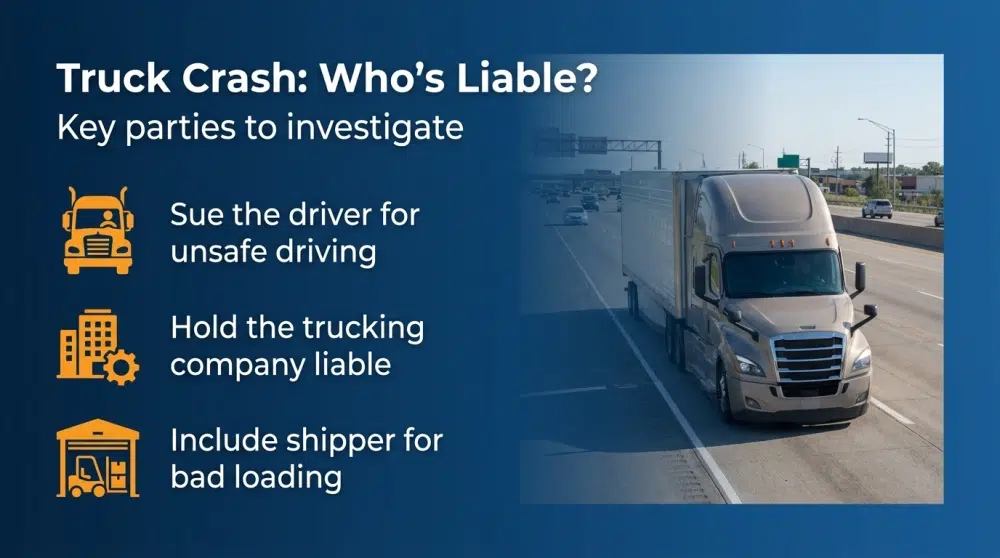
- The truck driver personally, for negligent or reckless operation.
- The trucking company (motor carrier) under respondeat superior, which holds employers liable for the negligent acts of employees performed in the scope of employment.
- The cargo shipper or broker, when improperly loaded or overweight cargo contributed to a crash or rollover.
- The truck manufacturer or component manufacturer, when a defective brake system, tire blowout, or steering component caused or worsened the collision.
- A third-party maintenance contractor, when the truck was returned to service with known mechanical defects.
This web of potential defendants is an important reason why commercial truck accident claims settle for higher amounts. A plaintiff who connects multiple responsible parties can aggregate claims across multiple insurance policies, and each defendant may have strong incentives to settle rather than face trial where full liability can be apportioned among all parties.
It’s complicated on the defense side as well. If a trucking company outsourced maintenance to a contractor, it can’t just shrug and blame the contractor when that contractor’s negligence directly caused the crash. Defendants have to think a few moves ahead. Pointing fingers at a co-defendant can backfire, fast, because the more you dig into their conduct the more your own conduct ends up under the microscope.
If you are injured by a commercial truck on I-35E in Dallas or in congested stop-and-go traffic on I-290 near the western Chicago suburbs, connecting all potentially responsible parties from the outset is critical. Missing a defendant early in the process can mean leaving substantial compensation on the table.
How Does Trucking Insurance Coverage Differ From Personal Auto Insurance?
The insurance gap between commercial trucks and personal vehicles is dramatic and directly shapes what settlements are possible.
Under 49 CFR § 387.9, for-hire motor carriers transporting non-hazardous property in interstate commerce with trucks weighing over 10,000 pounds must carry a minimum of $750,000 in public liability insurance. [2] Carriers transporting certain hazardous materials must maintain coverage of $1,000,000 to $5,000,000, depending on the substance. These federal minimums reflect Congress’s recognition that the harm these vehicles can cause far exceeds what a personal auto policy covers.
By contrast, many states require only $15,000 to $25,000 in bodily injury liability coverage per person for personal vehicles. California, for example, requires minimum bodily injury coverage of $15,000 per person. When a crash causes catastrophic injuries that generate medical bills of several hundred thousand dollars or more, the difference between a $15,000 personal auto policy and a $750,000 federal commercial minimumor a policy that is several million dollarsdetermines whether a plaintiff can be made whole.
Plenty of the bigger trucking companies carry umbrella policies that go way beyond the federal minimums. That extra coverage is honestly one of the main reasons truck accident settlements end up substantially larger than car accident settlements. The job of a truck accident lawyer is to track down every policy in playthe primary carrier policy, the motor carrier’s umbrella, sometimes even a cargo shipper’s policyand go after all of it on the client’s behalf.
What Types of Damages Are Available in a Truck Accident Case?
Civil damages in a truck accident claim can be organized into three broad categories, each of which is evaluated differently by courts across California, Texas, and Illinois.
What Are Economic Damages in a Truck Accident Claim?
Economic damages are the financial losses that can be calculated with relative precision:
- Past and future medical expenses, including hospitalization, surgery, rehabilitation, home nursing care, and assistive devices.
- Lost wages and lost earning capacity, which may extend decades into the future if the victim’s ability to work is permanently impaired.
- Property damage and related costs.
- Life care planning costs, particularly in catastrophic injury cases where a court-appointed life care planner documents the projected lifetime cost of care.
What Are Non-Economic Damages, and How Are They Calculated?
Non-economic damages are for the harms that don’t fit neatly on a calculator. Pain and suffering, emotional distress, loss of consortium, loss of enjoyment of life. Real losses, but slippery to quantify. When an injury is genuinely life-altering, like permanent paralysis or a severe brain injury or serious burns, the non-economic side can dwarf the economic side, which most people don’t realize. Personal injury lawyers will use per-diem calculations or multiplier methods, sometimes both, to give a jury a real framework for thinking about it.
California does not cap non-economic damages in most personal injury cases, making the state a jurisdiction where large non-economic awards are possible in truck accident litigation. In Texas, Chapter 41 of the Civil Practice and Remedies Code governs exemplary (punitive) damages and places certain caps and standards on their availability. [6]
When Are Punitive Damages Available in a Truck Accident Case?
Punitive damages, sometimes called exemplary damages, are designed to punish conduct that is especially egregious. They are not available in every truck accident casethey require a showing of something beyond ordinary negligence, such as gross negligence, willful conduct, or malice.
California has its own rule on this. Civil Code § 3294 lets a plaintiff recover exemplary damages when the defendant has acted with oppression, fraud, or malice, and the proof has to be clear and convincing. [5] That kind of standard might get met when, say, a trucking company knowingly kept a driver on the road who had a track record of hours-of-service violations, or when a carrier doctored maintenance records so a truck with bad brakes could keep running.
In Illinois, punitive damages in personal injury cases are governed by 735 ILCS 5/2-1115 and require the plaintiff to demonstrate willful and wanton conduct. When those standards are met, the potential for punitive damages can dramatically increase the exposure for trucking companiesand correspondingly raise settlement values during negotiations.

How Do Wrongful Death Claims Arise From Truck Crashes?
When a truck accident results in a fatality, the available compensation extends beyond what is available in a personal injury claim. Families may bring wrongful death claims that seek damages for funeral expenses, loss of financial support, loss of the decedent’s services, and grief, sorrow, and mental anguish, depending on the jurisdiction.
Wrongful death cases are usually the biggest. By a lot. You’re stacking liability for a catastrophic event on top of multiple possible defendants, large commercial policies, and the full range of survivor damages, and that’s a kind of exposure most trucking companies and their insurers would rather not put in front of a jury. So they settle. Or at least they try to.
Loss like this catches everyone unprepared. I-10 near the Irvine Spectrum, the Dan Ryan in Chicago, I-35E in Dallas, it doesn’t really matter where it happened, the legal deadlines keep running. Wrongful death statutes of limitations get enforced strictly, and they change depending on the state. Miss the deadline and the claim is just gone. Talking to wrongful death lawyers early is probably how evidence gets preserved and how the rights your family still has stay protected.
For a deeper look at how California law handles these situations specifically, you may find value in reading our legal overview for truck accident victims in California, which covers the specific procedural and substantive rules that apply in California courts.
How Do California, Texas, and Illinois Treat Truck Accident Claims Differently?
The legal framework governing truck accident settlements differs meaningfully across the states where our clients are most often injured. Understanding these differences is part of what helps a skilled personal injury lawyer build a claim that accounts for the full range of available recovery.
How Does California Handle Comparative Fault in Truck Accident Cases?
California follows pure comparative negligence. Under this rule, a plaintiff’s damages are reduced by their percentage of faultbut they may still recover even if they are 99% at fault. This framework matters in truck accident cases where a defense team tries to argue that the victim contributed to the collision, such as by failing to maintain a safe following distance before a rear-end crash. California does not bar recovery based on partial fault, which tends to produce more complete compensation for injured plaintiffs.
In Southern California, many truck accident cases are filed in the Los Angeles County Superior Court at the Stanley Mosk Courthouse, or in the Central Justice Center in Santa Ana for cases arising in Orange County. If you were injured in a crash on the I-405 or near a Newport Beach interchange, the venue for your case is likely one of these courts.
How Does Texas Modified Comparative Fault Affect Truck Accident Settlements?
Texas follows a modified comparative fault rule with a 51% bar. A plaintiff who is found to be 51% or more at fault for their own injuries recovers nothing. Below that threshold, damages are reduced proportionally. For truck accident plaintiffs in Dallas, where crashes on the High Five interchange or I-635 (LBJ Freeway) are common, this rule underscores why building the strongest possible evidentiary record is essential. If a defense team can push a plaintiff’s assigned fault over the 51% threshold, it eliminates recovery entirely. [6]
Texas truck accident cases typically proceed through Dallas County District Court at the George L. Allen Sr. Courts Building. Plano, Carrollton, and other communities in the Dallas metro area fall within the Dallas cluster for jurisdiction and venue purposes.
What Are the Rules in Illinois for Truck Accident Cases?
Illinois follows a 50% modified comparative fault rule: a plaintiff who is more than 50% responsible for an accident cannot recover. Courts in Cook County, including the Circuit Court of Cook County at the Richard J. Daley Center, handle a large volume of commercial truck accident litigation arising from crashes on I-94, I-90, and the Kennedy Expressway. Chicago-area trucking routes are heavily traveled, and both rear-end and side-swipe collisions involving commercial vehicles in stop-and-go traffic are common patterns seen in these cases.
Commercial truck accident claims involving interstate carriersthose crossing state linesare also subject to federal preemption issues under the FMCSA’s regulatory framework, which can affect which state law standards apply to certain aspects of the case.
What Should Plaintiffs and Defendants Understand About the Civil Process?
Whether you are the victim of a truck crash or a party being drawn into litigation, understanding how civil truck accident cases move through the legal system helps you make informed decisions.
What Steps Should an Injured Victim Take After a Truck Accident?
Trucking companies typically have trained response teams that respond to serious crashes within hours, often before victims have left the hospital. Those teams preserve evidence favorable to the carrier while minimizing the company’s legal exposure. Injured victims who delay reaching out to a personal injury lawyer may find that critical evidenceelectronic logging data, the truck’s black box, dashcam footage, cell phone records, and driver qualification fileshas already been lawfully destroyed or overwritten.
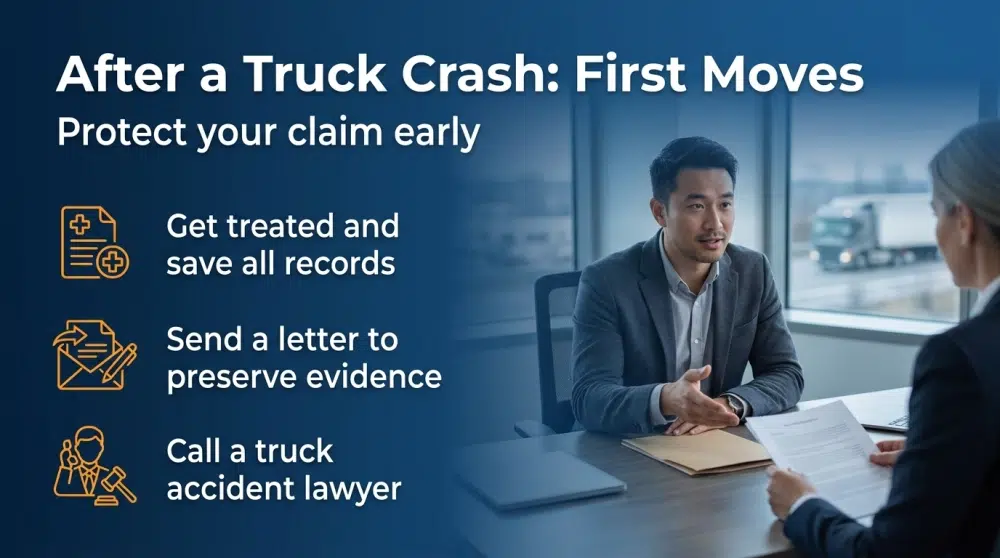
Acting quickly matters. Under federal regulations, certain records may be retained for only a limited period. In California, pre-litigation preservation letters (“litigation hold” notices) are a standard tool that personal injury lawyers use to compel trucking companies to preserve evidence before it disappears. The legal process begins not at the courthouse, but on the day of the crash.
What Defenses Do Trucking Companies and Their Insurers Typically Raise?
From the defendant’s perspective, commercial truck accident litigation involves a coordinated strategy aimed at minimizing exposure. Common defenses include:
- Comparative fault argumentsasserting that the plaintiff’s own driving contributed to the crash.
- Independent contractor defensesarguing that the driver was not an employee, which can limit respondeat superior liability under certain circumstances.
- Challenging causationarguing that the plaintiff’s injuries preexisted the accident or arose from another cause.
- Contesting damagesdisputing the extent of future medical needs or the plaintiff’s lost earning capacity through defense-hired medical or vocational witnesses.
For defendants, trial experience on the opposing side is a significant factor in settlement negotiations. Trucking companies and insurers track plaintiff firms’ litigation history. When they know a case is being handled by attorneys who regularly take commercial truck accident cases to verdict, settlement discussions tend to be more serious. This is one concrete reason why trial experience benefits personal injury clients even when a case resolves short of trial.

Why Is Legal Representation Critical in Truck Accident Cases?
Federal trucking regulations are detailed and technical. Collecting, preserving, and analyzing the evidence needed to build a commercial truck accident claim requires both legal knowledge and resources. Personal injury lawyers handling these cases routinely work with accident reconstruction engineers, trucking industry consultants, life care planners, and economic damage analysts. Self-represented parties rarely have access to those resources or the procedural knowledge to deploy them effectively.
Truck accident lawyers in Irvine handle cases across Orange County and the broader Southern California region. Our team also serves clients injured by commercial vehicles throughout Dallas, Chicago, and Los Angeles. The truck accident lawyers at GoSuits are prepared to act quicklyand to work across all relevant jurisdictionsto protect our clients’ rights from day one.
How GoSuits Irvine Can Help After a Truck Accident
If you or a family member has been injuredor if you have lost someonein a collision involving an 18-wheeler, semi-truck, or other commercial vehicle, the path forward can feel overwhelming. Medical bills accumulate, insurance adjusters call with early offers, and the trucking company’s response team is already working to protect its interests. You deserve someone in your corner who is doing the same.
We’re a personal injury law firm, but a technology-driven one. GoSuits works with clients in Irvine and across Orange County, and also in Los Angeles, Dallas, and Chicago. Between us, our team has more than 30 years of combined experience in personal injury and accident cases, which includes commercial truck accident claims, wrongful death matters, and catastrophic injury litigation. And we try cases. That’s not a small thing. The courtroom experience becomes leverage at the negotiation table, which is usually where the case actually resolves.
What sets us apart is how we work. GoSuits uses proprietary software to move cases forward faster and more efficiently than traditional law firms can, giving clients better access to information about their own case at every stage. But technology does not replace the attorney relationship. Every GoSuits client is assigned a designated attorney, not a case manager. You have direct, unfettered access to your attorney throughout the life of your case. When you have a question at 8 p.m. about a settlement demand, your attorney is the one who picks up the call.
Our attorneys handle truck accident cases across Irvine, through the Irvine Spectrum corridor, along SR-55 and SR-133, and throughout all four of our markets. We understand the driving conditions that produce these crashes: the congested merge zones on I-405, the commercial traffic that moves through the Dallas High Five interchange on I-635, the rear-end collisions that pile up during Chicago rush hour on the Kennedy Expressway, and the large-vehicle traffic on I-10 and I-5 in Los Angeles.
We handle cases on a contingency fee basis. There are no attorney fees unless we recover for you. A free consultation with our personal injury lawyers costs nothing and puts no obligation on you.
Our track record speaks through our prior cases, and you can learn more about our attorneys on the our attorneys page. For a broader picture of who we are and what we stand for, visit about us. To see the full range of matters we handle, see our practice areas page.
When you are ready to discuss your situation, we are ready to listen. Schedule a free consultation with the GoSuits team today.
References / Resources
- Large Trucks Research Area – Insurance Institute for Highway Safety (IIHS)
- 49 CFR § 387.9 – Financial Responsibility, Minimum Levels – Cornell Law School / LII
- 49 CFR Part 383 – Commercial Driver’s License Standards – Cornell Law School / LII
- 49 CFR Part 395 – Hours of Service of Drivers – Cornell Law School / LII
- California Civil Code § 3294 – Exemplary Damages – California Legislative Information
- Texas Civil Practice and Remedies Code Chapter 41 – Exemplary Damages – Texas Legislature Online
- Negligence – Legal Information Institute / Cornell Law School
- Large Truck Fatality Statistics – IIHS
- Federal Highway Administration – Vehicle Miles Traveled Statistics 2023 (VM-1) – FHWA
- NHTSA Traffic Safety Facts – Large Trucks – National Highway Traffic Safety Administration