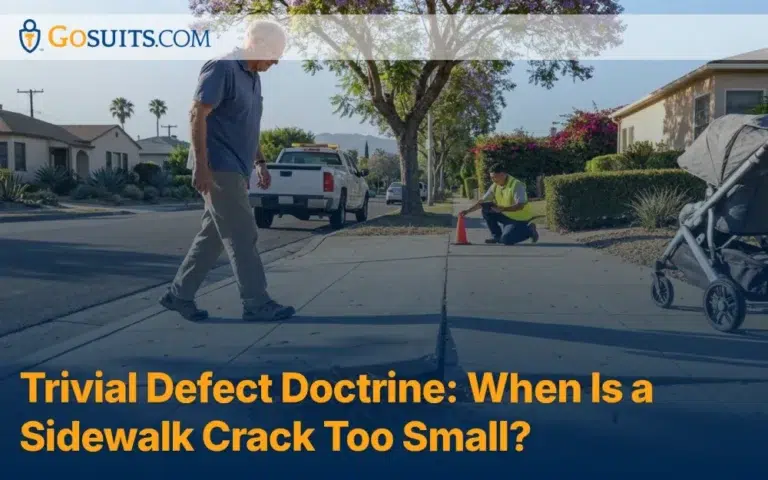
Under California law, a pavement crack, raised slab, or pothole is not automatically dangerous just because someone tripped on it. California Government Code section 830.2 allows a court to decide, as a matter of law, that a defect is so minor, trivial, or insignificant that no reasonable person would consider it a substantial risk of injury. When a court makes that finding, the landowner or public entity avoids liability entirely, and the case is dismissed without going to a jury. The key word in the statute is “circumstances.” Height differential is the starting point of the analysis, but it is never the endpoint. A crack that measures three-quarters of an inch can be ruled trivial on one set of facts and dangerous on another, depending on lighting, the jagged character of the break, debris obscuring the defect, pedestrian traffic volume, and whether prior falls or complaints put the property owner on notice. [1]
Legal Snapshot
- Legal Topic: Trivial Defect Doctrine – Sidewalk and Pavement Defects
- Case Stage: Pre-litigation, summary judgment, trial
- Primary Legal Issue: Whether a pavement defect constitutes a “dangerous condition” under California law
- Primary Authority: California Government Code §§ 830, 830.2, 835 (public entities); Civil Code § 1714 (private landowners)
- Secondary Authorities: Huckey v. City of Temecula, 37 Cal.App.5th 1092 (2019); Stathoulis v. City of Montebello, 164 Cal.App.4th 559 (2008); Caloroso v. Hathaway, 122 Cal.App.4th 922 (2004); Fielder v. City of Glendale, 71 Cal.App.3d 719 (1977); Hernandez v. City of Stockton, No. C095259 (Cal. Ct. App. Apr. 28, 2023)
- Jurisdiction: California (applies statewide; Irvine / Orange County cases filed in Orange County Superior Court, Central Justice Center, Santa Ana)
- Date Legal Authority Last Reviewed: June 2025
What Does the Trivial Defect Doctrine Mean?
The trivial defect doctrine is a legal rule that shields property owners and public agencies from liability when a walkway imperfection is so slight that a person exercising ordinary care would not expect it to cause injury. California courts have long recognized that perfect pavement is an unrealistic standard. Minor surface variations are inevitable, and requiring property owners to fix every small irregularity would effectively make them insurers of anyone who walks on their land. [2]
The doctrine is not an affirmative defense that a defendant must separately plead and prove. Instead, it is part of the plaintiff’s own burden. To prevail on a premises liability or dangerous-condition claim, the injured person must establish that the defect was substantial enough to create a genuine risk. If the evidence, viewed in the light most favorable to the plaintiff, shows only a minor condition, the court may terminate the case at the summary-judgment stage without empaneling a jury. [3]
The doctrine applies equally in Irvine, Newport Beach, Santa Ana, and every other California city. Slip and fall attorneys and defense counsel in Orange County encounter trivial-defect arguments in nearly every sidewalk case filed in the Orange County Superior Court. The Central Justice Center in Santa Ana is where most Orange County civil personal injury cases, including trip-and-fall claims, are heard.
What Does California Law Say?
For Public Entities: Government Code §§ 830 and 830.2
When the sidewalk, parking lot, or public pathway is owned or controlled by a city, county, transit authority, school district, or other government agency, the California Tort Claims Act framework applies. Government Code section 830 defines a “dangerous condition” as a condition of public property that creates a substantial, as distinguished from a minor, trivial, or insignificant, risk of injury when the property is used with due care in a manner that is reasonably foreseeable. [1]
Section 830.2 then carves out a specific judicial check on that definition. The full text of the enacted provision reads: “A condition is not a dangerous condition within the meaning of this chapter if the trial or appellate court, viewing the evidence most favorably to the plaintiff, determines as a matter of law that the risk created by the condition was of such a minor, trivial or insignificant nature in view of the surrounding circumstances that no reasonable person would conclude that the condition created a substantial risk of injury when such property or adjacent property was used with due care in a manner in which it was reasonably foreseeable that it would be used.” [1]
Government Code section 835 further requires a public-entity plaintiff to prove that the agency either created the dangerous condition through an employee’s negligent act or had actual or constructive notice of the condition with sufficient time to repair it before the injury occurred. Notice is a critical element in Orange County and Irvine municipal sidewalk cases, and it interacts directly with the trivial-defect analysis. [4]
For Private Landowners: Civil Code § 1714 and the Common Law Duty of Care
When the defect is on private property, a retail parking lot along Alton Parkway, a restaurant patio in the Irvine Spectrum, or a residential driveway in Costa Mesa, the public-entity statutes do not apply. Instead, the plaintiff must establish negligence under Civil Code section 1714 and the common law duty of reasonable care. Private landowners have a duty to inspect and repair conditions that present a foreseeable risk of harm. The trivial defect doctrine still applies as a practical limitation: courts and juries evaluate whether the condition was substantial enough to breach that duty. The surrounding-circumstances test used in Government Code section 830.2 cases has been adopted in private-property cases as well, through judicial application of the reasonableness standard. [5]
Adjacent Landowner Responsibility
California Streets and Highways Code section 5610 generally places responsibility for maintaining and repairing sidewalks on the owners of the property that abuts them. A city can require adjacent property owners to repair a defective sidewalk, and if the owner fails to act after proper notice, the city may repair it and charge the owner. Whether this adjacent-owner duty translates into tort liability to an injured pedestrian depends on the specific facts and whether local ordinances shift liability. Orange County cities vary in how aggressively they enforce adjacent-owner sidewalk maintenance obligations. An injured person should not assume that a sidewalk defect outside a private building automatically implicates the city rather than the building owner. [6]
What Legal Rules Apply? The Surrounding-Circumstances Test
California courts have consistently held that height differential, how much one slab is raised above another, or how deep a crack is, is the most important single factor, but it is not a bright-line rule. Courts examine the totality of circumstances. [3] The full set of factors recognized in California case law includes:
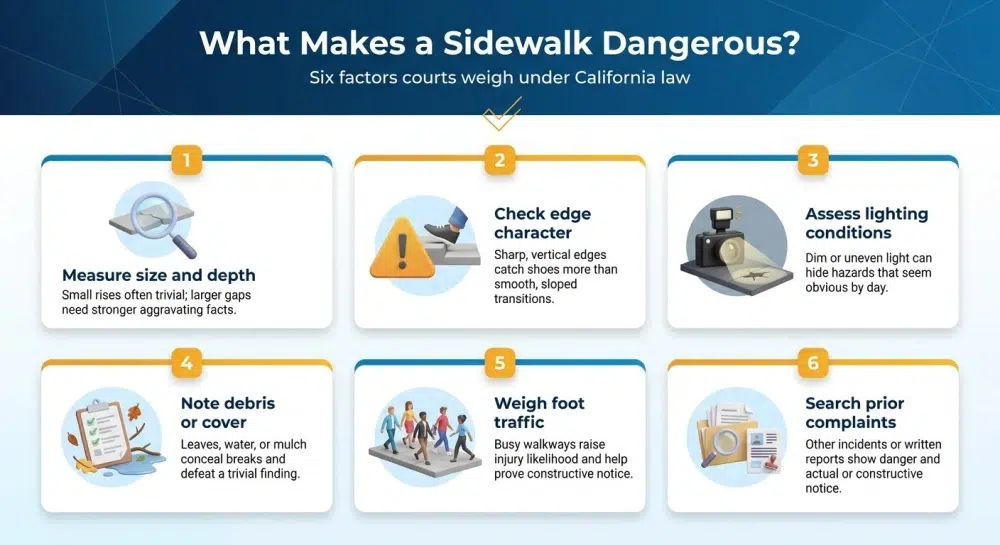
1. The Size, Depth, and Width of the Defect
Height differentials of less than half an inch have frequently been found trivial as a matter of law, particularly when no aggravating circumstances are present. As the depth begins to exceed one inch, courts become increasingly reluctant to declare the defect trivial without evaluating the surrounding circumstances. Differentials above one and a half inches are rarely found trivial on their own, though case-by-case analysis still applies. A tape measure alone cannot resolve the question. [3]
2. The Jagged, Broken, or Irregular Character of the Break
A smooth, gently sloping elevation change differs legally from a sharp, abrupt edge or a crack with broken, displaced concrete pieces. Jagged edges increase the risk that a shoe will catch and the pedestrian will fall without warning. Courts have distinguished between gradual rises and vertical-edged breaks when deciding whether the defect is substantial enough to submit to a jury. [3]
3. Lighting and Time of Day
A defect that is perfectly visible in afternoon sunlight on the SR-73 Toll Road’s pedestrian approaches may be nearly invisible on a poorly lit stretch of sidewalk in Santa Ana at night. Poor lighting does not automatically make a defect non-trivial, but it is a material circumstance that courts weigh. Evidence of ambient illumination levels at the time of the fall belongs in the factual record. [3]
4. Debris, Water, Grease, or Obstructions Concealing the Defect
When leaves, standing water, grease, mulch, or other material covers the crack or raised edge and prevents a pedestrian from seeing it, the hidden nature of the hazard is an aggravating circumstance. Courts consider whether a reasonably careful pedestrian would have noticed the defect with due attention under the actual conditions present at the time. [3]
5. Pedestrian Traffic Volume
A defect near a busy bus stop, a school crossing, or a high-volume retail entrance in the Irvine Spectrum receives more scrutiny than a crack in a seldom-traveled alley. High foot traffic increases the likelihood that the defect will cause injury and may also be relevant to whether the property owner had constructive notice, if thousands of people walk past a crack daily, the owner arguably should have discovered and repaired it. [7]
6. History of Prior Complaints or Similar Incidents
Evidence that other people have tripped at the same location, or that residents or maintenance workers submitted written complaints about the specific defect, directly undermines a trivial-defect finding. It tends to show both that the condition was substantial enough to cause harm and that the property owner had actual or constructive notice. This is one of the most powerful categories of evidence in Orange County sidewalk cases. [8]
7. Weather at the Time of the Accident
Rain, frost, or unusual weather conditions can alter how a pavement defect interacts with pedestrian movement. Wet pavement next to a raised crack may be more dangerous than dry pavement with the same crack. The weather conditions at the time and place of the fall are part of the full surrounding-circumstances picture. [3]

8. The Plaintiff’s Prior Knowledge of the Area
A person who uses the same sidewalk every day and knows about a specific crack occupies a different legal position from a visitor who encounters the defect for the first time. Prior knowledge may bear on whether the plaintiff exercised due care. It does not eliminate the property owner’s duty, but it is a circumstance that a court weighing the totality of the evidence will consider.
For a deeper look at how notice, actual and constructive, factors into premises liability claims in California, see our article on constructive vs. actual notice in premises liability.
How Does This Apply to a Real Case?
The California Court of Appeal’s decision in Huckey v. City of Temecula, 37 Cal.App.5th 1092 (2019), provides a careful worked example of how the surrounding-circumstances analysis unfolds. The court recognized that the analysis proceeds in two steps. First, the court considers the size and nature of the defect itself. If that review alone suggests the defect might be trivial, the court moves to the second step: examining all additional aggravating or mitigating circumstances. Only after both steps can the court decide whether to take the question away from the jury. [7]
In Stathoulis v. City of Montebello, 164 Cal.App.4th 559 (2008), the Court of Appeal reversed a summary judgment for the city even though the street gouges were roughly one inch deep. The court found that three adjacent irregularly shaped holes with jagged, abrupt edges, combined with neighborhood complaints that had been ignored and low ambient lighting, created a triable factual dispute. The city’s argument that one inch was within the range courts had previously called trivial did not prevail because the surrounding circumstances changed the analysis. [8]
Hypothetical Example A: A pedestrian steps off the curb at the intersection of Alton Parkway and Barranca Avenue in Irvine at midday on a clear day. She trips on a sidewalk crack with a three-quarter-inch elevation difference. The crack has smooth, gently sloped edges; no debris obscures it; the location is well lit; and there are no prior complaints on file with the city. A court reviewing those facts might find the defect trivial as a matter of law. No guarantee of any particular outcome exists, and facts in real cases are almost always more complex.
Hypothetical Example B: A pedestrian walks along a commercial sidewalk near a Irvine Spectrum parking structure at dusk. The lighting is dim. A section of concrete has buckled, creating a jagged, vertical-edged break roughly one and one-quarter inches high. Wet leaves from the adjacent landscaping cover the raised edge. The property manager received two written tenant complaints about the same spot six weeks earlier. Under those facts, the surrounding circumstances would likely preclude a finding of trivial defect as a matter of law, and the question of whether the condition was dangerous would go to a jury.
Hypothetical Example C (Private Property): A shopper trips on an uneven paver in the parking lot of a retail center in Costa Mesa. The paver is displaced about one inch but is located in a high-traffic walkway that thousands of customers use weekly. The maintenance log shows the property manager received a complaint about the same paver two months before the fall but did not schedule a repair. Because this is private property, the public-entity statutes do not apply, but the surrounding-circumstances analysis mirrors the government code framework. The prior complaint and high foot traffic would be significant evidence. These are hypothetical examples only and do not represent actual GoSuits cases or guaranteed outcomes.
How Should the Defect Be Measured and Documented?
Because the exact size and character of a defect are central to the trivial-defect analysis, proper documentation before any repair is made can determine whether a claim survives summary judgment.
The measurement should be taken with a ruler or caliper placed directly across the highest point of the raised slab or the lowest point of the crack, with a scale reference visible in the photograph, a coin, a ruler, or a measurement card placed next to the defect allows any viewer to verify the depth independently. Photographs from multiple angles, including straight-on, overhead, and side views, capture both the height differential and the character of the edges (jagged, broken, smooth, or sloped). If the area was wet or debris-covered at the time of the fall, a photograph taken as close in time to the accident as possible, before clean-up, preserves critical circumstantial evidence.
Wide-angle photographs showing the surrounding conditions, nearby light fixtures, the time-of-day lighting context, foot traffic patterns, and any signage or warnings, build the surrounding-circumstances record. Video walked slowly along the defect and its approaches can capture how visible the hazard was from normal pedestrian eye level.
If the property owner or public agency plans to repair the defect, it should be measured and photographed before repair, and the repair should be documented. An injured person who learns that repair work is imminent should request, in writing, that the owner or agency preserve all photographs, work orders, and records related to the defect before the repair is completed.
How Are Maintenance and Complaint Records Obtained?
Prior complaints and maintenance records are among the most important documents in a California sidewalk injury case. They can establish both that the condition was genuinely dangerous and that the property owner had notice. Obtaining them early is critical because local agencies often retain records only for a limited period.
For public entities in Orange County, the City of Irvine, Newport Beach, Santa Ana, Fullerton, or any other municipality, public records requests under the California Public Records Act (Government Code §§ 7920 et seq.) are the standard tool. A properly submitted request can obtain city maintenance logs, work orders, inspection records, pothole repair histories, and any 311 or service-request database entries associated with the address or location of the defect. Cities typically must respond within ten calendar days, though they may request extensions. [9]
For private property, discovery in litigation is the primary mechanism. Requests for production of documents can seek maintenance logs, prior incident reports, vendor invoices for pavement repair, and any communications from tenants, employees, or customers about the specific condition. A deposition of the property manager or maintenance supervisor often reveals whether informal verbal complaints were received even if they were not logged in writing.
A pre-litigation letter to the property owner or agency preserving all records, photographs, surveillance footage, and maintenance logs, sent as quickly as possible after the injury, can prevent destruction of evidence that may occur during ordinary business records retention practices. Personal injury lawyers who handle slip and fall cases in Irvine and throughout Orange County routinely send preservation letters within days of being retained.
Pedestrian injury claims in Southern California often intersect with notice issues that make early evidence preservation decisive. The Irvine slip and fall attorneys at GoSuits understand that the strongest cases are built when evidence is collected before it disappears.
What Evidence Can Matter in a Pavement Defect Case?
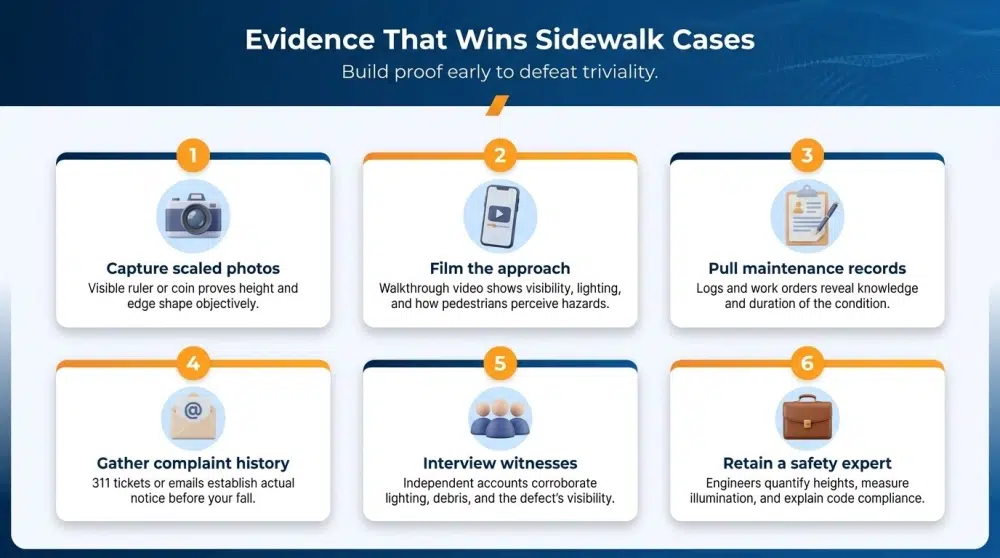
| Evidence Category | Why It Matters |
|---|---|
| Photographs with scale reference | Documents height differential, edge character, and surrounding conditions at the time of the fall |
| Video of the scene | Captures ambient lighting, pedestrian traffic, and the pedestrian’s eye-level view approaching the defect |
| Maintenance and repair records | Shows whether the property owner knew of the defect and how long it had existed |
| Prior complaint records | Establishes actual notice; undermines the trivial-defect defense |
| Prior incident reports | Evidence that others have been injured at the same location suggests the condition created a real risk |
| Medical records and bills | Establishes the nature and severity of injuries and connects them to the fall |
| Witness statements | Corroborates the injured person’s account; may establish lighting and condition at the time |
| Expert testimony (civil engineer or accident reconstructionist) | Provides professional opinion on whether the defect met or exceeded applicable safety standards and on lighting measurements |
| Surveillance or security footage | May capture the fall itself and the conditions at the moment of injury |
| Weather records | Documents precipitation, temperature, and visibility conditions at the time and place of the fall |
Evidence does not automatically prove liability or establish that a defect exceeded the trivial threshold. Each piece of evidence must be evaluated in context and weighed against the full record. The determination of whether a defect is trivial is made by the court reviewing all the evidence together, not by any single measurement or document.
What Damages or Remedies May Be Available?
If an injured person successfully establishes that a pavement defect was a dangerous condition rather than a trivial one, and if the other elements of negligence or dangerous-condition liability are proven, California law recognizes several categories of recoverable damages. What is actually recoverable in a specific case depends on the facts, the applicable law, and the evidence presented.
- Medical expenses – past and future costs of treatment, hospitalization, surgery, rehabilitation, and other care caused by the fall
- Lost income – wages or salary lost because the injury prevented the person from working
- Loss of earning capacity – if the injury has long-term effects on the person’s ability to earn income at their prior rate
- Physical pain and suffering – compensation for the physical pain caused by the injury
- Mental anguish and emotional distress – fear, anxiety, depression, and other psychological effects of the injury and its consequences
- Physical impairment and disability – if the injury results in lasting limitations on movement, function, or daily activities
- Disfigurement – if scarring or other permanent change in appearance results from the fall
- Property damage – damage to personal property, such as eyeglasses or a phone, that was broken in the fall
- Wrongful death damages – if a fall results in death, California law provides a separate cause of action for surviving family members; wrongful death lawyers who handle fatal premises liability cases in Irvine can explain who may recover and what is available under California Code of Civil Procedure section 377.60 et seq.
Punitive damages are generally not available against public entities in California and are only available against private defendants in premises liability cases where malice, oppression, or fraud is proven, a high standard rarely met in pavement-defect cases.
What If the Property Owner or Agency Disputes Liability?
Property owners and public entities routinely contest pavement-defect claims by arguing that the defect was trivial. This defense is almost always raised in motions for summary judgment, where the defendant asks the court to find, as a matter of law, that the condition could not support liability. The plaintiff must counter with specific evidence of aggravating circumstances that push the defect out of the trivial category.
California’s pure comparative fault rule also applies. If the injured person was not paying attention to the walkway, was looking at a phone, or was wearing inappropriate footwear that made tripping more likely, the jury may assign a percentage of fault to the plaintiff. Under California Civil Code section 1714 and the Li v. Yellow Cab Co. framework, comparative fault reduces the plaintiff’s recovery proportionally but does not bar the claim entirely. [10]
Government entities have additional defenses, including the notice requirement under Government Code section 835.2. If the city can show that it had no actual knowledge of the defect and that the defect was not visible enough to have been discovered through reasonable inspection, it may avoid liability even if the defect would otherwise be considered dangerous. The California personal injury lawyers at GoSuits are familiar with the notice and inspection standards applied in Orange County municipal cases.
How Long Do I Have to Act? Deadlines That Apply to Sidewalk Injury Claims
Deadlines in California pavement-defect cases are strict and unforgiving. Missing them typically results in the complete loss of the right to pursue a claim.
Claims Against Public Entities – Government Tort Claim Deadline
Before filing a lawsuit against a California city, county, school district, transit authority, or other public entity, an injured person must first file a government tort claim with the agency under Government Code section 911.2. The deadline is six months from the date of the incident. This is a mandatory prerequisite to filing suit. If the claim is rejected, the claimant then has six months from the date of the rejection notice to file suit in court. Failing to file the government tort claim within six months, or filing it late without court permission, usually bars the entire lawsuit. [11]
Claims Against Private Property Owners – Statute of Limitations
Personal injury claims against private landowners in California are governed by Code of Civil Procedure section 335.1, which provides a two-year statute of limitations from the date of injury. [12]
Tolling and Exceptions
Certain circumstances, minority, legal disability, fraudulent concealment of a defect, may toll (pause) the limitations periods. These are fact-specific legal determinations that require attorney review.
Important: Deadline calculations depend on the specific facts of each case, the nature of the defendant, and potentially applicable tolling rules. These deadlines require legal verification for any particular situation. Do not rely on this general information as legal advice for your specific claim.
What Should I Do Next?
If you or someone you know was injured in a trip-and-fall or slip-and-fall on a sidewalk or pavement defect in Irvine or elsewhere in Orange County, the following steps protect both your health and your legal rights:
- Seek medical attention immediately. Document your injuries with a physician as soon as possible. Medical records that begin close in time to the fall are important evidence of the injuries caused by the incident.
- Document the scene before it changes. Photograph the defect, including with a ruler or scale reference in the frame. Capture the lighting conditions, surrounding environment, and any debris or obstruction near the defect. If the fall was recorded by nearby security cameras, request preservation of that footage in writing as soon as possible.
- Identify witnesses. Get the names and contact information of anyone who saw the fall or who is familiar with the condition of the pavement at that location.
- Report the incident. If the property is public, file a written report with the agency. If it is private, notify the property owner or manager in writing and obtain a copy of any incident report. These reports create a record of the event and may trigger the property owner’s notice obligations.
- Do not repair or alter the scene. If you have any control over the property, preserve the defect in its current condition until it has been professionally measured and photographed.
- Be aware of the government tort claim deadline. If the property is owned by a public entity, you have only six months from the date of injury to file a government tort claim. Missing this deadline typically bars any later lawsuit.
- Consult a personal injury attorney. The trivial-defect doctrine, the notice requirements for public entities, and the evidence needed to defeat a summary judgment motion are all legally complex. Personal injury lawyers who handle premises liability cases in Irvine and Orange County can evaluate the specific circumstances of the fall and explain the options available.
If the injuries involve hip fractures, traumatic brain injury, spinal damage, or other serious conditions, the recovery timeline and the claim value can be substantial. The Irvine personal injury lawyers and Irvine slip and fall attorneys at GoSuits handle premises liability claims throughout Orange County. You can schedule a free consultation to discuss the circumstances of your case.

Related California Personal Injury Resources
These GoSuits resources address related topics that may be relevant to an Irvine or Orange County pavement-defect claim:
- Personal injury claims in Irvine- our Irvine personal injury team handles premises liability cases throughout Orange County
- Slip and fall accident claims in Irvine- slip and fall lawyers on the SR-55, I-405, and I-5 corridors in Irvine and surrounding areas
- California premises liability and the property owner’s duty to warn
- Constructive vs. actual notice- when a property owner is deemed to have known about a hazard
- California statute of limitations for personal injury claims
Talk With a GoSuits Attorney
A pavement-defect injury claim involves a detailed factual investigation, an assessment of the surrounding-circumstances evidence, and strict government tort claim deadlines if a public agency is involved. An injury claim of this type can involve medical evidence, insurance coverage questions, notice disputes, and the risk of summary judgment on trivial-defect grounds. If you were injured on a sidewalk, parking lot, or public pathway in Irvine or anywhere in Orange County, the GoSuits personal injury team can review the circumstances of your case and explain your options. Contact GoSuits for a free case evaluation.
References
- California Government Code § 830.2 – Leginfo.legislature.ca.gov
- California Government Code § 830 – Leginfo.legislature.ca.gov
- Huckey v. City of Temecula, 37 Cal.App.5th 1092 (2019) – CourtListener
- California Government Code § 835 – Leginfo.legislature.ca.gov
- California Civil Code § 1714 – Leginfo.legislature.ca.gov
- California Streets and Highways Code § 5610 – Leginfo.legislature.ca.gov
- Hernandez v. City of Stockton, No. C095259 (Cal. Ct. App. Apr. 28, 2023) – CourtListener
- Stathoulis v. City of Montebello, 164 Cal.App.4th 559 (2008) – CourtListener
- California Government Code § 7920 et seq. (California Public Records Act) – Leginfo.legislature.ca.gov
- Li v. Yellow Cab Co. (1975) 13 Cal.3d 804 – California comparative fault doctrine (Civil Code § 1714 context) – Leginfo.legislature.ca.gov
- California Government Code § 911.2 – Government Tort Claim Filing Deadline – Leginfo.legislature.ca.gov
- California Code of Civil Procedure § 335.1 – Two-Year Personal Injury Statute of Limitations – Leginfo.legislature.ca.gov