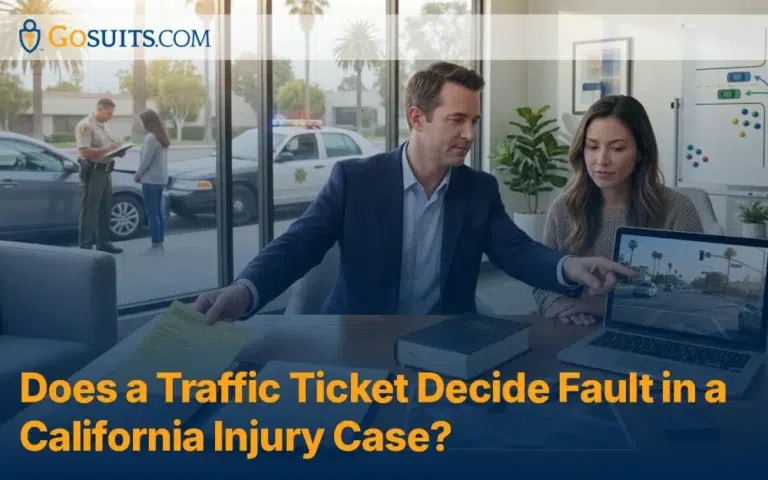
No. A traffic citation issued at the scene and the fault opinion written into a CHP 555 collision report are generally not admissible in a California civil trial to prove negligence. The officer did not witness most crashes, and California law treats the officer’s lay conclusions about who caused the collision as inadmissible opinion evidence. That said, a citation still matters because it can trigger a legal presumption of negligence under California Evidence Code section 669, and whether that presumption holds, gets rebutted, or gets complicated by a traffic-school dismissal or a guilty plea shapes the civil case in ways that are easy to misread without legal guidance.
Legal Snapshot
- Legal Topic: Traffic citation, collision report admissibility, and negligence per se in California civil injury cases
- Case Stage: Pre-litigation through trial
- Primary Legal Issue: Whether a traffic ticket or officer’s fault opinion establishes negligence in a civil personal injury claim
- Primary Authority: California Evidence Code § 669 (negligence per se); California Vehicle Code § 16000 (SR-1 reporting duty); CHP 555 (Statewide Integrated Traffic Records System collision report)
- Date Legal Authority Last Reviewed: July 2025
What Does “Fault” Mean in a California Civil Injury Case?
In California, a civil personal injury case is not decided by whoever received a traffic ticket. Fault in the civil sense means legal liability under the doctrine of negligence, the failure to use reasonable care under the circumstances, where that failure caused someone else’s injuries or property damage.
California uses a pure comparative fault system. Even if you were partly responsible for a collision, you may still recover damages reduced in proportion to your own fault percentage. This means that “who got the ticket” is not the final answer to “who pays.” The true question is how much each party’s conduct contributed to causing the crash and the resulting harm.
Collisions on Interstate 405 through the Irvine area, merge-related crashes near the SR-73 Toll Road interchange, and rear-end impacts in stop-and-go traffic on I-5 through the Irvine Spectrum all illustrate why fault is rarely a simple yes-or-no question. Officers arriving after a crash must reconstruct events from tire marks, vehicle positions, witness accounts, and party statements and their conclusions, even when written into an official report, do not decide the civil case.
What Does California Law Say?
The CHP 555 Collision Report: Central to Claims, but Not a Verdict
When the California Highway Patrol investigates a collision, it prepares a CHP 555 report. The report captures objective facts, road conditions, vehicle positions, posted speed limits, witness contact information, statements made at the scene, and any citations issued. Those factual portions of the report are valuable throughout the claims process and can become exhibits in litigation.
What the report also contains is the investigating officer’s opinion about contributing factors and which driver they believe caused the crash. California courts generally exclude that fault opinion from civil trial. The officer, however thorough, typically did not see the collision and is offering a lay reconstruction. The officer’s opinion is not the kind of evidence California civil courts allow in to prove negligence. Insurance adjusters read reports carefully, but they also know that the opinion section is not the last word.
Evidence Code Section 669: The Negligence Presumption
California Evidence Code section 669, verified at the California Legislative Information portal, creates a presumption of negligence when four conditions are all satisfied:
- The person violated a statute, ordinance, or regulation of a public entity;
- The violation proximately caused death or injury to a person or property;
- The death or injury resulted from an occurrence of the type the statute was designed to prevent; and
- The person who suffered the death or injury was a member of the class of persons the statute was adopted to protect. [1]
When all four elements are present, the violator is presumed not to have exercised due care. The jury instruction that flows from this presumption shifts the analysis: the injured party does not have to prove negligence step by step as long as those four conditions are met.
Traffic laws are the most common source of this presumption. A driver who runs a red light at the intersection of Jamboree Road and Alton Parkway in Irvine has violated a statute (the Vehicle Code provision against running a red light) that was specifically designed to prevent the type of collision that results from that behavior. Personal injury lawyers rely on section 669 frequently in Orange County crash cases because it can significantly simplify the liability phase.
How the Presumption Can Be Rebutted
Section 669(b) allows the defendant to overcome the presumption by proving either of two things:
- The defendant did what might reasonably be expected of a person of ordinary prudence, acting under similar circumstances, who desired to comply with the law; or
- The defendant was a child who exercised the degree of care ordinarily exercised by persons of similar maturity, intelligence, and capacity, with an exception for activities that normally require adult qualifications. [1]
As a practical matter, the first rebuttal avenue is most relevant to adult drivers. Common rebuttal evidence includes emergency swerving to avoid another vehicle, sudden mechanical failure, or a road hazard that made compliance impossible despite reasonable effort. Simply saying “I didn’t mean to” does not rebut the presumption.
How Does the Citation Outcome Affect the Civil Case?
The fate of the traffic ticket in the criminal or administrative proceeding has real, but varied, consequences for the civil injury claim. The four main outcomes work differently:
Conviction or Guilty Plea
A conviction or an in-court guilty plea to a moving violation in a California court is admissible in a subsequent civil case as an admission. If the other driver pled guilty to running a red light, that admission can be presented to a civil jury. The section 669 presumption of negligence would also apply because all four elements are typically satisfied. The conviction does not automatically prove causation or damages, those elements still require evidence, but it substantially strengthens the injured party’s position on the duty and breach elements.
Contested Citation Resulting in a Finding of Guilty
If the cited driver contested the ticket and lost at traffic court, the resulting guilty finding carries evidentiary weight similar to an uncontested conviction. The same admissibility rules apply.
Contested Citation Resulting in a Not-Guilty Finding
A not-guilty finding in traffic court does not automatically establish that the driver was not negligent in the civil sense. The burden of proof in traffic court differs from the civil standard. Evidence that was insufficient to prove guilt beyond a reasonable doubt in traffic court may still be sufficient to support a civil verdict under the preponderance-of-the-evidence standard. The section 669 presumption can still come into play if other evidence establishes that the statutory violation occurred, even without a traffic conviction.
Traffic School Completion (Dismissal After Diversion)
This is the outcome most likely to cause confusion. When a California driver completes a traffic school program, the traffic violation is typically dismissed and does not appear on the driving record. Drivers sometimes assume this also wipes away civil liability. It does not. Traffic school completion affects the administrative record kept by the DMV and the driver’s insurance points. It does not erase the underlying conduct. In the civil case, the plaintiff can still present evidence that the defendant made a lane change without signaling, or ran a stop sign, and the defendant cannot point to the traffic school dismissal as a shield against that evidence. The section 669 presumption can still apply if the statutory violation can be proven through independent evidence at trial.
What Is the SR-1 Report and Do You Have to File One?
California Vehicle Code section 16000 requires the driver of any motor vehicle involved in a collision that resulted in property damage exceeding $1,000 to any one person, bodily injury, or death to report the accident to the California DMV within 10 days. [2] This report, commonly called an SR-1 is filed directly with the DMV and is separate from any police or CHP report.
Failing to file a required SR-1 can result in the suspension of your driving privilege by the DMV. The SR-1 form asks each driver to provide their version of how the collision occurred, insurance information, and contact details. The contents of an SR-1 can potentially be used in related civil proceedings, which is one reason why consulting with a personal injury attorney before completing the form is advisable when injuries are involved.
The SR-1 requirement applies even when the police have already responded and prepared a CHP 555 report. The two reports serve different purposes and go to different agencies.
What If the Police Report Contains a Factual Error?
Officers write reports quickly, often from information gathered at a chaotic scene. Errors happen, wrong vehicle descriptions, incorrect driver statements, omitted witness names, or inaccurate road condition notes. When a factual error appears in a CHP 555 report, the affected party can request that a supplemental report be prepared to correct the record.
A supplement doesn’t overwrite the original report. It just adds to it and marks the correction. And since the Orange County Superior Court, which handles civil filings over in Santa Ana where basically all the OC injury lawsuits land, considers the entire investigation file when a report gets introduced, it’s kind of important to get corrections on paper. Leaving an error alone doesn’t make it go away. The original’s coming out in discovery no matter what.
Where do you send a supplement request? Usually straight to whichever agency investigated the crash. Out in the unincorporated parts of Orange County, that’s typically the CHP. Inside Irvine city limits, it’s the Irvine Police Department handling the traffic stuff. And every agency does it a little differently, so there’s no promise they’ll actually file the supplement you’re asking for. If the mistake really matters to your injury claim, honestly, locking down independent evidence, dashcam clips, photos, witness statements, whatever you’ve got, is at least as important as chasing the correction. Probably more so.
How Does This Apply in Practice?
Example (hypothetical for illustration only – not a GoSuits case):
A driver is stopped in stop-and-go traffic on the northbound I-405 near the SR-55 interchange when a vehicle behind them fails to stop and rear-ends their car at highway speed. The CHP arrives, issues a citation to the rear driver for following too closely in violation of Vehicle Code section 21703, and notes in the CHP 555 report that the rear driver was the contributing factor.
The rear driver attends traffic school and the citation is dismissed. The rear driver’s insurance company then suggests this means fault is disputed. What happens in the civil case?
- The officer’s opinion about contributing factors is generally inadmissible at trial.
- However, the objective facts in the report – that the rear vehicle collided with the stopped vehicle are admissible.
- The injured driver’s attorney can argue that the rear driver violated Vehicle Code section 21703 (following too closely), which would trigger the section 669 presumption of negligence, because that statute exists precisely to prevent this type of rear-end collision and the injured driver is in the class of people the statute protects.
- The traffic school completion does not prevent this argument. The underlying conduct still occurred.
- The rear driver would need to present evidence of ordinary prudence under the circumstances to rebut the presumption.
This is why an insurance company’s early suggestion that fault is “disputed” after a citation dismissal should be evaluated carefully by someone familiar with section 669 and how car accident lawyers in Irvine handle these situations.
What Evidence Actually Decides Disputed Fault?
When fault is genuinely contested, the following categories of evidence tend to carry more weight in the civil proceeding than the officer’s opinion or the citation outcome:
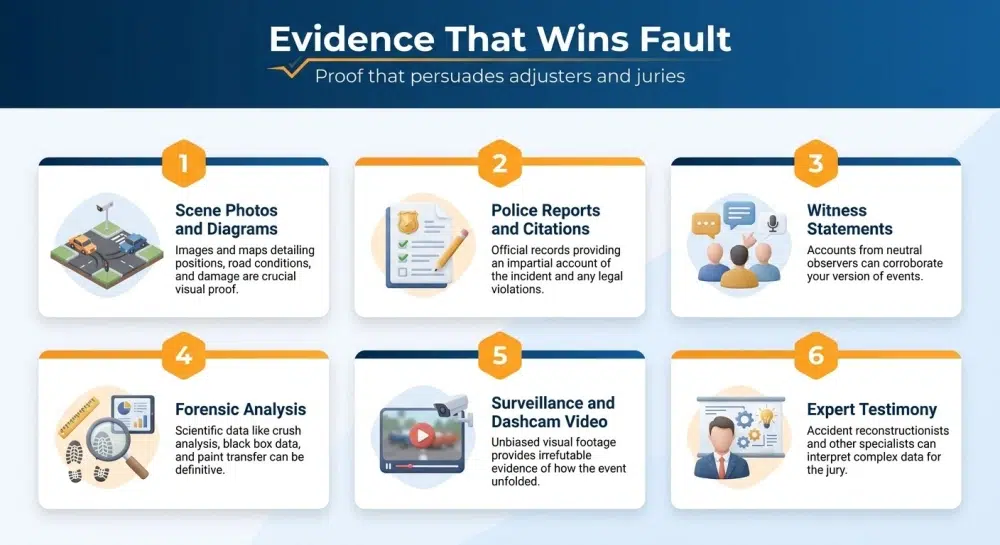
- Photographs and video: Dashcam footage, surveillance camera recordings, and cell phone photographs taken immediately after the crash capture vehicle positions, damage patterns, skid marks, and road conditions that exist only briefly.
- Physical evidence from the vehicles: Airbag deployment patterns, crush zones, and tire marks help accident reconstruction professionals determine speed and point of impact.
- Event data recorders (EDRs): Many modern vehicles record pre-crash speed, braking, and steering data that can contradict or confirm a driver’s account.
- Witness statements: Independent witnesses who were present but not involved in the crash often provide some of the most credible accounts.
- Traffic camera footage: Some intersections and freeway segments in Orange County are monitored by traffic management cameras. Footage retention periods are typically short, so prompt requests are essential. A related resource on obtaining traffic camera footage in California is available in our knowledge base article on rear-end collision fault in California.
- Expert accident reconstruction: When fault is heavily contested, retained experts can analyze the physical evidence and provide opinions that carry far more evidential value than the roadside officer’s notes.
- Prior statements: Statements made by drivers at the scene and recorded in the officer’s report can be used in the civil proceeding, even if the officer’s fault conclusion cannot.
Gathering this evidence quickly matters. Video footage is overwritten. Witnesses forget details. Vehicle EDR data requires prompt legal preservation demands. Personal injury lawyers advise clients to begin evidence preservation as soon as possible after any collision that resulted in injury.
What If Insurance Is Involved?
California is a tort-based state for automobile liability. Each driver’s liability insurer, if any pays for the other party’s damages when its insured is at fault. The CHP 555 report is one of the first things insurance adjusters request, and they use it to make initial coverage and liability assessments.
An adjuster’s liability determination is not bound by the rules of civil evidence. Adjusters may rely on the officer’s fault notation, the citation, and the SR-1 to make early decisions about whether to accept or deny a claim. This is why an insurer can dispute liability even when a citation was issued, and conversely, why an insurer may accept liability even without a citation.
When an insurer disputes a meritorious claim, California’s Insurance Code provides certain protections. Personal injury claims that involve disputed fault following a collision often involve parallel tracks: the insurance negotiation and, if necessary, civil litigation filed in Orange County Superior Court through the Central Justice Center in Santa Ana.
Our Irvine personal injury team regularly handles personal injury claims where liability was initially disputed by an adjuster and later established through independent evidence and the section 669 presumption.
What Damages or Remedies May Be Available?
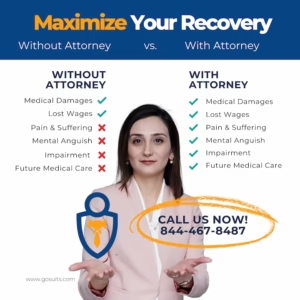
When fault is established in a California personal injury case, whether through the negligence per se presumption, independent evidence, or both the injured party may pursue several categories of damages. Actual recoverability depends on the facts of each case, applicable law, and the strength of the evidence.
- Medical expenses: Past and future costs of treatment, surgery, rehabilitation, physical therapy, and medical equipment.
- Lost income: Wages, salary, and other compensation lost because injuries prevented the injured person from working.
- Loss of earning capacity: Where injuries permanently affect a person’s ability to perform their occupation or earn at the same level.
- Physical pain and suffering: Non-economic damages for the physical experience of injury.
- Mental anguish: Psychological effects of the injury, including anxiety, depression, and post-traumatic stress.
- Physical impairment: Where injuries result in permanent limitation of physical function.
- Property damage: Vehicle repair or replacement costs and damage to other property.
- In fatal cases: California wrongful death claims allow certain family members to seek compensation for loss of financial support, loss of companionship, and related damages. Car accident lawyers and wrongful death attorneys in Irvine handle these cases with particular care given the different legal standards that apply.
How Long Do I Have to Act?
California generally requires personal injury lawsuits to be filed within two years of the date of injury under the standard statute of limitations. Wrongful death claims also carry a two-year limitation period running from the date of death. Different deadlines may apply in specific circumstances: for example, claims against government entities require a government tort claim to be filed much sooner, sometimes within six months of the incident, before a lawsuit can proceed.
The SR-1 accident report to the DMV under Vehicle Code section 16000 must be filed within 10 days of the accident when required.
Deadlines in specific cases can be affected by facts that accelerate or toll the standard period. An attorney familiar with California personal injury law should review the applicable deadlines for any particular situation. Missing a deadline can permanently bar a claim regardless of how strong it is on the merits.
What Should You Do Next?
If you were injured in a California collision where fault is being disputed or where an insurance company is pointing to a traffic school dismissal or a “disputed citation” as a reason to limit or deny your claim, several steps can protect your position:
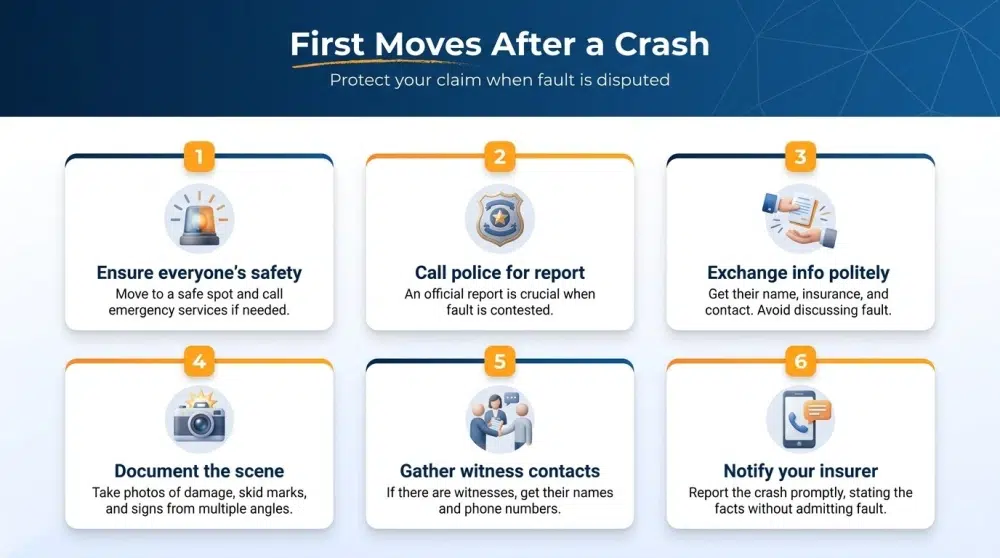
- Preserve evidence immediately. Request dashcam and surveillance footage before it is overwritten. Photograph your injuries and vehicle damage. Identify and get contact information from any witnesses who have not already given statements.
- Obtain the CHP 555 report and review it carefully. Look for factual inaccuracies that may need to be corrected through a supplemental report request.
- File the SR-1 if required. If the collision involved property damage over $1,000, bodily injury, or death, and no exempt entity was involved, you likely have a 10-day DMV reporting obligation under Vehicle Code section 16000.
- Avoid giving recorded statements to the other driver’s insurer before speaking with an attorney. What you say can affect how fault is characterized in a claim.
- Consult with a personal injury attorney promptly. Evidence preservation, statute of limitations issues, and the interplay between Evidence Code section 669 and the specific circumstances of your crash all benefit from early legal review.
An injury claim in Irvine or elsewhere in Orange County can involve medical evidence, disputed liability, insurance coverage questions, and legal deadlines that interact in ways that are difficult to navigate without legal guidance. If you or someone you know was injured in a California collision, a GoSuits personal injury attorney can review the circumstances of the claim and explain the options available. Schedule a free consultation today.

Related California Personal Injury Resources
- Car Accident Lawyers in Irvine
- California Comparative Negligence and Car Accidents
- How to Document an Irvine Car Crash
- Irvine Personal Injury Lawyers
- California Car Accident Statute of Limitations
Talk With a GoSuits Attorney
A California collision claim can involve disputed fault, complex evidence questions, insurance issues, and strict legal deadlines. If you were injured in an Irvine-area crash or anywhere in Orange County or Southern California, a GoSuits personal injury attorney can review the circumstances and explain your options. We represent injured people not insurance companies.
Schedule a free consultation with our Irvine personal injury team.
References
- California Evidence Code § 669 – Presumption of Failure to Exercise Due Care – California Legislative Information
- California Vehicle Code § 16000 – Accident Reporting Requirement (SR-1) – California Legislative Information
- Negligence Per Se – Legal Information Institute, Cornell Law School
- California Codes (EVID, VEH) – California Legislative Information
- California Courts – Official Judicial Branch Website