It depends on which insurer is asking. If your own insurance company calls and requests a recorded statement, your policy almost certainly requires you to cooperate – refusing can give your insurer grounds to deny coverage. If the other driver’s insurance company calls and asks you to record a statement, Texas law imposes no legal obligation to comply. That carrier represents the interests of the adverse party in your potential personal injury claim, and anything you say will be preserved and used to evaluate – and potentially reduce or deny – your claim.
Legal Snapshot
| Jurisdiction | State |
|---|---|
| State | Texas |
| City / Region | Dallas, TX (Dallas County) |
| Case Type | Personal Injury / Auto Accident |
| Legal Topic | Recorded Statements; Duty to Cooperate; Insurance Claims Handling |
| Case Stage | Pre-litigation / Claims stage |
| Primary Legal Issue | Contractual duty to cooperate with own insurer; no corresponding duty to adverse carrier |
| Primary Authority | Texas Insurance Code, Chapter 542 (Prompt Payment of Claims); Standard auto policy cooperation clauses; Texas Civil Practice & Remedies Code § 16.003 |
| Date Legal Authority Last Reviewed | July 2025 |
What Is a Recorded Statement?
A recorded statement is an audio-recorded interview conducted by an insurance adjuster in which the person being interviewed answers questions about how the crash happened, what injuries were sustained, and related topics. Adjusters use these recordings as part of their evaluation of a claim. The recording becomes a fixed document that can be compared against later medical records, deposition testimony, and trial testimony months or years down the road.
Adjusters are trained to conduct these interviews. They often begin with broad, open-ended questions about speed, reaction time, and road conditions before moving to more specific inquiries. Casual answers given in the first days after a crash – before the full extent of injuries is known – can create an inaccurate picture of the event and its consequences.
Your Own Insurer vs. the Other Driver’s Insurer: Why the Difference Matters
This is the most important line in the entire recorded-statement analysis, and it is one that many Texas drivers do not realize exists until after the call has already happened.
Duty to Cooperate With Your Own Insurer
Texas auto insurance policies – whether you carry liability, collision, uninsured motorist, or personal injury protection coverage – routinely include a cooperation clause. That clause is a contractual condition of coverage. It generally requires the insured to: assist in the investigation of any claim, submit to examination under oath when requested, provide documents and records related to the loss, and, in most standard policy forms, participate in recorded interviews.
Refusing to cooperate with your own insurer is not simply inconvenient – it may give the insurer a contractual basis to disclaim coverage or deny your claim entirely. Whether a refusal actually forfeits coverage depends on whether the insurer can show it was prejudiced by the refusal, which is a question that has been litigated under Texas law. The practical takeaway is this: when your own insurer asks for a recorded statement, you should speak with an attorney before deciding how to respond, but you should not ignore the request.
If you carry uninsured or underinsured motorist (UM/UIM) coverage and the other driver lacks sufficient insurance, your own insurer steps into the picture in a different role – and the cooperation clause applies there as well.
No Duty to Cooperate With the Adverse Carrier
When the other driver’s insurance company calls, they are representing a party whose interests are directly adverse to yours. Texas law does not require an injured person to give a recorded statement to an adverse party’s insurer. Understanding how insurance companies evaluate and contest claims is essential before picking up that call.
The Third-Party Claims Process in Texas operates on a negligence framework. If you are injured in a Dallas-area crash on a congested stretch of I-635 or I-35E, your claim against the at-fault driver’s carrier is a civil matter. As a claimant – not a policyholder – you have no contractual relationship with that company and no obligation to submit to their recorded interview process. Politely declining, or asking to postpone until you have spoken with counsel, is a legally protected choice.
How Early Answers About Speed, Sequence, and “How Are You Feeling?” Get Used Months Later
The timing of a recorded statement matters as much as what is said in it. In the hours and days after a crash – a rear-end collision on the LBJ Freeway, a broadside impact at a North Dallas intersection, or any other vehicle accident – injured people are often in shock, adrenaline is masking pain, and the full extent of injuries has not yet been medically documented. Statements made during that window frequently understate injury and misstate facts.
Questions About Speed and Sequence
An adjuster may ask: “How fast were you going?” “Did you see the other vehicle before impact?” “Did you brake before the collision?” A person who estimates their speed at 30 mph when they were actually traveling at 35 may face that discrepancy in a deposition. A person who says “I didn’t see the other car” may inadvertently introduce a comparative fault argument.
Texas follows a modified comparative fault rule under which an injured person’s recovery is reduced in proportion to their assigned share of fault and is barred entirely if their fault reaches 51 percent or more. [1] An early statement that places even partial blame on the injured person can affect the value of a claim substantially.
Questions About Physical Condition – “How Are You Feeling?”
This is one of the most consequential questions in a post-crash recorded statement. Someone who answers “I’m a little sore but okay” in the day or two after a collision may not yet know they have a herniated disc, a torn ligament, or a mild traumatic brain injury. Soft-tissue injuries in particular often worsen over several days. When a recorded statement captures a minimizing answer about physical condition and medical records later document serious injuries, the adjuster – and ultimately a defense attorney – will use that inconsistency to argue that the injuries were exaggerated or were not caused by the crash.
Adjusters sometimes open with social pleasantries rather than clinical questions. “How are you doing today?” is asked on the recording for a reason. Any answer suggesting the speaker is doing fine becomes part of the record.
How This Plays Out in Practice
Hypothetical Example: A driver is stopped in stop-and-go traffic on the Dallas North Tollway near the Addison area when a distracted driver rear-ends their vehicle. The injured driver is contacted two days later by the at-fault driver’s insurer asking for a recorded statement. Having not yet seen a doctor, the injured driver says they are “a bit stiff but okay.” Two weeks later, imaging reveals a herniated disc at C5-C6. The early recorded statement describing only stiffness – not neck or arm pain, not radiating symptoms – becomes the opening salvo in a dispute over whether the disc injury was pre-existing or crash-related. The adjuster’s position: “The claimant said they were okay just two days after the crash.”
Personal injury lawyers handling Dallas-area car accident claims routinely advise clients not to give recorded statements to adverse carriers before completing at least an initial medical evaluation and consulting with counsel. By the time a complete picture of damages is available – medical records, wage-loss documentation, treatment timelines – a representative can present that information in a structured way rather than through an off-the-cuff recorded interview.
What Evidence Can Matter in a Texas Car Accident Claim
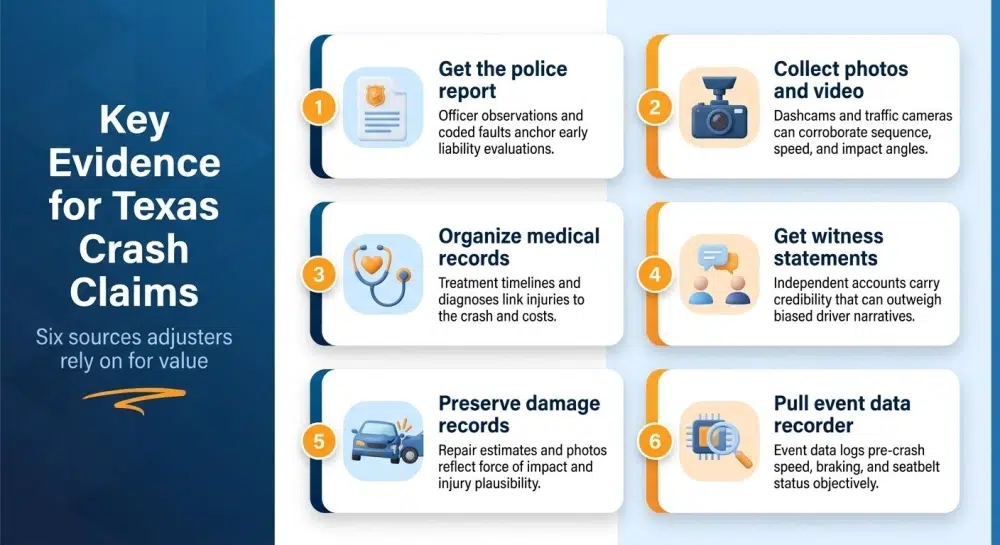
The recorded statement issue sits within a broader landscape of evidence. The following categories are commonly relevant in Texas auto injury claims:
- Police report – Documents the scene, officer observations, and initial fault determinations. Dallas County District Court cases regularly involve DPD or Texas DPS crash reports as foundational evidence.
- Photographs and video – Dashcam footage, traffic camera footage, and crash-scene photos can corroborate or contradict witness accounts.
- Medical records and bills – Establish the nature, extent, and cost of injuries. The timing of first medical visit is closely examined.
- Recorded statements – Including any statement already given, which becomes part of the claims file.
- Witness statements – Independent witnesses carry significant credibility weight.
- Vehicle damage records – Property damage extent can be compared against claimed injuries.
- Electronic data – Event data recorders (EDRs) in modern vehicles may capture pre-crash speed, brake application, and seatbelt status.
- Employment records – Support lost wage claims.
- Social media – Adjusters and defense lawyers regularly review social media posts for images or statements that appear inconsistent with claimed injuries.
None of these categories automatically proves liability or the extent of damages. Each piece of evidence is weighed alongside all others.
What If You Already Gave a Recorded Statement?
A recorded statement that has already been given is not necessarily fatal to a claim, but it requires careful management. Several options may be available depending on the circumstances:
- Request a copy of the recording. You are entitled to know what you said. An attorney can evaluate whether specific statements are actually damaging or whether the context mitigates any concern.
- Provide supplemental information. If you failed to mention symptoms that later developed, or if you misunderstood a question, medical records and treating-physician statements can provide additional context that the insurer must take into account when evaluating the full claim.
- Address inconsistencies proactively. Attempting to pretend an early statement does not exist is rarely effective. A well-prepared claim presentation acknowledges the prior statement and explains, through medical documentation, why the injury picture evolved over the days and weeks following the crash.
- Do not give another recorded statement to the same adverse carrier without legal guidance. A second statement can compound rather than correct problems from the first.
If the statement was given to your own insurer as part of a UM/UIM or collision claim, the analysis is similar in some respects but requires attention to the specific policy language governing the cooperation obligation.
What Texas Law Requires of the Insurer
While injured claimants have no duty to cooperate with adverse carriers, Texas law does impose obligations on insurers handling claims. The Texas Insurance Code, Chapter 542, known as the Prompt Payment of Claims Act, sets timelines for acknowledging, investigating, and deciding claims. [2] Among other requirements, an insurer must acknowledge receipt of a claim within 15 days, accept or reject a claim within 15 business days after receiving all items reasonably required to process the claim, and pay accepted claims within five business days of acceptance. Violations can expose an insurer to penalties in addition to the claim amount.
This framework means adjusters have their own timeline pressures. One reason they call early and request recorded statements is to begin building the file for evaluation within those statutory windows. Understanding that the adjuster’s call is driven partly by regulatory deadlines – not purely by goodwill – can inform how a claimant decides to respond.
The car accident lawyers in Dallas who regularly handle these claims understand the interplay between insurer deadlines and claimant rights.
What Damages May Be Available in a Texas Car Accident Claim
Recoverable damages in a Texas personal injury claim arising from a vehicle collision may include:
- Medical expenses – Past and future treatment costs, including emergency care, hospitalization, surgery, rehabilitation, and medication
- Lost wages – Income lost during recovery periods
- Loss of earning capacity – Where injuries affect long-term ability to earn at the same rate
- Physical pain and suffering
- Mental anguish
- Physical impairment
- Disfigurement
- Property damage
In cases where the at-fault driver’s conduct was grossly negligent or malicious, punitive (exemplary) damages may be available under Chapter 41 of the Texas Civil Practice and Remedies Code, though the standard of proof is elevated. [3]
Recoverability and the appropriate amount depend on the specific facts of the case, applicable law, and how evidence is developed. A recorded statement that diminishes the perceived severity of injuries can affect the ability to recover full compensation across these categories.

How Long Do You Have to Act in Texas?
The general statute of limitations for personal injury claims in Texas is two years from the date of the injury-causing event, under Texas Civil Practice and Remedies Code § 16.003. [4] For most Dallas-area car accident claims, this means the lawsuit must be filed within two years of the crash date or the claim is barred in most circumstances.
Several considerations can affect this deadline:
- Claims involving government entities (such as crashes involving city or county vehicles) may require a formal notice within a much shorter period – potentially six months or less – before any lawsuit can be filed.
- Claims involving minors may have different limitations periods.
- The discovery rule may apply in limited circumstances where an injury was not immediately apparent.
These are general statements only. The specific deadline applicable to any individual claim requires legal review. Missing the filing deadline ordinarily bars the claim entirely regardless of its merits.
Dallas personal injury lawyers can evaluate which deadlines apply and whether any exceptions may affect the timeline in a specific situation.
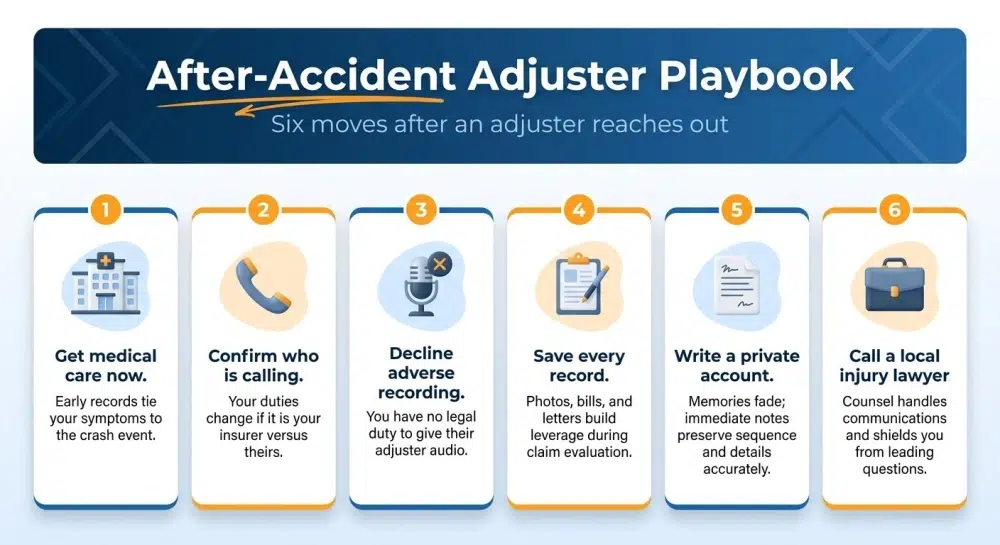
What Should You Do After a Crash When an Adjuster Calls?
- Seek medical attention first. Before any recorded statement, a medical evaluation establishes a baseline record of your condition immediately following the crash.
- Identify which insurer is calling. Is it your own insurer or the adverse carrier? The answer changes your obligations entirely.
- Do not agree to a recorded statement with the adverse carrier before consulting an attorney. You can politely tell the adjuster that you are not in a position to give a statement at this time.
- Document everything. Preserve crash-scene photos, medical records, medical bills, correspondence with insurers, and any prescription records from the date of injury forward.
- Write down your own account. A personal, unrecorded narrative written as soon as possible captures details that memory tends to blur over time.
- Review your policy. Locate your declarations page and your cooperation clause before responding to any insurer request.
- Contact a personal injury attorney promptly. Insurance companies act quickly; so should you.
A car accident claim can involve multiple insurers, disputed liability, comparative fault arguments, and evolving medical documentation – all of which take on different dimensions depending on what was said in any early recorded interview. Getting guidance before that interview happens is substantially easier than managing the consequences afterward.

Related Texas Personal Injury Resources
- Texas Insurance Code, Chapter 542 – Prompt Payment of Claims Act
- Texas Civil Practice & Remedies Code § 16.003 – Two-Year Statute of Limitations
- Texas Civil Practice & Remedies Code, Chapter 41 – Exemplary Damages
- Texas Civil Practice & Remedies Chapter 33 – Proportionate Responsibility (Modified Comparative Fault)
Talk With a GoSuits Attorney
A recorded-statement call from an adjuster is one of the earliest and most consequential events in a Texas car accident claim. The conversation is designed to gather information – and that information will be used in evaluating your claim, potentially months before any lawsuit is filed. A GoSuits personal injury attorney can review the circumstances of your accident, advise you on your obligations under your own policy, and communicate with adverse carriers on your behalf so that your claim is presented accurately and completely.
If you have already given a statement, an attorney can assess what was said and help determine the best path forward for your claim. Contact GoSuits by visiting our free consultation page or reaching out to our Dallas personal injury team directly.
Whether your crash happened in stop-and-go traffic on I-30, on the LBJ Freeway, or anywhere else in the Dallas area, car accident lawyers are available to help you understand your options without any obligation. Personal injury lawyers in the GoSuits Dallas office handle auto accident claims on a contingency-fee basis, meaning no fees are owed unless compensation is recovered.
References
- Texas Civil Practice & Remedies Code, Chapter 33 – Proportionate Responsibility – Texas Legislature Online
- Texas Insurance Code, Chapter 542 – Prompt Payment of Claims Act – Texas Legislature Online
- Texas Civil Practice & Remedies Code, Chapter 41 – Exemplary Damages – Texas Legislature Online
- Texas Civil Practice & Remedies Code § 16.003 – Two-Year Limitations Period – Texas Legislature Online
- Duty to Cooperate – Legal Information Institute, Cornell Law School
- Auto Insurance Consumer Information – Texas Department of Insurance
- Texas Law Research Guides – State Law Library of Texas
- Texas Constitution and Statutes – Official Texas Legislature Online Portal
- Texas Courts Online – Office of Court Administration
- What to Do After a Car Accident – Texas Department of Insurance Consumer Publication