
- What Are Pain and Suffering Damages in Illinois?
- How Does Illinois Define Non-Economic Damages in a Personal Injury Case?
- What Categories of Pain and Suffering Can You Claim in an Illinois Civil Case?
- How Is Pain and Suffering Calculated in an Illinois Personal Injury Case?
- Does Illinois Cap Non-Economic Damages in Personal Injury Lawsuits?
- How Does Comparative Fault Affect Your Pain and Suffering Recovery in Illinois?
- What Evidence Supports a Pain and Suffering Claim in Illinois?
- How Do Car Accidents on Chicago Roads Generate Pain and Suffering Claims?
- Can Pain and Suffering Be Claimed in a Wrongful Death Case in Illinois?
- What Is the Statute of Limitations for Pain and Suffering Claims in Illinois?
- How Do Insurance Companies Challenge Pain and Suffering Claims in Illinois?
- How GoSuits Chicago Helps Injury Victims
- References
What Are Pain and Suffering Damages in Illinois?
If you or someone you love was injured in an accident in Chicago or anywhere across Illinois, the financial toll becomes clear quickly: hospital bills, missed work, mounting therapy costs. But injuries do more than drain bank accounts. They disrupt sleep, cause anxiety, limit physical activities, and alter daily routines in ways that no invoice can capture. Illinois civil law recognizes this reality through a category of compensation known as pain and suffering damages.
Pain and suffering is kind of a catch-all phrase. It covers the physical discomfort plus the emotional toll when someone else’s negligence puts you in that position. In tort law these get bucketed as non-economic damages, mostly because you can’t point to a specific dollar amount on a receipt somewhere. What they’re really doing is paying for the human stuff. The ache, the dread, the way your routine just isn’t yours anymore. [1] #ref-1
So in Illinois, pain and suffering compensation kicks in on the civil side when a defendant’s negligent or wrongful conduct caused the injury. Different category from economic damages. Medical bills, lost wages, that kind of thing lives in its own column, even though both flow from the same accident. If you’re injured and weighing whether to file, getting a handle on how Illinois civil courts deal with non-economic damages is kind of essential. And bringing in personal injury lawyers early tends to give you the clearest view of what’s actually on the table.
Civil cases filed in Cook County are generally heard at the Circuit Court of Cook County. When you file in the downtown Chicago area, cases are often processed through the Richard J. Daley Center on Washington Street in the Loop. Knowing your local court and its requirements matters, and that local knowledge is one reason why connecting with a Chicago-area personal injury claim attorney early in the process makes a practical difference.
How Does Illinois Define Non-Economic Damages in a Personal Injury Case?
Illinois uses the term “non-economic damages” to describe losses that are real but not easily reduced to a dollar figure. The Illinois Code of Civil Procedure governs personal injury actions in the state, including how damages are assessed. Under Illinois law, non-economic damages in civil cases are distinguished from economic damages, which cover quantifiable losses such as past and future medical expenses, lost earnings, and property damage. [2]
Non-economic damages include:
- Physical pain arising directly from the injury and its treatment, including post-surgical discomfort and chronic pain conditions
- Emotional suffering such as anxiety, depression, post-traumatic stress, and grief
- Loss of enjoyment of life, which compensates for an injured person’s reduced ability to participate in activities and relationships that once brought fulfillment
- Disfigurement and disability, including permanent scarring or the loss of a limb or function
- Loss of a normal life, a separate category under Illinois law that addresses how the injury has altered the texture of daily living
- Loss of consortium, which recognizes harm to close family relationships caused by the injury
Illinois courts have long recognized that these categories overlap and that juries have considerable discretion in assigning values to them. A verdict may reflect a combined award for pain, suffering, and loss of enjoyment, or it may itemize each separately. The key legal requirement is that the damages be supported by evidence and be proportional to the nature and extent of the injury demonstrated at trial or in settlement negotiations. [3]
What Categories of Pain and Suffering Can You Claim in an Illinois Civil Case?
Illinois civil law gives injured plaintiffs a detailed framework for pursuing non-economic losses. Each category below has its own evidentiary requirements and its own impact on case value. Understanding the distinctions helps you and your attorney build the strongest possible claim.
What is physical pain and suffering in an Illinois injury case?
Physical pain and suffering covers the direct bodily discomfort caused by an injury and its necessary treatment. This includes acute pain immediately after a crash, pain during surgery and recovery, chronic pain that persists long after the initial healing, and the discomfort of ongoing physical therapy. It also encompasses pain caused by permanent injury, such as nerve damage or a compressed spine.
Physical pain is documented through medical records, treatment notes, physician testimony, and, in many cases, through a pain journal kept by the injured person. Courts and juries look to the frequency, duration, and severity of pain in assessing this element of damages.
What is emotional distress and how is it valued in Illinois?
Emotional distress refers to the psychological toll of the injury. In Illinois, emotional distress claims in a personal injury case may include documented anxiety, depression, post-traumatic stress disorder, insomnia, and other mental health consequences that flow directly from the accident or the injury itself. Mental health records, therapy notes, and the testimony of treating professionals all support these claims.
Courts treat emotional distress as a genuine and compensable harm. Juries can award substantial amounts for severe psychological injuries, particularly when the emotional consequences have altered the plaintiff’s ability to function at work, in relationships, or in daily activities. [4]
What does “loss of a normal life” mean in an Illinois personal injury claim?
Illinois recognizes a distinct category of non-economic damages called loss of a normal life, which is separate from loss of enjoyment. Loss of a normal life compensates for the ways in which an injury has changed the daily texture of the plaintiff’s existence: the inability to cook, clean, garden, exercise, or care for family members in the same way as before; the need for assistive devices; the limitations on driving, travel, or social activities.
This category tends to be highly fact-specific. A professional athlete who can no longer compete, a parent who can no longer lift their child, or a retiree who can no longer walk the same neighborhood they have walked for decades: each of these plaintiffs will have a different claim, with different evidence, and potentially a different dollar value assigned by a jury.
What is loss of consortium and who can claim it in Illinois?
Loss of consortium is a separate civil claim available to the spouse or immediate family of the injured person. It compensates for the loss of companionship, affection, support, and intimate relationship caused by the injury. In Illinois, loss of consortium claims are typically joined to the primary personal injury action but are considered the independent claim of the spouse or family member rather than the injured party.
These claims must be supported by evidence of the specific ways the relationship has been affected: reduced emotional intimacy, inability to share household responsibilities, changes in the quality of companionship. They are often among the most difficult to quantify but can represent significant value in a serious injury case.
How Is Pain and Suffering Calculated in an Illinois Personal Injury Case?
Illinois does not use a fixed formula for calculating pain and suffering damages. Unlike medical expenses, which appear on bills, or lost wages, which appear on pay stubs, non-economic losses require judgment. Courts and juries are asked to assess the evidence and assign a figure they find reasonable and fair in light of all the circumstances.
Two widely discussed approaches are used in building and presenting these calculations, though neither is mandated by Illinois statute.
What is the multiplier method for pain and suffering?
Under this approach, a multiplier (typically between 1.5 and 5 in practice, though there is no legal ceiling) is applied to the total economic damages to produce a non-economic damages figure. A more severe, permanent, or disabling injury warrants a higher multiplier. A less serious injury with full recovery warrants a lower one.
For example, if a rear-end collision on the Dan Ryan Expressway caused a herniated disc requiring surgery and resulting in permanent partial disability, an attorney might argue for a multiplier of 3 or higher applied to documented economic losses of $80,000, producing a pain and suffering demand of $240,000. This is a starting point for negotiation, not a court-ordered formula.
What is the per diem method for pain and suffering?
The per diem method assigns a daily dollar value to the plaintiff’s pain and suffering (sometimes derived from the plaintiff’s daily wage or another reasonable benchmark) and multiplies it by the number of days the plaintiff has suffered or is expected to suffer. For a plaintiff with permanent limitations, this calculation can extend over a projected remaining lifespan.
Illinois courts permit both types of argument in closing statements when supported by the evidence. The defense may challenge either approach as speculative or excessive, and juries retain full discretion to arrive at their own figure based on the totality of the evidence presented. [5]
What factors actually move the needle on pain and suffering values?
Several factors consistently influence how courts, juries, and insurance adjusters evaluate pain and suffering in Illinois:
- Severity and permanence of the injury: A fracture that heals within six weeks is valued differently from a spinal injury that causes permanent limited mobility
- Age and life expectancy of the plaintiff: A younger person with decades ahead of them in pain will generally receive a higher award than an older plaintiff with the same injury
- Pre-injury health and activity level: A plaintiff who was active and working before the crash has a more pronounced loss of normal life to document
- Credibility and consistency: Juries assess whether the plaintiff’s testimony about pain and limitation is consistent with the medical records and with how the plaintiff presents in court
- Quality of documentation: A well-kept pain journal, consistent medical treatment, and clear physician testimony all strengthen the pain and suffering presentation
Does Illinois Cap Non-Economic Damages in Personal Injury Lawsuits?
This is a question that has a specific and important history in Illinois law. In 2005, the Illinois General Assembly enacted damage caps limiting non-economic damages in personal injury cases. However, in 2010, the Illinois Supreme Court struck down those caps as unconstitutional in Lebron v. Gottlieb Memorial Hospital, holding that statutory limits on non-economic damages in tort cases violated the separation of powers doctrine by infringing on the jury’s constitutional function. [6]
As of today, Illinois does not impose a general statutory cap on non-economic damages in civil personal injury cases. Juries retain full discretion to assess pain and suffering damages in any amount they find supported by the evidence, subject to judicial review for excessiveness.
There are, however, important limitations in specific contexts:
- Claims against government entities: Suits against the City of Chicago, Cook County, the Illinois Department of Transportation, or other public bodies may involve different damage structures and procedural requirements under the Illinois Governmental Tort Immunity Act
- Workers’ compensation cases: The Illinois Workers’ Compensation Act governs most workplace injury claims and does not permit the same pain and suffering damages available in civil tort claims
- Medical context (not addressed here per topic scope)
Understanding which legal framework applies to your specific injury is foundational to knowing what compensation may be available to you. injury compensation lawyers who know the Illinois civil court system can help you identify which claims apply and how to value them accurately.
How Does Comparative Fault Affect Your Pain and Suffering Recovery in Illinois?
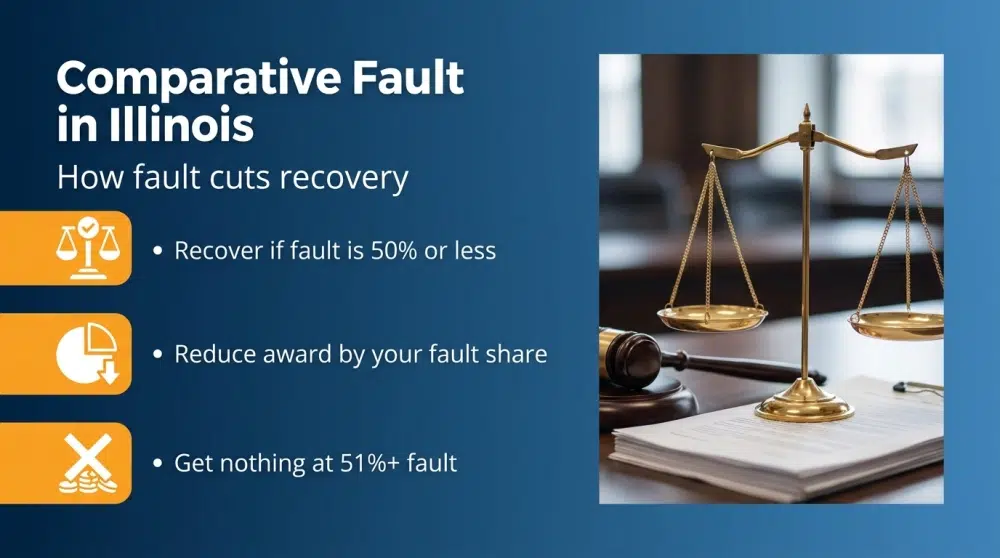
Illinois follows a modified comparative negligence framework under 735 ILCS 5/2-1116. This rule directly affects your ability to recover pain and suffering damages if you shared any responsibility for the accident. [7]
Here is how it works in practice:
- If your share of fault is 50% or less: You may recover damages, but they are reduced proportionally. If a jury finds your non-economic damages to be $200,000 and you were 30% at fault, you collect $140,000 (reduced by your 30% share)
- If your share of fault is 51% or more: You are completely barred from recovering any damages, including pain and suffering
Insurance adjusters are trained to argue that the injured person bears a greater share of fault than the evidence actually supports. They do this specifically to reduce or eliminate pain and suffering awards. Common tactics include arguing that you were following too closely, that you could have avoided the crash, or that your injuries were aggravated by a pre-existing condition rather than caused by the defendant’s conduct.
The stop-and-go traffic on the Kennedy Expressway during a Chicago commute, the sudden lane changes on I-290, or the complex merging patterns at major interchanges all create scenarios where fault allocation can be genuinely disputed. Countering a comparative fault argument requires the same solid evidence gathering that underlies the damages claim itself: dashcam footage, accident reconstruction, witness statements, and detailed medical documentation. car accident lawyers who understand Chicago traffic conditions and Cook County courtrooms are positioned to respond to these arguments effectively. [8]
What Evidence Supports a Pain and Suffering Claim in Illinois?
Pain and suffering are inherently subjective experiences, but they must be supported by objective and credible evidence to survive scrutiny in a courtroom or a settlement negotiation. The strength of a pain and suffering claim depends on the quality and completeness of the supporting evidence built from the earliest days after the injury.
Medical Records and Treatment Consistency
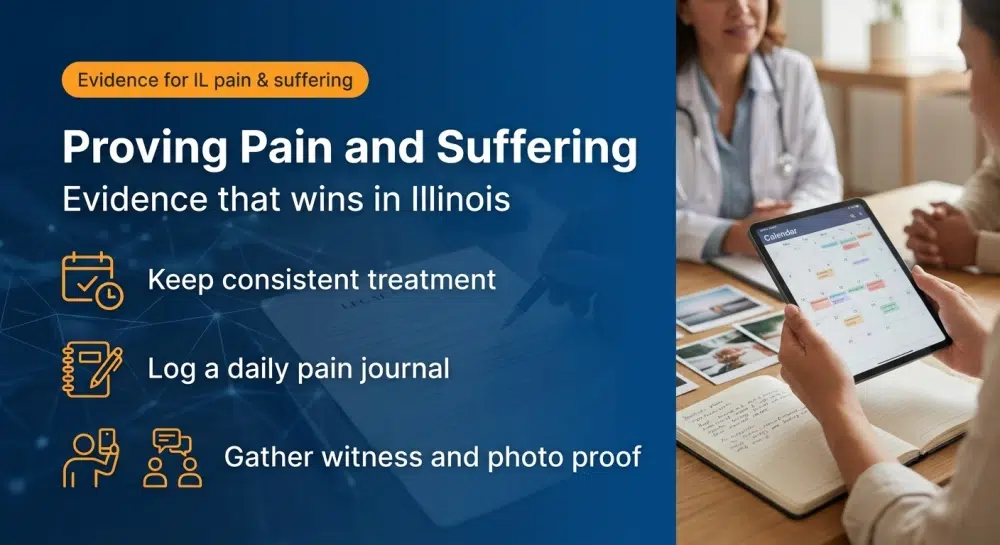
The foundation of any pain and suffering claim is consistent, documented medical treatment. Records from emergency rooms, surgeons, orthopedic specialists, neurologists, physical therapists, and mental health professionals all contribute to building a picture of the plaintiff’s actual experience. Gaps in treatment are routinely used by defense attorneys and insurance adjusters to argue that the pain was not as severe as claimed. Seeking and following through with recommended care is essential both for health and for claim integrity.

Pain Journals
A contemporaneous pain journal, maintained throughout recovery, is among the most powerful evidence a plaintiff can offer. It provides a day-by-day account of pain levels, limitations, emotional states, and the activities the plaintiff could not perform. Courts treat well-kept journals as credible firsthand records. An attorney can provide a structured format for keeping this documentation from the earliest days after an injury.
GoSuits’ knowledge base includes a detailed overview of compensation in Chicago personal injury cases, including guidance on how to document non-economic losses from the moment an injury occurs.
Lay and Expert Witness Testimony
Family members, friends, and coworkers who knew the plaintiff before and after the injury can testify to the observable changes in the plaintiff’s demeanor, activity level, and emotional state. These lay witnesses often provide the most relatable and vivid testimony for a jury. Expert witnesses, including vocational rehabilitation counselors, life care planners, and treating physicians, can project future pain and suffering needs and translate subjective experiences into defensible estimates.
Photographs and Video Evidence
Photographs taken at the scene, medical photographs documenting visible injuries, and video showing the plaintiff’s limitations in daily activities all contribute to a pain and suffering presentation. Social media posts, however, can cut the other way: defense teams routinely monitor publicly available posts to find images or statements that contradict the claimed limitations. Caution about what you post online during a pending personal injury claim is always warranted.
How Do Car Accidents on Chicago Roads Generate Pain and Suffering Claims?
The Chicago metro area produces a high volume of serious traffic collisions. The Illinois Department of Transportation’s crash data confirms that Cook County consistently accounts for a significant share of statewide injury crashes, with major expressways including I-90, I-94, I-55, and Lake Shore Drive seeing regular collision activity. Heavy commuter traffic on the Dan Ryan Expressway, the Eisenhower Expressway, and the Edens Expressway creates conditions where even moderate-speed impacts can produce serious injuries. [9]
The types of injuries that most commonly generate substantial pain and suffering claims include:
- Spinal injuries, including herniated discs, fractures, and spinal cord damage causing radiating pain, limited mobility, or paralysis
- Traumatic brain injuries, which can cause persistent headaches, cognitive changes, sleep disorders, and emotional instability
- Fractures, particularly of the pelvis, femur, and wrist, which often involve extended recovery periods and chronic residual pain
- Soft tissue injuries, including severe whiplash, torn ligaments, and rotator cuff tears, which are often underestimated by insurers but cause genuine, lasting discomfort
- Burns and scarring, which involve both the physical pain of the initial injury and the lasting distress of permanent disfigurement
Rear-end collisions at highway speeds on the Kennedy Expressway, T-bone crashes at Chicago’s dense intersection grid, and pedestrian accidents in neighborhoods like the South Side and the West Side all generate claims where pain and suffering values can be significant. Each crash scenario presents unique questions about fault, causation, and the trajectory of recovery that a personal injury claim attorney helps you navigate.
Can Pain and Suffering Be Claimed in a Wrongful Death Case in Illinois?
When an injury caused by negligence results in death, the legal framework shifts to the Illinois Wrongful Death Act, 740 ILCS 180/0.01 et seq., and the Survival Act, 755 ILCS 5/27-6. These two separate but related claims operate in tandem, and understanding them is essential for families facing a fatal crash in the Chicago area. [10]
Here’s how it shakes out. The wrongful death lawyers framework gives surviving family, usually a spouse, kids, or parents, the ability to chase damages for their own losses tied to the death. Loss of financial support. Loss of society and companionship. Grief and sorrow too. But pain and suffering the way you’d see it in a regular personal injury case? That doesn’t carry over to family under the Wrongful Death Act. Those losses stay with the decedent.
And that’s where the Illinois Survival Act steps in. A survival action gets filed by the personal representative of the decedent’s estate, and it lets the estate go after the same claims the decedent could’ve pursued if they’d lived. Including pain and suffering. The kind they actually went through between the moment of injury and the moment they died. So if someone survives a crash for hours, or days, before passing, the estate can recover for that window of documented suffering.
Important detail. The two-year statute of limitations on a wrongful death claim runs from the date of death, not the date of the accident itself. For families in Chicago who’ve lost someone on Lake Shore Drive, on I-55, or in a neighborhood collision, that means preserving evidence and moving quickly really does matter. Most Cook County wrongful death cases end up at the Circuit Court of Cook County, and the local procedural requirements there are strict enough that talking to a lawyer early isn’t optional, it’s the practical move.
What Is the Statute of Limitations for Pain and Suffering Claims in Illinois?
The general statute of limitations for personal injury claims in Illinois is two years from the date of the injury, as established in 735 ILCS 5/13-202. This applies to pain and suffering claims as part of a broader personal injury action. Missing this deadline almost always results in the claim being permanently barred, with very limited exceptions.
Key variations include:
- Minors: For plaintiffs who were under age 18 at the time of the injury, the limitations period may be tolled until they reach majority, though evidence preservation must still begin immediately
- Claims against government entities: Suits against the City of Chicago, the Chicago Transit Authority, the Illinois Department of Transportation, or other public bodies require strict compliance with notice requirements under the Local Governmental and Governmental Employees Tort Immunity Act, which may impose deadlines as short as one year from the incident
- Discovery rule: In some cases, the limitations period may not begin until the plaintiff knew or reasonably should have known about the injury and its connection to a defendant’s conduct
The practical lesson is straightforward: do not wait. Every day after an injury is a day that evidence may be lost, witnesses may become harder to locate, and electronic records may be overwritten. Reaching out to accident injury attorneys in Chicago promptly after a crash places you in the strongest position to preserve your claim and your evidence. [11]
How Do Insurance Companies Challenge Pain and Suffering Claims in Illinois?
Insurance companies are not passive participants in the claims process. They employ experienced adjusters and defense attorneys whose job is to minimize payouts, and pain and suffering claims are among their primary targets precisely because non-economic damages are harder to pin down with a single number.
How do insurers argue that pain and suffering is exaggerated?
Adjusters frequently point to gaps in medical treatment as evidence that pain was not as severe or continuous as claimed. If a plaintiff skipped several weeks of physical therapy or did not follow up with a specialist, the insurer will argue the pain resolved earlier than claimed. They may also cite prior injuries or pre-existing conditions to suggest the current pain existed before the accident.
How do insurers use social media against pain and suffering claims?
Defense teams routinely conduct social media investigations. A single photograph of you at a family gathering, a post describing a weekend outing, or even a check-in at a gym can be used to challenge the claimed extent of physical limitation. The argument is simple: if you were truly suffering as described, you would not have attended that event or posted that image. This is why pain and suffering claims require careful, consistent management from the moment the injury occurs.
What can you do to protect your pain and suffering claim?
The most effective protection is legal representation from the outset. When personal injury lawyers are involved early, they:
- Issue preservation letters to secure dashcam footage, surveillance video, and event data records before they are overwritten
- Advise on the documentation practices, including pain journaling, that will support the claim
- Handle all communications with adjusters so that no offhand statement is used against you
- Build the evidentiary record with the right medical experts and lay witnesses
- Counter lowball settlement offers with documented, reasoned demands
GoSuits’ proprietary case management platform is built to move quickly at every one of these steps: generating preservation letters within hours of intake, tracking the full damages record, and preparing demand packages supported by the complete evidence file. That speed and precision is built into how we work, not just what we say we do.
How GoSuits Chicago Helps Injury Victims
At GoSuits, we handle serious personal injury cases throughout Illinois, with a particular focus on Chicago, Cook County, and the surrounding Chicagoland area. We also serve clients across Texas and California, which gives our team a perspective on multi-jurisdiction injury law that single-state practices rarely develop.
Why does GoSuits use proprietary technology in personal injury cases?
GoSuits built its own proprietary case management software from the ground up, integrating every phase of the personal injury claim process: intake, evidence preservation, damages modeling, medical records analysis, demand letter preparation, and negotiation tracking. This is not off-the-shelf software adapted for law firms. It is a system our team designed to move faster, reduce errors, and build more complete case files than traditional paper-heavy processes allow.
Think about it this way. A Chicago intersection camera might overwrite its footage every 48 hours. That window closes fast. When an insurance adjuster sends over a lowball offer two weeks after a crash, your counter has to lean on a full, documented record, not a half-built file. Our technology is what makes both the speed and the completeness possible, and honestly, that’s one of the bigger gaps between how GoSuits works a case and how a more conventional practice handles the same one.

What makes the GoSuits client relationship different?
We do not use case managers as a buffer between you and the attorney handling your file. Every client at GoSuits has direct, unfettered access to their designated attorney by phone, email, or text. You will not be handed off to a paralegal when you need a substantive answer about your pain and suffering claim or a pending settlement offer. That direct access is a deliberate choice that reflects our belief that injured people deserve real counsel, not case management.
Between us, the team has 30 years of combined experience. Car accident claims, wrongful death litigation, truck collisions, catastrophic injury cases, the whole range. We’ve taken cases to verdict in Illinois courts too. Which matters more than it might sound, because it means our settlement demands come from a team that’s genuinely ready to try the case if the other side won’t be reasonable. Insurers notice that. And it shifts how negotiations actually go.
What practice areas does GoSuits handle for Illinois injury victims?
Our Illinois practice covers the full range of personal injury matters, from car accident claims and truck collision cases to wrongful death actions and catastrophic injury litigation. We serve clients across the Loop, Lincoln Park, the South Side, the West Side, and throughout the suburbs including Naperville, Elgin, Waukegan, Cicero, and Joliet. Detailed information about each practice area is available on our practice areas page.
Curious about the team itself? The our attorneys page lays out the background and experience of each member of our legal team. Our about us page covers how we actually approach every client and every case. And the prior cases page shows results, verdicts, and settlements across our practice areas. Fair caveat: past results don’t guarantee any particular future outcome. But they’re a pretty honest reflection of the consistent way our team handles every file.
How can a free consultation help if you were injured in Illinois?
A free consultation with a GoSuits Chicago personal injury attorney gives you direct access to someone who can evaluate your specific situation: the nature of the injury, the question of fault, the strength of the available evidence, and the realistic range of compensation, including pain and suffering, that the facts support. We take cases on a contingency fee basis, meaning there are no attorney fees unless we recover for you.
If you or a family member were injured in a car accident, a truck collision, or any other accident caused by someone else’s negligence in the Chicago area or anywhere across Illinois, now is the time to act. Evidence disappears, limitations periods are real, and the other side’s team is already working. Schedule a free consultation with GoSuits today and let us take it from here.
References
- Pain and Suffering – Legal Information Institute, Cornell Law School
- Damages – Legal Information Institute, Cornell Law School
- Illinois Code of Civil Procedure, 735 ILCS 5/2-1115 et seq. – Illinois General Assembly
- Intentional Infliction of Emotional Distress – Legal Information Institute, Cornell Law School
- Compensatory Damages – Legal Information Institute, Cornell Law School
- Illinois Supreme Court – Illinois Courts
- 735 ILCS 5/2-1116 – Contributory Fault – Illinois General Assembly
- Illinois Crash Statistics – Illinois Department of Transportation
- Cook County and Statewide Crash Data – Illinois Department of Transportation
- 740 ILCS 180 – Illinois Wrongful Death Act – Illinois General Assembly
- 735 ILCS 5/13-202 – Statute of Limitations for Personal Injury – Illinois General Assembly