Under California law, a property owner or occupier can be held liable when inadequate security allows a third party to commit a crime that injures a visitor, tenant, or invitee. The claim rests on premises liability principles rooted in California Civil Code section 1714, which imposes on every person a duty of ordinary care in the management of property.[1] Liability is not automatic. A court must first determine that criminal harm was foreseeable and California uses a demanding, context-sensitive sliding-scale test to make that determination. The greater the burden a proposed security measure places on the landowner, the higher the showing of foreseeability the plaintiff must make. Establishing that framework, and understanding the physical evidence that drives it, is the foundation of any negligent security claim in California.
Legal Snapshot
- Legal Topic: Negligent Security / Premises Liability, Third-Party Criminal Acts
- Jurisdiction: California (Orange County; Central Justice Center, Santa Ana)
- Primary Legal Issue: Duty of Ordinary Care Under California Civil Code § 1714; Foreseeability of Third-Party Criminal Harm
- Primary Authority: Rowland v. Christian, 69 Cal.2d 108 (1968); California Civil Code § 1714; Ann M. v. Pacific Plaza Shopping Center, 6 Cal.4th 666 (1993); Delgado v. Trax Bar & Grill, 36 Cal.4th 224 (2005); Castaneda v. Olsher, 41 Cal.4th 1205 (2007)
- Date Legal Authority Last Reviewed: June 2025
- Case Stage: Pre-litigation through trial
What Is Negligent Security?
Negligent security is a premises liability theory. It holds that a landowner or property manager breached a duty of reasonable care by failing to take adequate precautions against foreseeable criminal acts by third parties, and that this failure was a substantial factor in causing the plaintiff’s harm. Common settings include apartment complexes, parking structures, shopping centers, bars and restaurants, hotels, office buildings, and retail stores across the Irvine Spectrum, Newport Beach, Santa Ana, and surrounding Orange County communities.
The theory does not require the property owner to guarantee the safety of every person on the premises. California does not impose strict liability for crimes committed by strangers. Rather, the standard is whether a reasonably prudent owner in similar circumstances would have recognized the risk and taken steps to reduce it steps proportionate to the degree of danger and its predictability.
Personal injury lawyers who handle these cases regularly confront two threshold questions before any evidence of inadequate lighting or missing cameras matters at all: Was criminal harm foreseeable? And, given that level of foreseeability, did the owner’s security measures fall below what reasonable care required?
What Does California Law Say?
The General Duty – California Civil Code § 1714 and Rowland v. Christian
California Civil Code section 1714(a) states that “everyone is responsible, not only for the result of his or her willful acts, but also for an injury occasioned to another by his or her want of ordinary care or skill in the management of his or her property or person.”[1] This codified duty of ordinary care is the foundation of all California premises liability claims, including negligent security.
In Rowland v. Christian, 69 Cal.2d 108 (1968), the California Supreme Court abandoned traditional categorical rules that limited what duty a landowner owed based on a visitor’s status (invitee, licensee, or trespasser).[2] In their place, the court adopted a multifactor balancing test to determine whether a duty exists in any given case. The Rowland factors include:
- The foreseeability of harm to the plaintiff
- The degree of certainty that the plaintiff suffered injury
- The closeness of the connection between the defendant’s conduct and the injury
- The moral blame attached to the defendant’s conduct
- The policy of preventing future harm
- The extent of the burden to the defendant and the consequences to the community of imposing a duty
- The availability, cost, and prevalence of insurance for the risk
Foreseeability and the policy considerations of burden and consequence have become the dominant factors in negligent security litigation. The California Supreme Court’s later decisions in Ann M., Delgado, and Castaneda refined how those factors operate when the alleged harm is a criminal act by a third party.
Special Relationships – Landlords, Business Owners, and Invitees
California courts recognize that certain relationships impose heightened obligations. A landlord owes tenants a duty of reasonable care in maintaining common areas in a reasonably safe condition, including taking steps to address foreseeable criminal risks.[3] A business proprietor owes a similar duty to business invitees, customers, guests and patrons to maintain premises in a reasonably safe condition and to undertake reasonable steps to protect invitees from criminal acts of third parties when such conduct is reasonably foreseeable.[4]
These special-relationship duties arise without needing to satisfy a heightened threshold for every claim. They reflect the practical reality that a tenant living in an apartment complex in Anaheim or a customer using a parking garage in Costa Mesa has a reasonable expectation that the property manager has taken basic steps to address known dangers.
The Sliding-Scale Foreseeability Test: Ann M., Delgado, and Castaneda
Ann M. v. Pacific Plaza Shopping Center, 6 Cal.4th 666 (1993)
The central precedent in California negligent security law is Ann M. v. Pacific Plaza Shopping Center, decided by the California Supreme Court in 1993.[3] The plaintiff was sexually assaulted by a stranger inside a retail store within a shopping center. She argued that the shopping center should have provided security guards in common areas. The court held that the duty to provide guards, a costly and burdensome measure, required a higher showing of foreseeability than lesser precautions would demand.
The court established the following principle: the more burdensome the security measure sought, the greater the showing of foreseeability required to justify imposing a duty to adopt it. Evidence of prior similar incidents on or near the property is the primary source of that heightened foreseeability showing. The court cautioned that “the existence of [prior] similar incidents” does not merely mean incidents of any kind, it means incidents of the same general type as the harm that occurred, occurring in the same general location with enough frequency to put the owner on notice. Without such prior incidents for a high-burden measure like guards, a finding of duty typically fails.
Delgado v. Trax Bar & Grill, 36 Cal.4th 224 (2005)
In Delgado, the California Supreme Court refined the Ann M. framework and added important nuance.[4] The plaintiff was stabbed outside a bar by a patron involved in an earlier altercation inside the bar. The court held that when a landlord or business owner has a special relationship with the plaintiff and has notice of a specific third-party threat, the duty to protect can arise even without a pattern of prior similar incidents. The closer the temporal and geographic connection between a known, specific threat and the harm, the less the plaintiff must rely on a general history of crime to establish foreseeability.
Delgado also clarified the sliding scale in practical terms. The court distinguished between:
- Minimal-burden measures – such as calling police when a violent altercation is occurring on the premises, or issuing a warning to a person known to be at risk. These require relatively little foreseeability and may be triggered by a single incident unfolding in real time.
- Moderate-burden measures – such as improved lighting, camera systems, better access controls, or increased patrol frequency. These require a meaningful showing of foreseeability, typically established through a pattern of prior incidents in the same area.
- High-burden measures – such as hiring and stationing security guards. These require the most substantial showing of foreseeability, generally a robust pattern of prior similar incidents of the type the guards would be expected to prevent.
This sliding scale is not a rigid formula. Courts evaluate the totality of the circumstances. A property in the Irvine Spectrum with documented incidents of robbery in its parking structure over 18 months will face a different analysis than an otherwise quiet residential complex in Fullerton where a single incident occurred with no prior pattern.
Castaneda v. Olsher, 41 Cal.4th 1205 (2007)
Castaneda applied the sliding-scale test in the residential property context.[5] The plaintiff was a resident of a mobilehome park who was shot by a gang member living at a neighboring unit. He argued that the park’s owner had a duty to evict the gang member or take other protective measures. The California Supreme Court held that the duty to evict a tenant, a high-burden measure with significant legal and policy consequences, required a heightened showing of foreseeability. The evidence in that case, while showing some prior criminal activity in the park, was insufficient to satisfy the demanding standard for such a costly and legally complex remedy.
Castaneda reinforced three key points that practitioners and courts apply consistently:
- The burden and intrusiveness of the proposed security measure directly calibrates how much foreseeability evidence the plaintiff must produce.
- A history of prior similar incidents remains the most reliable form of foreseeability evidence for high-burden measures.
- Courts must exercise care not to impose duties that effectively require property owners to guarantee against all criminal harm, the standard is reasonableness, not perfection.
How Prior Similar Incidents Are Established
Because prior similar incidents are so central to the foreseeability analysis, gathering them is often the first and most important investigative task in a California negligent security case. These are the primary sources:
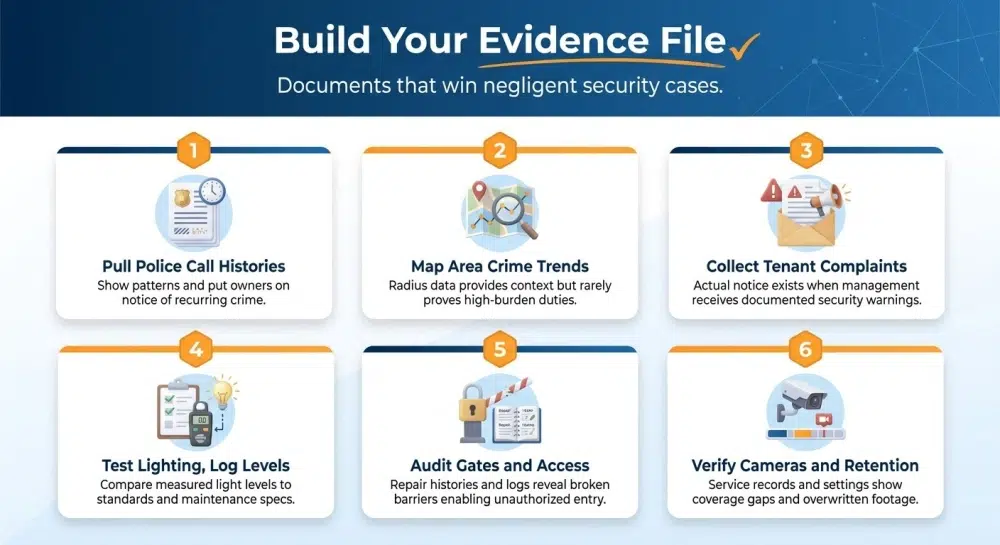
Police Call Histories and Crime Reports
Law enforcement agencies maintain records of calls for service at specific addresses and within geographic areas. In Orange County, the Irvine Police Department, Orange County Sheriff’s Department, and the Anaheim Police Department publish or produce these records through public records requests under the California Public Records Act.[6] Calls for service logs, distinct from arrest records often capture disturbances, thefts, assaults, and other incidents that were reported but may not have resulted in formal charges. These logs can establish a pattern of criminal activity at a property even when the owner claims no knowledge of prior problems.
Local police reports filed with the Orange County Superior Court or with the arresting agency document incidents with greater factual detail. Aggregating these reports for a property over a period of 12 to 36 months immediately preceding the incident typically forms the backbone of the prior-incidents showing.
Crime Grid Data
Geographic crime data, sometimes called crime grid or crime mapping data, shows the density and type of criminal activity in a defined geographic radius around a property. California law enforcement agencies and some county government portals make this data available in searchable formats. For a strip mall along the SR-55 corridor or a parking structure near the 405 in Irvine, crime grid data can demonstrate that the surrounding area had a documented, elevated rate of robberies, assaults, or thefts that a reasonable property manager exercising due care would have taken into account.
While general area crime data alone may be insufficient to establish the specific foreseeability required for high-burden measures like guards under Ann M. and Castaneda, it is properly considered alongside on-premises incident history to form a complete picture.
Incident Reports and Maintenance Records
Properties that have any formal incident reporting system whether a hotel’s front-desk log, a property management company’s maintenance ticket system, or a retail chain’s loss prevention database generate documents that may describe prior crimes or suspicious activity on the premises. These records are often discoverable in civil litigation. Critically, they may reveal that management was aware of incidents it never reported to law enforcement, undercutting any claim of ignorance.
Tenant and Employee Complaints
Complaints from tenants, guests, or employees about security conditions, suspicious activity, or prior crimes are highly probative. A tenant who reported to a property manager that her parking garage was poorly lit and that a neighbor had been followed to her car is not merely identifying a defect, she is providing direct evidence that the owner had actual notice of a foreseeable risk. Written complaints, emails, text messages to management, and records of verbal complaints documented by staff all fall into this category.
Collecting this evidence early is important because property management systems are often overwritten, upgraded, or discarded. A litigation hold letter sent promptly after an incident can preserve records that would otherwise be lost.
Physical Evidence That Decides These Cases
Once foreseeability is established, the analysis shifts to whether the security measures actually in place were adequate, and whether adequate measures would have reduced the risk. The physical condition of the property at the time of the incident is therefore critical evidence. The following categories are most frequently at issue.
Lighting Levels
Inadequate lighting is one of the most common physical deficiencies in negligent security cases. Parking structures, stairwells, walkways, entrances, and common areas that are poorly lit create conditions where crimes are more easily committed and more difficult to witness or deter. Quantifying inadequate lighting involves comparing the actual foot-candles or lux levels measured at the scene against applicable standards or the property’s own stated maintenance specifications.
Evidence of lighting deficiencies includes:
- Maintenance records showing burned-out or unreplaced bulbs at the location of the incident
- Photographs taken at the time of or shortly after the incident documenting light levels
- Expert measurement of foot-candles using a light meter at the scene, conducted as close in time to the incident as possible
- Complaints or work orders related to lighting failures in the area
- Comparison with the property’s own security or lighting policy, if one exists
An apartment complex with a documented pattern of inadequate parking lot lighting despite repeated tenant complaints presents a stronger case than one where a single bulb had just burned out. Context matters both to foreseeability and to the reasonableness of the owner’s response.

Gate and Access Control Function
Many residential properties and commercial facilities in Orange County use electronic gates, key-fob access systems, intercom controls, or physical barriers to limit access to parking areas, lobbies, and common spaces. When these systems are broken, wedged open, bypassed, or poorly maintained, they fail to perform their core function of controlling who enters the property.
Relevant evidence in this category includes:
- Maintenance logs showing prior reports of gate malfunctions, including the date of each report and how quickly (or slowly) the issue was repaired
- Photographs or video showing a gate propped open, damaged, or in disrepair at or near the time of the incident
- Access audit records showing how frequently unauthorized persons entered the property
- Vendor service records documenting the history of gate repairs and scheduled maintenance
- Electronic access logs, where available, showing the sequence of entries before the crime
A malfunctioning gate that management knew about for weeks before a violent crime occurred in the parking area connected by that gate is powerful evidence of breach. The cost of repairing a gate is modest. Under the Rowland/Ann M. framework, requiring maintenance of functional access control imposes a low burden relative to the risk it addresses.
Camera Placement and Whether Cameras Were Recording
Surveillance cameras serve two functions in negligent security claims. First, their presence (or absence) at the time of the crime is evidence of the security measures the owner actually had in place. Second, footage from working cameras or the absence of footage due to non-recording, overwriting, or inoperable cameras is often dispositive factual evidence of what happened, when it happened, and what conditions existed.
Evidence to pursue in this category includes:
- The placement and field of view of every camera installed at the property, obtained through a camera layout diagram or physical inspection
- Whether cameras in relevant areas were operational at the time of the incident vendors often maintain service records reflecting camera failures
- The footage retention schedule: many commercial systems overwrite footage within 24 to 72 hours. A preservation demand sent immediately after the incident is not optional it is essential
- Whether the recording resolution, storage capacity, and retention period meet the property’s own written security policy
- Any internal records showing management was aware that a camera was malfunctioning and had not arranged for repair
In cases where a camera positioned directly at the incident location was non-recording due to a known equipment failure, courts may allow a jury to draw an adverse inference depending on the circumstances and timing of the owner’s awareness. Separately, the absence of cameras in areas of known risk, a poorly lit stairwell in a property with documented prior assaults, is itself evidence of inadequate security for the purposes of breach.
Staffing and Patrol Logs
When a property employs security guards, patrol staff, or on-site management personnel with security responsibilities, their activity logs, shift schedules, training records, and any post orders (written instructions for their duties) are central to the case. A security guard who has not completed the patrol route required by post orders, who was not present at a location mandated by schedule, or who failed to respond to a reported incident creates a factual record that the contractually promised security was not delivered.
Even for properties that do not employ dedicated security personnel, building management or maintenance staff often conduct informal security checks. Any documented or reconstructed account of who was on the property, where they were, and what they observed in the time leading up to the incident is relevant.
Staffing-related evidence includes:
- Security guard patrol logs and sign-in sheets
- Post orders and written instructions for guard duties
- Guard licensing records – California requires security guards to be licensed through the Bureau of Security and Investigative Services under Business and Professions Code section 7590 et seq. [AUTHORITY TO VERIFY: Current licensing requirement citation]
- Training records showing whether guards received appropriate instruction for the property type and risk level
- Incident response logs showing how long it took management to respond to reports of a problem
- Radio or communication logs from the night of the incident
How This Applies to a Real Case
Example 1: Apartment Complex Assault – Prior Incidents Not Established
Hypothetical, for illustrative purposes only. Not a GoSuits case.
A tenant is assaulted in the parking garage of a large apartment complex in Santa Ana. The tenant sues the management company, alleging that security guards should have been posted in the garage. The management company produces police records and its own incident log showing no prior crimes in the parking structure or the complex’s common areas over the preceding three years. Under the Ann M. sliding scale, a court would likely find that the absence of prior similar incidents makes the foreseeability showing for a high-burden measure like security guards insufficient. The tenant’s claim may survive on other theories such as failure to maintain functional lighting or malfunctioning gate equipment but the guard-specific theory would face a high burden at summary judgment.
Example 2: Bar Parking Lot Attack – Specific Known Threat
Hypothetical, for illustrative purposes only. Not a GoSuits case.
A patron at a bar near the I-405 corridor in Irvine is assaulted in the parking lot by another patron who had been visibly threatening other customers inside the bar for 20 minutes before the attack. The bartender and manager were aware of the confrontation but took no action. Under Delgado, this scenario may establish foreseeability without relying on a pattern of prior incidents. The specific, known, ongoing threat observed by staff in real time created an obligation to take at minimum minimal-burden steps such as calling police or separating the parties. Whether to provide staff escorts to the parking lot (a moderate-burden measure) would depend on whether the confrontation had escalated to the point where such a response was required by reasonable care.
Example 3: Parking Structure Attack – Documented Crime Pattern
Hypothetical, for illustrative purposes only. Not a GoSuits case.
A visitor to a retail center near the SR-73 Toll Road is robbed at gunpoint in a parking structure that has experienced nine documented vehicle break-ins and two prior robberies over the preceding 14 months, according to police call records and the property’s own incident log. The parking structure has two non-functional cameras and no light fixtures in the northeast corner where the robbery occurred. Under these facts, the plaintiff has a substantially stronger foreseeability showing for moderate-burden measures, camera repair, lighting repair and possibly for periodic security patrols, depending on the severity and consistency of the prior crime pattern. The case under Ann M., Delgado, and the Rowland factors is meaningfully different from a case where no prior incidents exist.
What Evidence Can Matter?
| Evidence Type | What It Can Show |
|---|---|
| Police call records for the property | Pattern of prior incidents; actual or constructive notice to owner |
| Crime grid data for surrounding area | Elevated local crime rate; background foreseeability |
| Property incident reports and tenant complaints | Actual notice of prior crimes; owner’s knowledge of known risk |
| Lighting maintenance records and measurements | Breach of reasonable care; inadequate physical conditions |
| Gate and access control maintenance logs | Malfunctioning security features; known failure to repair |
| Camera placement diagrams and service records | Absence of coverage; known equipment failures; retention gaps |
| Surveillance footage (where preserved) | Direct evidence of incident, conditions, and timing |
| Security guard patrol logs and post orders | Whether contractually promised security was actually delivered |
| Guard licensing and training records | Adequacy of security personnel qualifications |
| Property’s written security policy | Standard the owner set for itself; whether it was followed |
| Expert testimony on security standards | Industry-standard practices for comparable properties |
No single piece of evidence automatically establishes liability. Each item is evaluated in context, and its weight depends on the specific facts of the case and the security measure at issue.
What Damages or Remedies May Be Available?
When a plaintiff establishes duty, breach, causation, and damages in a California negligent security case, the following categories of harm are potentially recoverable, subject to proof:
- Medical expenses – Past and future costs of treatment for physical injuries sustained in the criminal attack, including emergency care, surgery, hospitalization, rehabilitation, and ongoing care
- Lost income and loss of earning capacity – Wages lost during recovery and, where injuries are permanent, the reduction in the plaintiff’s ability to work and earn in the future
- Physical pain and suffering – Compensation for physical pain caused by the assault and resulting injuries
- Mental anguish and emotional distress – Post-traumatic stress, anxiety, depression, and other recognized psychological harms stemming from the criminal incident and its aftermath
- Physical impairment – Permanent functional limitations resulting from injuries sustained
- Disfigurement – Permanent visible scarring or deformity
- Wrongful death damages – Where the criminal attack results in death, the decedent’s family may pursue claims for loss of financial support, loss of companionship and society, funeral and burial expenses, and the decedent’s pre-death pain and suffering through a survival claim
California follows pure comparative fault. If the plaintiff is found to share some responsibility for the harm: for example, by voluntarily remaining in a location with a clearly known and announced danger, the plaintiff’s damages are reduced proportionally by their percentage of fault. Recovery is not barred unless the plaintiff bears 100% of the fault. [7]
Punitive damages require proof of malice, oppression, or fraud under California Civil Code section 3294 and are rarely awarded in negligent security cases. They are not discussed further here.
What If the Property Owner Disputes Liability?
Property owners and their insurers routinely challenge negligent security claims in California. Common defenses include:
- No prior similar incidents: The owner argues that no history of similar crime existed, making the specific harm unforeseeable. This is the most common summary judgment argument under Ann M. for high-burden security measures.
- Criminal act as superseding cause: The property owner argues that the independent criminal act of a third party broke the chain of causation between any security deficiency and the plaintiff’s harm.
- Open and obvious danger: The owner argues that any risk was open and obvious to the plaintiff, shifting focus to the plaintiff’s comparative fault.
- Adequate security in place: The owner contends that its security measures, cameras, lighting, guards, met the standard of reasonable care for a property of that type in that location.
- Lack of control: In multi-tenant settings, a property manager may argue that the owner of the specific space where the crime occurred was responsible for security in that area, not the landlord of common areas.
Responding effectively to these defenses requires thorough preparation of foreseeability evidence, physical evidence of security deficiencies, and expert testimony capable of connecting the dots between the deficiency and the harm.
What If Insurance Is Involved?
Most commercial property owners and residential landlords in California carry general liability insurance that may cover negligent security claims. Property management agreements often require properties to maintain specified coverage limits. Identifying all potentially applicable policies, including umbrella policies and any security contractor’s liability policy, is an early-stage task in these cases.
Insurance companies defending these claims may deploy their own investigators to document conditions, interview witnesses, and assess the strength of the plaintiff’s foreseeability evidence shortly after an incident. This creates time-sensitive pressure on the plaintiff’s side to preserve evidence, document conditions, and identify witnesses before conditions change or memories fade.
The Irvine personal injury attorneys at GoSuits understand how carrier defense strategies operate in Orange County and work to counter them from the outset of representation.
How Long Do I Have to Act?
The general statute of limitations for personal injury claims in California is two years from the date of injury under California Code of Civil Procedure section 335.1.[8] For wrongful death claims, the two-year period typically runs from the date of death under the same statute.
Several exceptions and circumstances can shorten or extend this deadline:
- Claims against public entities – If the property is owned or managed by a public entity such as a government agency or public housing authority, the Government Claims Act requires presentation of a claim within six months of the incident before a lawsuit can be filed. Missing this deadline may permanently bar the claim.[9]
- Minor plaintiffs – Minors generally have until two years after reaching the age of 18 to file, with some exceptions
- Delayed discovery – In limited circumstances, the statute of limitations may be tolled if the plaintiff did not discover and could not reasonably have discovered the connection between the security deficiency and the harm
Deadlines in California negligent security cases should be confirmed by a licensed California attorney based on the specific facts of the case. The information above is general and does not constitute legal advice.
Beyond legal deadlines, evidence deadlines are equally pressing. Surveillance video typically overwrites within 24 to 72 hours. Incident reports are deleted or reorganized. Witnesses relocate. Acting immediately after an incident, not months later, is critical to preserving the physical evidence described in this article.

What Should I Do Next?
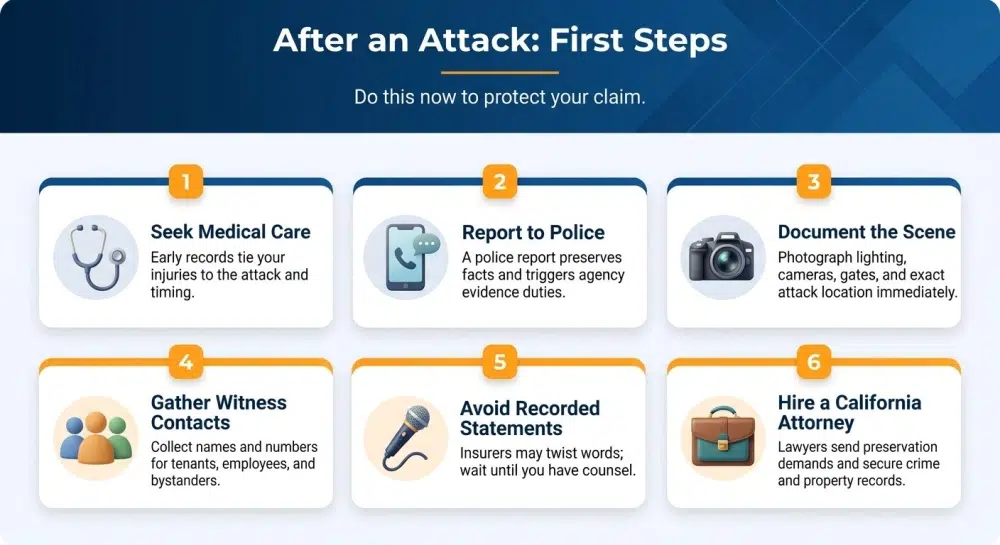
If you or a family member were harmed by a criminal attack on a property where you had a right to be present, several steps can protect your ability to pursue a civil claim:
- Seek medical attention immediately and follow treatment recommendations. Medical records documenting injuries close in time to the incident are essential evidence.
- Report the incident to law enforcement if you have not done so. The police report creates a contemporaneous record and triggers the law enforcement agency’s own evidence-preservation obligations.
- Photograph and document the scene as soon as you are safe: lighting conditions, camera positions, gate or access control status, and the specific location of the attack.
- Identify and retain contact information for any witnesses-other tenants, bystanders, employees.
- Do not give a recorded statement to the property owner’s insurance company before speaking with an attorney.
- Contact a qualified California personal injury attorney promptly. An attorney can send preservation demands, initiate the investigation into prior incidents, request police and crime data, and prevent evidence from being lost.
A negligent security claim in California can involve complex foreseeability analysis, expert testimony, and intensive discovery of property records. These cases require legal guidance. If you were injured in Orange County whether near Newport Beach, the Irvine Spectrum, the SR-133 corridor, or Santa Ana – our Irvine personal injury team can review the circumstances and explain your options. Schedule a free consultation to discuss your case.
Talk With a GoSuits Attorney
A negligent security claim in California involves foreseeability analysis under multiple California Supreme Court decisions, physical evidence of property conditions, a detailed investigation into prior incidents, and expert testimony on security standards. These cases benefit from early action, evidence disappears quickly, and the foreseeability record is often built from documents that property owners control.
If you were injured in a criminal attack in Orange County, Los Angeles County, or elsewhere in California, our Irvine personal injury team can review what happened, assess the foreseeability evidence available, and explain what a civil claim may involve. We represent clients in cases involving slip and fall accident claims, premises liability, and other serious personal injury matters throughout California. Consultations are free, and we do not collect fees unless we recover compensation for you. To speak with our team, schedule a free consultation.
Learn more about our work and results:
References and Resources
- California Civil Code § 1714 – California Legislative Information
- Rowland v. Christian, 69 Cal.2d 108 (1968) – CourtListener
- Ann M. v. Pacific Plaza Shopping Center, 6 Cal.4th 666 (1993) – CourtListener
- Delgado v. Trax Bar & Grill, 36 Cal.4th 224 (2005) – CourtListener
- Castaneda v. Olsher, 41 Cal.4th 1205 (2007) – CourtListener
- California Public Records Act – Government Code § 7922.500 et seq. – California Legislative Information
- Judicial Council of California Civil Jury Instructions (CACI) – Courts.ca.gov
- California Code of Civil Procedure § 335.1 – California Legislative Information
- California Government Claims Act – Government Code § 911.2 – California Legislative Information
- Premises Liability – Legal Information Institute, Cornell Law School
- California Codes – California Legislative Information
- California Supreme Court Opinions – courts.ca.gov