When you file a personal injury claim in California, you do not hand over your entire medical history. California law protects communications between patients and physicians through the physician-patient privilege established in the California Evidence Code. However, the moment you place your physical condition at the center of a lawsuit, that privilege gives way under what courts call the patient-litigation exception. Under California Evidence Code § 996, there is no physician-patient privilege as to a communication relevant to an issue concerning the patient’s condition when that issue has been tendered by the patient, by a party claiming through the patient, or by a plaintiff suing for the patient’s injury or death.[1] In practical terms: the records that document the injuries you claim are open to disclosure; records that have nothing to do with those injuries are generally not.
What Is the Physician-Patient Privilege and Why Does It Matter?
California Evidence Code Article 6 (§§ 990–1007) creates a physician-patient privilege that prevents a doctor from disclosing confidential communications made in the course of a professional relationship. The privilege belongs to the patient. You may invoke it to block a physician from testifying or from turning over records.
The privilege is not absolute. California Evidence Code § 999 provides that there is no privilege in a proceeding to recover damages on account of the patient’s conduct when good cause for disclosure is shown.[2] More commonly for injury plaintiffs, § 996 operates to remove the privilege for any communication relevant to the very condition you are claiming in your lawsuit.[1]
Understanding these boundaries matters before you sign anything or accept any phone calls from an insurance adjuster. Once you begin the personal injury claim process, the opposing side will look for every avenue the law allows to examine your health history.
How the Patient-Litigation Exception Works
The patient-litigation exception rests on a straightforward principle: a party cannot simultaneously claim damages for a physical injury and shield the medical evidence that is directly relevant to that very injury. When you file suit alleging, for example, a herniated disc after a collision on the I-405, you “tender” the condition of your spine as an issue. That act of tendering lifts the privilege for medical records, imaging studies, and physician notes related to your lumbar spine, past, present, and future to the extent those records bear on the claimed injury.[1]
What the exception does not do is convert your entire lifetime of medical history into an open book. Records related to a wholly unrelated condition, your blood pressure medication, a childhood illness, a dermatology visit, are not automatically swept in simply because you filed a personal injury claim. Courts in California distinguish between conditions placed “in controversy” by the plaintiff and those that remain collateral to the case.
The more specific your claimed injuries, the tighter the zone of permissible inquiry. If you claim only a knee injury, the defense generally cannot compel production of your mental health history or your cardiac records simply by hoping to find something useful. If, however, you claim loss of enjoyment of life, emotional distress, or cognitive impairment, you may broaden the scope of discoverable records by your own pleadings.
This is one reason injured people across Orange County benefit from consulting personal injury lawyers before making formal representations about the scope of their claimed injuries.
Narrow Authorization vs. Blanket Authorization: Know the Difference
Shortly after an accident, insurance adjusters, including the adjuster from your own carrier, may ask you to sign a medical authorization. There are two very different types, and the difference is significant.
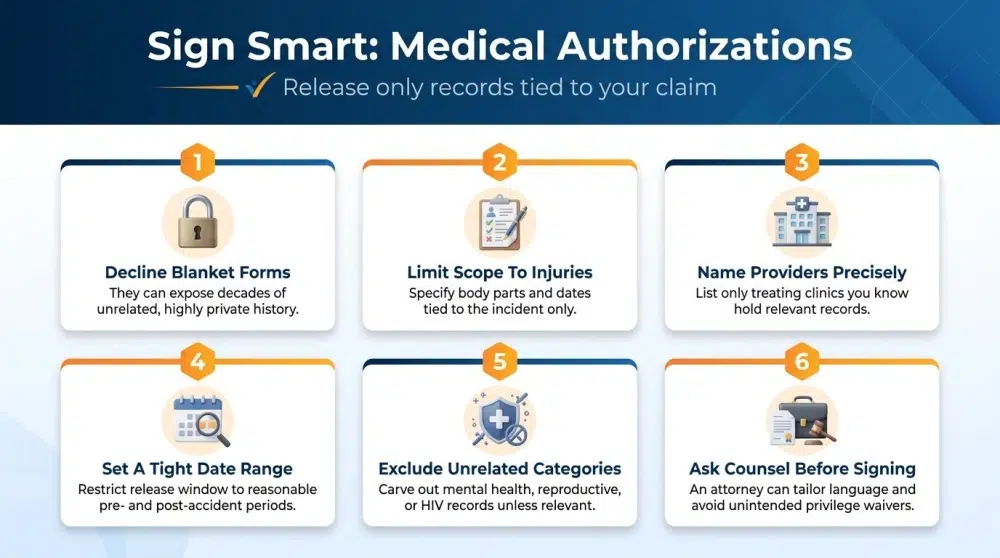
A Narrow Authorization
A narrow, injury-specific authorization permits a medical provider to release only records related to a defined body part, a specific date range, or a particular treatment episode. For example, an authorization limited to “records related to injuries sustained on [date] involving the right shoulder and cervical spine” restricts the release to those records alone.
A Blanket Authorization
A blanket authorization typically reads something like “all medical records from [date] to present” with no limitation on condition or body part. When you sign a blanket authorization, you may be releasing decades of unrelated medical history, including records the defense has no legal entitlement to obtain. Pre-existing conditions that have no bearing on your accident injuries could surface, be taken out of context, and be used to argue that your current symptoms pre-existed the incident.
Insurance companies routinely request blanket authorizations. California law does not require you to sign one simply because you were injured. Agreeing to a blanket authorization before speaking with personal injury lawyers can limit your ability to recover full compensation for your injuries.
How a Defense Subpoena to a Medical Provider Works
Once litigation begins in earnest, whether filed at the Orange County Superior Court or anticipated there, the opposing party’s attorneys can subpoena records directly from your medical providers or from medical records services. Under California Code of Civil Procedure § 1985.3, a deposition subpoena for personal records requires the issuing party to provide notice to the consumer (you) before the records are produced.[3] That notice requirement gives you and your attorneys an opportunity to act.
When a subpoena is served that you believe is overbroad, seeks records beyond what the patient-litigation exception covers, or targets records protected by heightened statutes, your attorneys may file a motion to quash or modify the subpoena under California Code of Civil Procedure § 1987.1.[4] A judge will then determine whether the subpoena must be narrowed, quashed entirely, or allowed to proceed.
The timeline matters. A motion to quash generally must be filed before the date set for production. Missing that window can mean the records are released before your objection is even heard.
Illustrative Example
Example (hypothetical, not a GoSuits case): Suppose a driver is rear-ended in stop-and-go traffic near the SR-73 interchange in Newport Beach and sustains a cervical spine injury. The defense attorney issues a subpoena to the plaintiff’s primary care physician seeking all records for the past ten years. If the plaintiff claims only a neck injury from the accident, a motion to quash or modify could limit production to records related to the cervical spine and any conditions that could plausibly affect recovery, and exclude records related to the plaintiff’s diabetes management, which has no bearing on the neck injury.
Protective Orders and In Camera Review
Even when a court determines that some medical records are discoverable, that does not mean they become public. A protective order under California Code of Civil Procedure § 2031.060 can restrict who may view the records, how they may be used, and whether they may be filed publicly.[5] Attorneys commonly seek protective orders that designate sensitive medical records as “confidential” and limit their use to the litigation at hand.
When a dispute arises over whether specific records are protected, a judge may conduct an in camera review. The judge reviews the contested records privately, without opposing counsel present, to determine whether they fall within a claimed privilege or exception. This process allows the court to make a precise ruling about what must be disclosed without requiring the party to waive privilege simply by submitting to the review.
In camera review is particularly common for records that potentially carry both privileged and discoverable content: for example, a treating psychologist’s file that contains both notes about accident-related anxiety and unrelated material from sessions predating the incident.
Records That Receive Heightened Protection Under California Law
California imposes additional layers of protection on certain categories of sensitive health information. Even when a personal injury case opens your injury-related records to discovery, these categories are not automatically swept into that disclosure.
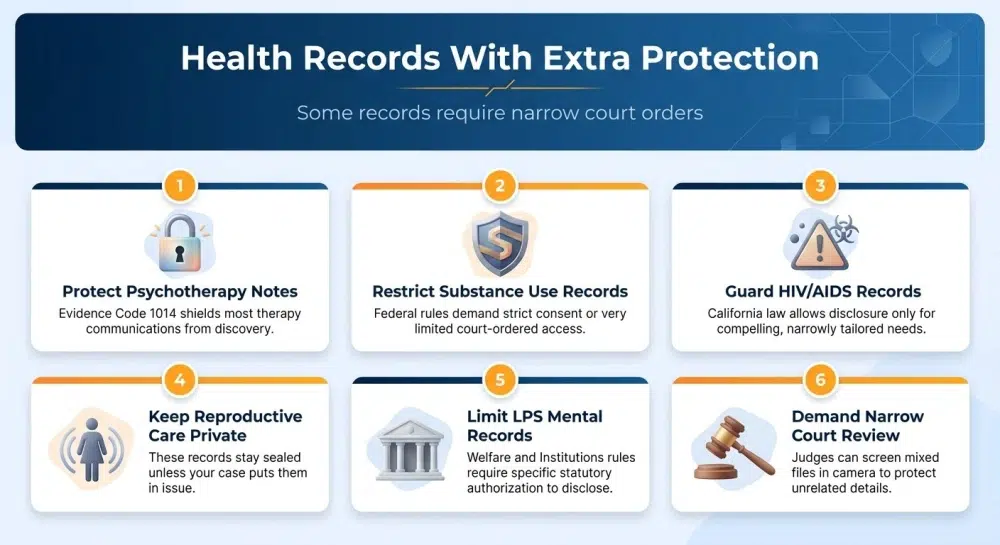
Mental Health and Psychotherapy Records
The psychotherapist-patient privilege under California Evidence Code § 1014 is a distinct and generally stronger privilege than the physician-patient privilege.[6] It applies to communications between a patient and a licensed psychotherapist, which includes psychiatrists, licensed psychologists, licensed clinical social workers, marriage and family therapists, and licensed professional clinical counselors.
If you claim emotional distress or psychiatric injury in your lawsuit, you may put mental health records at issue in a way that allows some disclosure, but only of the records directly relevant to the claimed emotional condition. Unrelated mental health treatment generally remains protected. Courts scrutinize these requests carefully, and the privilege is not easily overcome.
Substance Use and Drug or Alcohol Treatment Records
Records from federally funded substance use disorder treatment programs receive protection under federal law (42 C.F.R. Part 2), which can restrict disclosure even in civil litigation. California also provides state-level protections for substance use treatment records. Consent requirements for disclosure are stringent, and courts treat these records with care even when other medical records are subject to discovery.
HIV/AIDS Status and Testing Records
California Health and Safety Code provisions create heightened confidentiality requirements for HIV/AIDS-related records, including testing results.[7] These records generally cannot be disclosed in civil litigation without a showing of compelling need that goes substantially beyond ordinary relevance. A court order is required, and the scope of any ordered disclosure is narrowly tailored.

Reproductive Health Records
California has enacted protections for reproductive health information, and disclosure of reproductive records in civil litigation requires careful analysis of applicable statutes and the specific claims at issue. If your injury claim does not place reproductive health in controversy, those records should not be disclosed.
Mental Health Records Under the Lanterman-Petris-Short Act
Records created in connection with involuntary mental health holds or treatment under California’s Lanterman-Petris-Short Act (Welfare and Institutions Code § 5328 et seq.) carry special confidentiality protections.[8] Disclosure requires specific statutory authorization, and a general personal injury claim does not automatically supply that authorization.
Billing Records, Pharmacy Histories, and Wearable or Health App Data
Medical Billing Records
Medical billing records occupy a somewhat different position than clinical records. Billing statements, insurance explanations of benefits, and itemized charges are generally considered relevant in personal injury cases because they establish the economic damages you are claiming. While billing records carry some privacy protections under HIPAA and California law, they are frequently discoverable when you are seeking reimbursement for medical expenses.[9] Defense attorneys use billing records to examine the nature of treatment, the treating facilities, the timeline of care, and the amounts paid or billed.
The detail embedded in billing records can sometimes indirectly reveal diagnoses through procedure codes and ICD codes. This is another reason why working with car accident lawyers or personal injury counsel from the outset allows you to understand what you are disclosing when you present your damages claims.
Pharmacy Histories
Pharmacy records, including prescription histories from a pharmacy chain or pharmacy benefit manager, can be subpoenaed in California personal injury litigation. Your prescription history may be relevant if the defense seeks to establish that you had a pre-existing condition, were taking medications that might affect the mechanism of injury, or were not complying with prescribed treatment. Prescription records for medications unrelated to your claimed injuries may be objected to on relevance and proportionality grounds.
California law includes privacy protections for prescription records, and a subpoena for pharmacy records triggers the same consumer-notice requirement discussed above under Code of Civil Procedure § 1985.3.
Health App and Wearable Device Data
Fitness trackers, smartwatches, and health apps create a continuous record of steps, heart rate, sleep, activity levels, and other biometric information. This data is increasingly sought in personal injury litigation, particularly when defendants want to compare a plaintiff’s claimed activity limitations against their actual movement data recorded before and after an accident.
California does not yet have a specific statute addressing the discoverability of wearable device data in civil litigation, and courts have approached these requests under general discovery principles of relevance and proportionality. Data that predates the accident may be sought to establish a baseline; post-accident data may be sought to test claims of impairment. The discovery of wearable data raises significant privacy concerns, and objections based on proportionality, privacy, and overbreadth are actively litigated. A well-crafted protective order can limit how such data is used even if some of it is produced.
What Actually Appears in the Public Court File
Many people assume that filing a lawsuit means their medical records become public. In practice, the raw medical records themselves typically do not appear in the public court file unless they are attached to a motion or other filing by one of the parties. Even then, parties routinely seek to file sensitive medical records under seal.
What does appear publicly in a case filed at the Central Justice Center in Santa Ana or at another Orange County courthouse includes the complaint (which describes your injuries in general terms), motions and oppositions, orders, and the judgment. The actual clinical records, the physician notes, diagnostic images, and test results, are generally exchanged between counsel as part of discovery, which is largely conducted outside the public record.
When a case goes to trial, exhibits introduced into evidence become part of the public trial record. Parties can move to seal specific exhibits, but courts apply a presumption in favor of public access to trial proceedings. Cases that settle before trial typically result in a dismissal being filed, with the underlying records never becoming public.
Understanding this distinction can help you decide how to manage your case. Settling before trial keeps your medical records out of the public record; trials carry a greater risk of sensitive information becoming part of a public transcript or exhibit file.
How These Rules Apply in Practice
Example 1 (hypothetical): A pedestrian is struck by a vehicle while crossing a street in Irvine and suffers a broken femur and post-traumatic stress disorder. The plaintiff places both the physical fracture and the PTSD in controversy by claiming damages for both. The defense may seek physical therapy records and orthopedic imaging (clearly in controversy under § 996). The defense may also seek psychotherapy records related to the PTSD, but those records are protected by the stronger psychotherapist-patient privilege under § 1014. A court would likely require a careful balancing: some psychotherapy records documenting the accident-related trauma may be discoverable, while records of therapy conducted years before the accident for unrelated anxiety would likely remain protected.
Example 2 (hypothetical): A passenger in a rideshare vehicle is injured in a collision near the Irvine Spectrum and sustains a shoulder injury. The defense subpoenas ten years of records from the plaintiff’s primary care physician. The plaintiff’s attorney files a motion to limit the subpoena to shoulder-related records and records within a time frame reasonably connected to the injury. The defense argues that it needs older records to evaluate pre-existing conditions. The court conducts an in camera review of disputed records and orders production of records showing prior shoulder complaints, while excluding records related to the plaintiff’s unrelated gastrointestinal treatment.
These scenarios illustrate why the specific injuries you claim, the way those claims are framed in your complaint, and the authorizations you sign early in the process all shape what the opposing side can ultimately access.
For a deeper look at how formal discovery works in California injury cases, see our knowledge base article on what you must disclose during car accident lawsuit discovery.
Timing and Deadlines That Affect Your Privacy Rights
The statute of limitations for most personal injury claims in California is two years from the date of injury under California Code of Civil Procedure § 335.1 [AUTHORITY TO VERIFY exact section]. Missing this deadline generally bars the claim entirely. However, the privacy issues discussed in this article arise well before any statute of limitations becomes relevant, they begin the moment you report the accident to an insurance company or sign any document.
Once litigation begins, discovery deadlines imposed by the court’s scheduling order set the timeline within which the defense can seek your records. Motions to quash subpoenas or seek protective orders must be filed promptly, often within days of receiving notice of a subpoena. These windows are not forgiving.
If your claim involves a government entity, a city bus, a municipal vehicle, or a defective roadway-government tort claim notice deadlines under California Government Code § 911.2 typically require written notice within six months of the incident, far sooner than the general statute of limitations. [DEADLINE REQUIRES LEGAL VERIFICATION for specific application to your facts]
What Should You Do Next?
If you were injured in an accident in Irvine, Newport Beach, Costa Mesa, or anywhere in Orange County and are concerned about what medical information the opposing side may access, there are concrete steps to consider.
- Do not sign any blanket medical authorization before speaking with an attorney. The scope of what you disclose early in the process can affect your recovery.
- Preserve your own records. Gather documentation of your injuries, treatment, and expenses, but store them carefully and share them only with your legal counsel.
- Understand what you are claiming. The injuries and conditions you describe in your complaint and to insurance companies directly determine which records are “in controversy” and therefore discoverable.
- Act promptly on subpoena notices. If you or your provider receives a subpoena for your medical records, notice to you is required before production. The window to object is short.
- Discuss sensitive records with your attorney at the outset. If you have mental health treatment, substance use treatment, HIV-related records, or other sensitive categories in your history, tell your attorney before those categories become relevant in the litigation.
A personal injury claim involves navigating not only the physical and financial consequences of an injury but also a complex set of rules about what information can be demanded from you and on what terms. Knowing these rules before the process begins puts you in a stronger position.

Talk With a GoSuits Attorney
An injury claim in California involves medical evidence, insurance tactics, discovery disputes, and legal deadlines that operate simultaneously. If you were injured and are concerned about the privacy of your medical records or the scope of what an insurance company or defense attorney can access, a GoSuits personal injury attorney can review the specific circumstances of your situation and explain your options under California law.
Our Irvine personal injury team serves clients throughout Orange County, including in Santa Ana, Newport Beach, Costa Mesa, Fullerton, and the surrounding communities. We handle personal injury claims across California, and our Los Angeles personal injury team also represents injured clients throughout Southern California.
References and Legal Authority
- California Evidence Code § 996 – Patient-Litigation Exception to Physician-Patient Privilege – California Legislative Information
- California Evidence Code § 999 – No Privilege in Damages Proceedings – California Legislative Information
- California Code of Civil Procedure § 1985.3 – Subpoena of Personal Records; Consumer Notice – California Legislative Information [AUTHORITY TO VERIFY section number and current text]
- California Code of Civil Procedure § 1987.1 – Motion to Quash Subpoena – California Legislative Information [AUTHORITY TO VERIFY section number and current text]
- California Code of Civil Procedure § 2031.060 – Protective Orders in Discovery – California Legislative Information [AUTHORITY TO VERIFY section number and current text]
- California Evidence Code § 1014 – Psychotherapist-Patient Privilege – California Legislative Information
- California Health and Safety Code § 120975 et seq. – HIV/AIDS Confidentiality – California Legislative Information [AUTHORITY TO VERIFY specific subsection applicable]
- California Welfare and Institutions Code § 5328 – Lanterman-Petris-Short Act Confidentiality – California Legislative Information [AUTHORITY TO VERIFY specific subsection applicable]
- HIPAA Privacy Rule – U.S. Department of Health and Human Services