- What Happened at the GKN Aerospace Facility?
- What Is the Evacuation Zone and Who Is Affected?
- Where Are the Shelter Locations?
- Where Can You Get Official Real-Time Updates?
- What Is Methyl Methacrylate and Why Is It Dangerous?
- What Are the Health Risks of Methyl Methacrylate Exposure?
- What Should You Do to Protect Yourself and Your Family?
- What Is the State of Emergency and What Does It Mean?
- What Are Your Legal and Financial Rights After a Chemical Evacuation?
- What Costs May Be Recoverable?
- How Does a Toxic Exposure or Evacuation Claim Generally Work in California?
- How GoSuits Irvine Can Help You Navigate This Situation
- References and Resources
What Happened at the GKN Aerospace Facility?
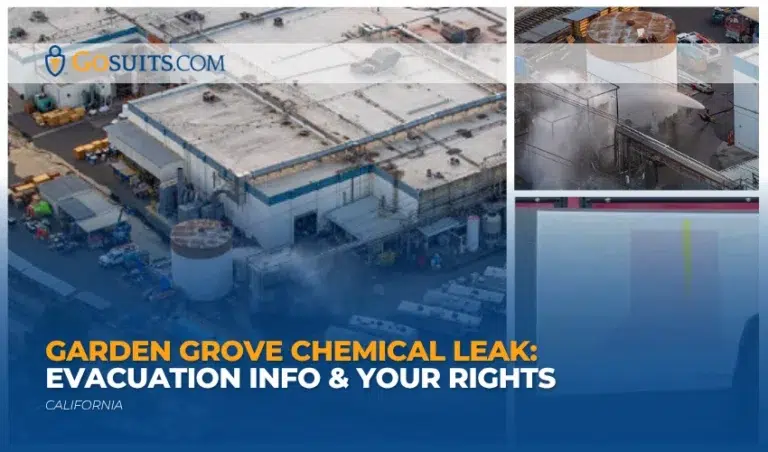
On May 21, 2026, a chemical storage tank at the GKN Aerospace facility on Western Avenue in Garden Grove, California began leaking methyl methacrylate (MMA), a flammable and pungent industrial liquid used in the aerospace manufacturing process. The Orange County Fire Authority (OCFA) responded to the scene and established an incident command to contain the release and protect nearby residents and businesses. [1]
OCFA confirmed the incident on their official platforms, activating a community hotline at (714) 628-7085 for residents seeking information. The Orange County District Attorney’s office has opened an investigation into the circumstances surrounding the release. A state of emergency has since been declared for the affected area.
This is an ongoing and evolving situation. The information on this page is provided as a public resource and will not be updated in real time. For current conditions, please monitor official channels listed below.
What Is the Evacuation Zone and Who Is Affected?
The primary hazard zone is centered on the GKN Aerospace facility located on Western Avenue in Garden Grove, Orange County, California. Evacuation boundaries are established and adjusted by OCFA based on wind direction, concentration readings, and containment status. Nearby communities that may be within or near the affected area include portions of Garden Grove, Stanton, Westminster, and West Anaheim.
Because evacuation boundaries can change rapidly in hazardous materials incidents depending on atmospheric conditions and containment progress, we strongly urge you to check the official Garden Grove evacuation zone map and OCFA active incident page rather than relying on any static boundary description here. [2]
If you received an emergency alert through the Orange County Alert system (a component of the Wireless Emergency Alert network), follow those instructions precisely. Do not re-enter an evacuated area until OCFA or local authorities lift the order officially.
Where Are the Shelter Locations?
The City of Garden Grove and Orange County emergency management have coordinated shelter access for displaced residents. Shelter locations during declared disasters in Orange County are typically established at local community centers, schools, and faith-based facilities.
For confirmed, current shelter locations during the Garden Grove chemical incident, please contact:
- Community Hotline: (714) 628-7085
- City of Garden Grove Emergency Information: Monitor the City of Garden Grove official channels
- American Red Cross Southern California: The Red Cross often activates shelter operations during declared local emergencies and can be reached at 1-800-RED-CROSS (1-800-733-2767)
- Orange County Emergency Management: The Orange County Emergency Management Division coordinates multi-agency shelter operations
We do not publish specific shelter addresses in this article because shelter assignments can change as the response evolves. Verified, current shelter information comes only from OCFA, the City of Garden Grove, and Orange County Emergency Management.
Where Can You Get Official Real-Time Updates?
Trustworthy, official sources for real-time information on the Garden Grove chemical leak include:
- Orange County Fire Authority (OCFA) website: [1] – ocfa.org, including active incidents page
- OCFA Community Hotline: (714) 628-7085
- OCFA on X (formerly Twitter): @OCFireAuthority, which provides near real-time field updates
- Orange County Alert / OC Alert system: Sign up at ocsd.org for text and phone notifications
- City of Garden Grove official communications
- South Coast Air Quality Management District (SCAQMD): For air quality advisories and monitoring data in the area [3]
- California Office of Emergency Services (Cal OES): For state-level emergency declarations and resources [4]
Social media posts from neighbors, local news accounts, or third-party apps are not reliable sources for official evacuation boundaries or shelter-in-place orders. Always confirm with the above sources before making decisions about your safety or your family’s safety.
What Is Methyl Methacrylate and Why Is It Dangerous?
Methyl methacrylate (MMA) is a colorless, flammable liquid with a sharp, fruity odor. It is a monomer widely used in the production of acrylic plastics, coatings, adhesives, and dental materials. Aerospace manufacturing facilities such as GKN Aerospace use it as part of composite and bonding processes. [5]
MMA is classified as a volatile organic compound (VOC) and is regulated by the U.S. Environmental Protection Agency (EPA) and the California Air Resources Board (CARB). At low concentrations in the open air, the pungent odor is the primary sensory warning. At higher concentrations such as those that can occur near a storage tank rupture, MMA poses risks to human health through inhalation, skin contact, and eye irritation.
The substance is also flammable, with a relatively low flash point, which is why fire authority hazardous materials (HazMat) teams take chemical releases involving MMA seriously even when ignition has not occurred.
What Are the Health Risks of Methyl Methacrylate Exposure?
According to occupational health and toxicological data maintained by federal agencies, exposure to methyl methacrylate can produce a range of health effects depending on the concentration and duration of exposure. [5] [6]
Acute (short-term) effects may include:
- Respiratory irritation: Coughing, shortness of breath, tightness in the chest, and wheezing
- Eye and mucous membrane irritation: Burning, tearing, redness
- Headache and dizziness
- Nausea
- Skin irritation or sensitization with direct contact
Potentially longer-term concerns with repeated or high-level exposure:
- Possible respiratory sensitization, particularly in individuals with pre-existing asthma or lung conditions
- Neurological effects at very high concentrations
As of this writing, no injuries have been officially reported in connection with the Garden Grove chemical leak. If you or a member of your family experience respiratory symptoms, eye irritation, dizziness, or other health concerns after being in the affected area, seek medical attention promptly and document your symptoms and the timeline carefully. That documentation can matter significantly for any future personal injury claim.
If you were displaced by the evacuation, even in the absence of immediate symptoms, it is prudent to consult a physician, particularly if you have respiratory conditions, heart conditions, or if a child or elderly family member was exposed. Keep records of all medical visits, dates, and findings.
What Should You Do to Protect Yourself and Your Family?
If you are in an evacuation zone:
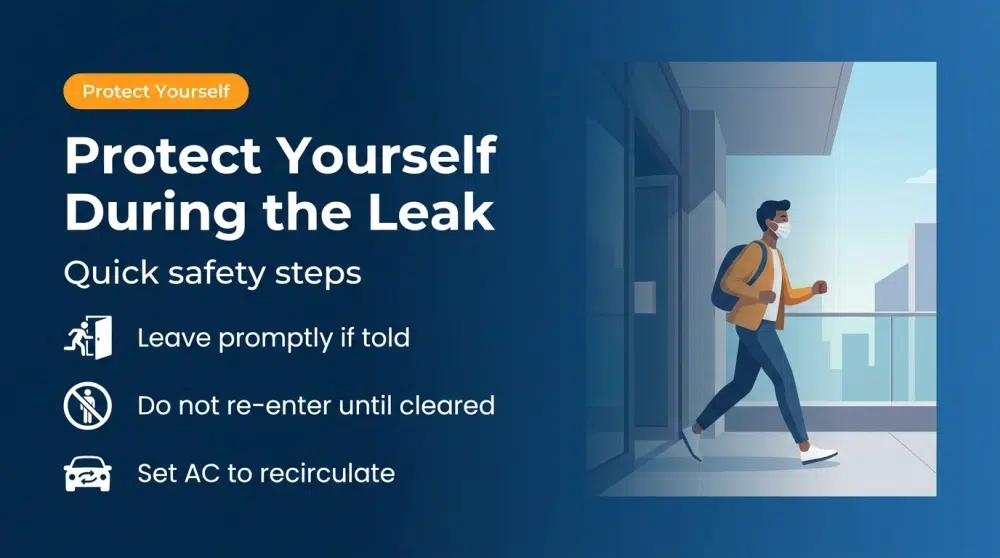
- Leave promptly when ordered to do so, do not delay to gather belongings beyond essential documents, medications, and pets
- Do not re-enter until authorities officially lift the order
- Close windows and set HVAC systems to recirculate indoor air if you are sheltering-in-place rather than evacuating
- Keep children and pets indoors if in a shelter-in-place zone
- Avoid areas with strong chemical odor
Begin documenting everything from the moment you are affected. Keep copies of:
- Any emergency alert messages you received and when you received them
- Evacuation orders and notices
- Hotel or lodging receipts if you were forced to find temporary housing
- Receipts for meals and other out-of-pocket evacuation costs
- Any medical evaluations or treatments related to possible exposure
- Business records if your business was forced to close or suspend operations
- Photographs and videos of the scene and your property
This documentation is the foundation of any potential civil claim you may pursue later.
What Is the State of Emergency and What Does It Mean?
A state of emergency declared in connection with a local hazardous materials incident activates a coordinated government response and can also affect the legal and financial landscape for affected residents and businesses. Under California Government Code, a local emergency declaration allows authorities to exercise emergency powers, access state resources, and potentially open pathways to state and federal assistance programs. [7]
A state of emergency does not automatically provide compensation to displaced residents. Rather, it opens government channels for disaster relief programs. What matters for individual financial recovery is whether you have civil claims against responsible parties, a separate and independent legal question from emergency declarations.
The Orange County District Attorney’s investigation into the cause of the release is also significant. If the investigation determines that the leak resulted from negligence, regulatory violations, or inadequate safety protocols, that finding can bear on civil liability though a criminal investigation and a civil lawsuit proceed separately and independently.

What Are Your Legal and Financial Rights After a Chemical Evacuation?
This section is general educational information only. It is not legal advice, and reading it does not create an attorney-client relationship between you and GoSuits or any attorney. Every situation is different. If you believe you have been harmed or suffered financial losses as a result of the GKN Aerospace chemical release in Garden Grove, you should consult a qualified personal injury attorney to evaluate your specific circumstances.
With that important context, here is what California law generally provides in situations like this one.
Who May Be Legally Responsible?
In California, when a company releases a hazardous substance that forces residents to evacuate, injures people, or damages property, affected individuals and businesses may have civil claims based on several legal theories:
- Negligence: The responsible party had a duty to store and handle MMA safely, breached that duty, and caused harm as a result. This is a foundational personal injury claim under California law.
- Nuisance (public and private): California Civil Code provides claims for unreasonable interference with the use and enjoyment of property. A chemical release that forces an entire neighborhood to evacuate is a textbook candidate for a nuisance claim.
- Strict liability for ultrahazardous activities: Under California common law, certain activities are so inherently dangerous that liability may attach even without proof of negligence. Storage of large volumes of flammable, toxic industrial chemicals may qualify.
- Product liability: If a defective tank, valve, fitting, or other component contributed to the release, product liability lawyers may identify claims against manufacturers or equipment suppliers.
- Trespass: Chemical contamination of a person’s property can constitute trespass under California law.
Toxic tort claims – injury claims arising from exposure to hazardous substances require plaintiffs to connect the chemical exposure to actual harm. [8] At this stage, with the incident still fresh and health effects still being assessed, preserving evidence and documenting potential exposure is the critical first step. Our Irvine personal injury team can help you understand how California courts approach toxic exposure cases and what steps to take now to protect your potential claim.
California’s Statute of Limitations
Under California Code of Civil Procedure Section 335.1, most personal injury claims must be filed within two years from the date of the injury. However, California’s discovery rule may apply in toxic exposure cases: the limitations period can begin running from the date you discovered or reasonably should have discovered that you suffered a harm connected to the chemical exposure. [9]
Claims against government entities follow different, shorter timelines under the California Government Claims Act. If any government agency’s actions or failures played a role, a government tort claim may need to be filed within six months of the incident. Missing this deadline can permanently bar your claim against a public entity.
These deadlines make it important to consult with personal injury lawyers in Irvine promptly, not because you need to file a lawsuit immediately, but because early consultation helps you understand your rights and preserve evidence before it disappears.
What Costs May Be Recoverable?
Residents and businesses displaced by or harmed by the Garden Grove chemical tank leak may be able to recover for a range of losses, depending on the facts of their individual situation. [10]
Potentially recoverable costs in a civil claim may include:
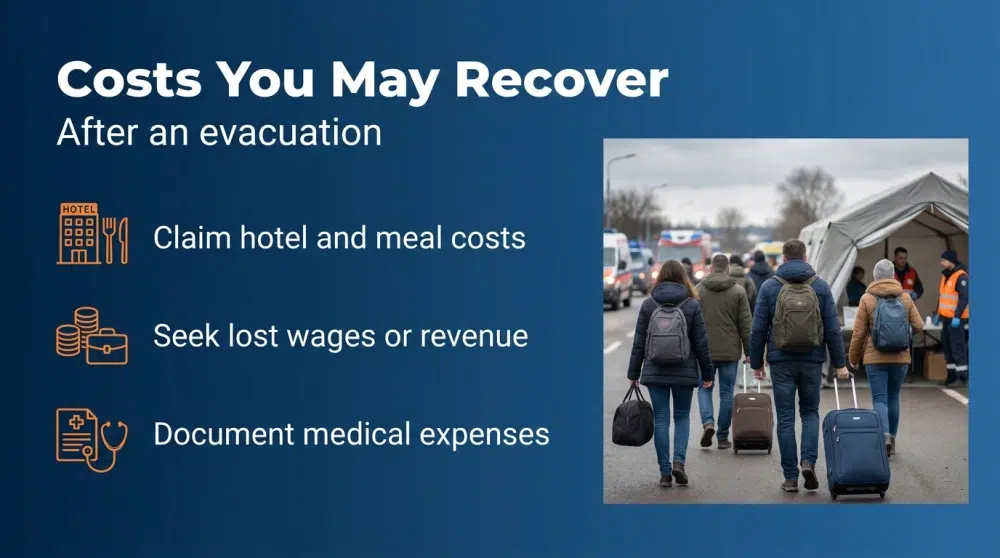
- Evacuation expenses: Hotel and lodging costs, meals, transportation, and related out-of-pocket costs incurred because of the evacuation order
- Lost wages: Income lost by employees who could not work during the evacuation period
- Business interruption losses: Revenue lost by businesses forced to close, suspend operations, or relocate
- Property damage: Contamination of real property or personal property by the released chemical
- Medical expenses: Costs of medical evaluation and treatment for exposure-related symptoms
- Pain and suffering: Non-economic harm including anxiety, disruption of daily life, and distress caused by the forced evacuation
- Future medical monitoring: In some toxic exposure cases, courts recognize the cost of ongoing medical surveillance as a recoverable item
The availability and amount of these recoveries depend on the evidence in your case, the conduct of the responsible parties, and California law as applied to your specific circumstances. Businesses in Stanton, Cypress, Westminster, or West Anaheim that rely on the Western Avenue corridor and were forced to shut down due to road closures or air quality concerns may also have claims worth evaluating.
You can learn more about how product liability and toxic exposure claims work in our knowledge base.
How Does a Toxic Exposure or Evacuation Claim Generally Work in California?
A civil claim arising from a chemical release generally progresses through these stages, though each case is different and timelines vary:
- Evidence preservation: Your attorney works to document your losses, gather medical records, obtain government incident reports, and identify expert witnesses who can address chemical exposure causation.
- Investigation and demand: Your attorney investigates the responsible parties which may include GKN Aerospace, equipment manufacturers, contractors, or insurers and issues a demand for compensation.
- Negotiation: Many toxic exposure claims resolve through settlement negotiation without litigation. Your attorney’s knowledge of California civil law and the facts of your case drives this process.
- Litigation if necessary: If a fair settlement is not reached, your case may proceed to the Orange County Superior Court, where civil cases of this type are filed. The Central Justice Center in Santa Ana handles civil filings for Orange County. Your attorney handles all filings, depositions, discovery, and trial preparation.
You do not need to understand every step of this process before consulting an attorney. A free consultation with our Irvine personal injury team is designed precisely to answer your questions without pressure or obligation.
When it comes to toxic exposure and evacuation disruption, you do not want to be unrepresented. Insurance adjusters and corporate defense teams have experience minimizing claims. Having skilled personal injury lawyers in Irvine on your side levels the playing field from the start.
How GoSuits Irvine Can Help You Navigate This Situation
If you were displaced from your home in Garden Grove, lost income because your business was forced to close, or have concerns about chemical exposure, you deserve a straightforward conversation about your rights, not a sales pitch.
GoSuits is a personal injury law firm serving clients across Orange County, California, Texas, and Illinois. Our Irvine office handles toxic exposure cases, property damage claims, and the full range of personal injury claims in Irvine and throughout Orange County. Our team has recovered meaningful compensation for clients across a wide range of situations, you can review our prior cases for a sense of the work we do.
What Makes GoSuits Different?
We combine 30 years of combined legal experience with a technology-driven approach that sets us apart from traditional law firms. GoSuits has developed proprietary case management software that organizes your case documents, tracks deadlines, and keeps communication efficient so nothing falls through the cracks and your case moves forward on the right timeline.
Critically, every client at GoSuits works directly with a designated attorney, not a case manager or paralegal acting as an intermediary. You have unfettered access to the attorney handling your case. When you need answers, you get them from the lawyer, not from a staff layer between you and the person responsible for your case.
Our attorneys are trial-ready, meaning we do not treat settlement as the only option and corporate defendants know it. That trial experience affects how cases resolve at every stage, including negotiation, because the other side understands we are prepared to take a case all the way when the facts warrant it.

Our Practice Areas
GoSuits handles personal injury cases across a broad range of practice areas relevant to Orange County clients. Our Irvine personal injury attorneys handle claims involving toxic exposure, product liability, work injury, vehicle accidents, construction accidents, and wrongful death. You can review our full practice areas and meet our team on the our attorneys page. Learn more about us and our commitment to Orange County clients.
If you were affected by the Garden Grove chemical leak whether as a resident, a business owner, or a worker in the area, we invite you to reach out for a free, no-obligation case review. There is no cost and no pressure. We will listen, answer your questions honestly, and give you a clear picture of whether and how we can help.
Schedule a free case review with GoSuits Irvine today.
References and Resources
- Orange County Fire Authority (OCFA) – Official Incident Information and Community Hotline
- City of Garden Grove – Official City Government Website
- South Coast Air Quality Management District (SCAQMD) – Air Quality Information
- California Governor’s Office of Emergency Services (Cal OES) – Emergency Declarations
- U.S. Environmental Protection Agency – Methyl Methacrylate Hazard Summary
- Centers for Disease Control and Prevention (CDC) / NIOSH – Methyl Methacrylate Pocket Guide to Chemical Hazards
- California Government Code Section 8558 – State of Emergency Definitions
- Cornell Law School Legal Information Institute – Toxic Tort Definition and Legal Standards
- California Code of Civil Procedure Section 335.1 – Personal Injury Statute of Limitations
- Cornell Law School Legal Information Institute – Damages in Civil Actions
- U.S. Department of Justice – Environmental Torts Overview
- U.S. Courts – Overview of Civil Cases