Yes. When another driver’s negligence damages your vehicle, Texas law allows you to seek compensation for more than just the cost of repairs. A car that has been in a collision is often worth less on the open market than an identical vehicle with a clean history, even after professional repairs are completed. That permanent reduction in market value is called inherent diminished value, and it is recoverable as part of a Texas property damage claim against an at-fault party. [1]
Your property damage claim and any bodily injury claim arising from the same collision are handled as separate tracks. Understanding how each works, how diminished value is measured, what the contested 17c formula does and does not do, how loss-of-use rental reimbursement functions, and what happens when a total-loss dispute arises are all critical pieces of protecting your recovery after a Dallas-area crash.
Legal Snapshot
- Legal Topic: Diminished Value, Property Damage, and Loss-of-Use Claims
- Jurisdiction: State of Texas (civil law)
- Case Stage: Pre-litigation / Insurance Negotiation / Civil Litigation
- Primary Legal Issue: Recovery of inherent diminished value following a motor vehicle collision
- Primary Authority: Texas common law on property damage; Texas Insurance Code, Chapters 541 and 542 (Prompt Payment of Claims Act) [2] [3]
- Date Legal Authority Last Reviewed: July 2025
- Attorney Review Recommended: Yes, before settling any property damage or bodily injury claim
What Is Diminished Value?
Diminished value refers to the loss in a vehicle’s market worth that results from the fact that it was in a collision. Even if a body shop restores a vehicle to pre-accident condition in appearance, a buyer in the marketplace will typically pay less for a car that has a documented accident on its history report. Three forms of diminished value are recognized in the industry:
| Type | What It Means | Recoverability in Texas |
|---|---|---|
| Inherent Diminished Value | The stigma-related loss in market value that remains after complete, professional repairs | Recoverable from an at-fault party under Texas common law [1] |
| Repair-Related Diminished Value | Loss caused by inferior repairs or parts used during the repair process | Recoverable if substandard repairs are proven |
| Immediate Diminished Value | The difference in value immediately after a collision and before repairs | Rarely pursued separately; typically subsumed in the repair cost or total-loss claim |
Inherent diminished value is the type most commonly at issue in Texas personal injury and property damage cases. Insurance companies for the at-fault driver are responsible for this loss when their insured caused the collision. Your own first-party carrier, by contrast, typically has no contractual obligation to pay diminished value unless your policy expressly covers it.
What Does Texas Law Say About Recovering Diminished Value?
Texas common law has long recognized that property damage includes not only repair costs but also any remaining loss of market value. The general measure of property damage to a vehicle in Texas is the difference between its fair market value immediately before the collision and its fair market value immediately after the collision. [1] When a vehicle can be repaired but its post-repair market value is still lower than its pre-collision value, the injured party may recover the difference as inherent diminished value.
No single Texas statute specifically mandates that insurers pay diminished value on a first-party basis. The right to recover diminished value from an at-fault third party, however, flows from the general negligence and tort principles codified and developed through Texas case law. The Texas Insurance Code’s provisions on unfair settlement practices and the Prompt Payment of Claims Act also create obligations relevant to how and when property damage claims must be processed. [2] [3]
If you were injured in a crash on I-635 (LBJ Freeway), US-75 (Central Expressway), or anywhere in the Dallas area, your right to seek diminished value arises from this common law framework. The at-fault driver’s liability carrier is the correct target for this claim.
What Is the 17c Formula and Why Is It Contested?
The “17c formula” is a methodology that some insurance companies use to calculate diminished value on their own claims. It was named after a provision in a regulatory document, and it produces a figure based on a percentage of the vehicle’s pre-loss value, reduced by a series of multipliers based on the vehicle’s mileage and the severity of structural damage.
The formula is controversial for several reasons. First, it consistently produces values that are lower than those generated by independent market-based appraisals. Second, it is not a product of Texas law or any Texas regulatory requirement; it is an insurer-developed methodology. Third, automotive appraisers and courts have found that the formula often fails to account for real-world market conditions, the specific make and model of a vehicle, and local buyer behavior in markets like the Dallas-Fort Worth metroplex.
An independent diminished value appraisal from a qualified automotive valuation professional typically uses actual comparable vehicle sales data, examines the vehicle’s accident history report, and may include a physical inspection. Courts are far more likely to credit a market-based appraisal than a formula generated by the very party that has a financial interest in minimizing the payout. Car accident lawyers in Dallas who handle property damage disputes routinely challenge 17c formula figures in negotiations and litigation.
When Is an Independent Appraisal Required?
Texas law does not prescribe a mandatory method for measuring diminished value. However, in practice, any contested diminished value claim will require credible evidence. An independent appraisal provides that evidence.
You should consider obtaining an independent appraisal when:
- The insurance company’s offer is significantly lower than your estimate of the vehicle’s lost value.
- The insurance company relies on the 17c formula or a similar proprietary calculation.
- The vehicle was a newer model, a luxury vehicle, or a truck with high pre-collision value, where the stigma of accident history has a disproportionate effect on resale.
- The collision involved significant structural damage, even if repaired to a high standard.
- You are considering filing a lawsuit and need evidentiary support for your damages claim.
If an insurance dispute cannot be resolved through negotiation, many Texas auto policies contain an appraisal clause that allows both parties to hire independent appraisers and submit their disagreement to an umpire. Whether and how such a clause applies depends on the specific policy language. An attorney can review your policy and advise whether invoking the appraisal clause makes sense in your situation.
Loss of Use and Rental Reimbursement in Texas
When a collision leaves your vehicle unusable, you are deprived of the benefit of using your property. Texas law recognizes loss of use as a compensable element of property damage. [4] In practical terms, this means you may be entitled to the reasonable cost of renting a substitute vehicle for the period your car is being repaired.
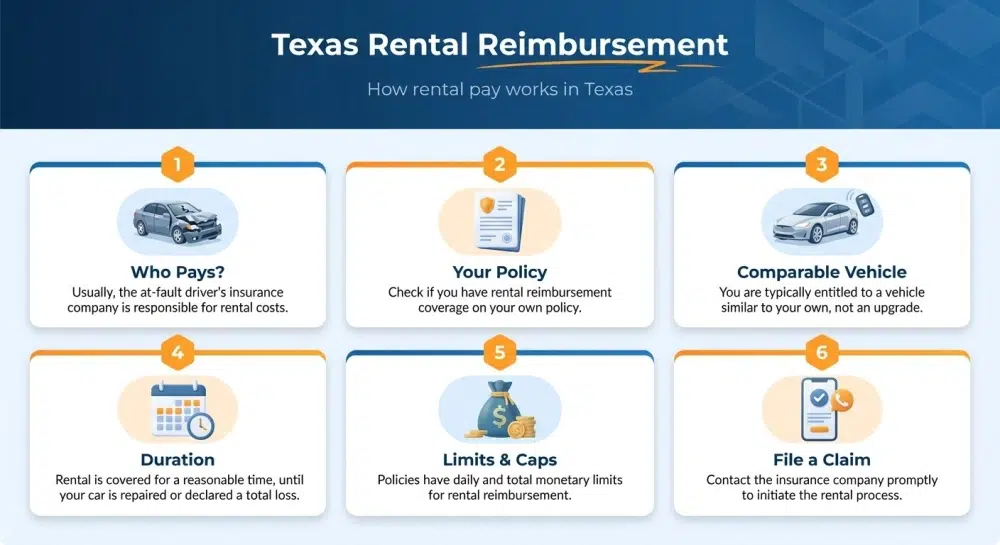
Several factors affect how this claim is handled:
- Duration: Rental reimbursement generally covers only the time reasonably necessary to repair the vehicle. Delays caused by the claimant, not the repair process, may not be covered.
- Vehicle class: An insurer is generally required to provide a rental equivalent to your own vehicle’s class, not a vehicle significantly inferior or superior.
- First-party vs. third-party claims: If the at-fault driver’s insurer accepts liability, rental costs should run against that carrier. If you file under your own collision coverage, your policy’s rental reimbursement endorsement governs. Many Texas policies cap rental reimbursement at a daily limit and a total maximum.
- Disputed liability: When fault is contested, rental reimbursement from the at-fault carrier may be delayed until liability is established. Your own carrier, if you carry rental reimbursement coverage, may provide rental support during this period.
The Texas Prompt Payment of Claims Act requires insurers to acknowledge, accept, or reject a claim within specified time frames and to pay accepted claims promptly. [3] Delays in processing a rental reimbursement claim that violate these deadlines may entitle a claimant to interest and attorney fees. You can learn more about how property damage payments work in the GoSuits resource on who pays for property damage in a car accident.
Total-Loss Valuation Disputes in Texas
A vehicle is typically declared a total loss when the cost to repair it equals or exceeds a threshold percentage of its actual cash value. Different insurers apply different thresholds; Texas does not mandate a single percentage. Once a vehicle is declared a total loss, the measure of compensation shifts from repair cost plus diminished value to the vehicle’s actual cash value immediately before the collision. [5]
Insurance companies use databases such as CCC One, Mitchell, and Audatex to generate actual cash value estimates. These tools use comparable vehicle sales in the relevant geographic market. Total-loss disputes frequently arise because:
- The insurer’s comparable vehicle search uses sales from markets that do not reflect local Dallas-area pricing.
- The database does not account for the vehicle’s specific trim level, aftermarket improvements, or documented maintenance history.
- The insurer uses wholesale values rather than retail replacement values.
If you disagree with a total-loss valuation, you have several options. You may present documentation of the vehicle’s actual condition and value, including recent maintenance records, prior appraisals, and comparables from local dealerships. Most policies contain an appraisal dispute process. You also retain the right to negotiate with the insurer and, if necessary, to pursue litigation.
One issue that frequently arises in total-loss situations is the interaction of a GAP insurance policy. If you owe more on your vehicle loan than the actual cash value the insurer pays, GAP coverage is designed to cover the difference. GAP is not property damage coverage; it is a separate financial product. If you financed your vehicle and it is declared a total loss, understanding your GAP policy terms is important.
Why Your Property Damage Claim Is Normally Settled Separately From Your Bodily Injury Claim
In Texas, property damage and bodily injury claims arising from the same collision are legally distinct. Settling one does not automatically resolve the other, but the order and manner in which you resolve them has real practical consequences.
Property damage is typically resolved relatively quickly after a collision. The repair or replacement of the vehicle is a time-sensitive need, and the scope of the damage is ascertainable early. Bodily injury claims, by contrast, may not be fully understood until medical treatment is complete and the full extent of injuries is known.
Signing a full and final release of all claims when resolving the property damage claim can be dangerous if the release language is broad enough to encompass personal injury. Always review the release language carefully before signing anything. A release that covers only vehicle damage, rental, and diminished value should not bar a later personal injury claim, but releases that use expansive “all claims” language can create problems.
The practical approach is to:
- Resolve the property damage claim, including diminished value and rental, as a separate negotiation.
- Confirm that any release signed is limited to property damage only.
- Allow the bodily injury claim to proceed on its own timeline, ideally after reaching maximum medical improvement.
- Engage personal injury lawyers before settling either claim if there is any dispute about liability or if your injuries are significant.
Personal injury lawyers who handle car accident claims understand how to coordinate these two tracks to protect the full value of your case. Dallas-area drivers who settle the property damage claim too quickly, or who sign broad releases, can inadvertently compromise their ability to recover for their injuries.
What Evidence Can Matter in a Diminished Value Claim?
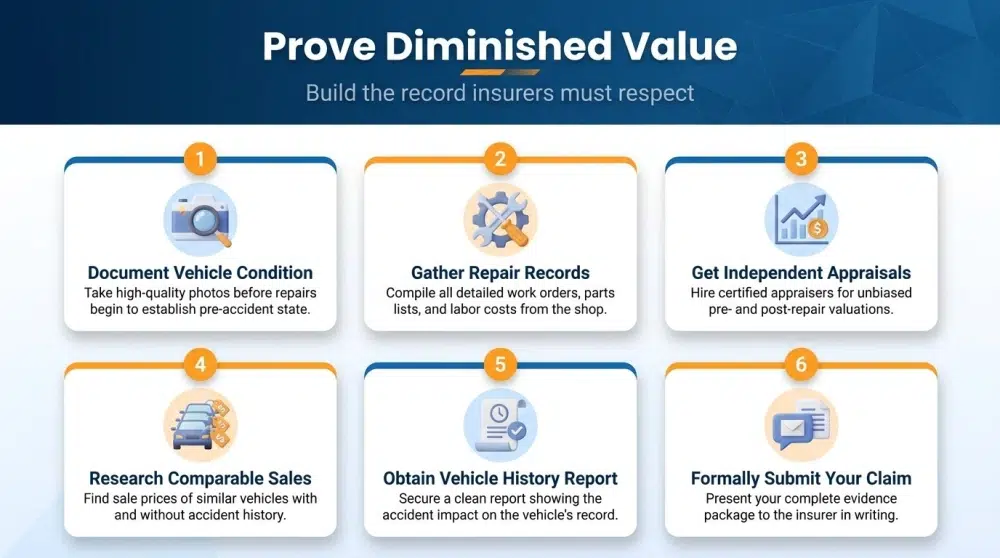
Supporting a diminished value claim requires organized, specific documentation. The following categories of evidence tend to be most significant:
- The accident report: Establishes that the collision occurred, identifies the at-fault party, and documents the scope of the crash. In Dallas County, reports are typically available through the Dallas County District Court or the investigating agency. [6]
- Repair records: Itemized repair invoices, parts lists, and shop documentation establish what was damaged and what was done. The nature and extent of structural repair directly affects diminished value.
- Pre-collision value documentation: Maintenance records, prior appraisals, vehicle history reports, and comparable market listings help establish what the vehicle was worth before the crash.
- Post-repair appraisal: An independent diminished value appraisal from a credentialed automotive appraiser is the centerpiece of a contested claim.
- Photographs: Pre-repair photographs document the extent of damage. Post-repair photographs can show the quality of repairs and any visible residual effects.
- Vehicle history reports: Services such as CARFAX or AutoCheck record accidents and can be used to demonstrate how accident history affects market perception and resale value.
- Insurer communications: Written correspondence, claim notes, and the insurer’s own valuation documents are useful in demonstrating how the insurer calculated its offer and whether it complied with legal obligations.
None of this evidence automatically proves your claim. Evidence of damage must be connected, through argument and testimony, to a specific dollar figure for the diminished value.

What Damages or Remedies May Be Available?
In a Texas property damage claim following an at-fault collision, the following categories of compensation may be available, depending on the facts:
- Cost of repairs: Labor, parts, and paint to restore the vehicle to its pre-collision condition.
- Inherent diminished value: The residual loss in market value after repairs, measured by a qualified appraisal.
- Loss of use / rental reimbursement: Reasonable cost of a substitute vehicle during the repair period.
- Actual cash value (total loss): In a total-loss situation, the fair market value of the vehicle immediately before the collision.
- Storage fees: Reasonable storage charges during the processing of the claim.
- Interest and attorney fees (prompt payment violations): If an insurer violates Texas’s Prompt Payment of Claims Act, the claimant may be entitled to 18% interest and attorney fees in addition to the claim amount. [3]
What is recoverable depends on the specific facts, the policy language, and whether the claim is pursued against the at-fault driver’s insurer or your own carrier. Recoverability is not guaranteed and must be established with competent evidence.
How Long Do I Have to Act?
The applicable limitation period depends on the nature of the claim and the parties involved:
- Negligence claim against the at-fault driver (property damage + personal injury): Texas Civil Practice & Remedies Code Section 16.003 establishes a two-year statute of limitations for personal injury and property damage claims. [7] This period generally runs from the date of the collision.
- First-party insurance contract claim: Claims against your own insurer may be governed by the statute of limitations in your policy or the general two-year period. Review your policy carefully.
- Prompt Payment of Claims Act: Insurers have specific deadlines within which to acknowledge, investigate, and pay or deny property damage claims. Violations of these deadlines can create additional remedies. [3]
The insurance company is using the 17c formula. Do I have to accept it?
No. The 17c formula is an insurer’s internal methodology. It is not required by Texas law or regulation. You may obtain an independent appraisal and present it as evidence of the actual inherent diminished value. If the insurer refuses to negotiate in good faith, additional legal remedies may be available.
Should I resolve my property damage before my injury claim?
Resolving the property damage claim separately is common and often practical because vehicle repairs are a pressing need. The critical concern is the release language. Sign only a release that is clearly limited to property damage. Do not sign any document releasing “all claims” until you have consulted an attorney, especially if you sustained injuries.
What if the at-fault driver has no insurance?
If the at-fault driver is uninsured, your uninsured motorist (UM) coverage, if you carry it, may cover property damage depending on your policy. Uninsured motorist property damage coverage is an optional endorsement in Texas. If you do not have it, you may need to sue the at-fault driver directly, though collecting a judgment from an uninsured driver can be difficult.
What Should I Do Next?
If your vehicle was damaged in a collision caused by another driver, taking the following steps can protect your claim:
- Document everything at the scene. Photograph all vehicles, any property damage, and the surrounding road conditions.
- Obtain the police report. Accident reports from the investigating agency or Dallas County authorities establish the basic facts of the collision.
- Notify your own insurance company. Even if the other driver is at fault, most policies require prompt notification of any collision.
- Keep your repair records. Request an itemized repair invoice and all documentation from the body shop, including any notes about structural repairs.
- Do not sign a broad release prematurely. Review all settlement documents before signing, especially if you were injured.
- Consider an independent appraisal. Before accepting the insurer’s diminished value figure, especially if the 17c formula was used, consult an independent automotive appraiser.
- Consult a personal injury attorney. Property damage, diminished value, rental reimbursement, and any bodily injury claim involve overlapping deadlines and strategic considerations. An attorney can help coordinate all of them.
Related Texas Personal Injury Resources
- Who Pays for Property Damage in a Car Accident?
- What to Do After a Car Accident in Dallas
- How Much Is My Car Accident Case Worth in Dallas?
- Texas Prompt Payment of Claims Act: Your Rights
- Dallas Injury Help Guide

Talk With a GoSuits Attorney
A property damage dispute involving diminished value, a rental reimbursement disagreement, or a total-loss valuation conflict can become complicated quickly. If you were also injured in the collision, coordinating the property damage and bodily injury tracks requires careful attention to release language, deadlines, and the overall strategy of your claim.
If you were injured in a Dallas crash, our Dallas personal injury lawyers can review the circumstances of your property damage claim and your injury claim and explain your options. Car accident lawyers on our team handle cases throughout Dallas County, Collin County, and surrounding areas.