Yes. Under California law, diminished value is a recognized element of property damage and is pursued as a claim separate from any bodily injury claim arising from the same collision. The two claims involve different evidence, different valuation methods, and different releases. Settling one does not automatically settle the other, but signing the wrong release form without reading it carefully can waive both. In Orange County and throughout Irvine, late-model vehicles and higher-trim SUVs commonly show measurable diminished value after a collision, making this an issue worth understanding before you accept any insurance payment.
Legal Snapshot
- Legal Topic: Diminished Value & Property Damage Claims in California
- Jurisdiction: California (Orange County / Irvine)
- Primary Legal Issue: Whether inherent diminished value is separately recoverable from the at-fault party’s insurer
- Governing Standard: Cal. Civil Code § 3333 (measure of tort damages); “amount which will compensate for all the detriment proximately caused”
- Claim Types Covered: Repair cost, inherent diminished value, loss of use / rental, total loss fair market value
- Key Caution: A property damage release must be reviewed before signing to confirm it does not release bodily injury rights
- Date Legal Authority Last Reviewed: 2025
Understanding the Three Separate Property Claims
When a negligent driver damages your vehicle in California, three distinct property-related claims can arise from the same incident. They are separate not just conceptually but often procedurally handled by different departments inside the same insurance company, documented differently, and resolved at different times.
| Claim Type | What It Covers | How It Is Measured | Who Pays |
|---|---|---|---|
| Repair Cost | Restoring the vehicle to pre-loss mechanical and cosmetic condition | Repair estimate from licensed shop; often negotiated against insurer’s assessment | At-fault carrier (third-party claim) or your collision coverage |
| Inherent Diminished Value | The residual reduction in market value that persists even after complete repairs | Appraisal comparing pre-loss value to post-repair market value using comparable sales | At-fault carrier (third-party claim); generally not covered by your own collision policy unless policy expressly provides |
| Loss of Use / Rental | Cost of substitute transportation while the vehicle is in the shop | Actual rental cost or standard daily rate for a comparable vehicle, for a reasonable repair period | At-fault carrier; your rental-reimbursement endorsement if pursuing under your own policy |
All three are independent from any bodily injury claim. Personal injury lawyers working on Irvine cases routinely remind clients that the property adjuster and the injury adjuster may represent the same insurer but operate under separate claim files. Settling one file does not close the other unless a release says it does.
What Is Inherent Diminished Value?
Even after a collision repair is completed perfectly, a vehicle that has a recorded accident history typically commands less money on the open market than an identical vehicle with a clean history. That reduction in resale value is called inherent diminished value. It is not caused by a poor repair; it is caused by buyer and dealer skepticism about a vehicle that has been in a collision.
California’s general tort damages statute Civil Code § 3333, provides that the measure of damages for a wrong not arising from contract is “the amount which will compensate for all the detriment proximately caused thereby.” [1] Courts applying this principle have recognized that a vehicle owner whose car loses market value due to another driver’s negligence suffers detriment that is compensable. The detriment is the gap between what the vehicle would have been worth without the accident history and what it is actually worth with that history.
Two other forms of diminished value repair-related and claim-related, also exist conceptually, but inherent diminished value is the most commonly pursued because it exists even after a proper repair.
How a Third-Party Diminished Value Claim Works in California
Inherent diminished value is generally pursued as a third-party claim against the at-fault driver’s liability insurer, not under your own collision coverage. Your own first-party collision policy typically does not include a diminished value benefit unless the policy expressly provides for it. Reviewing your declarations page and endorsements is the starting point for knowing which avenue is available. [2]
A third-party diminished value claim works as follows:
- You establish that the other driver was at fault and that the collision caused the vehicle damage.
- You document the vehicle’s pre-loss fair market value using condition, mileage, and comparable sales data.
- You obtain a diminished value appraisal from a qualified automotive appraiser who compares pre-loss value to post-repair market value, referencing actual comparable sales in the local market.
- You submit the appraisal to the at-fault carrier as part of your property damage demand.
- If the insurer disputes the amount or denies the claim, negotiation, appraisal arbitration, or civil litigation may follow.
California does not cap diminished value recovery by statute, but the recovery must reflect actual market loss, not a formula applied in a vacuum. Appraisers typically research actual auction and retail sales of comparable vehicles with and without accident histories to measure the real-world impact.
Scenario: A driver is rear-ended while stopped in heavy I-405 traffic near the Irvine/Culver interchange. The three-year-old mid-size SUV sustains significant rear-end damage. Repairs are completed properly and cost $9,800.
Diminished value question: Before the crash, comparable vehicles with no accident history were selling for approximately $38,000 in the Orange County market. After repairs, vehicles with a similar recorded accident even a properly repaired one were selling for roughly $34,500. The inherent diminished value in this scenario is approximately $3,500.
This is a hypothetical illustration only and does not represent a GoSuits case result. Actual diminished value varies by vehicle, condition, repair quality, and local market conditions.
Documenting Diminished Value: Appraisal and Comparable Sales
Insurance adjusters routinely start with their own internal formulas to calculate diminished value. These formulas sometimes produce low figures that do not reflect actual Orange County market conditions. An independent appraisal based on verifiable comparable sales carries more weight in negotiation and, if needed, in litigation.
Key documentation elements include:
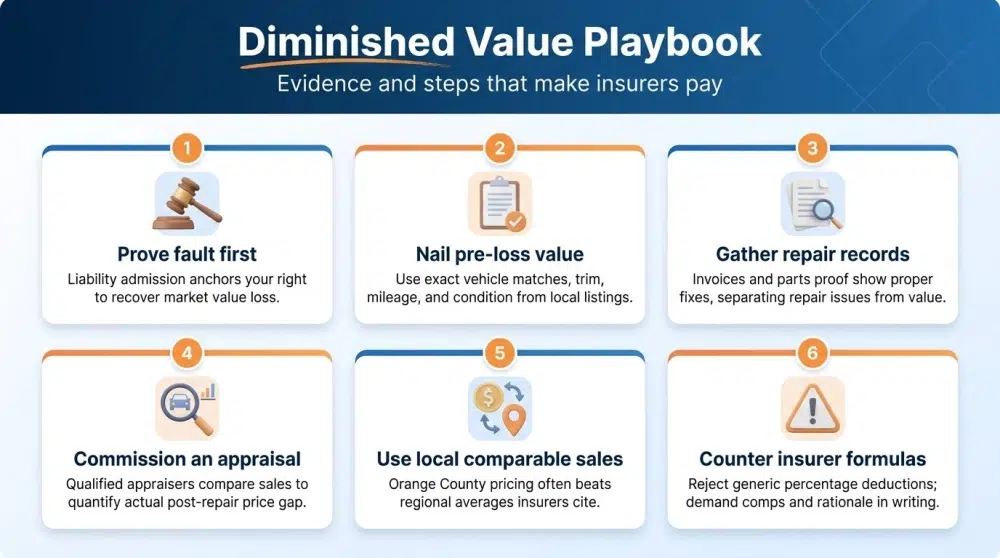
- Pre-loss vehicle valuation: NADA, Kelley Blue Book, and actual comparable dealer and private-party listings for your specific year, make, model, trim, and mileage in the local market before the accident.
- Post-repair market evidence: Comparable listings and auction data for the same vehicle type with a disclosed accident history, showing the price differential buyers and dealers apply.
- Vehicle condition at time of loss: Maintenance records, prior accident disclosures, and condition photos all affect starting value and must be addressed in the appraisal.
- Repair documentation: A complete repair invoice showing all replaced or repaired panels and components, proof of OEM or certified parts, and alignment/structural verification.
- Appraisal report: A written report from a qualified automotive appraiser explaining methodology, the comparable sales relied upon, and a stated diminished value figure with supporting rationale.
Loss of Use and Rental Reimbursement
California law recognizes that a vehicle owner is entitled to the reasonable cost of substitute transportation while a damaged vehicle is being repaired. This is sometimes called a loss of use claim. When the at-fault carrier accepts liability, it is typically required to provide a rental vehicle or reimburse reasonable rental costs for a reasonable repair period. [3]
Several practical points matter:
- Comparable class vehicle: You are generally entitled to a vehicle of similar size and type, not necessarily the lowest available rental rate. If you drive a full-size SUV, reimbursement for a compact car at a lower rate may be contested.
- Reasonable repair period: Rental reimbursement typically runs from when your vehicle enters the shop to when repairs are reasonably completed. Parts delays caused by the insurer’s choice of supplier or supply chain disruptions can extend this period, but disputes arise about what constitutes a reasonable timeline.
- Total loss scenarios: If the vehicle is declared a total loss, rental typically continues through a reasonable period after settlement, giving you time to locate and purchase a replacement vehicle. The exact number of days is often subject to negotiation or dispute.
- First-party rental endorsement: If you are pursuing through your own collision coverage, your rental reimbursement limit is capped by your policy endorsement. Check your declarations page for the daily and aggregate limit.
If an adjuster cuts off rental reimbursement prematurely or provides reimbursement at a rate that does not cover a comparable vehicle, that is a point for negotiation or, if bad faith is involved, a matter to document carefully.
Total Loss Valuation and Fair Market Value
A vehicle gets branded a total loss when the repair estimate, added to whatever the salvage is worth, hits or exceeds the car’s actual cash value. That’s the same thing as fair market value, just different words. California, kind of surprisingly, doesn’t lock in a single statutory percentage that triggers a total loss. The insurer makes that call based on the policy, but the California Insurance Code and Department of Insurance rules control how the whole thing has to play out. [4]
Fair Market Value Standard
Totaled car, big question: what do they actually owe you? Pre-loss fair market value. Meaning what a willing buyer would pay a willing seller in the local market, both acting with reasonable knowledge and neither one being pressured. The insurer’s number usually comes out of a valuation service like CCC ONE or Audatex, which lean on regional comparable-vehicle data. Fine in theory. In practice, though, if those comparables are pulled from lower-demand regions instead of the actual Orange County market, the ACV they hand you can be low. Sometimes noticeably low.
You have the right to dispute the total loss valuation by providing:
- Dealer listings for comparable vehicles in Orange County, Riverside County, and the greater LA market.
- Private-party asking prices on platforms like AutoTrader, Cars.com, and Craigslist for the same year, make, model, trim, mileage, and condition range.
- Documentation of any recent improvements, low mileage, extended warranties, or aftermarket upgrades that affect value.
- An independent appraisal or a demand letter citing specific comparable listings.
Sales Tax and Registration Reimbursement
So you cash the total loss settlement and head out to buy something to actually drive. Sales tax is going to hit you on that purchase, no way around it. But California law requires the at-fault carrier’s total loss payment to include applicable sales tax, which basically means you shouldn’t be out of pocket just to make yourself whole. [5] California regs go a little further too. Reasonable registration fees, and the fees for transferring ownership of the replacement vehicle, also have to be reimbursed.
These amounts are sometimes omitted from initial settlement offers or require a specific request. Review any total loss settlement offer to confirm it includes tax and transfer fees, not just the ACV.
Owner-Retention (Keeping the Salvage)
In some total loss situations, the vehicle owner may wish to retain the salvage, perhaps because the vehicle has sentimental value, is repairable at lower-than-estimated cost, or has valuable parts. If you retain the salvage, the insurer deducts the salvage value from the settlement. You are then responsible for obtaining a salvage title from the California DMV. [6]
Retaining salvage can make sense in narrow circumstances but typically requires careful evaluation of the cost to repair, the ability to insure a rebuilt title vehicle, and the impact on resale value. A vehicle with a rebuilt title may face additional scrutiny during any future insurance claim.
The Property Damage Release: Why Reading It Carefully Matters
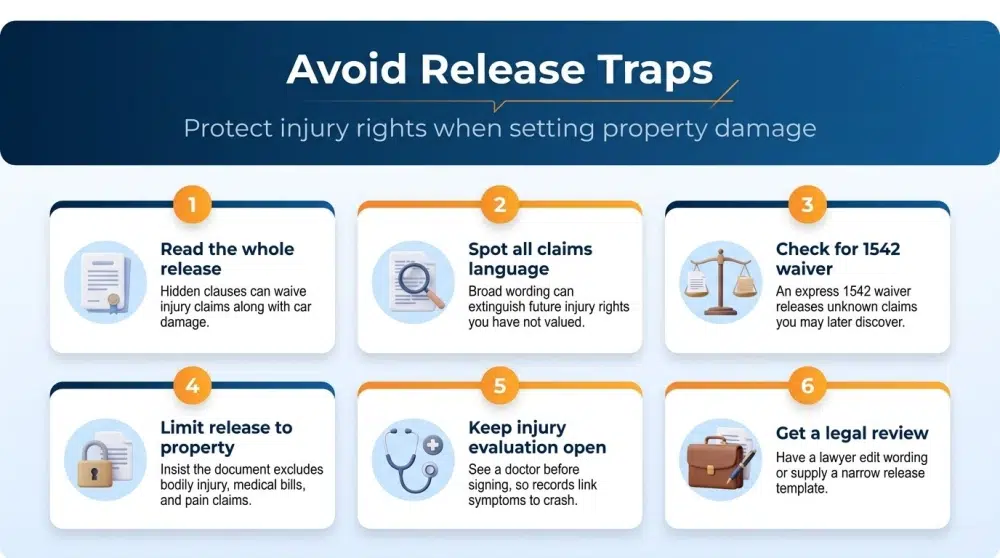
This is one of the most consequential points in this article. When an insurance company pays out a property damage claim, it will ask you to sign a release. Some releases are narrow and cover only the vehicle damage payment. Others are written broadly and purport to release all claims arising from the accident, including any bodily injury claim you have not yet resolved or even fully understood.
Under California law, a release of known or unknown claims can extinguish a valid bodily injury claim if it is signed knowingly. Civil Code § 1542 provides a specific protection: a general release does not extend to claims that the releasing party does not know or suspect to exist at the time of the release, unless the release expressly waives those rights under § 1542. [7]
In practice, insurers frequently include language that expressly waives Civil Code § 1542 rights. If you sign a release with that language before you have been evaluated by a physician, before your injuries are fully diagnosed, or before you understand the scope of your bodily injury claim, you may forfeit rights to compensation that you did not yet know you had.
Key practices before signing any release:
- Read the entire document, not just the payment amount on the check.
- Look for the phrase “all claims” or language releasing claims “arising out of the incident,” which is broader than a vehicle damage release.
- Look for an express waiver of Civil Code § 1542.
- Confirm that the release covers only property damage and not bodily injury.
- If you have any current or developing symptoms, consult a physician before settling the property claim.
- Consider consulting a personal injury attorney before signing any release that uses broad language.
Insurers have an interest in closing property claims quickly. A rapid property payment is not inherently problematic, but the accompanying release language requires careful attention. Separating your property settlement from your injury evaluation preserves your options.
California’s Liability and Fault Framework
California is a fault-based state for auto insurance claims. The driver whose negligence caused the collision is financially responsible for the resulting damages, including property damage. The at-fault driver’s liability policy covers property damage up to the policy’s property damage liability limit. [8]
California runs on pure comparative fault. What that means, in plain terms: if you’re partly to blame for the crash, whatever you recover gets trimmed by your share. Picture a lane-changer on SR-55 near Irvine clipping you while you happen to be nudging a few miles over the limit. A factfinder might land on something like 85% on the lane-changer, 15% on you. And your property damage recovery? Reduced by that same 15%. [9]
For property damage claims, comparative fault analysis often centers on the collision mechanics who had right of way, whether turn signals were used, what speed was involved, and what each driver’s actions contributed to the impact. Insurers conduct their own liability investigations, and their findings are not final. You have the right to dispute a partial fault finding with evidence.
Personal injury lawyers assisting Irvine and Orange County clients regularly deal with disputed liability on SR-55, I-405, SR-73, and surface streets around the Irvine Spectrum. Evidence such as surveillance footage from adjacent businesses, dashcam recordings, and cell phone records can all bear on who bore the greater share of responsibility.
How Property Claims Interact with Your Bodily Injury Claim
Property damage and bodily injury arise from the same collision, but they are handled separately and should be resolved in a deliberate order. Rushing to close the property damage file can, under some circumstances, complicate or foreclose the injury file particularly if a broad release is involved.
A few practical interaction points:
- Timing of medical evaluation: Some injuries, soft tissue damage, concussion, disc injuries become apparent days after a crash. Settling property before a medical evaluation is complete can create gaps in the record that adjusters later use to argue the injuries were minor or unrelated.
- Policy limit considerations: When property damage absorbs a significant portion of a low-limit policy, less may remain for bodily injury. Understanding the at-fault driver’s total policy limits before settling property damage helps with overall claim strategy.
- Subrogation: If your own insurance pays for property damage and you later recover from the at-fault carrier, your insurer may have a subrogation right to be reimbursed from your recovery. Understanding these rights before settling helps avoid disputes about who gets paid first.
- Evidence preservation: Photographs of the vehicle before and after repair, the complete repair file, and the adjuster’s inspection notes are all useful in bodily injury litigation. Request copies before the vehicle is repaired and before documents are archived.
What to Do After a Crash in Irvine or Orange County
The following steps apply whether you are on I-405, the SR-73 Toll Road, Newport Center Drive, or anywhere in Orange County. Acting promptly protects both your property and bodily injury options.
- Call 911 if anyone is injured, and ensure a police or CHP report is generated. The report number will be needed for all claim filings.
- Photograph all vehicle positions, damage, skid marks, signage, and nearby cameras before vehicles are moved.
- Collect the other driver’s insurance information, driver’s license, registration, and contact details.
- Seek medical evaluation the same day or the next morning, even if you feel relatively okay. Create a contemporaneous medical record.
- Report the collision to your own insurer as required by your policy, but understand you are not required to give a recorded statement to the other driver’s insurer without consulting counsel first.
- Retain all repair estimates, invoices, photographs, and rental receipts.
- Do not sign any release without reading it and, when in doubt, having it reviewed.
- If the vehicle is declared a total loss, request the insurer’s comparable vehicles used for valuation so you can assess whether they reflect the local market.
Orange County has specific local resources worth noting: the California Highway Patrol handles freeway collisions on I-405, SR-55, and SR-73, and collision reports can be requested through the CHP statewide records process. [10] For city-street collisions within Irvine, the Irvine Police Department maintains its own records. [11]
Statute of Limitations and Key Deadlines
Property damage claims in California have their own limitations period. Under California Code of Civil Procedure § 338(c), an action for injury to personal property (which includes vehicle damage) must generally be filed within three years of the date of loss. [12] This is longer than the two-year period for personal injury claims under Code of Civil Procedure § 335.1. [13]
However, several practical deadlines arrive sooner:
- Insurer notice requirements: Your own policy likely requires prompt notice of a loss. Review your policy for specific deadlines, which can be as short as thirty days in some contexts.
- Preserve rental records: Rental receipts should be submitted promptly; delayed submission can result in disputed reimbursement.
- Diminished value demand: There is no fixed internal deadline for submitting a diminished value claim, but earlier submission before the vehicle’s post-repair market position changes supports a stronger comparable-sales analysis.
- Total loss title transfer: If the insurer takes the salvage, the title transfer process must follow California DMV procedures. Delays can affect registration and replacement vehicle timelines.
Insurance Coverage Layers That Affect Property Claims
Multiple coverage layers may be available depending on the circumstances of the collision. Understanding which layer applies in what order is part of effective claim management.
| Coverage Type | Source | Applies When | Diminished Value? |
|---|---|---|---|
| Third-Party Property Damage Liability | At-fault driver’s policy | Other driver is at fault; their insurer pays your damage up to their limit | Yes, generally recoverable |
| First-Party Collision Coverage | Your own policy | You use your own collision to repair quickly, regardless of fault; subject to deductible | Typically not covered unless policy expressly provides |
| Uninsured / Underinsured Motorist Property Damage (UMPD) | Your own policy (if purchased) | At-fault driver has no insurance or insufficient coverage | Coverage terms vary; review policy |
| Rental Reimbursement Endorsement | Your own policy (if purchased) | Vehicle is in the shop for covered repairs | N/A (covers rental, not diminished value) |
California law requires insurers to handle claims in good faith and to promptly investigate, process, and pay valid claims. The California Department of Insurance provides a consumer complaint process if you believe your property damage claim is being handled unfairly or unreasonably delayed. [15]
Personal injury lawyers who handle car accident cases in Irvine can help identify all available coverage and coordinate claims across multiple layers. Navigating the interaction between third-party liability, your own collision coverage, and any UM/UIM coverage can directly affect what you recover.
GoSuits – Irvine Personal Injury Attorneys
A property damage claim involves real money, the repair cost, the residual loss in your vehicle’s market value, the rental you paid out of pocket, and potentially thousands of dollars in total loss underpayment. These amounts matter, and the releases you sign have consequences that can extend beyond the vehicle.
If you were injured in the same collision, the interaction between the property file and the bodily injury file adds another layer of complexity. Our Irvine personal injury lawyers work with clients across Orange County to evaluate both the property and injury dimensions of a collision claim, helping ensure that no claim is inadvertently waived and that all available evidence is preserved.
If you have questions about a diminished value claim, a total loss valuation dispute, or the scope of a release you have been asked to sign, a free consultation can provide clarity before you make decisions you cannot undo. Schedule a free consultation with the GoSuits Irvine team.
Questions About Your Property Damage or Injury Claim?
Understanding how diminished value, loss of use, and a property release interact with your bodily injury rights can change what you recover. A free consultation with a GoSuits Irvine personal injury attorney can clarify your options before you make decisions you cannot reverse.
Schedule a Free Consultation Or call us 24/7: (844) 467-8487
Related California Personal Injury Resources
References & Legal Authorities
- Cal. Civil Code § 3333 – Measure of Damages for Wrongs Not Arising From Contract – California Legislature
- California Auto Insurance Consumer Guide – California Department of Insurance
- Cal. Civil Code § 3333 – Loss of Use as an Element of Detriment Proximately Caused – California Legislature
- Cal. Insurance Code § 560 – Total Loss Definitions – California Legislature
- Total Loss Settlement Requirements Including Sales Tax – California Department of Insurance
- Salvage Vehicles – California Department of Motor Vehicles
- Cal. Civil Code § 1542 – General Release Does Not Extend to Unknown Claims – California Legislature
- Cal. Vehicle Code § 16000 et seq. – Financial Responsibility Requirements – California Legislature
- Cal. Civil Code § 1714 – Negligence and Comparative Fault – California Legislature
- Collision Report Requests – California Highway Patrol
- Police Department Records – City of Irvine Official Website
- Cal. Code of Civil Procedure § 338(c) – Three-Year Limitation for Injury to Personal Property – California Legislature
- Cal. Code of Civil Procedure § 335.1 – Two-Year Limitation for Personal Injury – California Legislature
- Cal. Government Code § 911.2 – Six-Month Deadline for Government Tort Claims – California Legislature
- Consumer Help & Insurance Complaints – California Department of Insurance