California government agencies are liable for injuries caused by dangerous conditions on public property, but only when a plaintiff satisfies four distinct elements set out in Government Code section 835. Two defenses – design immunity and the trivial defect rule – eliminate the majority of these claims before trial. Getting a dangerous-condition case right requires understanding each element, recognizing how these defenses work, and acting quickly to preserve evidence and meet strict filing deadlines.
Legal Snapshot
- Legal Topic: Dangerous Condition of Public Property – Government Tort Liability
- Case Stage: Pre-litigation / Litigation
- Primary Legal Issue: Government agency liability for road defects and dangerous public property conditions
- Primary Authority: California Government Code §§ 830–840.6 (Division 3.6, Part 2, Chapter 2)
- Date Legal Authority Last Reviewed: July 2025
- Jurisdiction: California (statewide; Orange County / Irvine)
What Is a Dangerous Condition of Public Property?
Under California Government Code section 835, a “dangerous condition” is a physical defect in public property that creates a reasonably foreseeable risk of the kind of injury that actually occurred. Common examples include uneven pavement at a crosswalk, eroded shoulders on a county road, a missing guardrail on a curve, malfunctioning traffic signals at a busy intersection, or a drainage channel that channels water across a travel lane.
The concept does not extend to mere operational choices, such as where to place a stop sign, that do not result in a physical defect in the property itself. The condition must be one of the property, not simply a risk that exists in the surrounding environment.
In Orange County, high-traffic corridors on SR-55, SR-73, SR-133, and I-405 pass through multiple agency jurisdictions, which matters because the responsible agency changes at the boundary of each jurisdiction. Caltrans owns and maintains state highways; the county or municipality is responsible for its own roads. Identifying the correct defendant is a threshold task in every public-property injury case.
What Does California Law Require? The Four Elements of Section 835
Government Code section 835 – enacted in 1963 – states that a public entity is liable for injury caused by a dangerous condition of its property when the plaintiff establishes all of the following.[1]
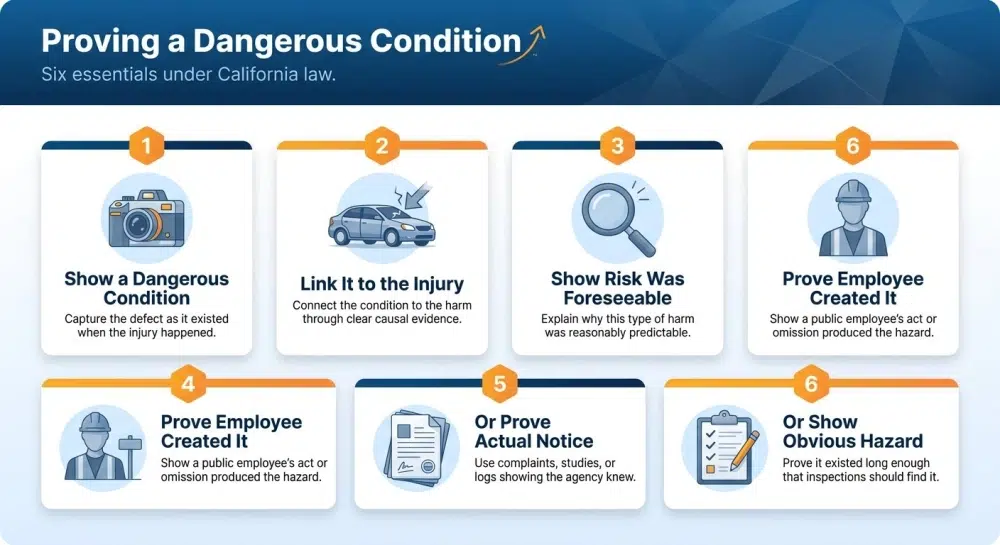
Element 1: A Dangerous Condition Existed at the Time of Injury
The property must have been in a dangerous condition at the moment of the injury, not merely at some earlier or later time. Evidence commonly includes photographs taken at the scene, prior incident reports, and expert engineering analysis of the defect. Because road surfaces and intersection geometry can change after an accident, through repairs, repaving, or signal retiming, documenting the condition promptly is critical. A traffic engineer or civil engineer retained early in the case can photograph, measure, and test the condition before it is altered.
Element 2: Proximate Causation
The dangerous condition must be the proximate cause of the injury. A plaintiff who trips on a pothole but who was also looking at a phone when they fell may face an argument that their own inattention was the superseding cause of their injury. California follows a pure comparative fault system, so the jury can apportion fault between the dangerous condition, the plaintiff, third parties, and the agency.
Element 3: A Reasonably Foreseeable Risk of the Kind of Injury Incurred
The type of harm that occurred must have been reasonably foreseeable from the dangerous condition. A road surface that routinely floods during rain foreseeably causes vehicles to hydroplane. A guardrail gap along an embankment foreseeably causes a vehicle to leave the road. A signal timing error that allows opposing traffic to receive simultaneous green lights foreseeably causes intersection collisions. The foreseeability inquiry focuses on the category of risk, not on the specific plaintiff.
Element 4: Notice or Employee Negligence
The plaintiff must establish one of two alternatives under section 835:[1]
- Subdivision (a) – Employee negligence: A negligent or wrongful act or omission of a public employee within the scope of employment created the dangerous condition.
- Subdivision (b) – Notice: The public entity had actual or constructive notice of the dangerous condition under section 835.2 a sufficient time prior to the injury to have taken measures to protect against it.
Notice is the battleground in most dangerous-condition cases. Actual notice under section 835.2(a) exists when the agency had actual knowledge of the condition and knew or should have known of its dangerous character.[2] Constructive notice under section 835.2(b) requires the plaintiff to show that the condition existed long enough and was sufficiently obvious that the agency, exercising due care, should have discovered it through a reasonable inspection system.[2]
Prior written complaints submitted to a city or county, service requests logged in an agency maintenance database, and prior crash reports from the same location are powerful notice evidence. A signal timing study completed by Caltrans that flagged an intersection as high-risk years before a collision creates a strong actual-notice argument. A pothole that appears in satellite imagery for an extended period, or a guardrail gap that appears in agency inspection photographs, supports constructive notice.
Two Defenses That End Most Dangerous-Condition Claims
Design Immunity Under Government Code Section 830.6
Design immunity is the most powerful defense available to a public entity in a dangerous-condition case. Under Government Code section 830.6, a public entity and its employees are immune from liability for injury caused by the plan or design of a construction or improvement to public property when that plan or design was approved in advance by the legislative body or by another body or employee exercising discretionary authority – provided the trial or appellate court determines that substantial evidence supports the reasonableness of the approved plan or design.[3]
The immunity has three components, each of which the public entity bears the burden of establishing:
- Prior approval: A legislative body, a board, or a delegated employee with discretionary authority approved the plan or design before construction began, not merely acknowledged the project after the fact.
- Discretionary exercise: The approval reflected a policy-level or technical judgment, not a purely ministerial act.
- Substantial evidence: The court must determine that there is any substantial evidence upon which a reasonable public employee or legislative body could have adopted the plan, design, or applicable standards.
Design immunity is not permanent. Section 830.6 also provides that immunity survives a reasonable period after the agency receives notice that the constructed property no longer conforms to a plan or design that could reasonably be approved – allowing time to obtain funding and carry out remedial work. If the entity cannot remedy the condition due to practical impossibility or insufficient funds, immunity continues only while the entity reasonably attempts to provide adequate warning of the nonconforming condition.[3]
In practice, overcoming design immunity requires showing that the agency received notice that the design had become dangerous, perhaps through a history of collisions at the intersection, a traffic engineering study recommending changes, or a signal timing analysis identifying a hazard and then failed to act within a reasonable period or to warn the public adequately.
The Trivial Defect Rule Under Government Code Section 830.2
A condition is not a “dangerous condition” within the meaning of the statutory scheme if the trial or appellate court determines as a matter of law viewing the evidence most favorably to the plaintiff that the risk created by the condition was of such a minor, trivial, or insignificant nature in view of the surrounding circumstances that no reasonable person would conclude it created a substantial risk of injury when the property was used with due care in a reasonably foreseeable manner.[4]
This rule is most commonly invoked in sidewalk cases where the vertical displacement of a concrete panel is small, in pothole cases where the depression is shallow, or in pavement crack cases where the crack is narrow and the surface is otherwise sound. Courts consider not just the size of the defect but the surrounding circumstances the location of the defect relative to pedestrian or vehicle paths, lighting conditions, the presence of warnings, and the history of prior incidents at that location.
A plaintiff who can demonstrate prior falls or crashes at the same location undermines the trivial-defect argument: a condition that has repeatedly caused harm is, by definition, not trivially risky. Expert testimony quantifying defect dimensions and comparing them to industry standards for safe pavement design also helps rebut the defense.
How These Rules Apply in Practice
Hypothetical example – intersection collision: A driver is stopped at a traffic signal on Jamboree Road at a major intersection in Irvine. The signal cycles but does not clear opposing traffic before releasing perpendicular traffic. A cross-traffic driver enters the intersection on what they believe is a green signal and strikes the first driver’s vehicle. The injured driver seeks to hold the City of Irvine liable.
Break it down. Signal timing goes bad, that’s a condition of public property. Documented repeat malfunctions plus prior complaints to the City equals notice, which handles element 4. Causation’s there. The kind of accident that follows from a broken signal is exactly the kind of accident that’s foreseeable, so element 3 is pretty straightforward too. The City’s likely play is design immunity, pointing back to whenever traffic engineering originally approved the timing plan. Reasonable argument on paper. But if later complaints put them on notice that the timing had turned dangerous and they didn’t move within a reasonable window, that immunity can be overcome.
Here’s another one. A motorcyclist on SR-73 near Newport Beach swerves partway onto the shoulder to get around debris, the edge crumbles, and down goes the bike. SR-73 is Caltrans territory. If prior inspection records already noted the shoulder was falling apart and no repair ever got scheduled, constructive notice is pretty much locked in. And if Caltrans pulls out an approved maintenance plan showing the shoulder was up to design standards at the last resurfacing, now you’ve got a design immunity fight on your hands.
These hypotheticals illustrate why the same facts can cut in opposite directions depending on the available records. Prior crash data, traffic study records, inspection logs, and maintenance work orders can either make or break a dangerous-condition claim.
Here’s the unglamorous part. Personal injury lawyers working dangerous-condition cases in the Irvine area basically live inside the California Public Records Act early on, pulling Caltrans files, then chasing down Orange County agencies for collision databases, signal timing records, maintenance logs, whatever they’ll turn over. Boring on paper. But that record-gathering usually decides whether you survive summary judgment on the notice and design-immunity questions, or whether the case dies right there.
What Evidence Can Matter?
Dangerous-condition cases are evidence-intensive. The categories below are among the most significant.

Collision History Records
Nothing beats prior crashes at the same spot. Especially when those earlier wrecks involved the same maneuver, the same intersection geometry, the same failing piece of pavement. That’s the strongest notice evidence you’re going to find. CHP keeps collision data. Cities run their own traffic engineering databases. County public works keeps records too. You can pull most of it through the California Public Records Act under Government Code § 6250 and following, and then hit the rest through discovery once the case is actually filed.
Traffic Engineering Studies and Signal Timing Records
Signal timing plans. Speed studies. Gap studies. Warrant analyses. Any of these, done by or for Caltrans or a local agency, can show that engineers had already flagged a safety problem before the crash. And that’s huge. A signal timing report that recommended a protected left-turn phase nobody bothered to install, or a gap study showing the existing crossing was unsafe, essentially hands you notice and design-inadequacy proof in the same file.
Maintenance Logs and Inspection Records
Maintenance logs tell a story. They show when the road was last inspected, what problems the crew noted, what got fixed, and what got kicked down the road. Say a pothole was flagged six months before your client hit it, but somebody stamped it low priority and moved on. That’s constructive notice, plain and simple. And if there’s no maintenance log at all, no inspection ever done? Now you’re arguing the agency didn’t even have a reasonable inspection system in place, which is its own separate hit under section 835.2(b).
Photographs, Video, and Mapping Data
Get photos immediately. Time-stamped ones, before the road gets repaired. That window closes fast. Satellite imagery services keep historical archives, which can be gold for showing when a defect first appeared. Dashcam footage counts too, and so does surveillance video from nearby businesses, either might have captured the wreck itself or the road conditions right before it. For hard numbers on the defect, you bring in a civil engineer to run a formal photogrammetric survey.
Expert Testimony
Traffic engineers, civil engineers, human factors engineers, and accident reconstruction specialists provide the analytical framework courts use to evaluate dangerous-condition claims. An expert who can testify that the intersection geometry or signal timing deviated from MUTCD standards or Caltrans Highway Design Manual standards, and that this deviation created a foreseeable hazard, provides the scientific foundation a plaintiff needs to rebut design immunity and support foreseeability.
Because Caltrans and local agencies frequently retain their own engineering experts to support design-immunity arguments, retaining qualified expert witnesses early, before agency records disappear or are overwritten, is one of the most important strategic decisions in these cases.
What Damages May Be Available?
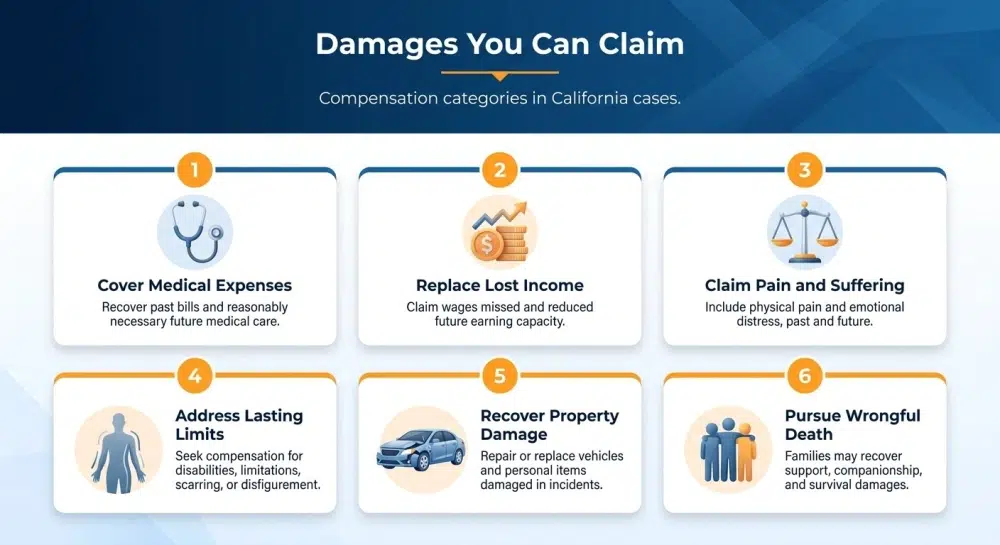
A plaintiff who successfully establishes liability against a public entity for a dangerous condition of public property may recover the same categories of compensatory damages available in any California personal injury case. Recoverability depends on the applicable law, the facts of each case, and the evidence presented.
- Medical expenses: Past medical bills and the present value of reasonably necessary future medical care.
- Lost income: Wages, salary, and other compensation lost as a result of the injury, including diminished future earning capacity for injuries that affect a plaintiff’s ability to work.
- Pain and suffering: Compensation for physical pain and emotional distress, both past and future.
- Physical impairment and disfigurement: Compensation for lasting limitations on physical function and for scarring or other permanent physical changes.
- Property damage: Compensation for damage to a vehicle or other personal property.
- Wrongful death damages: Where a dangerous condition causes a fatality, surviving family members may pursue wrongful death and survival claims under California Code of Civil Procedure sections 377.60 and 377.30. Recoverable elements include pecuniary loss, loss of financial support, loss of companionship, and the decedent’s pre-death pain and suffering.
Government Code section 818 expressly prohibits punitive damages against public entities in California. However, a public entity may face enhanced exposure through the statutory scheme if the injury resulted from employee misconduct for which the entity is vicariously liable.
Serious crash injuries in Orange County, including traumatic brain injury, spinal cord injury, and orthopedic fractures from intersection collisions or highway shoulder failures, can result in damages that far exceed minimum insurance policy limits. Because the defendant is a government entity with fiscal resources, settlement potential in documented dangerous-condition cases can be significant when notice and causation are clearly established. No specific recovery amount or outcome can be promised, as results depend entirely on the facts and law applicable to each case.
Personal injury lawyers on the Irvine team at GoSuits handle cases involving slip and fall accidents on dangerous public walkways, which share important structural similarities with road-defect claims.
What If the Agency Disputes Liability?
Public entities routinely contest dangerous-condition claims at every stage. Common agency arguments include:
- Design immunity: The agency will point to approved engineering plans and argue that the design met applicable standards when constructed.
- No notice: The agency will produce maintenance logs and inspection records showing it had no actual or constructive knowledge of the specific defect.
- Trivial defect: The agency will argue that the defect was too minor to create a substantial risk under section 830.2.
- Plaintiff’s comparative fault: The agency will argue that the plaintiff was speeding, distracted, or otherwise contributed to the accident.
- Causation: The agency may argue that the defect was not the proximate cause of the injury, or that an intervening act broke the chain of causation.
Each of these defenses is fact-specific. Whether design immunity applies depends on the specific approval documents in the agency’s records. Whether notice is established depends on the collision history and inspection records the plaintiff can obtain. Whether the defect is trivial depends on its measured dimensions and the surrounding circumstances. Litigation in these cases typically involves significant pre-trial discovery, expert battles, and motions for summary judgment.
How Long Do I Have to Act? The Government Claims Act Deadline
Before filing a lawsuit against a California government entity for personal injury, a claimant must first present a written tort claim directly to the entity. This requirement is imposed by the California Government Claims Act (Government Code § 900 et seq.).
Under Government Code section 911.2(a), a claim relating to a cause of action for death or personal injury must be presented to the public entity not later than six months after the accrual of the cause of action.[5] A claim relating to other causes of action (such as property damage alone) must be presented within one year.
Missing this six-month deadline is typically fatal to the claim. If a claim is not timely presented and the entity rejects a late-claim application, the plaintiff generally has no legal remedy regardless of the merits of the underlying case. Courts have interpreted “accrual” strictly in most circumstances, it begins when the cause of action arises, which is usually the date of injury.
After the claim is presented, the entity has 45 days to accept or reject it (Government Code § 912.4). If the claim is rejected, the claimant has six months from the date of rejection to file a lawsuit. If the entity does not act within 45 days, the claim is deemed rejected by operation of law, and the statute of limitations for filing suit begins to run.
The six-month window runs quickly, especially when injured persons are receiving medical treatment and have not yet retained legal counsel. Because the consequences of missing the deadline are severe and the rules are technical, anyone who believes they may have a claim against a public entity for a dangerous road or public property condition should seek legal guidance without delay. The deadline varies depending on the entity involved and other case-specific factors that require legal verification.
[DEADLINE REQUIRES LEGAL VERIFICATION – the specific accrual date and applicable deadlines should be confirmed by an attorney for each individual claim.]
What Should You Do Next?
If you or someone you know was injured on a dangerous road or public property in Orange County or elsewhere in California, the following steps can help preserve your legal options:
- Document the scene immediately. Take photographs and video of the defect, the surrounding area, any signage, and skid marks or debris before the agency makes repairs. Mark the defect’s location with GPS coordinates if possible.
- Preserve your medical records. Obtain and keep copies of all emergency room records, physician notes, diagnostic imaging, and treatment bills from the date of the injury forward.
- Request incident or accident reports. Ask the responding law enforcement agency for a copy of the collision report. Request any agency inspection reports or service-request logs relating to the location.
- Identify and contact witnesses. Obtain contact information for any witnesses who observed the accident or who have knowledge of prior incidents at the same location.
- Consult a personal injury attorney promptly. The six-month government claims deadline begins running on the date of injury. An attorney can identify the responsible agency, submit the required government claim on your behalf, and begin preserving the evidence needed to establish notice and causation.
An injury claim against a government agency involves medical evidence, liability disputes, strict procedural deadlines, and legal defenses that are specific to the public-entity context. If you were injured because of a dangerous condition on a public road or public property in the Irvine area, our team can review the circumstances of your situation and explain your options. Schedule a free consultation to get started.

Related California Personal Injury Resources
- Irvine Personal Injury Lawyers – GoSuits
- Irvine Car Accident Lawyers – GoSuits
- Irvine Slip and Fall Accident Lawyers – GoSuits
- Irvine Wrongful Death Lawyers – GoSuits
- Sue Caltrans for Road Damage – GoSuits Knowledge Base
- What Is Considered Personal Injury in California? – GoSuits
- Constructive vs. Actual Notice in Premises Liability – GoSuits
- Claims Act Deadline in California – GoSuits
- Property Owner Duty to Warn of Hidden Dangers – GoSuits
- How to File a Public Records Request in California – GoSuits
Talk With a GoSuits Personal Injury Attorney
Dangerous-condition claims against California government entities are among the most technically demanding injury cases. The six-month government claims deadline, the notice requirements of section 835, the design-immunity defense of section 830.6, and the need for engineering and accident-reconstruction experts all require early, focused legal attention.
If you were injured on a dangerous road, a defective sidewalk, or other public property in Orange County, the Irvine personal injury team at GoSuits can review the facts of your situation, identify the responsible agency, advise you on the applicable deadlines, and explain your legal options. There is no fee unless your case is resolved in your favor.
Contact GoSuits for a free consultation.
References and Legal Authorities
- California Government Code § 835 – Liability of Public Entities for Dangerous Conditions – California Legislative Information
- California Government Code § 835.2 – Actual and Constructive Notice – California Legislative Information
- California Government Code § 830.6 – Design Immunity – California Legislative Information
- California Government Code § 830.2 – Trivial Defect Rule – California Legislative Information
- California Government Code § 911.2 – Time to Present Claim – California Legislative Information
- California Government Code § 830 – Definition of Dangerous Condition – California Legislative Information
- California Government Code, Division 3.6 – Claims and Actions Against Public Entities and Public Employees – California Legislative Information
- California Rules of Court – California Courts Official Website
- CourtListener – Federal and State Court Opinions Database
- Sovereign Immunity – Legal Information Institute, Cornell Law School