
- How does burn severity and total body surface area affect a Texas injury claim?
- What do graft surgeries and revision procedures mean for the damages timeline?
- How are prosthetic replacement cycles and lifetime costs documented in a claim?
- Is disfigurement a separate category of damages under Texas law?
- How do courts account for the psychological harm of a burn or amputation injury?
- What defenses do defendants typically raise in these claims?
- Where are Dallas-area burn and amputation injury cases filed, and what deadlines apply?
- How GoSuits Dallas Helps Burn and Amputation Injury Clients
- References
How does burn severity and total body surface area affect a Texas injury claim?
If you or a family member suffered a serious burn in Dallas, whether from a workplace accident near an industrial corridor on I-35E, a defective product fire, or a vehicle crash, the depth and surface area of the injury shape nearly everything in the civil claim that follows. Burn severity is not a single number. Clinicians use two intertwined measurements: the degree of the burn and the percentage of total body surface area (TBSA) affected.
The American Burn Association classifies burns by depth into four categories [1]:
- Superficial (first-degree) burns affect only the outer layer of skin. Healing is typically complete within a week, scarring is minimal, and civil damages are correspondingly modest.
- Superficial partial-thickness (second-degree) burns damage the outer layer and part of the deeper dermis. These are painful, may blister extensively, and can take two to three weeks to heal with appropriate wound care. Scarring risk rises noticeably.
- Deep partial-thickness burns destroy most of the dermis. Hair follicles and sweat glands are compromised. Without surgery, these wounds heal poorly and almost always leave permanent scarring. Skin grafting is usually necessary.
- Full-thickness (third-degree) burns destroy the entire dermis and can reach underlying fat, muscle, or bone. Sensation is often absent because the nerve endings are gone. These injuries require surgical reconstruction and frequently result in permanent disfigurement.
- Fourth-degree burns extend through all skin layers and into underlying structures including muscle, tendon, and bone. Limb amputation is common at this severity level.
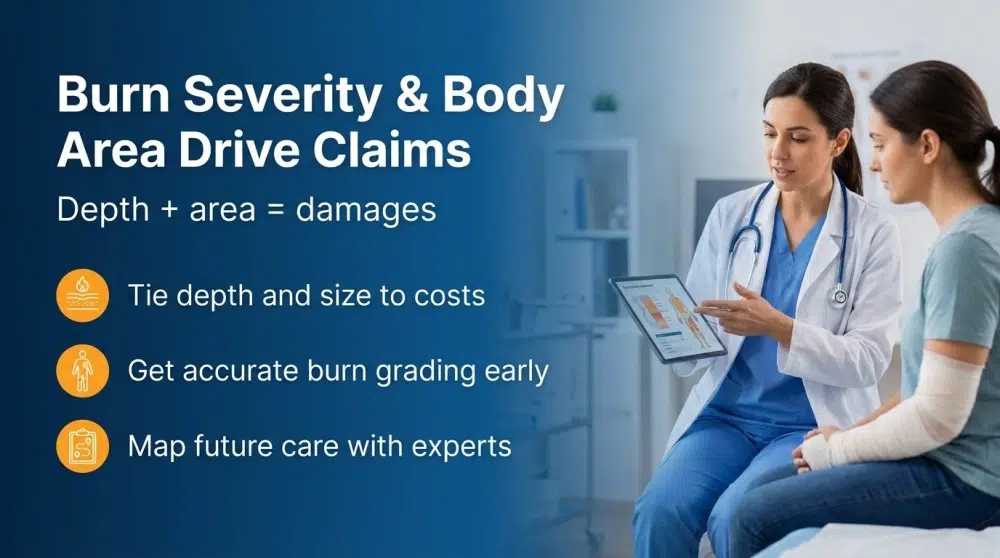
TBSA tells you how much of the body is involved. Clinicians use the Rule of Nines to estimate this quickly: each arm is roughly 9 percent, each leg is 18 percent, the anterior trunk is 18 percent, and the posterior trunk is 18 percent. Burns covering more than 20 percent TBSA in adults are generally treated as major burns requiring intensive care [2]. A burn injury claim in Dallas County that involves 30 percent TBSA full-thickness damage is fundamentally different from one involving 5 percent partial-thickness burns – different acute treatment costs, different graft requirements, different recovery timelines, and different long-term care projections.
For plaintiffs, the significance is this: degree and TBSA together determine how a life-care planner quantifies future medical needs. For defendants, the same measurements become the foundation for challenging damage calculations. An accurate classification, established by burn center documentation early in treatment, becomes one of the most important factual anchors in the entire case.
If you have been injured and want to understand how personal injury lawyers analyze these claims, speaking with a qualified attorney is the right first step. A free consultation can help you understand what your documentation shows and what categories of compensation may apply under Texas law.
What do graft surgeries and revision procedures mean for the damages timeline?
Skin grafting is not a single event. It is a process, and understanding that timeline matters because Texas courts treat past medical expenses and future medical expenses as distinct damage categories [3].
How does the initial graft procedure work?
In a standard split-thickness skin graft, surgeons harvest a thin layer of skin from an unburned donor site on the patient’s own body and transfer it to the wound bed. The procedure is typically performed in stages for large burns – the body can only tolerate so much surgery at once, and donor-site availability limits how much coverage can be achieved in a single operation. For extensive burns affecting multiple areas, a patient may undergo three, four, or more separate grafting procedures over weeks or months of hospitalization.
Full-thickness burns over joints, hands, and the face often require composite grafts, flap reconstruction, or cadaveric skin as a temporary covering while permanent coverage is planned. Each additional procedure adds to the tally of medical bills, anesthesia costs, and hospital days that make up the plaintiff’s economic damages.
Why do revision surgeries matter to a claim?
Graft outcomes vary. Hypertrophic scarring, contracture formation, and graft failure are not rare complications – they are routine challenges in burn care. A contracture near the elbow or across the palm can pull tissue tight enough to restrict movement and require surgical release. Hypertrophic scars can thicken, discolor, and cause ongoing pain for years after the initial injury. Laser treatments, pressure garment therapy, and steroid injections are standard components of long-term burn scar management, and they carry real costs that continue well past hospital discharge.
The practical consequence for a burn injury claim in Texas is that the medical cost picture at the time of a lawsuit filing may capture only a fraction of the total projected expense. A life-care plan prepared by a qualified clinician and reviewed against the medical record is how plaintiffs document future revision procedures, dermatology visits, pressure garment replacements, and ongoing therapy [4]. Texas courts permit recovery of these anticipated future expenses when supported by credible evidence, though defendants will challenge the methodology and the projections.
The gap between what insurers offer early and what the full-lifetime medical costs actually represent is often where the real dispute in a serious burn injury case lives. Our Dallas personal injury team has seen this gap clearly in claims involving refinery and industrial accidents along corridors like I-30 and the industrial areas south and east of downtown Dallas.
How are prosthetic replacement cycles and lifetime costs documented in a claim?
Amputation injuries – whether caused by a severe industrial burn that progresses to limb loss, a crush injury, or a direct traumatic amputation – carry a category of damages that plaintiffs must project over an entire lifetime. That projection centers on the prosthetic replacement cycle.
What is the replacement cycle, and why does it compound costs?
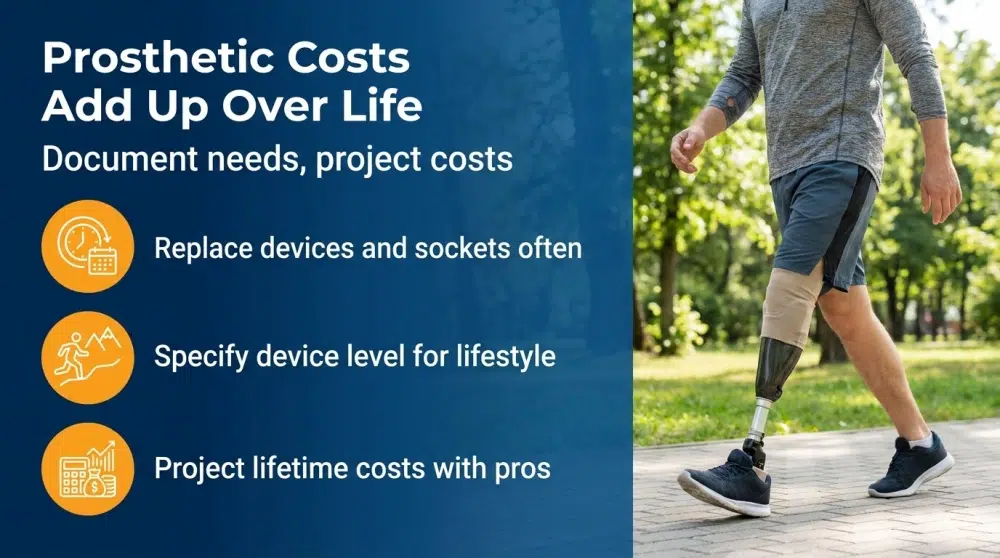
A modern prosthetic limb is not a permanent device. Activity level, body weight changes, and wear from daily use mean that the prosthetic socket typically requires replacement every one to three years. The prosthetic components themselves – feet, knees, and microprocessor units for more advanced devices – have their own replacement schedules, often every three to five years for mechanical components [5].
Microprocessor-controlled knees and feet, which have become increasingly standard for active patients, carry device costs in the tens of thousands of dollars per unit. A 30-year-old amputee facing a normal life expectancy could need eight to twelve major prosthetic systems over a lifetime, with sockets replaced far more frequently. Stack those costs together and add the associated prosthetist fitting fees, physical therapy following each new device, and skin care for the residual limb, and the lifetime prosthetic expense for a single amputation routinely reaches seven figures.
The claim must document this with specificity. Rehabilitation physicians and certified prosthetists can provide opinions on what device category the injured person requires given their activity level, age, and occupation. Life-care planners then translate those opinions into a year-by-year projection that serves as the evidentiary foundation for the future damages number. Texas courts applying the proper measure of damages require that future medical expenses be established with reasonable certainty, not speculation [3].
For defendants and their insurers, challenging the assumed device tier or the replacement frequency is a common strategy. If the plaintiff’s expert assumes a microprocessor knee when the insurer argues a mechanical device would suffice, the gap in the projected cost can be hundreds of thousands of dollars. These disputes often become the center of the litigation.
Workers who lose limbs on job sites near the Dallas–Fort Worth metroplex may have concurrent workers’ compensation claims, but those systems do not compensate for pain, disfigurement, or the full economic picture that a civil injury claim can pursue. If a third party – such as an equipment manufacturer or a negligent subcontractor – contributed to the injury, a separate civil action for amputation injury compensation in Dallas may be available alongside any workers’ compensation benefit.
Is disfigurement a separate category of damages under Texas law?
Yes. Under Texas law, physical disfigurement is an independent, recognized element of damages in a personal injury case – it is not folded into pain and suffering and it is not the same as physical impairment [6].
How does Texas define disfigurement as a damage element?
Texas Pattern Jury Charge 115.3 includes a distinct entry for “physical disfigurement” alongside separate entries for physical pain, mental anguish, physical impairment, and medical expenses. A jury can award compensation for disfigurement as a stand-alone item, separate from any impairment award [7].
The distinction matters in practice. Physical impairment addresses the functional loss – the inability to use a hand, lift a certain weight, or perform a specific occupation. Physical disfigurement addresses the alteration of appearance: the visible scarring, the missing limb, the skin that no longer looks or moves the way it did before. These are genuinely different harms. A plaintiff with severe facial scarring who has recovered full range of motion has a disfigurement claim that stands independently of any impairment award. Texas courts have upheld substantial disfigurement awards in burn cases, recognizing that the harm to a person’s appearance is real, measurable in its social and economic consequences, and compensable.

What evidence supports a disfigurement damages award in a Texas courtroom?
Documentation typically includes photographic evidence taken across the treatment timeline (early, mid-recovery, and at maximum medical improvement), treating physician reports describing the permanent nature of the scarring or limb loss, and expert opinion from plastic surgeons or dermatologists on prognosis for improvement. Testimony from the plaintiff about daily life with the changed appearance – including reactions from others, avoidance of public settings, and the emotional weight of seeing oneself differently – is also relevant to this category.
For defendants, the strategy is frequently to argue that the plaintiff’s disfigurement award is duplicative of the pain and mental anguish award, or that the scarring is less extensive or less permanent than claimed. Medical evidence fixing the permanence of the condition is the plaintiff’s best counter to those arguments.
If you want to understand what categories of damages are available in a Texas personal injury case, including how disfigurement fits alongside economic and other noneconomic categories, that resource walks through the full framework.
How do courts account for the psychological harm of a burn or amputation injury?
The psychological consequences of severe burns and amputation are well-documented in the medical literature and are compensable in Texas civil claims under the category of mental anguish [8]. Separating this from the disfigurement category and from physical pain requires careful presentation – but the law gives each element its own space.
What psychological conditions commonly follow severe burn injuries?
Research in burn care rehabilitation consistently identifies post-traumatic stress disorder, depression, and anxiety as significantly elevated in burn survivors compared to general population rates. Body image disturbance following visible scarring or amputation is a recognized clinical phenomenon. Sleep disturbances, social withdrawal, and fear of future medical procedures compound the psychological burden. For amputees specifically, phantom limb pain is a distinct neurological phenomenon that is both physically painful and psychologically disorienting – it is not imaginary, and it is not compensated by disfigurement or standard physical pain awards alone.
In a Texas civil claim, mental anguish requires evidence of more than temporary upset. Courts look for evidence of a high degree of mental pain and distress that is more than mere worry, embarrassment, or anger. Medical records from psychologists, psychiatrists, or licensed counselors who have treated the plaintiff provide the most persuasive evidence. The treating records document the diagnosis, the severity, the treatment course, and the prognosis for ongoing impairment.
Can a defendant challenge the psychological component of the claim?
Defendants frequently retain their own psychological evaluators or argue that the plaintiff’s distress predated the injury. Independent medical examinations by defense-retained clinicians are common in serious injury cases. Texas plaintiffs and their attorneys need to be prepared to present a thorough mental health treatment record and, where appropriate, expert testimony connecting the psychological condition causally to the injury event.
The psychological component also intersects with the disfigurement claim in ways that can strengthen both. Testimony about avoidance of social situations because of altered appearance speaks to both the disfigurement harm and the mental anguish harm. A skilled attorney will present these as distinct, non-duplicative elements rather than allowing the jury to collapse them into a single, reduced number.
What defenses do defendants typically raise in these claims?
Understanding how the opposing side approaches a burn or amputation injury claim helps plaintiffs prepare more effectively. In Texas civil litigation, defendants and their insurers have several standard strategies.
- Comparative fault allocation. Texas uses a modified comparative fault rule: a plaintiff who is more than 50 percent responsible for their own injury cannot recover damages [9]. Defendants will scrutinize whether the injured person bypassed safety equipment, ignored posted warnings, or contributed to the conditions that caused the fire or explosion.
- Causation challenges. In industrial burn cases, multiple sources of ignition or multiple employers may have been present. Defendants argue that another party’s negligence – not theirs – was the proximate cause of the injury.
- Pre-existing conditions. Defense counsel will examine medical records for prior skin conditions, previous injuries, or psychological diagnoses that could be argued to diminish the damages attributable to the defendant’s conduct.
- Life-care plan challenges. Defense experts routinely challenge the methodology, assumptions, and cost figures in plaintiff life-care plans. Competing projections can vary substantially in their estimates of future prosthetic or reconstructive costs.
- Damage caps in certain contexts. Texas caps noneconomic damages in some categories of cases, though the rules vary by defendant type. In cases against health care providers, for example, Chapter 74 of the Texas Civil Practice and Remedies Code imposes specific limitations. Claims against non-medical defendants generally are not subject to those same caps, though the broader Chapter 41 framework for exemplary damages does apply where punitive damages are sought [10].
Where are Dallas-area burn and amputation injury cases filed, and what deadlines apply?
Civil injury cases arising from incidents in Dallas and surrounding Dallas County are filed at the Dallas County District Court, with the George L. Allen Sr. Courts Building as the primary civil courthouse on Commerce Street in downtown Dallas. The correct district court depends on which court holds jurisdiction for the claim amount and type.
The Texas statute of limitations for personal injury claims is two years from the date of the injury [11]. Missing that deadline almost always means permanently losing the right to pursue the claim in civil court. This deadline appears simple but can become complicated in burn cases where the full extent of injury, or the identity of all responsible parties, may not be apparent immediately after the accident.
For claims involving a wrongful death – which can occur when a catastrophic burn injury eventually proves fatal – the two-year period generally runs from the date of death rather than the date of the incident, though this requires careful analysis of the specific facts. Workers who are injured on job sites and pursue claims against third parties outside the workers’ compensation system face their own procedural considerations about subrogation rights and how settlement proceeds are allocated.
Delay in pursuing a burn injury claim in Texas is almost always costly. Evidence degrades. Witness memories fade. Corporate defendants may alter or lose records. Anyone injured in the Dallas area who has questions about timing should speak with personal injury lawyers as soon as practicable rather than waiting to see how their recovery progresses.
If the injuries are severe enough to be fatal, the family may also have a wrongful death claim. The fatal crash attorneys in Dallas at our firm handle those claims separately and in coordination with the underlying injury investigation.

How GoSuits Dallas Helps Burn and Amputation Injury Clients
Burn injury claim texas cases – especially those involving graft revisions, prosthetic replacement schedules, and permanent disfigurement – are among the most document-intensive in personal injury litigation. The medical records, life-care plans, and expert opinions that build these cases require organization, timely preservation, and a clear strategic framework from the start.
GoSuits brings a technology-driven approach that most personal injury practices simply do not have. Our proprietary software was built to manage the document workflows, timeline reconstruction, and damages projection coordination that serious injury cases demand. That means cases move forward on a faster, more organized track – without the administrative bottlenecks that can delay justice for injured clients.
What sets us apart is not just the technology. Every client at GoSuits is assigned a designated attorney who handles their case directly. There are no case managers standing between you and your lawyer. You have unfettered access to your attorney, who knows your file, knows your situation, and handles every significant step in the litigation personally. That structure matters in complex burn and amputation cases, where the attorney-client relationship directly affects the quality of preparation.
Our attorneys bring more than 30 years of combined experience handling catastrophic injury cases across Texas, California, and Illinois. We have trial experience that we use as leverage – defendants and their insurers know when an opposing firm is genuinely prepared to try a case, and that knowledge affects how seriously they treat settlement discussions. You can review the outcomes we have achieved for our clients by looking at our prior cases.
We serve clients across the Dallas-Fort Worth metroplex, including those injured in industrial accidents, vehicle collisions, product failures, and premises incidents throughout Dallas County and the surrounding region. To learn more about our team, visit our our attorneys page or read more about us. Our full range of injury practice areas is available at our practice areas page.
If you have questions about a burn or amputation injury claim in Texas, the most practical next step is a free consultation. Schedule a free consultation with our Dallas personal injury team today, and we will review the facts of your situation and give you an honest picture of what your claim involves.
References
- Standards of Care for Burn Injury – American Burn Association
- Burn Injuries – National Institute for Occupational Safety and Health (NIOSH), CDC
- Texas Civil Practice and Remedies Code Chapter 41 – Texas Legislature Online
- Types of Cases in Federal Court – United States Courts
- Limb Loss Resources – U.S. Department of Health and Human Services
- Texas Rules and Standards – Texas Judicial Branch
- Texas Pattern Jury Charges – Office of Court Administration, Texas
- Post-Traumatic Stress Disorder – National Institute of Mental Health
- Texas Civil Practice and Remedies Code Chapter 33 (Proportionate Responsibility) – Texas Legislature Online
- Texas Civil Practice and Remedies Code Chapter 74 (Medical Liability) – Texas Legislature Online
- Statute of Limitations for Personal Injury in Texas – GoSuits