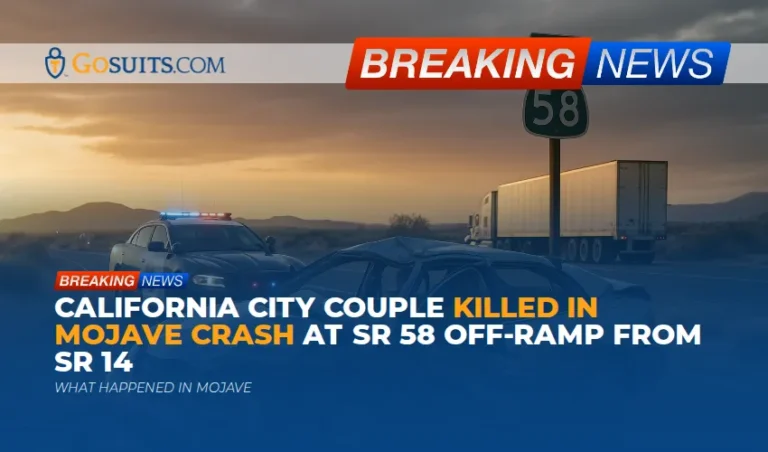
- What Happened in Mojave
- Location and Roadway Context at SR 14 and SR 58
- How Fatal Collision Investigations Typically Proceed
- How to Get Official Records: Police Report, Autopsy Information, and Vital Records
- Insurance and Next Steps: Protecting Yourself Before Speaking to Adjusters
- Understanding the Civil Side: Wrongful Death Basics in California
- Local Resources and Practical Help for Kern County Families
- Context: Traffic Safety and Senior Drivers
- What to Do After a Fatal Crash: A Practical Checklist
- Why Acting Soon Matters
- Commentary from Gosuits Mojave, California Personal Injury Attorney
- References
What Happened in Mojave
Two California City residents died after a collision in Mojave at approximately 5:07 p.m. on a Monday afternoon. According to the Kern County coroner’s office, the driver, Roland James Squires, 85, and the passenger, Carolyn Darnell Squires, 83, were declared deceased at the scene. The crash occurred at the Highway 58 off ramp from Highway 14. At the time of writing, public reporting indicates the California Highway Patrol is the investigating agency for this state route interchange. Details such as the involved vehicles’ directions of travel, primary collision factor, and any witness accounts typically become available once CHP finalizes the collision report and related findings.
It is natural for friends and neighbors in California City and Mojave to seek answers quickly. The interchange serves many locals traveling between the Antelope Valley, Mojave Air and Space Port, and communities along SR 58 toward Tehachapi and Bakersfield. When a tragedy strikes at a familiar off ramp, the shock ripples through the entire High Desert community.
Location and Roadway Context at SR 14 and SR 58
If you drive that corridor often, you know SR 14 funnels traffic north and south through the Antelope Valley and Mojave, while SR 58 carries heavy regional and interstate freight across the Tehachapi corridor. The junction near Mojave is a busy transition point where passenger vehicles, local commuters, and long haul trucks mix. Caltrans identifies both SR 14 and SR 58 as important goods movement routes that experience significant truck volumes statewide, which can influence congestion patterns and collision dynamics, especially at ramps and merges [1].
Local conditions can change fast. In the Mojave area, drivers frequently encounter strong crosswinds and, at times, blowing dust. Even without a specific weather advisory, late afternoon glare, wind gusts in the Antelope Valley, and fluctuating traffic speeds near interchange ramps can affect reaction time and visibility. None of this suggests a cause here; rather, it helps the community understand the kinds of factors investigators routinely review after serious crashes.
How Fatal Collision Investigations Typically Proceed
A CHP response to a fatal crash usually includes on scene measurements, photographs, and interviews. If warranted, CHP’s Multidisciplinary Accident Investigation Team may conduct a more detailed reconstruction for complex collisions involving severe injuries or fatalities [2]. The coroner separately determines cause and manner of death. These two investigative tracks often proceed in parallel, and their timelines can differ.
Here is what commonly takes place after a fatal crash on state routes like SR 14 and SR 58:
- Scene control and documentation: CHP secures the area, triages any injuries, and documents positions of vehicles, debris fields, fluid trails, skid or yaw marks, and damage profiles.
- Witness and involved party statements: Officers may take statements and cross reference them with physical evidence for consistency and detail.
- Data sources: Depending on the vehicles, investigators may seek event data recorder (EDR) downloads, which can show speed, braking, and other pre impact factors.
- Medical determinations: The county coroner examines injury patterns and cause of death, which may corroborate elements of collision dynamics.
- Final report issuance: CHP collision reports are not instantaneous. Families and insurers often must wait days or weeks for finalized findings, diagrams, and officer conclusions.
Those reports, together with any supplementary diagrams, are essential for civil insurance claims and, where applicable, wrongful death claims. Many families choose to speak with wrongful death attorneys before they initiate any insurance communications to ensure their rights are preserved.
How to Get Official Records: Police Report, Autopsy Information, and Vital Records
Obtaining the right documents early can help answer factual questions and clarify next steps. In California, there are formal paths to request each type of record.

1. CHP Collision Report
– Who holds it: The California Highway Patrol maintains reports for collisions on state routes and in CHP jurisdiction. The Mojave Area Office’s contact details can be found using the CHP’s office locator [3].
– How to request: CHP uses a specific request process for collision reports. Eligible parties typically include involved drivers, their legal guardians, next of kin in a fatal collision, vehicle owners, and legal representatives. Instructions and request forms are available through the CHP’s official website and local area offices [3].
– What to expect: You may be asked for the date, time, location, and incident number if available. Reports can include a narrative, diagram, and officer’s opinion about the primary collision factor.
2. Coroner Records and Autopsy Findings
– Who holds it: County coroners maintain autopsy and related death investigation records. Procedures vary by county. Families can inquire about next steps directly with the county coroner’s office handling the case. For statewide guidance on accessing public records in California, the Attorney General provides information on the California Public Records Act [4].
– Consider privacy and timing: Some coroner records are public, while specific autopsy details may have restrictions. Release timing can depend on ongoing investigations.
3. Certified Death Certificates
– Who holds it: Certified death certificates in California are issued through the California Department of Public Health’s Vital Records division, and also at the county level. CDPH outlines who can request a certified copy and the steps to follow [5].
– Why it matters: Death certificates are required for many practical matters, from insurance notifications to estate administration.
4. DMV Accident Reporting Requirements
– California requires drivers to report certain collisions to the DMV within 10 days if there was injury, death, or property damage above a statutory amount. Although this particular crash was fatal and may involve multiple parties, the DMV provides statewide rules and forms that may apply to involved drivers or owners [6].
Insurance and Next Steps: Protecting Yourself Before Speaking to Adjusters
In the first days after a fatal crash, insurers reach out quickly, often while families are still grieving and trying to piece together what happened. Speaking with an attorney before providing any recorded statement or signing forms can protect your options. What you say to an insurance company can be used later and may affect liability and damages evaluations. The California Department of Insurance offers general consumer guidance on auto insurance claims that can help set expectations for timelines, valuations, and disputes [7].
Two practical reminders:
- Recorded statements: Insurers may ask for a recorded interview. Consider consulting counsel first, especially in a fatal crash involving multiple vehicles or unclear fault.
- Policy layers and benefits: Coverage can involve multiple policies, including liability limits, potential umbrella coverage, and, where applicable, uninsured or underinsured motorist benefits. Coordination among carriers can be complex.
Families often find it helpful to consult with Los Angeles wrongful death attorneys who routinely handle claims arising from serious crashes on state routes in and around the Mojave and Antelope Valley corridors. Experienced legal guidance can help identify all potentially responsible parties and all available coverage.

Understanding the Civil Side: Wrongful Death Basics in California
California law provides a path for eligible survivors to seek civil remedies when a death is caused by another’s wrongful act or negligence. While every case is unique, several foundational points apply statewide.
Who may bring a wrongful death claim
The California Code of Civil Procedure sets the time limit to bring a wrongful death lawsuit in most cases at two years from the date of death [8]. Eligibility to file and distribution of any recovery are governed by statute, and depend on the decedent’s family structure and relationships. The California Courts’ public resources explain the general framework of civil cases and provide access to statewide rules and forms [9].
Possible defendants and liability theories
Potential defendants may include a negligent driver, vehicle owner, employer of an on duty driver, or, in limited circumstances, a public entity if a dangerous condition of public property contributed to the crash. Claims against public entities in California have special notice requirements, typically requiring a written claim within a short period, often six months, before any lawsuit can be filed. The Government Code outlines these claim deadlines and prerequisites for suing public entities [10].
Damages in wrongful death
Damages are intended to compensate for proven losses such as loss of financial support, loss of household services, and the intangible loss of love, companionship, comfort, care, assistance, protection, affection, society, and moral support. A related but distinct survival action may also exist to recover certain damages the decedent could have claimed had they survived, limited by statute.
For a step by step look at the civil issues families face after a fatal roadway crash in California, see what happens if someone is killed in a car accident.
Local Resources and Practical Help for Kern County Families
Families in California City, Mojave, and nearby communities often need a short list of practical actions and offices to contact. Here is a locally grounded guide to get started.
- CHP Mojave Area Office: Use the CHP office locator to find the Mojave Area Office page and contact information for requesting the collision report, clarifying report numbers, and learning when documents will be ready [3].
- Caltrans updates: Caltrans posts real time travel information through QuickMap. While it is not a collision record source, it can help the community track closures or lane restrictions after major crashes. General Caltrans corridor and freight planning pages provide context on traffic flow and truck volumes along SR 14 and SR 58 [1].
- County coroner’s office: Families can inquire about the status of the autopsy and the process for obtaining records. If questions arise about accessing public records, the Attorney General’s Public Records Act guidance offers statewide rules on requesting government records [4].
- Vital records: Order certified death certificates through the California Department of Public Health’s Vital Records program or your county vital records office following CDPH’s instructions [5].
- DMV requirements: If an involved driver or owner needs to file a report, see DMV’s guidance on vehicle accident reporting requirements and deadlines [6].
Many neighbors drive this interchange to commute to Edwards Air Force Base, the Mojave Air and Space Port, or across the Tehachapi Pass toward Bakersfield and the Central Valley. If anyone witnessed this collision near the SR 58 off ramp from SR 14 and has not yet spoken to CHP, providing a factual statement to the investigating office can help finalize the record.
Context: Traffic Safety and Senior Drivers
Serious crashes rarely have a single explanation. Investigators consider roadway design, lighting and visibility, speeds, maneuvers at ramps and merges, potential vehicle issues, and human factors. It is important not to leap to conclusions based on age alone. National data show that older drivers can be more vulnerable to severe outcomes due to frailty, even at similar impact severities, which is one reason fatality risk can be higher when older adults are involved [11]. That statistic is about injury severity, not blame.
For community awareness, state and national safety agencies continue to publish data and prevention strategies. California’s traffic safety programs track trends across roadway types and encourage design and operational improvements, including at high volume interchanges that carry significant truck traffic [12].
What to Do After a Fatal Crash: A Practical Checklist
In the wake of a fatal collision, people often ask, where do we start. The checklist below focuses on preserving information and avoiding common missteps that can affect future insurance or civil claims.
- Collect key identifiers early: Keep a written log of the CHP incident or report number, responding agency, date and time, exact location, towing company and yard, and names of any officers or investigators you spoke with.
- Secure the vehicle and personal items: If a family vehicle was towed, confirm the yard location and ask that the vehicle not be altered or destroyed. Preservation matters. Photographs and a later inspection can be critical.
- Preserve phone and location data: Do not reset or swap phones of anyone involved before consulting counsel. Location histories, call logs, and photos can corroborate timelines.
- Keep medical and funeral records organized: Save all invoices, statements, and correspondence related to medical response and funeral arrangements. These documents are often needed for claims.
- Request official records the right way: Submit requests for the CHP collision report through the CHP process, and order certified death certificates from CDPH Vital Records as soon as practical [3][5].
- Avoid early recorded statements: If an insurance adjuster calls, consider scheduling a consultation with a lawyer first. Even simple answers can be interpreted against your interests later.
- Mind critical deadlines: Wrongful death lawsuits must be filed within the time limits set by statute in most cases. Claims against public entities require earlier written claims before any suit can be filed [8][10].
- Consider counseling and support: Grief is personal. Seeking support through community networks can help families navigate both the emotional and administrative burdens that follow a sudden loss.
If uncertainty remains about the insurance path, many families find it useful to consult seasoned wrongful death attorneys who can clarify the order of operations and help avoid avoidable mistakes that insurers may later seize upon.
Why Acting Soon Matters
– What to do: Identify the lead investigating agency, request the official reports through the proper channels, secure the involved vehicles from alteration, and arrange a confidential consultation with a qualified attorney before giving any recorded statement to an insurer.
– Why it matters: Timelines start running immediately. Tow yards may charge daily storage fees, and vehicles can be dismantled without a preservation request. Witness memories fade. Government claim deadlines in California can be as short as six months when a public entity is implicated. Acting methodically helps keep your options open.
– The benefit of acting now: Early action improves the quality of evidence and reduces the risk of gaps that insurers can exploit. A clear evidence record can support liability determinations and facilitate a more accurate evaluation of losses under California law.

Commentary from Gosuits Mojave, California Personal Injury Attorney
Our hearts are with the families and neighbors affected by this loss in Mojave. This article is intended for general information and education about what typically follows a fatal collision on our state highways and how families can gather records and understand their options.
Based on the information publicly reported, this tragedy occurred at the SR 58 off ramp from SR 14, a busy interchange that blends passenger vehicles and significant truck traffic. Interchanges and ramps carry unique risks because speed differentials, lane changes, and merging decisions all compress into a short stretch of roadway. None of that points to fault in this case; it does highlight why thorough investigation and proper evidence preservation matter so much after fatal crashes.
Insurance carriers and large corporate defendants often use the early days to their advantage. They request recorded statements, press for quick authorizations, and sometimes float early valuations before the full facts are in. Without complete reports, diagrams, and EDR downloads, a family can be nudged into positions that are hard to change later. Knowledge gaps are where adjusters probe.
A confidential, no cost consultation offers a safe place to understand the landscape. It allows families to learn how liability is determined, what documents will matter most, and how deadlines work, including the shorter claim rules if a public entity’s role must be evaluated. With clarity, families can decide the best path forward, whether that is insurance-only resolution or a civil wrongful death filing.
References
- Freight Planning in California – Caltrans
- California Highway Patrol – Official Site
- Find a CHP Office – California Highway Patrol
- California Public Records Act Overview – Office of the Attorney General
- Vital Records: Birth, Death, Marriage – California Department of Public Health
- Vehicle Accident Reporting Requirements – California DMV
- Auto Insurance Consumer Information – California Department of Insurance
- Code of Civil Procedure § 335.1 – California Legislative Information
- California Courts Self Help – Judicial Branch of California
- Government Code § 911.2 – California Legislative Information
- Older Drivers – National Highway Traffic Safety Administration
- Office of Traffic Safety – State of California