
























What areas in Cook County do Chicago motorcycle accident lawyers serve?
If you were hurt riding anywhere in the Chicago metro area, GoSuits is ready to help. While our work is centered in Chicago, we represent injured riders throughout Cook County and the surrounding collar counties. We have handled cases on the Kennedy Expressway near O’Hare, the Dan Ryan through Bronzeville, the Eisenhower heading west toward Oak Park, and Lake Shore Drive from the South Loop up through Edgewater.
Crashes happen everywhere a motorcycle shares the road with cars: at signalized intersections in the West Loop, on the curving ramps off I-90/94 near the Circle Interchange, on the high-speed straightaways of LSD, and on residential streets in Pilsen, Hyde Park, Logan Square, Lincoln Park, and Rogers Park. No matter where the collision happened, we bring local knowledge and legal experience to protect your rights and pursue the compensation you deserve.
According to the Illinois Department of Transportation’s annual crash report, Illinois recorded more than 2,500 motorcycle crashes in a recent year, with Cook County consistently accounting for the largest share of urban motorcycle injuries in the state. That volume reflects the reality of riding in a dense metro: more vehicles, more left-turning drivers, more lane changes, more risk for the rider who is doing nothing wrong.
Areas we commonly serve:
- Central Chicago neighborhoods: West Loop, The Loop, River North, South Loop, Pilsen, Bronzeville, Hyde Park
- North Side: Lincoln Park, Lakeview, Wicker Park, Logan Square, Uptown, Edgewater, Rogers Park
- South and West Side: Bridgeport, Chinatown, Beverly, Garfield Park, Austin, Englewood
- Cook County and collar communities: Cicero, Evanston, Oak Park, Skokie, Berwyn, Elgin, Naperville, Waukegan, Joliet
Wherever you ride in the Chicago area, we are a call away and ready to step in the moment you need legal guidance after a motorcycle crash.
What kinds of Chicago motorcycle accident cases do we handle?
Motorcycle crashes rarely look like other traffic collisions. The injuries are more severe, the property damage is total far more often, and the insurance fight is harder because adjusters quietly assume the rider was at fault. We build every case with that bias in mind, and we tailor our approach to the specific facts of how you went down.
Left-turn collisions at Chicago intersections
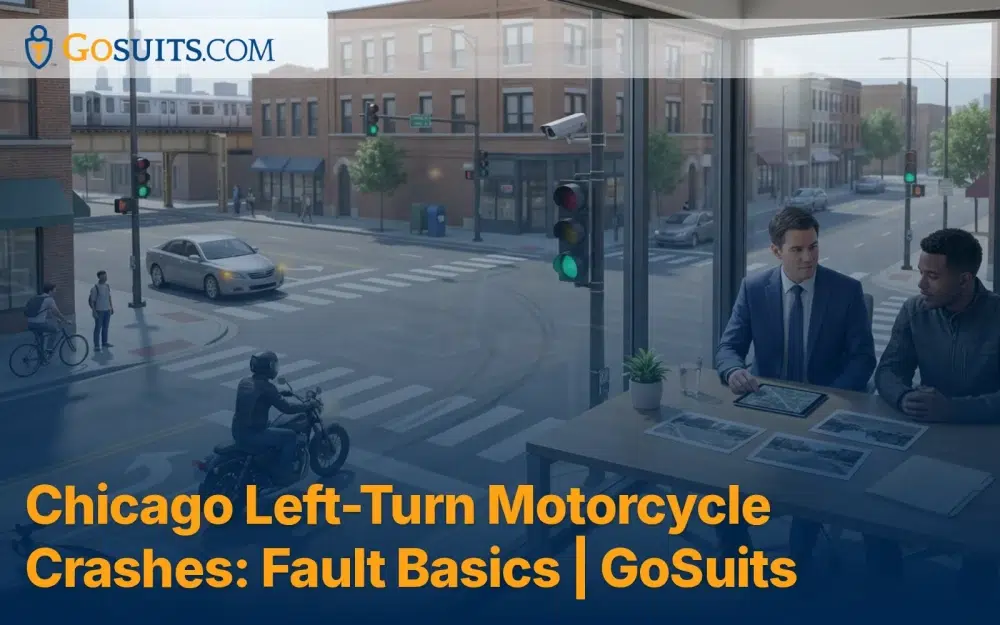
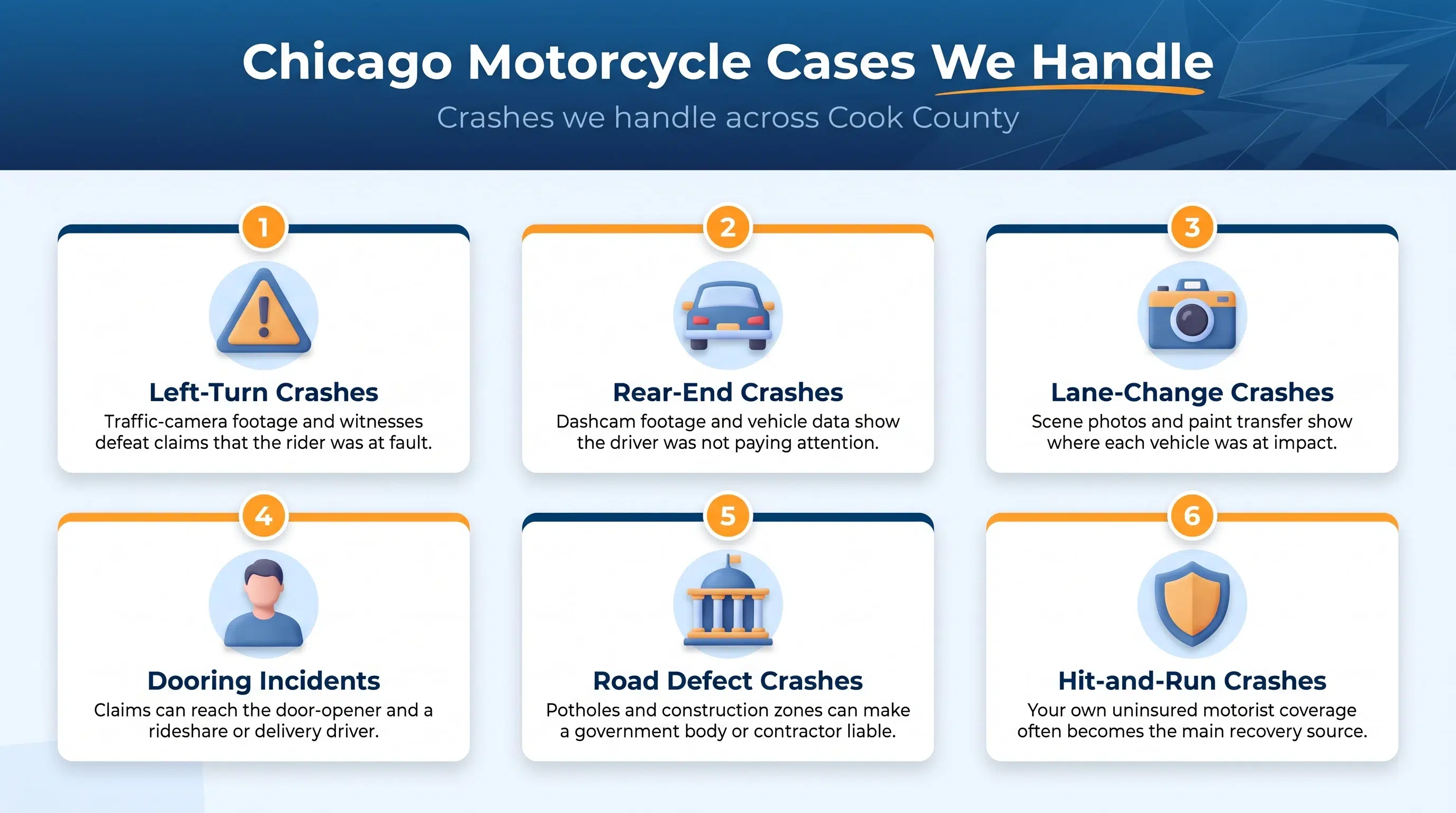
A driver waiting to turn left across your path, then turning anyway, is the single most common cause of serious motorcycle injuries in urban areas, and Chicago is no exception. These crashes happen at busy intersections along Halsted, Ashland, Western, and Milwaukee Avenue, where drivers misjudge a bike’s speed or simply fail to see it. Liability typically rests with the turning driver under the Illinois Vehicle Code rules on yielding the right-of-way, but insurers still try to push blame onto the rider. We pull traffic-camera footage, locate witnesses, and reconstruct the approach to defeat that argument.
Rear-end and stopped-in-traffic crashes
Stop-and-go congestion on the Kennedy or the Dan Ryan creates a hazard most riders know well: the distracted driver who never slows down. A motorcycle hit from behind by a passenger car or pickup at highway speed almost guarantees serious injury, even with full gear. We collect dashcam footage, cell-phone records subpoenaed in discovery, and ECM data from the striking vehicle to prove the driver was inattentive.
Lane-change and “didn’t see you” crashes
Mirror checks miss motorcycles. That phrase is so common in police reports that insurers treat it as routine, but it does not absolve the driver of liability. Under Illinois law, a driver changing lanes must yield to traffic already in the lane, full stop. We use crash-scene photographs, paint-transfer analysis, and the police narrative to show exactly where each vehicle was positioned at impact.
Dooring incidents in the West Loop, Pilsen, and Wicker Park
On dense neighborhood streets with on-street parking, an opened car door is a wall a rider cannot avoid. Chicago Municipal Code prohibits opening a vehicle door into traffic when it is not reasonably safe to do so, and Illinois law backs that rule statewide. Our team pursues claims against both the door-opener and, where applicable, the rideshare or delivery driver whose passenger caused the impact.
Expressway and high-speed crashes
Crashes on I-90, I-94, I-290, and Lake Shore Drive often involve catastrophic injury, multiple vehicles, and disputed sequences. We retain accident-reconstruction professionals, obtain Illinois State Police crash reports, and pull roadway-design records to evaluate every factor, including pavement defects, signage, and any commercial driver involvement.
Single-vehicle crashes caused by road defects or hazards
Chicago’s freeze-thaw cycle produces some of the worst pothole conditions in the country, and a pothole that a car barely registers can throw a motorcycle on its side. Where a roadway defect or construction zone caused the crash, we evaluate claims against the responsible governmental body or contractor under Illinois’s tort-immunity rules, which carry a shorter one-year filing deadline that you cannot afford to miss.
Hit-and-run and uninsured-motorist cases
If the driver who hit you fled, or carried no insurance, your own uninsured/underinsured motorist (UM/UIM) coverage usually becomes the primary recovery source. Illinois requires UM coverage on all auto policies, and our team handles the policy review, claim filing, and any arbitration the policy demands.
Group-ride and passenger-injury cases
When a passenger is hurt on a motorcycle, or when a group ride is struck and multiple riders go down, the claim structure gets complicated quickly. We coordinate the medical record collection, sort out the liability allocations among drivers, and protect each rider’s individual recovery.
Insurer bias against motorcyclists: how we fight it
Every rider who calls us already knows what we are about to say: the insurance company is going to assume you were at fault. Adjusters are trained to look at a motorcycle file and start from the position that the rider was speeding, weaving, splitting lanes, or failing to wear gear. That bias is well-documented, and it is one reason the National Highway Traffic Safety Administration (NHTSA) and the Insurance Information Institute report that motorcycle injury claims consistently settle for less than they should relative to the severity of harm.
We attack that bias directly. We gather scene evidence the adjuster will never request, including 911 audio, surveillance footage from nearby businesses, and witness statements taken before memories fade. We pair that with medical narrative reports from your treating physicians that tie each diagnosis to the mechanism of injury. By the time we send a demand letter, the insurer is no longer arguing with a rider, they are arguing with a documented record.
Illinois follows a modified comparative fault rule under 735 ILCS 5/2-1116, meaning a plaintiff who is more than 50 percent at fault recovers nothing, and any recovery is reduced by the plaintiff’s share of fault. This differs from California’s pure comparative negligence framework. That 51-percent bar is exactly the rule insurers exploit against riders. We do not let percentage-of-fault arguments float free, we tie them to physical evidence and witness testimony.
Illinois motorcycle laws every Chicago rider should know
Illinois is one of the few states in the country without a universal motorcycle helmet law. Under the Illinois Vehicle Code (625 ILCS 5/), adult riders are not required to wear a helmet, and the absence of a helmet is generally not admissible to reduce damages in a crash caused by another driver. We make that point clearly any time an adjuster tries to imply otherwise. Eye protection is required for riders, however, unless the bike is equipped with a windscreen.
Lane splitting and lane filtering are illegal in Illinois. Riders in Chicago must stay in a single lane, and overtaking between rows of stopped or slow-moving traffic is not permitted. That said, we routinely see police reports where an officer assumed lane splitting occurred when the rider was simply changing lanes lawfully, and we challenge those assumptions with physical evidence.
The statute of limitations for a personal injury claim in Illinois is two years from the date of the crash under 735 ILCS 5/13-202. If the at-fault party is a local public entity, such as the City of Chicago, a lawsuit generally must be filed within one year under the Illinois Local Governmental and Governmental Employees Tort Immunity Act (745 ILCS 10/8-101). Some entities have their own notice rules: the Chicago Transit Authority, for example, requires written notice within six months (70 ILCS 3605/41). Missing a deadline ends a case before it begins, which is why early legal involvement matters.
Illinois also recognizes wrongful-death claims under the Illinois Wrongful Death Act (740 ILCS 180/), which is the governing statute when a rider does not survive the crash. Damages can include lost financial support, lost companionship, and grief and sorrow for surviving family members.
Choosing the right motorcycle accident legal representation in Chicago
Picking a motorcycle accident lawyer in Chicago is not like picking a general practice attorney. You want a firm that has handled bike crashes specifically, understands rider gear and bike mechanics, and knows how Cook County juries respond to motorcycle cases. Ask any prospective lawyer how many motorcycle matters they have taken to verdict, how they handle the inevitable comparative-fault fight under 735 ILCS 5/2-1116, and how they preserve electronic evidence from the at-fault vehicle.
Local knowledge matters too. A Chicago motorcycle injury attorney who knows the Cook County Circuit Court system, the local judges, and the major trauma centers like Stroger, Northwestern Memorial, and University of Chicago Medical Center can move your file faster and anticipate the obstacles that out-of-town firms miss. Most trusted firms, including GoSuits, offer free consultations and work on contingency, meaning you pay only if we recover.
When you work with a lawyer who listens, communicates plainly, and treats motorcycle injuries as a focused area of work rather than a side practice, the legal process becomes far less intimidating. Choose someone who brings both compassion and technical skill to the table.
How GoSuits Chicago motorcycle accident lawyers can help you
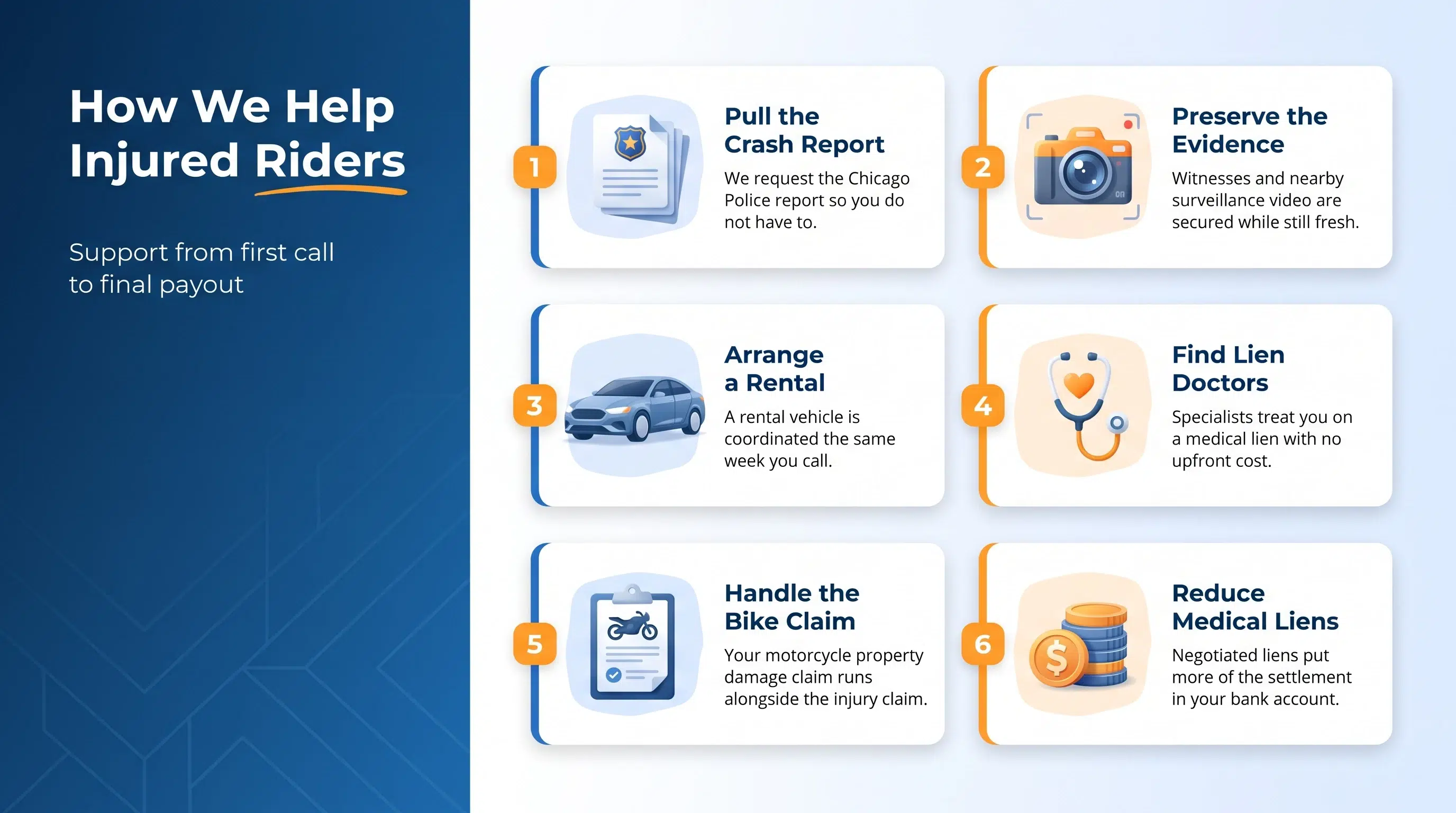
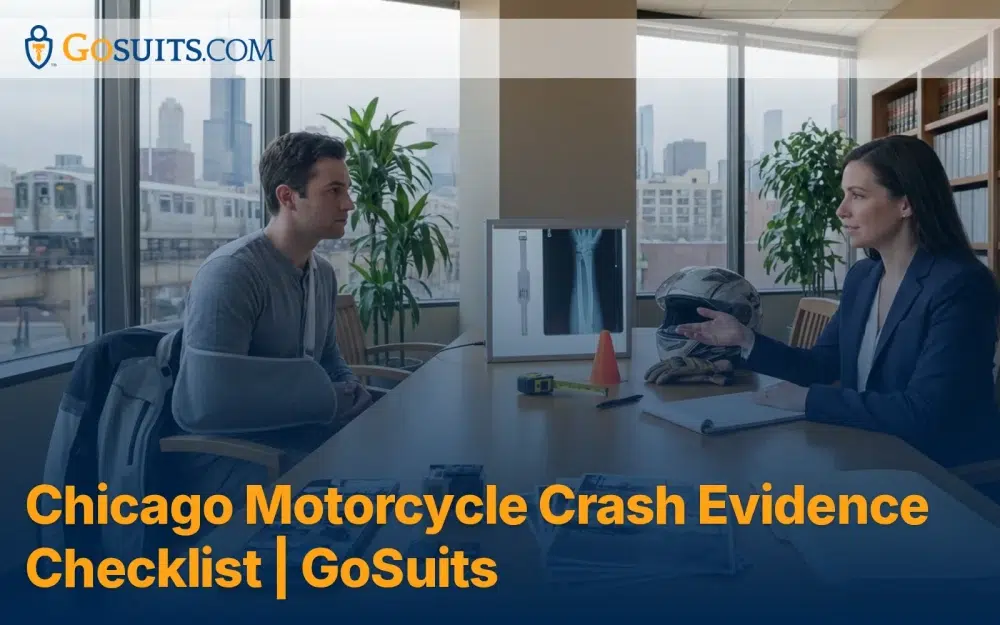
From the moment you call us, our team gets to work on the things you should not have to think about while you’re healing. We pull the Chicago Police Department crash report, contact witnesses while their memories are fresh, preserve any surveillance video that exists near the crash scene, and document the condition of your bike and gear before insurers can dispute them. We handle the police-report request directly so you do not have to navigate it during recovery.
From there, the full client journey looks like this: we coordinate a rental vehicle the same week you call so you are not stranded, we connect you with Chicago-area orthopedic surgeons, neurologists, and physical therapists who will treat you on a medical lien with no upfront cost, and we manage the property-damage claim on your bike in parallel with the bodily-injury claim. As your treatment progresses, our team builds a medical-special-damages model that captures every charge, every co-pay, every projected future cost. When the settlement is finalized, we negotiate down your medical liens at the back end so the dollars that actually reach your bank account are as high as we can make them. That last piece, the lien reduction, is where many firms quietly leave money on the table, and it is one of the things we work hardest on.
We understand the insurance process and what it takes to build a strong claim. We work with treating providers and life-care planners to estimate long-term costs including future surgeries, ongoing therapy, and lost earning capacity. If the insurance carrier will not negotiate fairly, our trial team is prepared to file suit in Cook County Circuit Court and take the case the distance.
What sets GoSuits apart is our deep knowledge of the Cook County legal landscape combined with technology that keeps your case moving. You will receive regular case updates, secure access to your file, and a prompt response when you reach out. Our team is part of our Chicago personal injury team, and we treat every client the way we would want a family member treated.
We work on a contingency-fee basis, meaning no attorney fee up front and a fee only if we recover compensation. Case costs and medical bills may still be owed. If you’re ready to talk, you can schedule a free consultation any time, day or night.
For more resources, explore our Knowledge Base, including our guides to how long a personal injury lawsuit takes in Illinois and how much most personal injury cases settle for.