- What is an insurance declaratory judgment action and why do insurers file it?
- What should you do immediately after being served with a declaratory judgment lawsuit?
- How do the duty to defend and the duty to indemnify differ in Texas, California, and Illinois?
- Can you ask the court to dismiss or stay the insurer’s case under abstention doctrines?
- What deadlines apply in federal, Texas, California, and Illinois courts?
- How do you respond to an insurer’s declaratory judgment action effectively?
- What evidence helps policyholders fight a declaratory judgment case?
- How does a reservation of rights letter affect your coverage rights and strategy?
- Can you file counterclaims or seek fees for insurer misconduct or bad faith?
- How do policy limits, conditions, and exclusions impact these cases?
- What happens at summary judgment in insurance coverage disputes?
- How can you negotiate or settle a declaratory judgment case to protect coverage?
- How do local considerations in Texas, California, and Illinois affect your strategy?
- How can GoSuits help you fight an insurance declaratory judgment now?
- Where can you find authoritative resources about insurance declaratory judgments?
What is an insurance declaratory judgment action and why do insurers file it?
An insurance declaratory judgment action is a civil lawsuit where a court is asked to declare the rights and obligations of parties under an insurance policy. At the federal level, the Declaratory Judgment Act allows a court to “declare the rights and other legal relations of any interested party” when an actual controversy exists (28 U.S.C. § 2201; Fed. R. Civ. P. 57). Texas, California, and Illinois each have state statutes authorizing similar relief for insurance coverage disputes: the Texas Declaratory Judgments Act (Tex. Civ. Prac. & Rem. Code ch. 37), California Code of Civil Procedure section 1060 (Cal. CCP § 1060), and Illinois Code of Civil Procedure section 2-701 (735 ILCS 5/2-701).
Insurers commonly file declaratory judgment suits to ask a court to rule that they have no duty to defend or indemnify you in a pending injury or liability case. They also use these lawsuits to interpret policy terms, exclusions, or conditions that could restrict coverage. If you are a policyholder or an injured person relying on insurance to pay a claim or defense costs, this type of lawsuit may threaten the very funds you need to protect yourself or recover damages.
For personal injury victims and families, the stakes are high. In 2022, the United States saw 42,514 traffic fatalities, showing how many injury claims depend on liability insurance every year (NHTSA 2022 national statistics). Liability policies are also required by law for drivers in Texas, California, and Illinois, with minimum limits set by statute (Tex. Transp. Code § 601.072; Cal. Veh. Code § 16056; 625 ILCS 5/7-203). When an insurer files a declaratory judgment action attacking coverage, it puts those statutory protections and your negotiated policy benefits at risk.
What should you do immediately after being served with a declaratory judgment lawsuit?
Time matters. The first days after service set the tone for your defense and your ability to keep coverage in place. Here are immediate steps that help you fight an insurance declaratory judgment effectively:
- Do not ignore the summons. Missing a filing deadline can lead to a default judgment. Federal Rule 12 gives you 21 days to answer or move to dismiss, unless a different deadline applies (Fed. R. Civ. P. 12(a)). State deadlines in Texas, California, and Illinois are described below.
- Retain coverage counsel quickly. Insurance coverage law is complex and highly state specific. Your liability defense depends on keeping the insurer on the hook to defend and indemnify.
- Gather your policy documents. Collect the complete policy, endorsements, declarations, renewal notices, underwriting correspondence, reservation of rights letters, and claim file communications. These documents often contain the keys to your defense.
- Preserve evidence and claim communications. Keep a folder of all emails and letters with your insurer, broker, or defense counsel, and the pleadings from any underlying injury case.
- Identify all potentially responsible insurers. Multiple policies may respond, including primary, umbrella, or excess carriers. Tender claims to all potentially applicable insurers to avoid gaps.
- Consider venue and removal options. If you were sued in state court, you may have options to remove to federal court or to seek remand from federal to state, depending on jurisdiction and timing (28 U.S.C. § 1446; 28 U.S.C. § 1332).
- Plan for abstention or stay motions. If a related injury lawsuit is pending in state court, you may be able to ask a federal court to decline the case or stay it in deference to the state proceeding, as explained below.
How do the duty to defend and the duty to indemnify differ in Texas, California, and Illinois?
The duty to defend and the duty to indemnify are distinct. Generally, the duty to defend is broader: if the allegations show a potential for coverage, the insurer must defend the entire lawsuit, even if some claims are not covered. The duty to indemnify concerns whether the insurer must pay a judgment or settlement for covered claims. These core rules are recognized nationwide (LII Wex: Duty to defend; LII Wex: Indemnify), but states differ in how they apply them.
What is the Texas approach to the duty to defend vs. indemnify?
Texas applies the “eight corners” rule for the duty to defend: courts compare the four corners of the live pleading in the underlying case with the four corners of the insurance policy, without relying on outside evidence in most situations. If the facts alleged potentially fall within coverage, the insurer owes a defense. Texas courts treat the duty to indemnify as narrower and often unripe until liability facts are resolved, though it may sometimes be determined early if no set of facts could bring the claim within coverage. You will also frequently see reservation of rights and appointed defense counsel issues in Texas.
Because the eight corners framework is pleadings-driven, your strategy often involves identifying amended allegations that trigger a defense obligation. The underlying complaint’s wording matters for Houston, Dallas–Fort Worth, Austin, and San Antonio cases just as much as in smaller counties.
How does California evaluate defense and indemnity duties?
California requires an insurer to defend whenever there is a potential for coverage, and California courts allow the use of extrinsic facts to establish that potential. The California Supreme Court has emphasized the breadth of the defense duty and the availability of declaratory relief to resolve coverage disputes. Seminal California decisions include:
- Gray v. Zurich, confirming a broad duty to defend whenever the third-party complaint raises a potential for coverage (Gray v. Zurich Insurance Co., 65 Cal.2d 263, SCOCAL).
- Montrose v. Superior Court, recognizing the use of extrinsic evidence to trigger the duty to defend where it shows a potential for coverage (Montrose Chemical Corp. v. Superior Court, 6 Cal.4th 287, SCOCAL).
- Buss v. Superior Court addresses allocation of defense costs between covered and uncovered claims, with the insurer bearing the initial duty to defend the entire action and seeking reimbursement for certain uncovered costs in narrow circumstances (Buss v. Superior Court, 16 Cal.4th 35, SCOCAL).
California policyholders in Los Angeles, San Diego, and San Francisco frequently invoke these cases to keep a defense in place.
What is the Illinois rule on defense and indemnity?
Illinois also recognizes that the duty to defend is broader than the duty to indemnify, and that a refusal to defend can expose the insurer to penalties if it is later found unjustified. Two cornerstone Illinois authorities are:
- Employers Ins. of Wausau v. Ehlco Liquidating Trust explaining that an insurer that breaches the duty to defend can be estopped from raising policy defenses in some circumstances.
- Section 155 of the Illinois Insurance Code authorizing fee shifting and penalties for unreasonable and vexatious delay or denial (215 ILCS 5/155).
In Cook County and across Illinois, the potential-for-coverage test remains the central defense lever for policyholders.
Can you ask the court to dismiss or stay the insurer’s case under the abstention doctrines?
Yes, especially in federal court. Even if federal jurisdiction exists, federal courts have discretion to decline to hear a declaratory judgment case when parallel state proceedings are pending. The Supreme Court’s decisions in Brillhart and Wilton confirm that district courts may dismiss or stay insurer-filed coverage suits to avoid needless decisions of state law and duplicative litigation (Brillhart v. Excess Ins. Co., 316 U.S. 491; Wilton v. Seven Falls Co., 515 U.S. 277).
In practice, policyholders in Texas, California, and Illinois often move to dismiss or stay a federal insurer declaratory judgment action while the underlying injury case proceeds in state court. Arguments include:
- Parallel state action. The state court is already deciding facts that bear on coverage.
- State-law predominance. Insurance coverage issues turn on state statutes and common law.
- Avoid piecemeal litigation. Conflicting rulings are possible if both cases proceed.
- Ripeness concerns. Indemnity may be unripe until liability facts are established.
Courts consider factors like the scope of the pending state case, the availability of necessary parties there, and whether the federal case would settle the entire controversy. Filing a strong abstention motion early can pause an insurer’s attempt to cut off your defense.
What deadlines apply in federal, Texas, California, and Illinois courts?
Deadlines vary by forum, so check your summons and the governing rules where you were sued.
- Federal court. Answer or move to dismiss within 21 days after service (Fed. R. Civ. P. 12(a)(1)). If you plan to remove a state case to federal court, the general deadline is 30 days after service (28 U.S.C. § 1446(b)).
- Texas state court. In most civil cases, your answer is due on the Monday next after 20 days from service, under the Texas Rules of Civil Procedure (see Texas Rules of Civil Procedure, commonly Rule 99).
- California state court. You generally have 30 days after service to file a responsive pleading (Cal. CCP § 430.40).
- Illinois state court. A defendant must appear or answer within the time specified by the summons, commonly 30 days after service, as provided by Illinois Supreme Court Rule 181 (Ill. S. Ct. R. 181(a)).
Missing these deadlines risks default judgments that can strip coverage. Courts in Houston, Dallas–Fort Worth, Austin, San Antonio, Los Angeles, San Diego, San Francisco, Chicago, and Cook County expect strict compliance.
How do you respond to an insurer’s declaratory judgment action effectively?
Effective responses combine procedural and substantive strategies.
What procedural defenses should you consider first?
- Motion to dismiss for lack of jurisdiction or ripeness. If indemnity turns on unresolved facts in the injury case, argue the claim is unripe under Rule 12(b)(1).
- Motion to dismiss or stay under Brillhart/Wilton. Ask a federal court to decline the case in favor of state proceedings.
- Improper venue or forum non conveniens. Seek transfer to a forum with closer ties to the policy and the underlying case.
- Failure to join the necessary parties. Identify additional insureds, co-insurers, or injured claimants necessary to fully resolve coverage.
What substantive defenses help policyholders keep a defense?
- Pleading potential for coverage. Emphasize allegations that bring the claim within the insuring agreement or exceptions to exclusions.
- Broad duty to defend. Cite that the duty to defend is broader than the duty to indemnify (LII Wex).
- Ambiguity. Argue that ambiguous policy terms must be construed in favor of coverage under state law standards.
- Estoppel and waiver. Where the insurer’s delay or conduct prejudiced you, estoppel may bar late coverage defenses, particularly in Illinois under the Ehlco line of cases.
- Compliance or substantial compliance. Show you met conditions precedent, or the insurer was not prejudiced by any technical noncompliance.
Should you file counterclaims?
Often yes. Counterclaims can include breach of contract, declaratory relief in your favor, and state-specific bad faith or unfair claims practices statutes, as addressed below. Counterclaims preserve your right to affirmative relief and, in some states, attorneys’ fees.
What evidence helps policyholders fight a declaratory judgment case?
Coverage cases turn on the policy’s text, underlying allegations, and key facts. Useful evidence includes:
- The complete policy. Include all endorsements and forms. Missing or replaced forms can alter exclusions and limits.
- Tenders and claim correspondence. Your initial tender letter, updates, and the insurer’s responses or delays can prove notice, cooperation, and estoppel.
- Reservation of rights letters. These reveal what defenses the insurer preserved and any conflicts created by the appointment of defense counsel.
- Underwriting and broker communications. Emails or applications may show the parties’ understanding of covered risks.
- Pleadings and discovery from the injury case. Allegations and deposition testimony can demonstrate a potential for coverage in California and Illinois, and may shape pleading strategy in Texas.
- Defense counsel invoices and reports. These can show the scope of the defense owed, subject to privilege protections and appropriate redactions (Fed. R. Civ. P. 26(b)(3) considerations on work product).
How does a reservation of rights letter affect your coverage rights and strategy?
A reservation of rights letter is the insurer’s notice that it will defend now but reserves the ability to deny coverage later. It preserves policy defenses but also may create conflicts that affect your choice of counsel and who controls the defense (LII Wex: Reservation of rights).
- California independent counsel. If a conflict arises because coverage turns on facts that appointed defense counsel could influence, California law gives you a right to independent counsel paid by the insurer under Civil Code section 2860 (Cal. Civ. Code § 2860), often called “Cumis counsel.”
- Texas conflict control. Texas law recognizes conflicts in limited situations and allows insureds to reject appointed counsel where a genuine conflict exists over control of defense strategy. These issues frequently arise in DFW, Houston, Austin, and San Antonio courts.
- Illinois conflict counsel. Illinois law permits the insured to select independent counsel at the insurer’s expense when a reservation creates a conflict of interest in defense. Federal courts applying Illinois law have acknowledged this protection.
Always review the reservation letter for timing, coverage defenses asserted, and the insurer’s position on defense cost rates and panel counsel. Your response can preserve important rights.
Can you file counterclaims or seek fees for insurer misconduct or bad faith?
Depending on the state, you may be able to obtain fees or statutory penalties for unreasonable claim handling. Consider these tools:
- Texas. Breach of contract and claims under the Insurance Code may be available, including unfair methods of competition and unfair or deceptive acts or practices (Tex. Ins. Code ch. 541). Prompt payment provisions may apply in certain contexts (Tex. Ins. Code ch. 542).
- California. Tort claims for breach of the implied covenant of good faith and fair dealing are recognized where an insurer unreasonably withholds benefits (Gruenberg v. Aetna Ins. Co., 9 Cal.3d 566). Attorney fee recovery for policy benefits can be available as Brandt fees in appropriate cases.
- Illinois. Section 155 allows reasonable attorney’s fees and penalties where the insurer’s actions are vexatious or unreasonable (215 ILCS 5/155).
In all three states, you can also counterclaim for declaratory relief in your favor and breach of contract for denied defense or indemnity.
How do policy limits, conditions, and exclusions impact these cases?
Insurers often rely on exclusions and conditions to avoid defense or indemnity. Your response should focus on the policy’s structure and burdens of proof.
- Insuring agreement first. Confirm the claim falls within the insuring clause. You bear the initial burden to show the claim potentially falls within coverage.
- Exclusions are construed narrowly. The insurer bears the burden to prove an exclusion applies. Ambiguities and exceptions to exclusions are read in favor of coverage in many jurisdictions.
- Conditions precedent. Notice and cooperation provisions matter. But prejudice is often required for an insurer to deny coverage due to late notice or technical deficiencies, depending on state law.
- Policy limits. Liability limits cap indemnity, but not necessarily defense costs. In California, the duty to defend can exceed limits until exhausted under applicable law. Umbrella and excess policies may stack vertically depending on policy wording and state rules.
For injury claims in Houston, Dallas–Fort Worth, Austin, San Antonio, Los Angeles, San Diego, San Francisco, Chicago, Cook County, and Naperville, keep an eye on endorsements that narrow coverage for contractors, rideshare, or professional exposures.
What happens at summary judgment in insurance coverage disputes?
Coverage disputes are frequently decided on summary judgment because they turn on policy interpretation and undisputed facts. Summary judgment is governed by Rule 56 in federal court (Fed. R. Civ. P. 56) and parallel state rules.
- Duty to defend. Courts often decide the duty to defend early. If there is any potential for coverage, summary judgment for the insured on defense is common, while indemnity is deferred until facts are developed.
- Burden of proof. The insured shows potential coverage. The insurer bears the burden for exclusions. If ambiguity exists, summary judgment for the insurer is generally improper.
- Partial summary judgment. Courts may grant partial relief, declaring a duty to defend and reserving indemnity for later. In California, allocation and reimbursement issues can follow under Buss.
How can you negotiate or settle a declaratory judgment case to protect coverage?
Negotiation is often more cost effective than litigating coverage to the end, especially when your main goal is to keep your defense funded while the injury case proceeds.
- Standstill agreements. Maintain a defense subject to a reservation while the underlying case advances.
- Partial coverage stipulations. Insurer agrees to defend while reserving indemnity issues for later mediation.
- Rate and panel flexibility. In California and Illinois, conflict counsel rate compromises can resolve disagreement over who controls the defense.
- Global mediation. Mediate the injury case and coverage issues together to reach efficient, confidential resolutions that protect policy limits and minimize personal exposure.
How do local considerations in Texas, California, and Illinois affect your strategy?
Do local courts approach insurer declaratory suits differently?
- Texas. The eight corners rule shapes defense motions statewide. Underlying pleadings in Harris County or Bexar County can be dispositive for triggering a defense. Texas declaratory relief is under Chapter 37 of the Civil Practice and Remedies Code.
- California. Courts in Los Angeles, San Diego, and San Francisco often consider extrinsic evidence for the defense duty and apply Civil Code section 2860 for independent counsel where appropriate.
- Illinois. In Cook County and other circuits, Section 155 fee exposure can shift leverage when the insurer’s denial appears unreasonable.
In all three states, if your insurer files in federal court, evaluate a Wilton-Brillhart stay or dismissal motion early.
How can GoSuits help you fight an insurance declaratory judgment now?
If you are facing an insurer’s declaratory judgment in Texas, California, or Illinois, you do not have to navigate it alone. A focused team can preserve your defense, protect your indemnity rights, and coordinate strategy with your injury case. Here is how GoSuits supports policyholders and injured people when an insurer files a declaratory judgment action.
How does our availability and communication support urgent coverage issues?
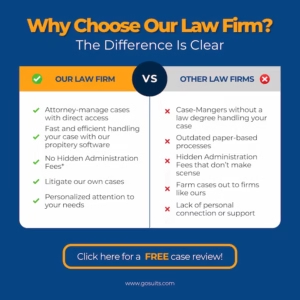
- Available 24/7. You can reach us any time, day or night, for an immediate free consultation. Time is critical when you must answer a complaint, remove to federal court, or file a stay motion before deadlines hit.
- Multilingual communication. We provide multilingual customer service. Spanish and Farsi speakers are available 24/7 so your questions about defense, indemnity, and policy rights are understood and answered clearly.
What is our fee policy and cost transparency for coverage disputes tied to injury cases?
- No win, No Attorney Fees. Learn about our policy here: No win, No Attorney Fees.
- No hidden administrative fees. You will know how costs are handled from the start. We discuss potential coverage litigation expenses and ways to control them through targeted motions and negotiated solutions.
How do our tools and case workflow improve your position against insurers?
- Proprietary Personal Injury software. We built an internal platform that streamlines investigation, demand preparation, negotiation, and, when necessary, lawsuit filing and discovery. It helps us track deadlines, manage reservation of rights issues, and coordinate strategy across your coverage and injury cases to stay ahead of insurer tactics.
- Integrated coverage and injury strategy. Our workflow keeps your defense funded, protects settlement leverage, and coordinates underlying pleadings to preserve the duty to defend under state-specific rules.
What experience and track record do we bring to coverage and injury litigation?
- 30 years of combined experience. We have handled complex injury and insurance disputes across Texas, California, and Illinois.
- 1,000-plus litigated matters. Settlement and verdict results are published on our website: Past Cases.
- Complex case readiness. In product liability, 18-wheeler collisions, brain and spinal injury, and other complex matters, we retain qualified in-state professionals to establish liability and damages where technically intensive issues arise.
- Multi-state litigation. We litigate severe injury and complex cases in Texas, California, and Illinois, coordinating with local courts from Harris County to Cook County.
- Awards and recognition.
- #1 settlements and verdicts across multiple U.S. counties according to TopVerdict.
- Top 100 Settlement in Texas.
- Sean Chalaki named Top 40 under 40 by National Trial Lawyers.
- Recognized by Best Lawyers in 2023, 2024, 2025.
- Selected to Super Lawyers since 2021.
How do we add value specifically in insurer declaratory judgment actions?
- Rapid response to preserve your defense. We evaluate abstention strategies, removal or remand options, and answer deadlines immediately so you do not lose ground.
- Focused motion practice. We pursue motions to dismiss, stay, or limit the case to the duty to defend when that strengthens your position, and we prepare for early summary judgment where appropriate.
- Counterclaims and fee leverage. We assert breach and statutory claims, including California bad faith, Texas Insurance Code claims, and Illinois Section 155, when supported by the record.
- Settlement-guided strategy. We aim to keep your defense funded and protect your indemnity rights while facilitating a positive resolution of the underlying injury case. We structure standstills, rate compromises, and global mediations when they benefit you.
Where are we located and how do we help you immediately near you?
- Texas. Serving Houston, Dallas–Fort Worth, Austin, San Antonio, and statewide matters. We can mobilize quickly in Harris, Dallas, Travis, Bexar, and neighboring counties.
- California. Serving Los Angeles, San Diego, San Francisco, and statewide. We address Cumis issues and defense control disputes under California law.
- Illinois. Serving Chicago, Cook County, Naperville, and statewide. We use Section 155 and Illinois defense standards to preserve your rights.
- 24/7 attorney and staff at each location. We are ready to review the complaint, your policy, and your reservation of rights letter today, and we can coordinate with your underlying injury counsel immediately.
We offer thoughtful representation rather than a volume approach. Our goal is to protect your defense and indemnity rights while advancing your injury case toward the best available outcome under the law. Contact us any time for a free consultation to discuss the insurer’s lawsuit, your deadlines, and your options.
Where can you find authoritative resources about insurance declaratory judgments?
- 28 U.S.C. § 2201 Declaratory Judgment Act
- Fed. R. Civ. P. 57 Declaratory Judgment
- Brillhart v. Excess Ins. Co., 316 U.S. 491
- Wilton v. Seven Falls Co., 515 U.S. 277
- Texas Declaratory Judgments Act, Tex. Civ. Prac. & Rem. Code ch. 37
- California Declaratory Relief, CCP § 1060
- Illinois Declaratory Judgment, 735 ILCS 5/2-701
- LII Wex: Duty to defend
- LII Wex: Indemnify
- California Civil Code § 2860 independent counsel
- Gray v. Zurich Insurance Co., 65 Cal.2d 263
- Montrose Chemical Corp. v. Superior Court, 6 Cal.4th 287
- Buss v. Superior Court, 16 Cal.4th 35
- Illinois Insurance Code § 155
- 28 U.S.C. § 1446 removal timing
- 28 U.S.C. § 1332 diversity jurisdiction
- Fed. R. Civ. P. 12 response deadlines
- Fed. R. Civ. P. 56 summary judgment
- LII Wex: Reservation of rights
- NHTSA 2022 traffic fatalities
- Texas minimum auto limits, Tex. Transp. Code § 601.072
- California minimum auto limits, Veh. Code § 16056
- Illinois minimum auto limits, 625 ILCS 5/7-203
- Texas Insurance Code ch. 541
- Texas Insurance Code ch. 542
- Texas Rules of Civil Procedure
- Cal. CCP § 430.40 response time
- Illinois Supreme Court Rule 181