








Who can be held responsible for a truck crash in Champaign?
A truck crash claim is often against more than the driver. The trucking company is usually responsible for its driver, and a broker, the company that loaded the cargo, or a repair shop can be responsible for its own mistakes. Who is responsible decides which insurance applies, so we look at every company involved in the trip.
| Party | When they may be responsible | Evidence to secure first |
|---|---|---|
| Driver | Speeding, distraction, fatigue or an unsafe lane change | Logs, ELD data, phone records |
| Motor carrier | For its driver at work, and its own hiring, training and supervision | Driver qualification file, dispatch records |
| Broker | It controlled how the driver did the job | Broker contract, check-call records |
| Shipper or loader | Overloaded or badly secured cargo | Bill of lading, weigh tickets |
| Maintenance company | Faulty brake, tire or steering work | Work orders, inspection reports |
| Parts maker | A defective part failed | The part itself, recall notices |
| Public body | A city, county or MTD vehicle caused the crash | Crash report, note the one-year deadline |
The driver
Speed, following distance, lane changes, phone use and rest are the starting point. The driver’s logs and the truck’s data often show what happened in the minutes before the crash.
The motor carrier
In McQueen v. Green, 2022 IL 126666 (Illinois Supreme Court, 2022) [Confirm], the jury found the driver not negligent but the trucking company negligent, including over how the cargo was loaded. The court held that a company can be sued for its own negligence in hiring, training and supervising, even when it admits the driver was working for it. The company’s own conduct counts, not just the driver’s.
Brokers, and drivers called “independent contractors”
In Sperl v. C.H. Robinson Worldwide, 408 Ill. App. 3d 1051 (Third District, 2011), a driver hauling a load arranged by a freight broker couldn’t stop on I-55 near Plainfield and hit several vehicles. Her contract called her an independent contractor, but the broker set her schedule, required check calls and fined her for breaking its rules. The court upheld the finding that she was the broker’s agent. A contract label doesn’t decide who is responsible; control does.
Shippers and loaders
The company that loaded the trailer can be responsible when overloaded or poorly secured cargo caused a rollover or a spill.
Maintenance companies and parts makers
A repair shop can be responsible for faulty work, and a parts maker for a defective part, so the truck has to be kept and inspected.
Delivery vans, box trucks and farm vehicles
In 2023, 29 single-unit trucks and 10 pieces of farm equipment were involved in reported Champaign County crashes (IDOT, 2023). The same fault questions apply, but some federal rules may not [Confirm].
A truck driver hurt by another truck [Confirm]
Workers’ compensation usually covers you, and you may also claim against the other company, with your employer repaid from that recovery (820 ILCS 305/5(b)) [Confirm].
[ATTORNEY NOTE: one line from Shawn on how often downstate truck claims involve a second company.]
How federal trucking rules affect your claim
Commercial trucks follow federal safety rules on driving hours, driver qualifications, inspections and cargo. A broken rule doesn’t win a case on its own, but it is often the clearest evidence of what went wrong. In 2023, 155 tractor-semitrailers and 29 single-unit trucks were involved in reported Champaign County crashes (IDOT, 2023).
| Rule | What it requires | What a breach can show |
|---|---|---|
| Hours of service (49 CFR 395.3) | 10 hours off, 11 hours of driving, nothing after the 14th hour, a 30-minute break after 8 hours | Fatigue, or pressure to keep moving |
| Driver logs (49 CFR 395.8) | A daily record of duty status, kept six months | Hours that don’t add up |
| Driver qualification (Part 391) [Confirm] | A file with license, medical certificate and history | An unqualified driver on the road |
| Inspection and maintenance (Part 396) [Confirm] | Regular inspection and repair, with records | Known defects left unfixed |
| Cargo securement (Part 393) [Confirm] | Cargo secured so it can’t shift or fall | A load that shifted |
| Insurance (49 CFR 387.9) | Minimum liability coverage | How much coverage should exist |
Hours of service
Under 49 CFR 395.3, a property-carrying driver gets 11 hours of driving after 10 hours off, may not drive after the 14th hour on duty, and needs a 30-minute break after 8 hours of driving. When the hours in the logs don’t match fuel receipts, tolls or delivery times, that gap can show a tired driver who was pushed to keep going.
Electronic logging devices
Electronic logging devices tie the driver’s duty status to the truck’s engine and location, so they are harder to change than paper logs. A mismatch between the device and the paper trail is often what proves an hours violation.
Driver qualification files [Confirm]
A missing or out-of-date file under Part 391 can show the company never checked whether the driver should have been driving.
Inspection and maintenance records [Confirm]
Part 396 records show whether known problems with brakes, tires or lights were reported and left unfixed before the trip.
Cargo securement [Confirm]
A load that moved in breach of Part 393 can point to the driver, the carrier or the loader.
Trucks that stay inside Illinois [Confirm]
Illinois applies the federal safety rules to many trucks operating only within the state (625 ILCS 5/18b-105) [Confirm], so staying in Illinois doesn’t lower the standard.
[ATTORNEY NOTE: one line from Shawn on which rule breach shows up most often in the records he reviews.]
Truck crash evidence and how quickly it can disappear
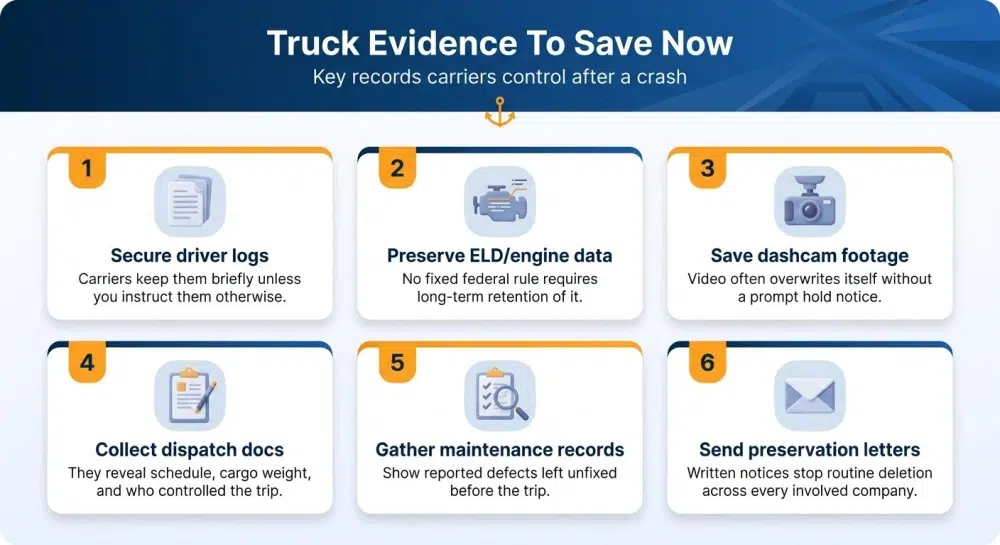
Much of the proof in a truck case belongs to the trucking company, and federal rules only make it keep some records for a short time. Driver logs and supporting documents only have to be kept for six months. That is why we send preservation letters to the carrier and every other company involved as soon as we are hired.
| Record | Who holds it | How long the law requires it to be kept |
|---|---|---|
| Driver logs and supporting documents | Carrier | 6 months from receipt (49 CFR 395.8(k)) |
| Accident register | Carrier | 3 years after each crash (49 CFR 390.15) [Confirm] |
| Engine and dashcam data | Carrier or truck owner | No fixed federal rule [Confirm] |
| Maintenance records | Carrier, repair shop | Set by Part 396 [Confirm] |
Driver logs and ELD data
Carriers must keep records of duty status and supporting documents for six months from receipt (49 CFR 395.8(k)), and may discard them after that unless told to keep them.
The carrier’s accident register [Confirm]
The register of crashes is kept for three years (49 CFR 390.15) [Confirm] and can show earlier crashes by the same driver.
The engine control module and dashcam
Engine data can record speed and braking around the crash, and cameras may show the road. No fixed rule says how long either is kept [Confirm].
Dispatch messages, bills of lading and weigh tickets
These show where the driver was told to be, what the truck carried and how heavy it was.
Maintenance and inspection records
Work orders and inspection reports show the condition of the brakes and tires before the trip. In 2023, police noted a brake defect on 39 vehicles and a tire defect on 26 vehicles in reported Champaign County crashes (IDOT, 2023).
Preservation letters, and evidence that is destroyed [Confirm]
A preservation letter tells each company in writing which records to keep. If a company destroys evidence it should have kept, Illinois courts can respond in several ways [Confirm].
[ATTORNEY NOTE: what Shawn asks a carrier to preserve first.]
What to do after a truck crash in Champaign
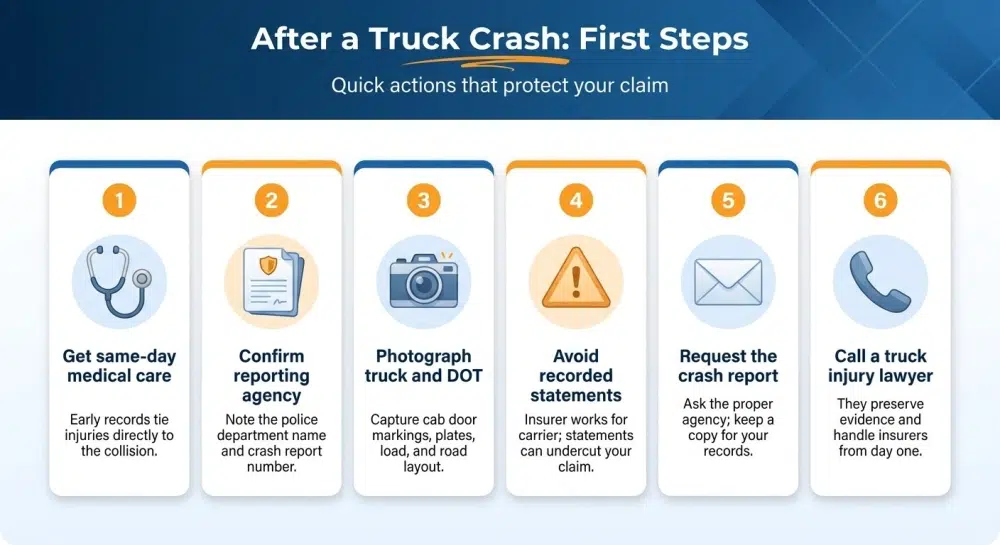
Get medical care, make sure police make a report, and write down the trucking company’s name and DOT number from the cab door. Don’t give a recorded statement to the carrier’s insurer before you get advice. In 2023, Champaign County recorded 3,006 crashes, with 1,197 people injured and 17 killed (IDOT, 2023).
Which agency handles your crash [Confirm]
The Illinois State Police usually respond on I-57, I-74 and I-72. In town, the Champaign or Urbana Police take the report, and the Champaign County Sheriff covers unincorporated areas. Ask which agency is making the report and write down the report number.
Photos of the truck, trailer, DOT number and load
If it is safe, photograph the truck and trailer from all sides, the DOT number and company name on the cab door, the plates, the load and the road. Note any witnesses.
Medical care the same day
See a doctor the same day if you can, even if you feel fine. Some injuries show up later, and insurers point to gaps in care. If you didn’t see a doctor right away, you may still have a claim.
The written report within 10 days [Confirm the practical wording]
A driver in a crash with injury, death or property damage over $1,500 ($500 if any vehicle was uninsured) has to send a written report within 10 days (625 ILCS 5/11-406). This is separate from the officer’s police report, and you should keep a copy.
How to get the crash report
Interstate crash reports usually come from the Illinois State Police [Confirm], and local reports from the agency that made them. We can request the report for you.
Why the carrier’s team may already be at the scene
Trucking companies and their insurers often send investigators to a serious crash quickly. They work for the company. Be polite, don’t sign anything, and don’t give a recorded statement before you get advice.
[ATTORNEY NOTE: one line from Shawn on the step people most often miss after a truck crash.]
How much insurance do trucking companies carry?
Most interstate trucks hauling general freight must carry at least $750,000 in liability coverage, and trucks carrying oil or hazardous materials must carry more. That is far above the minimum for a car, but a serious crash can still involve more than one policy. In 2023, 19 of the Champaign County crashes involving a tractor-semitrailer caused injuries (IDOT, 2023).
The federal minimums [Confirm on eCFR]
Under 49 CFR 387.9, the minimum is $750,000 for general freight in interstate commerce, $1,000,000 for oil and some hazardous materials, and $5,000,000 for large amounts of hazardous materials. The amount depends on what the truck was carrying, so the bill of lading matters.
Trucks that only travel inside Illinois [Confirm]
Trucks that stay inside Illinois may have different minimums [Confirm], so we read the policy itself rather than assume a number.
Policies held by the carrier, the broker and the trailer owner
The carrier’s policy is usually the first to look at. A broker, the trailer owner or the company that loaded the truck may each carry separate coverage that applies to the same crash.
Your own underinsured coverage
If the other policies are not enough, your own underinsured motorist coverage may help.
These are insurance minimums set by law, not claim values.
[ATTORNEY NOTE: one line from Shawn on how often a second policy turns up.]
How long do you have to file a truck accident claim in Illinois?
Most injury claims have to be filed within two years of the crash. A lawsuit against a city, county or other local public body, for example over a city truck or an MTD bus, generally has to be filed within one year. In 2023, 31 buses with more than 15 seats were involved in reported Champaign County crashes (IDOT, 2023). Check your filing deadline early.
| Claim | Deadline | Law |
|---|---|---|
| Private driver or carrier | 2 years | 735 ILCS 5/13-202 |
| City, county or MTD | 1 year | 745 ILCS 10/8-101(a) |
| Injured child | 2 years after turning 18 | 735 ILCS 5/13-211 |
| Wrongful death | [Confirm] | 740 ILCS 180/2 [Confirm] |
The two-year rule
Most personal injury lawsuits have to be filed within two years (735 ILCS 5/13-202).
The one-year rule for local public bodies
In Slaughter v. Rock Island County Metropolitan Mass Transit District, 275 Ill. App. 3d 873 (Third District, 1995), a transit bus hit the plaintiff’s car and she sued 17 months later. The court held that the one-year limit (745 ILCS 10/8-101) applied, and the case was dismissed.
Wrongful death [Confirm]
The deadline and who brings a wrongful death claim are set by 740 ILCS 180/2 [Confirm].
Children
Someone injured under 18 generally has until two years after turning 18 (735 ILCS 5/13-211).
Why the six-month record rule matters more in the first weeks
Logs can be discarded after six months, long before the filing deadline.
[ATTORNEY NOTE: one line from Shawn on the deadline mistake he sees most often.]
Where truck crashes happen in Champaign County
Champaign sits where I-57, I-74 and I-72 meet, and freight moves through the county every day. In 2023, 155 tractor-semitrailers were involved in reported crashes in Champaign County, two of them in fatal crashes (IDOT, 2023).
| Vehicle type | Number involved in reported crashes | Source |
|---|---|---|
| Tractor-semitrailers | 155 (2 fatal, 19 injury crashes) | IDOT, 2023 |
| Single-unit trucks | 29 | IDOT, 2023 |
| Single-unit trucks with trailers | 21 | IDOT, 2023 |
| Tractors without trailers | 12 | IDOT, 2023 |
| Farm equipment | 10 | IDOT, 2023 |
The I-57 and I-74 interchange
The CUUATS Rural Champaign County Area Safety Plan (2022) lists segments of I-74 and I-57 among its high-priority interstate segments, based on 2012 to 2016 crash data. In Rettig v. Heiser, 2013 IL App (4th) 120985 (Fourth District, 2013), a driver merging onto westbound I-74 from I-57 lost control and crossed the lanes. The car ahead swerved, and a pickup behind it, which also swerved, hit it from behind. The court said a rear-end crash doesn’t automatically make the rear driver negligent, and found no evidence he did anything wrong. Evidence decides fault, so collect it early.
US 45, US 136, US 150 and IL 130
Trucks also run through Rantoul, Mahomet, Tolono and smaller towns, where highway speeds meet driveways and farm entrances.
Farm equipment at harvest
Ten farm vehicles were involved in reported crashes in 2023 (IDOT), often slow machines on fast rural roads.
Delivery vans and box trucks in town
In Champaign and Urbana, delivery vans and box trucks stop often, turn wide and back up.
[ATTORNEY NOTE: one line from Shawn on the local roads that come up most in his truck files.]
Common types of truck crashes
Rear-end crashes at highway speed
A loaded truck needs far more room to stop than a car. When traffic slows on I-57 or I-74 and the truck doesn’t, the impact is severe. Champaign County had 534 front-to-rear crashes of all kinds in 2023 (IDOT). Speed and braking data, following distance, dashcam video and the driver’s hours usually decide fault.
Jackknife
The trailer swings out at an angle to the cab, often after hard braking, too much speed on a curve, or a slick surface such as black ice. Braking data, speed, the weather report and the weight and balance of the load usually show whether the driver could have kept control.
Underride
A car slides under the back or side of a trailer, often at night or in poor light. The condition of the rear guard, the trailer’s lights and reflective tape, the inspection records and where and how the truck was stopped usually decide who is at fault. Rear guard and lighting condition are checked against the federal equipment rules.
Wide-turn squeeze
A truck swings left before turning right, or the other way round, and a car or bike gets caught in the gap. Mirror and camera views, the turn signal, intersection video and the driver’s training records usually show whether the turn was made safely. Whether the truck used the correct lane to start the turn also matters.
Rollover
A truck tips over on a ramp, a curve or after a sudden swerve. Champaign County had 60 overturn crashes of all vehicle types in 2023 (IDOT). Speed data, how the load was placed and secured, and the road layout show whether the driver, carrier or loader is responsible. Ramp warning signs and posted speeds matter too.
Tire blowout
A tire fails and the driver loses control. The failed tire itself, maintenance and inspection records, tread and pressure checks, and the weight of the load usually point to a defect, worn tires or overloading, and to who was responsible for each. Keeping the failed tire is the first step, because it often tells the whole story.
Lost or shifting cargo
Cargo falls off or shifts and the truck becomes unstable or blocks the road. Securement records, the bill of lading, weigh tickets and photos of the load usually show who loaded it, how it was tied down and whether it met the federal cargo rules. Photos taken at the scene before the load is cleared are often the strongest proof.
Blind-spot lane changes
A truck moves into a lane where a car is already traveling. Champaign County had 238 same-direction sideswipe crashes of all kinds in 2023 (IDOT). Mirror condition, camera and dashcam footage, lane-change data and the driver’s hours often decide fault. Damage to the side of each vehicle and witness accounts show who moved into whose lane.
Runaway truck and brake failure
The brakes fade or fail, often on a grade or after poor maintenance. Brake inspection records, work orders, engine data and the brake parts themselves usually show whether the carrier, a repair shop or a parts maker is responsible for the failure. Brake adjustment checks from recent inspections are often where problems first show up in the records.
Farm equipment and slow-moving vehicles
A tractor or combine on a rural road is hit by faster traffic, or turns across its path. Lighting and slow-moving vehicle signs, the time of day, visibility and witness accounts usually decide fault, along with how fast the other driver was going.
Common truck accident injuries and how they are documented
Brain injury
A brain injury can range from a concussion to lasting damage that affects memory, mood, sleep and the ability to work. It is proven with emergency records, CT or MRI imaging, neurology and neuropsychology testing, and accounts from family and co-workers about changes since the crash. The other side often argues that a normal scan means there was no real injury, or that symptoms came from something else. Neuropsychology testing can also measure changes that scans miss.
Spinal cord injury
Damage to the spinal cord can cause weakness, numbness, loss of movement or paralysis below the injury. It is proven with emergency and surgical records, MRI results, neurology findings and rehabilitation notes that show what the person can and can’t do. The other side often looks for an earlier back or neck condition and argues the crash only made it slightly worse. Records of home changes, equipment and ongoing care show the long-term cost.
Herniated discs
A disc between the bones of the spine bulges or ruptures and presses on nearby nerves, causing pain, numbness or weakness in the back, arms or legs. It is proven with MRI results, treatment and therapy records, and the timing of symptoms after the crash. The other side often argues the disc change came from age or wear rather than the collision. Earlier medical records, if any, help show what changed after the crash.
Rib and chest injuries
Broken ribs, a bruised lung or chest wall injuries make breathing, sleeping and moving painful for weeks or longer. They are proven with emergency records, X-rays or CT scans, and follow-up notes that track breathing and recovery. The other side often argues the injuries healed quickly and caused no lasting limits on work or daily life. Pain management records and time missed from work show how long the effects really lasted.
Internal injuries
Damage to the liver, spleen, kidneys or other organs, or internal bleeding, may not show at the scene and can become serious hours later. It is proven with emergency imaging, surgical notes, hospital records and lab results. The other side may point to any delay in diagnosis and argue the injury came from something other than the crash. Follow-up scans and visits to treating doctors show whether the organs recovered and whether more care is needed.
Fractures
Broken bones in the arms, legs, pelvis, hips or face are common when a car is hit by a much heavier truck. They are proven with X-rays and CT scans, surgical records for any plates or screws, and therapy notes on strength and movement. The other side often argues the bone healed fully and that the person can return to normal work. Doctors’ notes on future surgery or arthritis risk support the long-term part of the claim.
Burns
A fuel fire or a chemical spill can cause burns that need long hospital stays, skin grafts and repeated surgery. They are proven with burn unit records, photographs taken over the course of healing, surgical notes and records of scarring. The other side may dispute how much future treatment is needed and how long the effects will last. Notes from the burn team on future grafts and therapy support the cost of that care.
Crush injuries and amputation
When a heavy truck crushes part of a vehicle, the people inside can suffer crush injuries, nerve damage or the loss of a limb. These are proven with surgical records, prosthetic fittings, rehabilitation records and plans for long-term care. The other side often accepts the injury but disputes the cost of future care and lost earning ability. Life-care plans, vocational reports and records of home and vehicle changes help show those costs.
Whiplash and soft tissue injuries
Neck, back and shoulder strains can cause pain and stiffness that last for months and limit work and sleep. They are proven with prompt medical visits, treatment and therapy records, and notes on how symptoms affect daily life. The other side often calls these injuries minor, points to gaps in care, and argues they should have healed quickly. A record of missed work and of limits on lifting, sitting or driving helps answer that.
Facial injuries and scarring
Cuts, broken facial bones and scars can need surgery and can affect confidence and work with the public. They are proven with photographs taken over time, surgical records and treating doctors’ notes on whether the scars will fade. The other side may argue the scarring is small, will improve on its own or doesn’t affect earning ability. A plastic surgeon’s opinion on future procedures and their cost supports the claim.
Emotional injury
Anxiety, depression, trouble sleeping or post-traumatic stress can follow a serious truck crash, sometimes making it hard to drive again. It is proven with counseling and medical records, prescriptions, and accounts from family about changes in mood and routine. The other side often argues there is no physical cause or that the problems existed before the crash. Notes from a treating counselor on the diagnosis and treatment plan carry the most weight.
Injuries that show up days later
Some injuries, such as concussions, soft tissue damage and internal bleeding, appear hours or days after a crash. They are proven with prompt medical visits and a written record of when each symptom started. In 2023, Champaign County crashes left 139 people with suspected serious injuries (IDOT). The other side often uses any gap between the crash and treatment to argue the injury came from something else. Telling every doctor about the crash at the first visit helps link the injury to it.
What compensation can a Champaign truck accident claim include?
Compensation depends on the injury and the evidence. It can include medical bills, future care, lost income, pain and suffering and the effect on your daily life. In 2023, Champaign County crashes left 139 people with suspected serious injuries (IDOT, 2023). Each item has to be shown with records.
Medical bills
In Wills v. Foster, 229 Ill. 2d 393 (Illinois Supreme Court, 2008) [Confirm pin cite], a crash victim’s bills were paid by Medicare and Medicaid at about a quarter of the billed amount. The court held she could present the reasonable value of her care, and the defense couldn’t show the jury the lower amount paid. A jury can see the reasonable value of care even when insurance paid less.
Future medical care
If doctors expect more treatment, surgery or therapy, that future care can be part of the claim. Their written opinions and cost estimates support it.
Lost wages and earning capacity
Time missed from work can be recovered, and so can the loss of future earnings if the injury limits the work you can do.
Pain and suffering
Physical pain, and the limits an injury puts on work, family and daily life, can be part of the claim.
Disfigurement and scarring
Scars and lasting changes to how you look are considered on their own, apart from pain and suffering.
Emotional distress
Anxiety, fear and other emotional effects of the crash can be included when treatment records support them.
Property damage
The repair or replacement of your vehicle and other property damaged in the crash.
Loss of consortium
A spouse may have a claim for the loss of companionship, care and support caused by the injury.
Wrongful death damages
When a crash takes a life, the family’s losses are claimed under the Illinois Wrongful Death Act.
Punitive damages in rare cases [Confirm]
In rare cases of willful or reckless conduct, a court may allow punitive damages [Confirm].
How medical liens are capped
Under 770 ILCS 23/10, medical liens are capped at 40 percent of the recovery in total, and no one type of provider gets more than a third.
Illinois and federal laws that apply to Champaign truck crashes
| Law | Legal effect |
|---|---|
| 49 CFR 395.3 | Property-carrying drivers need 10 hours off before driving, may drive 11 hours, may not drive after the 14th hour on duty, and need a 30-minute break after 8 hours of driving. |
| 49 CFR 395.8(k) | Carriers must keep drivers’ records of duty status and supporting documents for six months from receipt. |
| 625 ILCS 5/12-610.2 | Handheld phone use while driving is banned for every driver, and has been a moving violation from the first offense since July 1, 2019. |
| 735 ILCS 5/2-1116 | Recovery is reduced by your share of fault and barred if you are more than 50 percent at fault. See how the comparative fault rule works. |
| 735 ILCS 5/13-202 | Two years for personal injury. |
| 735 ILCS 5/13-211 | Someone injured under 18 generally has until two years after turning 18. |
| 745 ILCS 10/8-101(a) | A lawsuit against a local public body or its employees has to be started within one year of the injury. |
| 625 ILCS 5/12-603.1(c) | Not wearing a seat belt isn’t evidence of negligence and can’t reduce recovery. |
| 625 ILCS 5/11-406 | A driver in a crash with injury, death or property damage over $1,500 ($500 if a vehicle was uninsured) has to send a written report within 10 days. |
| 770 ILCS 23/10 | Medical liens are capped at 40 percent of the recovery in total, and no one type of provider gets more than a third. |
How GoSuits handles a Champaign truck claim from Chicago
We handle Champaign truck cases from our Chicago office. We send preservation letters to the carrier as soon as we are hired, collect the crash report and the carrier’s records, and meet by phone or video, or in person when the case needs it.
Distance doesn’t change the work. Requests for records, letters to insurers and filings in the Circuit Court of Champaign County can all be done from Chicago, and we travel when a meeting, an inspection or a hearing needs us there. With 3,006 reported crashes in Champaign County in 2023 (IDOT, 2023), most people searching for a lawyer here want to know one thing first: can a Chicago firm move fast enough? The answer is in the first week. The letters go out, the records are requested, and you know who is working on your claim, how to reach them and what happens next.
If your crash involved a car rather than a truck, our Champaign car accident attorneys can help.
No Attorney Fee Unless There Is a Recovery*
*Attorney fees, case costs and other terms are set out in the written representation agreement.