






















































What areas in Orange County do Irvine toxic tort lawyers serve?
If you have been harmed by chemical exposure, hazardous waste, or a toxic substance anywhere in Orange County, GoSuits is prepared to help. Our legal team is based in Irvine but serves clients throughout the region, from coastal communities to inland cities where industrial activity and legacy contamination sites create ongoing health risks.
We understand that toxic exposure does not follow city boundaries. Contaminated groundwater can spread across multiple neighborhoods. Industrial emissions can affect residents living miles from a facility. Regardless of where in Orange County you experienced the exposure that harmed you, we bring legal depth and scientific resources to protect your rights and pursue compensation.
Orange County is home to more than 3 million residents and includes a mix of residential neighborhoods, business parks, agricultural zones, and former industrial sites. We are familiar with the geographic and environmental factors that shape toxic tort claims across different parts of the county, and we tailor our approach accordingly.
Areas we commonly serve
- North and Central OC: Anaheim, Fullerton, Santa Ana, Garden Grove, Tustin, Orange
- Coastal Communities: Newport Beach, Huntington Beach, Costa Mesa, Laguna Beach, Dana Point, San Clemente
- South County and Foothills: Irvine, Lake Forest, Mission Viejo, Aliso Viejo, Laguna Niguel, Rancho Santa Margarita, Ladera Ranch
- Gateway Cities and Beyond: Westminster, Buena Park, La Habra, Cypress, Seal Beach, Stanton
Wherever your exposure occurred in Orange County, we are a call away and ready to step in when you need focused legal guidance on a toxic injury claim.
What types of toxic tort cases do we handle in Irvine and Orange County?
Toxic tort law covers a wide range of injuries caused by exposure to dangerous chemicals, pollutants, and hazardous substances. If another party’s negligence, recklessness, or failure to warn placed you in contact with a toxic substance that damaged your health, you may have a claim. At GoSuits, we handle the full spectrum of toxic exposure cases that arise for Irvine and Orange County residents, workers, and families.
What is a toxic tort and how does it differ from other personal injury claims?
A toxic tort is a civil claim arising from harm caused by exposure to a dangerous chemical, substance, or environmental pollutant. Unlike a standard vehicle accident claim, toxic tort cases require proving not only that a harmful substance was present, but also that your exposure caused your specific medical condition, and that the defendant is legally responsible for that exposure.
California recognizes toxic tort claims under several legal theories, including negligence, strict liability for abnormally dangerous activities, and failure to warn under products liability principles. Under California Civil Code sections governing strict products liability and under the common-law framework applied by California courts, defendants who manufacture, distribute, or negligently release toxic substances can be held responsible for the resulting harm. The California Department of Toxic Substances Control (DTSC) and the State Water Resources Control Board both maintain databases of contaminated sites and enforcement actions that often become important evidence in these cases.
What types of chemical and environmental exposure cases do we handle?
Our Irvine toxic tort team handles a broad range of exposure scenarios. Each type carries its own scientific and legal complexities, and we work with qualified toxicologists, industrial hygienists, and environmental scientists to build the causation record your case requires.
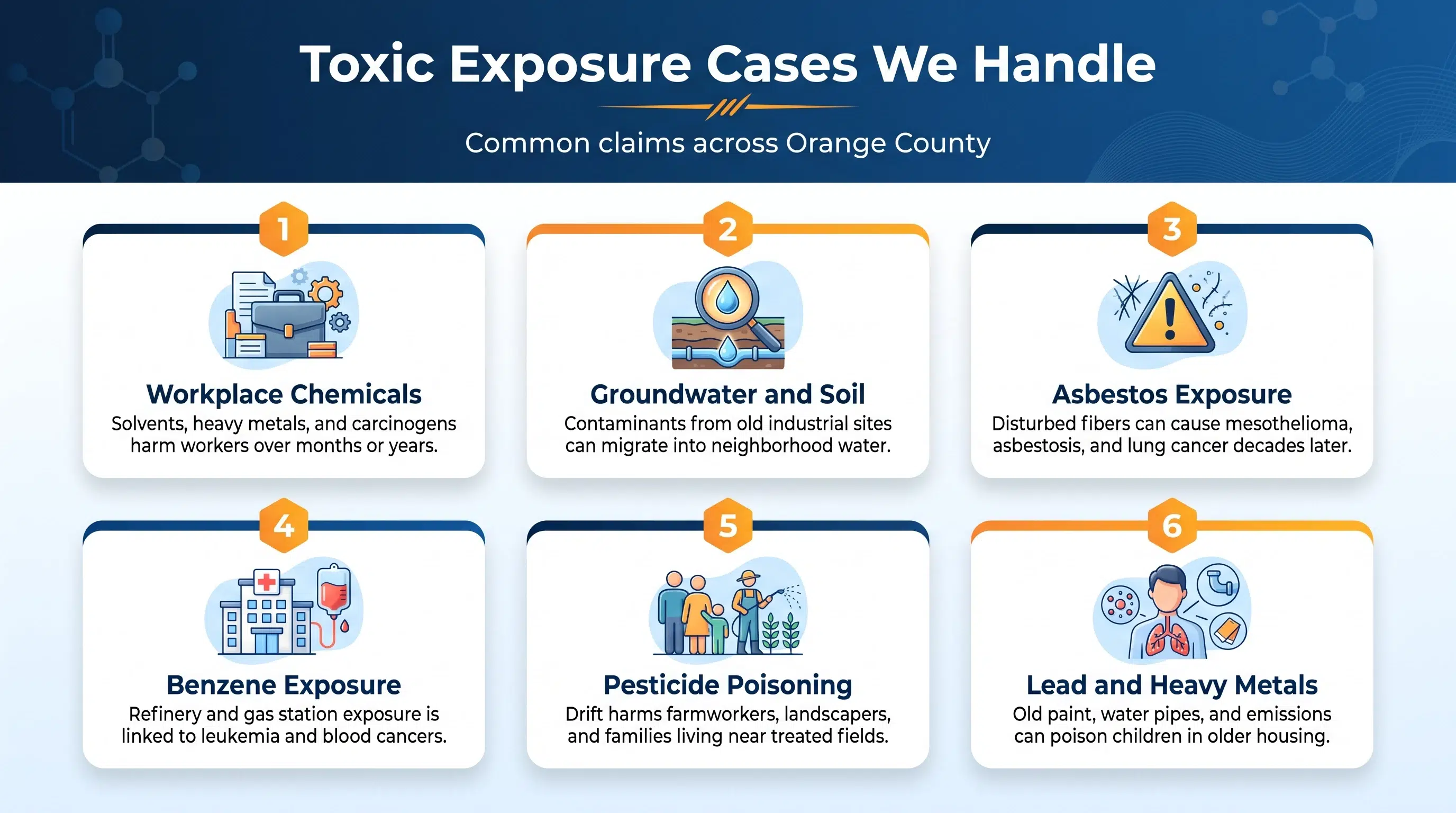
Occupational chemical exposure is one of the most common toxic tort scenarios. Workers in manufacturing, construction, agriculture, dry cleaning, auto repair, and healthcare can be exposed to solvents, heavy metals, cleaning agents, and carcinogenic compounds over days, months, or years. California’s Division of Occupational Safety and Health (Cal/OSHA) sets permissible exposure limits under Title 8 of the California Code of Regulations, and violations of those limits can support a negligence or premises liability claim against an employer or facility owner when workers’ compensation alone does not provide full redress.
Groundwater and soil contamination affects residential communities situated near former industrial zones, dry cleaning facilities, gas stations, or agricultural operations. The U.S. Environmental Protection Agency’s National Priorities List and the DTSC’s EnviroStor database identify hundreds of contaminated sites throughout California. When a property owner or industrial operator allows contaminants to migrate into a neighborhood’s water supply or soil, affected residents can pursue claims for personal injury, property damage, and medical monitoring costs.
Asbestos exposure remains a significant source of toxic tort litigation in California. Asbestos fibers, once disturbed in older buildings, shipyards, or industrial facilities, can cause mesothelioma, asbestosis, and lung cancer. The latency period between exposure and diagnosis can be decades, which creates specific challenges for filing deadlines and causation evidence. California law provides special rules for delayed-discovery of asbestos-related disease under Code of Civil Procedure Section 340.2, which allows a claim to be filed within one year of discovering that the disease is related to an occupational or other exposure.
Benzene and petrochemical exposure can occur at refineries, gas stations, chemical plants, and anywhere petroleum products are handled at scale. The National Toxicology Program and the International Agency for Research on Cancer have classified benzene as a known human carcinogen linked to leukemia and other blood cancers. Workers and nearby residents who develop related conditions after sustained benzene exposure may have viable civil claims against facility operators or product manufacturers.
Pesticide and herbicide poisoning affects farmworkers, landscapers, and residents living adjacent to agricultural operations. The California Department of Pesticide Regulation enforces rules under the California Food and Agricultural Code governing pesticide application and drift. When applicators or agricultural operations allow regulated substances to drift onto neighboring properties or expose workers beyond safe limits, those harmed can pursue civil claims for their injuries and ongoing health monitoring needs.
Lead and heavy metal poisoning can arise from deteriorating lead paint in older rental housing, contaminated drinking water infrastructure, or industrial emissions near residential areas. The California Department of Public Health maintains surveillance data on childhood blood lead levels, and elevated readings can be linked to specific environmental sources that form the basis of a civil claim against property owners, landlords, or facility operators.
Consumer product toxic exposure involves harm from dangerous chemicals in everyday goods, including personal care products containing carcinogenic impurities, household cleaners with inadequate safety warnings, or building materials releasing harmful off-gases. These cases often proceed under California’s strict products liability doctrine, which holds manufacturers and distributors responsible for placing unreasonably dangerous products into the stream of commerce regardless of whether they were negligent.
What injuries are commonly associated with toxic tort claims in California?
Toxic exposure can cause a wide range of acute and chronic health conditions depending on the substance involved, the duration and intensity of exposure, and individual health factors. Common injuries we see in Irvine toxic tort cases include:
- Respiratory disease, including occupational asthma and chemical pneumonitis
- Neurological damage from heavy metal, solvent, or organophosphate exposure
- Cancer, including leukemia, mesothelioma, non-Hodgkin’s lymphoma, and bladder cancer
- Liver and kidney damage from prolonged solvent or heavy metal exposure
- Reproductive harm and pregnancy complications linked to endocrine-disrupting chemicals
- Skin and eye injuries from caustic chemical contact or chemical burns
- Psychological effects, including anxiety and cognitive impairment tied to chronic chemical exposure
Because many of these conditions take time to manifest, the connection between a specific exposure and a resulting illness is often contested by defendants and their insurers. That is precisely why having a legal team capable of assembling a rigorous scientific record is so important in these cases.
How do toxic tort cases work under California law?
What legal theories apply to toxic exposure claims in California?
California toxic tort plaintiffs typically pursue one or more of the following legal theories, depending on the facts of their case:
Negligence requires showing that the defendant owed a duty of care, breached that duty by failing to handle toxic substances responsibly, and that the breach caused your injury. For example, an industrial facility that stores chemical waste in corroded containers without proper containment, in violation of California Health and Safety Code requirements enforced by the DTSC, may face a negligence claim if those chemicals leach into a neighboring community’s water supply.
Strict liability for ultrahazardous activities applies when a defendant engages in an abnormally dangerous activity, such as large-scale storage or transportation of highly toxic chemicals, and harm results even if reasonable care was taken. Under this theory, you do not need to prove that the defendant was careless. The California Supreme Court has recognized strict liability for abnormally dangerous activities based on Restatement (Second) of Torts Section 520 factors, weighing the degree of risk, the gravity of potential harm, and the inability to eliminate risk through ordinary care.
Products liability applies when a toxic substance is a consumer product or industrial product with a design defect, manufacturing defect, or inadequate warning label. Under California’s strict products liability doctrine established in Greenman v. Yuba Power Products (1963), a manufacturer is liable when a product placed into commerce is defective and causes harm, regardless of negligence. This theory is particularly important in cases involving toxic chemicals in consumer goods, pharmaceutical products with undisclosed toxic risks, or industrial equipment that releases harmful substances under normal use.
Nuisance and trespass claims are available when a defendant’s release of toxic substances interferes with your use and enjoyment of your property or physically invades your land. California Civil Code Sections 3479 and 3480 define public and private nuisance, and courts have applied these provisions to industrial emissions, contaminated runoff, and similar environmental harms affecting neighboring landowners.
Fraudulent concealment may extend the statute of limitations and support additional damages when a defendant knowingly withheld information about the risks of a toxic substance from regulators, the public, or affected communities. California courts have applied the delayed discovery doctrine in cases where plaintiffs could not reasonably have known about the toxic exposure and its connection to their illness.
What is the statute of limitations for toxic tort claims in California?
The general statute of limitations for personal injury claims in California is two years from the date of injury, under Code of Civil Procedure Section 335.1. In toxic tort cases, however, the injury is often not immediately apparent. A worker exposed to benzene may not develop leukemia for years. A resident drinking contaminated groundwater may not receive a diagnosis linking the illness to the water source until long after the exposure occurred.
California applies the “discovery rule” to toll the limitations period in appropriate circumstances: the clock begins when the plaintiff discovers, or through reasonable diligence should have discovered, the injury and its connection to the defendant’s conduct. In asbestos cases, Code of Civil Procedure Section 340.2 provides a specific one-year period from the later of the date of disability or the date of knowledge linking disability to asbestos exposure.
Additionally, when a government entity is responsible for the contamination, the California Government Claims Act (Government Code Sections 911.2 and 945.4) typically requires filing a government tort claim within six months of the injury before a lawsuit can be filed. Missing this administrative deadline can bar your claim entirely, which is one reason early legal consultation matters so much in environmental and toxic exposure cases.
How is causation proved in a toxic tort case?
Causation is almost always the most contested element of a toxic tort claim. Defendants frequently argue that the plaintiff’s illness has an alternative cause, that the exposure level was too low to cause harm, or that the scientific evidence linking the specific substance to the specific condition is insufficient under California’s evidentiary standards.
California courts apply a substantial factor test for causation in toxic tort cases: the plaintiff must show that the defendant’s negligence or product was a substantial factor in bringing about the harm. In cases involving multiple potential causes, the Supreme Court of California has addressed the substantial factor standard in cases such as Rutherford v. Owens-Illinois, Inc. (1997) 16 Cal.4th 953 and subsequent decisions. Expert testimony from qualified toxicologists, epidemiologists, and medical professionals is essential to satisfy this standard. Federal courts hearing California toxic tort cases under diversity jurisdiction apply Daubert v. Merrell Dow Pharmaceuticals standards for expert testimony admissibility, which require that scientific methodology be reliable and peer-reviewed.
Practical tools for building the causation record include: industrial hygiene monitoring data showing exposure levels at the relevant site, medical records and diagnostic imaging, peer-reviewed epidemiological studies published in journals indexed by the National Library of Medicine’s PubMed database, regulatory agency inspection and enforcement records from Cal/OSHA and the DTSC, and testimony from independent scientific professionals retained specifically for your case.
What damages are available in an Irvine toxic tort case?
What compensation can you recover from a toxic exposure claim?
Toxic tort damages can be extensive because the injuries are often serious, long-lasting, and require ongoing medical care. In California civil cases, damages fall into several categories:
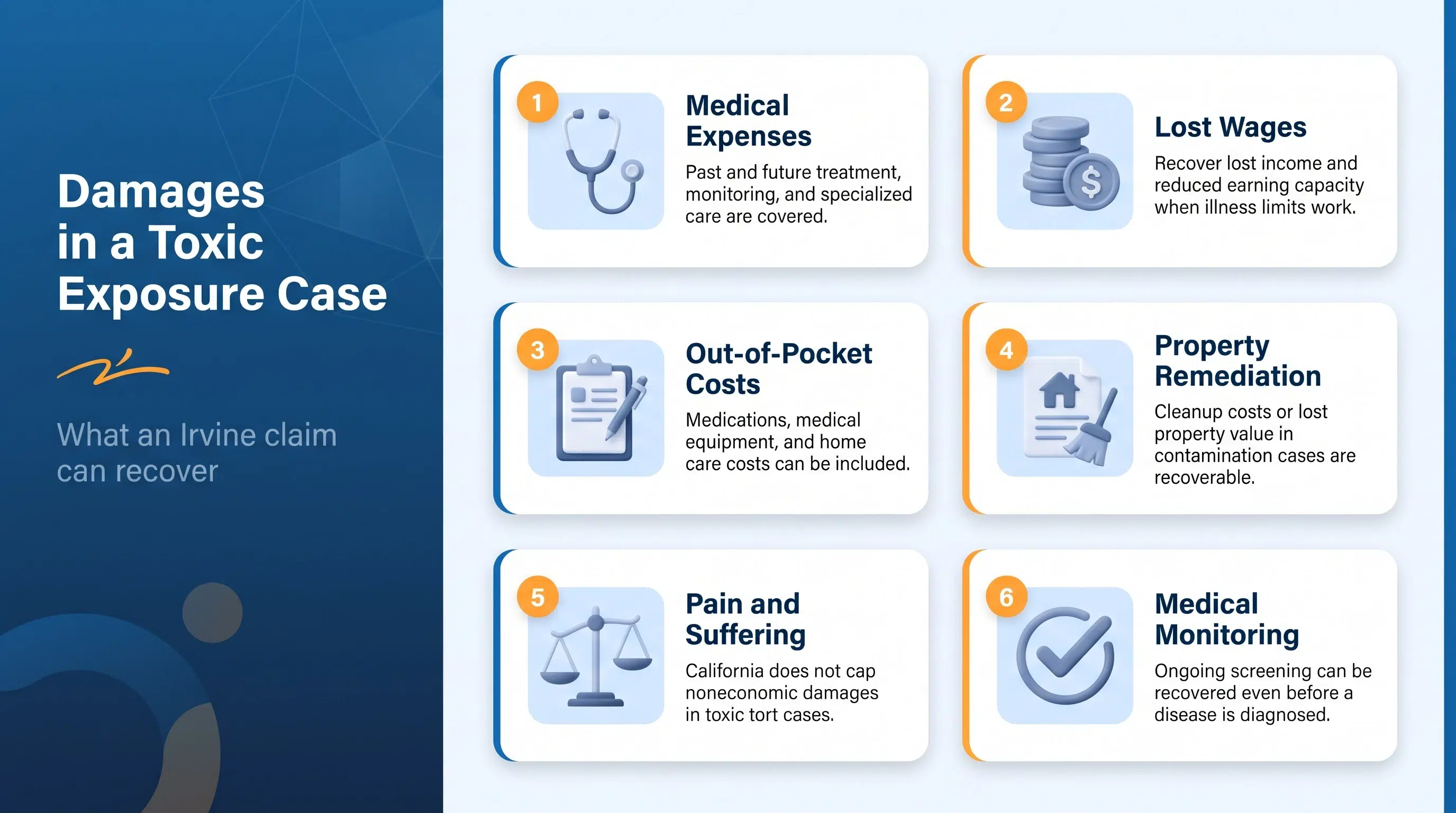
Economic damages cover quantifiable financial losses, including past and future medical expenses for treatment, monitoring, and specialized care; lost wages and reduced earning capacity if the illness has limited your ability to work; out-of-pocket costs for medications, medical equipment, and home care; and, in property contamination cases, the costs of remediation or diminished property value.
Noneconomic damages compensate for the human cost of the injury: physical pain and suffering, emotional distress, loss of enjoyment of life, and the impact on your relationships and daily functioning. California does not cap noneconomic damages in toxic tort cases (the cap under MICRA applies specifically to medical malpractice actions and does not carry over to environmental or products liability claims).
Medical monitoring damages are a category specific to toxic exposure cases. Even if you have not yet developed a diagnosed disease, California courts have recognized that individuals with a credible risk of future illness resulting from a toxic exposure may recover the cost of ongoing medical surveillance to detect early signs of disease. This is grounded in the California Supreme Court’s recognition that early detection can significantly improve outcomes for exposure-related cancers and other conditions.
Punitive damages may be available under California Civil Code Section 3294 when the defendant acted with malice, fraud, or oppression, for example by knowingly releasing toxic chemicals while concealing the risk from affected residents or regulators. Punitive damages are not available in every case, but when the evidence supports them, they can be a significant component of the recovery.
How GoSuits Irvine toxic tort lawyers can help you
From the moment you reach out to our team, we begin building the foundation of your case. We start by gathering and preserving the documents and physical evidence that are most vulnerable to loss: workplace safety records, regulatory inspection reports, environmental monitoring data, and any records held by government agencies like Cal/OSHA or the DTSC. In toxic tort cases, this early preservation work is critical because defendants often move quickly to contest or limit access to records after a claim is filed.
Once we have secured the documentary record, we coordinate your medical care with physicians and specialists who treat on a medical lien, meaning there is no upfront cost to you for evaluation or treatment related to your exposure. We connect you with toxicologists who can conduct biological monitoring and document the presence of the relevant substance in your body, as well as specialists in the conditions most associated with the chemical at issue. Those medical records and expert opinions become the clinical backbone of your causation argument.
We then develop the liability record: matching the documented exposure to the defendant’s operations, regulatory violations, or product defects, and building the chain of evidence that shows the substance reached you because of that defendant’s conduct. Our team draws on industrial hygienists, environmental scientists, and qualified safety professionals to construct the expert case that toxic tort causation requires.
With the medical and liability records assembled, we prepare a detailed demand that accounts for your current and projected future damages. We handle all communications with the defendant’s insurer or legal counsel, protecting you from pressure tactics designed to extract damaging admissions or minimize the value of your claim. If the opposing party offers terms that do not fairly reflect your harm, we are fully prepared to file suit in Orange County Superior Court and take the case through discovery, expert depositions, and trial.
Throughout this process, you receive regular updates, secure access to your case file, and direct access to your attorney whenever you have questions. At the end of your case, we negotiate outstanding medical liens to increase the net amount that actually reaches you. No portion of our representation is hidden or unexpected. We operate on a contingency fee basis, meaning no attorney fee unless we recover on your behalf. Case costs and medical bills may still be owed. To take the first step, schedule a free consultation with our Irvine toxic tort legal team today.
If your situation also involves related areas of injury law, our team can coordinate across practice areas. Clients facing exposure-related losses that have intersected with occupational or product issues can learn about our our Irvine personal injury team and the full range of services we provide across Orange County.